
How to Become a Data Engineer: Skills, Roadmap & Salary
How to become a data engineer: the four real entry paths, a six-month roadmap with stop conditions, current US and India salary data, and the honest catch. Demand is real - Robert Half puts the US starting midpoint at $156,250 and 78% of tech leaders are adding headcount - but entry-level hiring is down about 65% against 2019, which is why finishing a course and getting no callbacks are both normal. Inside: what the primary sources actually say (including the BLS stat every guide miscites), the four doors into the field and which is shortest, a three-tier skill order, a month-by-month roadmap with stop conditions, US and India salary tables with collection dates, and the portfolio bar that gets callbacks.
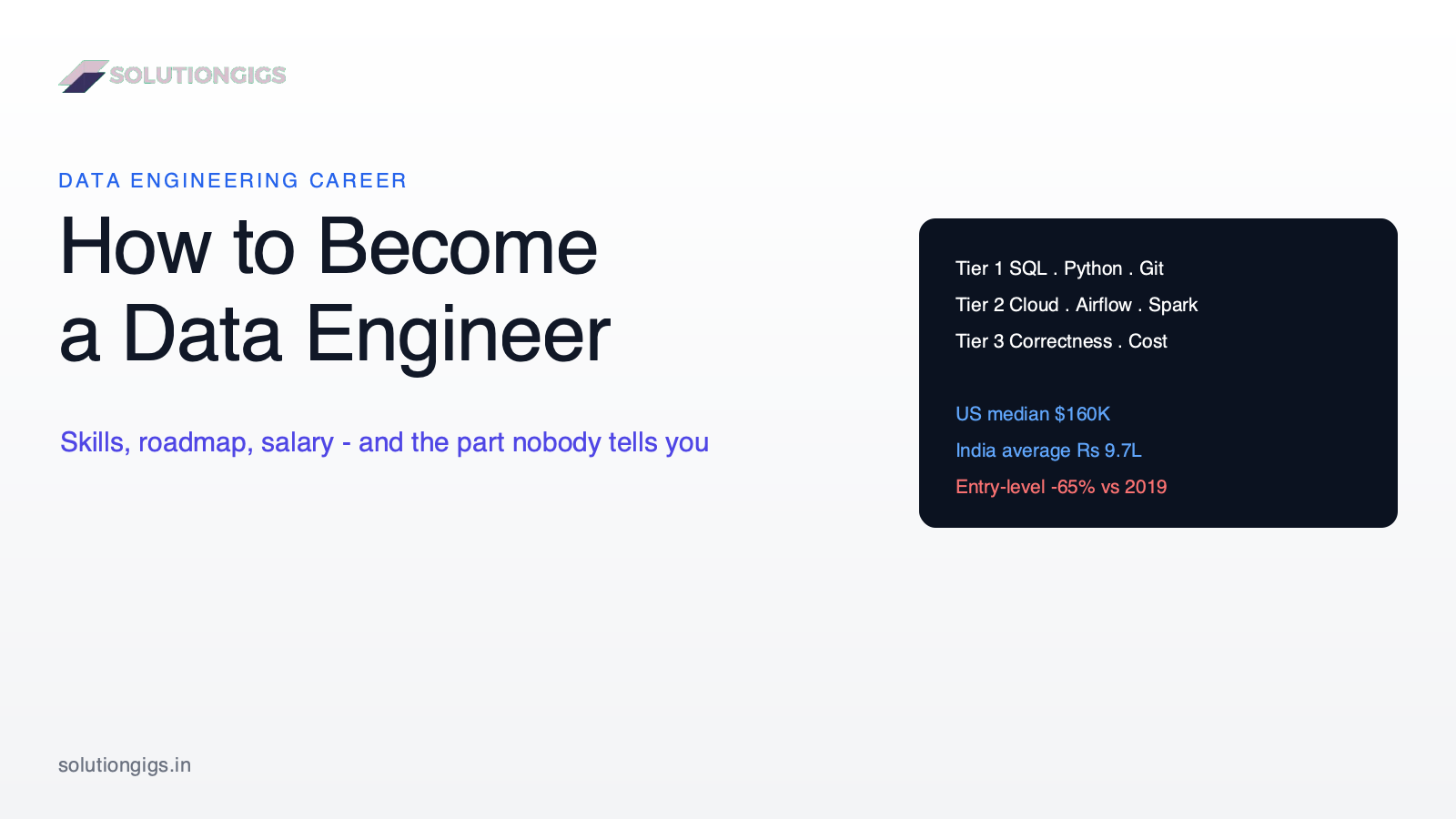
Quick Answer: To become a data engineer, get genuinely strong at SQL and Python, learn one cloud platform and one orchestrator, then prove you can build a pipeline that is correct, re-runnable and cheap — not just one that runs once. The part most guides omit is the entry point: data engineering has almost no true entry-level door, so the realistic path is lateral. Take an adjacent role — analyst, backend developer, ops — and move sideways within six to twelve months. The demand is real and well paid; it is simply concentrated above the junior tier.
Two things are true about data engineering right now, and they sound contradictory. Employers rank it among their hardest-to-fill roles and pay a US starting midpoint of $156,250 for it. And thousands of people who have finished a data engineering course cannot get a single callback.
Both are true because the boom is not evenly distributed. This guide gives you the honest version: what the hiring data actually says, the four real doors into the field, a six-month roadmap with stop conditions instead of a tool list, current salary figures for the US and India, and the portfolio bar that separates a callback from silence.
Is data engineering actually booming?
Yes — demand is strong and rising, but it is concentrated in mid and senior roles. The headline numbers and the ground-level experience diverge sharply, and knowing which is which changes how you should spend the next six months.
Here is what the primary sources say, rather than what course marketing says:
| Signal | Figure | Source |
|---|---|---|
| US tech job postings, 2025 | ~1.1 million | Robert Half |
| AI, ML and data science postings, 2025 | 49,200 — up 163% year over year | Robert Half |
| Data engineer US starting salary | $127,000 low / $156,250 mid / $180,750 high | Robert Half |
| Tech leaders adding permanent headcount, H2 2026 | 78% | Robert Half |
| Data scientist employment growth, 2024–2034 | +34%, ~23,400 openings a year | US Bureau of Labor Statistics |
| New-grad hiring at large tech firms vs 2019 | down ~65% (~76% at early-stage startups) | SignalFire State of Tech Talent, June 2026 |
Read those last two rows together and the whole picture snaps into focus. The field is expanding and the front door is narrowing at the same time.
The statistic almost every guide gets wrong
That 34% growth figure appears in nearly every "data engineering is booming" article — attributed to data engineers. It is not. The Bureau of Labor Statistics has no occupational code for data engineer at all; the 34% projection is for data scientists, whose BLS median wage is $112,590 (May 2024). Data engineers are scattered across the software developer and database administrator categories.
That matters for you practically: no official US projection for this job exists, so anyone quoting a precise growth rate for data engineering specifically is either estimating from job-board scrapes or repeating the data science number. Treat both accordingly.
The contradiction: booming demand, collapsing entry level
The market splits in two. Above roughly three years of experience, data engineering is a seller's market. Below it, you are competing with laid-off senior engineers for the few reqs that exist. SignalFire's 2026 report found entry-level hiring at large tech companies down about 65% against 2019, and top computer science graduates 45% less likely to land those roles than in prior years.
There is a structural reason this hits data engineering harder than most software roles, and it has nothing to do with AI: the job owns production systems that other teams depend on. A data engineer's mistake does not produce a bug, it produces a wrong number in a board deck, silently, for three weeks. Teams have always been reluctant to hand that to someone learning on the job, and in a tight market they simply stopped.
So the question "how do I become a data engineer" has a different real answer than the one the roadmap articles give. It is not what do I learn. It is which door do I walk through.
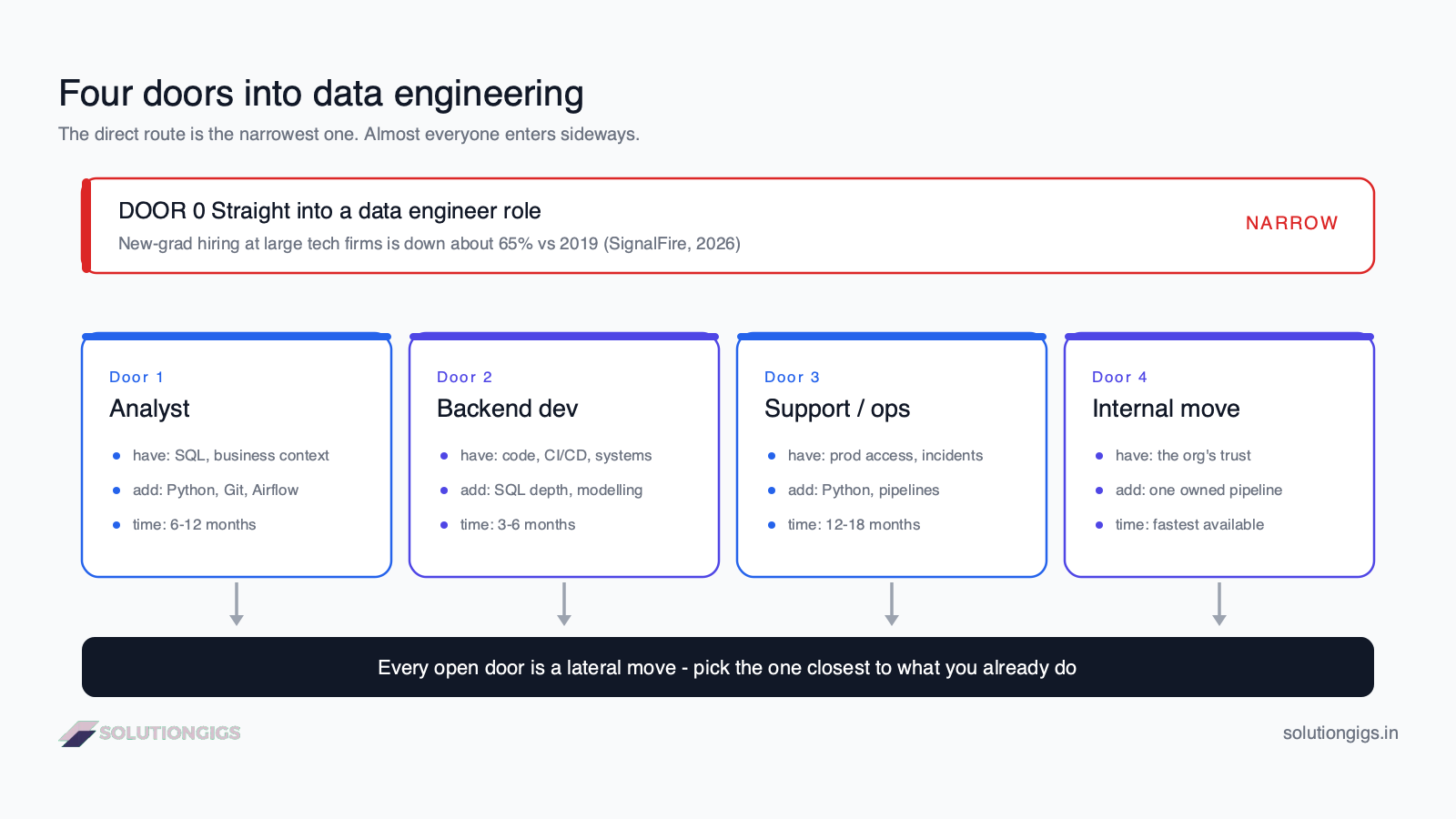
The four doors into data engineering
Almost nobody's first job is data engineer; almost everybody's second or third one can be. Each door below has a different entry cost and a different thing you must prove. Pick the one closest to what you already do — the fastest path is nearly always the shortest lateral move, not the most impressive one.
| Door | You already have | You must add | Realistic time |
|---|---|---|---|
| Data analyst → DE | SQL, business context, stakeholder trust | Python, Git, orchestration, testing | 6–12 months |
| Backend developer → DE | Code quality, CI/CD, systems thinking | SQL depth, data modelling, Spark | 3–6 months — the shortest door |
| Support / ops / DBA → DE | Production access, incident instinct | Python, pipeline design, modelling | 12–18 months |
| Internal transfer (any role) | The org's trust and context | One owned pipeline, end to end | Fastest of all, when available |
| Straight from college | Fundamentals | Everything above, without a safety net | Hardest — treat as a bonus, not a plan |
The backend door is underrated and consistently the quickest. A backend developer already writes tested code, reads a stack trace, and understands idempotency and retries — which are, honestly, most of the job. What they usually lack is dimensional modelling and the OLAP mindset: thinking in columnar scans and analytical queries rather than row lookups.
The analyst door is the most common and the most emotionally frustrating, because analysts already write better SQL than many data engineers. What is missing is the software engineering half — version control, tests, deployment, and the discipline that a pipeline must survive being run twice.
If you are currently employed anywhere near data, the internal transfer beats every other strategy. It skips the resume screen, which is where the entry-level collapse actually bites. Volunteer for the broken weekly report or the manual CSV export nobody wants, automate it properly, and you have production experience with a reference attached.
The skills that actually get you hired
Three tiers, in strict order: SQL and Python are non-negotiable, a cloud plus an orchestrator make you employable, and correctness engineering is what gets you paid. The failure mode of every roadmap article is presenting twenty tools as a flat list. They are not flat. Skipping ahead is why people finish courses and fail interviews.
Tier 1 — Non-negotiable (nothing else counts until these are solid)
- SQL, to an uncomfortable depth. Not
SELECT ... WHERE. Joins including the semantics of outer joins, aggregation, and above all window functions, which appear in more real data engineering interviews than any other single topic. - Python for data plumbing. Reading APIs and files, error handling, virtual environments, and writing a function someone else can test. You do not need to be an application developer.
- Git, properly. Branches, pull requests, resolving a conflict without panic. Its absence is an instant signal that someone has only worked in notebooks.
Stop condition: you can answer a business question end to end in SQL, and script the extraction of an API into a clean table, without looking up syntax every third line.
Tier 2 — Employable (this is where interviews start happening)
- One cloud, deeply — not three shallowly. AWS is the safest default; S3, Glue and EMR will carry you. Azure is a strong choice in the Indian enterprise market specifically.
- One orchestrator. Apache Airflow remains the one most job descriptions name, whatever its ergonomic flaws.
- A warehouse or lakehouse and how it bills you. Understand the data lake vs warehouse vs lakehouse distinction, and know why ELT displaced ETL.
- Distributed processing — realistically PySpark. It is the single most-tested skill in senior interviews.
Stop condition: you can schedule a pipeline that ingests, transforms and loads on a daily cadence, and explain the cost of running it.
Tier 3 — What actually gets you paid
This tier is invisible in most curricula and is precisely what separates a candidate who gets an offer from one who gets a polite no:
- Idempotency — a pipeline you can safely re-run without duplicating or corrupting data. See idempotent data pipelines.
- Data quality testing — gates that stop bad data before a dashboard does.
- Backfills — reprocessing three months of history without melting the cluster or the budget.
- Cost awareness — knowing what your job costs per run, and why small files or a missing partition filter changes that by an order of magnitude.
- Data contracts — because most pipeline failures are actually upstream schema changes.
Every one of those is a correctness and ownership skill, not a tool. That is not an accident, and it leads directly to the next section.
What changed now that AI writes the SQL
AI removed the typing from this job, not the judgement — and it removed exactly the part juniors used to be hired for. A model will produce a competent Airflow DAG, a window function, or a PySpark transformation in seconds. That work used to fill a junior engineer's first year while they absorbed the context around it.
What no model does is decide what correct means for a given table, notice that a source system silently changed its timezone, or answer to the finance team for a number that is wrong. Those are ownership tasks, and ownership is not delegable to a tool.
The practical implication for your learning plan is sharp: do not build your value on writing transformations. Build it on guaranteeing them. When we built the pipeline behind Telemetrix, our infrastructure monitoring product, the transformation logic was the easy week. The hard months were making ingestion re-runnable after an outage, catching a device that started reporting metrics in the wrong unit, and keeping the EMR bill flat as volume grew. An LLM would have written every transformation in that system. It would not have caught the unit change.
A realistic six-month roadmap
Learn in the order you will be interviewed, and stop when you hit each checkpoint — not when you finish a course. Assume 8–10 focused hours a week alongside a job. Adjust the timeline honestly; nobody who followed a 30-day roadmap is employed because of it.
| Month | Focus | Stop condition (how you know you're done) |
|---|---|---|
| 1 | SQL depth — joins, aggregation, window functions | Solve a multi-step analytical question in one query, unaided |
| 2 | Python for data + Git | Script an API → cleaned file → table, in a repo with commits |
| 3 | Modelling + warehouse thinking | Explain a star schema and why analytics is columnar |
| 4 | One cloud + one orchestrator | A scheduled Airflow DAG running daily on real cloud storage |
| 5 | Spark + scale | Explain a shuffle and diagnose a slow job from the Spark UI |
| 6 | Correctness: tests, idempotency, backfill, cost | Your project re-runs safely and you can state its cost per run |
Two rules make this work. First, build one project across all six months instead of six tutorial projects — the compounding is the whole point, and month six only means something if it is applied to something you built in month two. Second, write down what breaks. The incidents are the interview answers; nobody gets hired for describing a pipeline that worked the first time.
If you want a structured version of this sequence with lessons and exercises, our free Data Engineering course follows roughly this order, and the end-to-end pipeline capstone is a reasonable spine for the single project above.
Data engineer salary: US and India
US data engineering compensation clusters around $150–160K, and Indian compensation ranges from about ₹5L at entry to ₹25L+ at senior level, with a steep experience curve in both. Figures below are from primary salary sources with their collection dates, because salary content ages faster than anything else on the internet.
United States
| Measure | Figure | Source |
|---|---|---|
| Starting salary, low / mid / high | $127,000 / $156,250 / $180,750 | Robert Half, 2026 |
| Median total compensation | ~$160,000 | Levels.fyi |
| Top-paying employers (median total comp) | Google ~$276K · Apple ~$230K · Microsoft ~$217K | Levels.fyi, mid-2026 |
India
| Experience | Average annual salary | Notes |
|---|---|---|
| Entry level (< 1 year) | ₹5,18,398 | PayScale, n = 1,284, updated 14 July 2026 |
| Early career (1–4 years) | ₹8,10,624 | +17% over entry level |
| Overall average | ₹9,74,783 | Full range ₹4.1L – ₹20L |
| Mid career | ~+71% vs entry | PayScale experience curve |
| Experienced / late career | ~+150% vs entry | Product companies and GCCs pay well above this |
Source: PayScale India — Data Engineer.
Three things worth knowing about the Indian market that the averages hide. Product companies and global capability centres pay two to three times what services firms pay for the same years of experience — the single largest variable in your compensation is which category of employer you are in, not which tools you know. Cloud and Spark specialisation moves you faster than a job change alone. And the steepest jump is the 3-to-6-year window, which is exactly when correctness and cost skills start showing up in your work.
Portfolio projects that get callbacks
A production-shaped project beats five tutorial projects, and the difference is failure handling. Reviewers can tell within thirty seconds. Almost every rejected portfolio contains a pipeline that ingests a clean Kaggle CSV, transforms it, and writes it somewhere — which demonstrates none of the things the job is actually about.
Here is the bar, as a checklist. A project that clears it is unusual:
- Runs on a schedule, not by hand — orchestrated, with retries configured
- Idempotent — you can re-run yesterday's date and the numbers don't double
- Has data quality checks that actually fail the run when the source misbehaves
- Can be backfilled across a date range without a separate script
- Handles a real schema change — document what happened when the source changed
- Has a stated cost — "this costs about $4 a month to run"
- Has a README with a diagram and an honest "what I'd do differently" section
- Uses messy real data — a public API with rate limits and nulls, not a clean CSV
The last one matters more than people expect. Clean data hides every skill worth demonstrating. A rate-limited API with inconsistent nulls forces you to solve retries, partial loads and deduplication — the exact problems the interview will ask about.
For the interview itself, the questions you will face are largely diagnostic rather than definitional; our PySpark interview questions guide covers the senior-level form of those answers.
Common mistakes that stall people for a year
- Learning tools instead of fundamentals. Airflow, dbt and Snowflake are learnable in weeks by anyone whose SQL and Python are solid. The reverse is not true. Tool-first learners plateau immediately.
- Collecting certifications as a substitute for evidence. One cloud certification helps you pass an automated resume filter in India. Three do not help three times as much, and none substitute for a project.
- Waiting to feel ready. The gap between "finished the syllabus" and "ready" never closes on its own, because it closes only with production exposure.
- Applying exclusively to roles titled "Data Engineer." Analytics engineer, BI engineer, ETL developer, platform engineer and backend-with-data roles all lead to the same place, and many have a genuinely open front door.
- Ignoring the business side. The engineers who get promoted are the ones who know which tables matter and what the numbers mean, not the ones with the cleverest DAG.
- Building projects nobody could break. If your pipeline has never failed, you have not learned the job yet.
Where SolutionGigs fits
We write about this because we do it. The Data Engineering course on SolutionGigs is free, follows the tier order above, and is drawn from the same production work described in this article — not from a syllabus. If you'd rather start with the role itself before committing six months, what is data engineering and the modern data stack guide are the two shortest paths to a clear picture.
And if you're on the other side of this — a founder who needs a pipeline built rather than a career changed — you can post a project on SolutionGigs and get matched with a vetted data engineer.
Frequently Asked Questions
How long does it take to become a data engineer?
For someone already working in tech — an analyst, backend developer, or ops engineer — six to twelve months of deliberate practice alongside the day job is realistic. Starting from zero with no technical job, plan on eighteen to twenty-four months. The bottleneck is not the syllabus; it is accumulating production experience, which is what employers screen for.
Can you become a data engineer with no experience?
Directly, it is now very hard. Data engineering has almost no true entry-level door, because the role owns production systems other teams depend on. The realistic path is to take an adjacent role first — data analyst, junior backend developer, or an ops job with database access — and move sideways from inside a company that already trusts you.
Do you need a degree to become a data engineer?
No. Data engineering is one of the least credential-bound roles in software, because the work is verifiable: your pipeline is correct, idempotent and affordable, or it isn't. A CS degree helps you pass the first automated screen, particularly at large firms in India, but one production-shaped project beats a degree with no evidence attached to it.
Is data engineering a good career in 2026?
Yes — if you can get past the first role. Robert Half lists data engineer among the highest-demand technology roles, with a US starting midpoint of $156,250, and AI, ML and data science postings rose 163% year over year in 2025. But entry-level hiring has been cut sharply, so the career is excellent at mid and senior level and unusually hard at the very start.
Will AI replace data engineers?
AI has replaced part of the job, not the job. Language models write SQL, boilerplate transformations and DAGs competently, removing much of the typing that used to fill a junior's week. What they cannot do is take ownership — decide what "correct" means for a table, guarantee a pipeline is safe to re-run, or answer for a wrong number on a dashboard.
Data engineer vs data scientist — which pays more?
They are close, with data engineering quietly ahead at the median in several markets. Levels.fyi puts median data engineer total compensation near $160,000 in the US, while the BLS reports a $112,590 median wage for data scientists (May 2024). The bigger difference is stability: every ML team needs pipelines, so data engineering demand survives shifts in AI fashion better.
What is the fastest way to get a data engineering job?
Move sideways inside a company that already employs you — an internal transfer skips the resume screen, which is exactly where the entry-level squeeze bites. The fastest version is to volunteer for the data work nobody wants: the broken report, the manual export, the pipeline that fails every Monday. Six months of owning that beats any certification.
Conclusion
Data engineering is booming, and the boom is real — Robert Half puts the US starting midpoint at $156,250, 78% of technology leaders are adding headcount in the second half of 2026, and every AI product being built right now runs on pipelines someone has to own. What the boom is not is evenly distributed. Entry-level hiring across tech is down roughly 65% against 2019, and data engineering feels that more acutely than most roles because teams hesitate to hand production data to someone learning on the job.
So plan for the market that exists. Get SQL and Python genuinely solid before touching a tool. Pick one cloud and one orchestrator rather than sampling five. Then spend your differentiating effort on the tier almost nobody studies — idempotency, quality gates, backfills, and cost — because that is the half of the job AI has not touched and probably will not. And choose your door deliberately: the shortest lateral move from where you already stand will beat the most impressive plan you can't execute.
If you want the sequence with lessons and exercises attached, the free Data Engineering course on SolutionGigs follows this exact order — and it's the same path we'd give a junior joining our own team.

Mohammed Yaseen
Founder, SolutionGigs
Mohammed builds production data platforms on Spark, Kafka and Iceberg, and writes the free Data Engineering course on SolutionGigs. He's more interested in pipelines that survive a bad Monday than in pipelines that demo well. LinkedIn →
More in Data Engineering
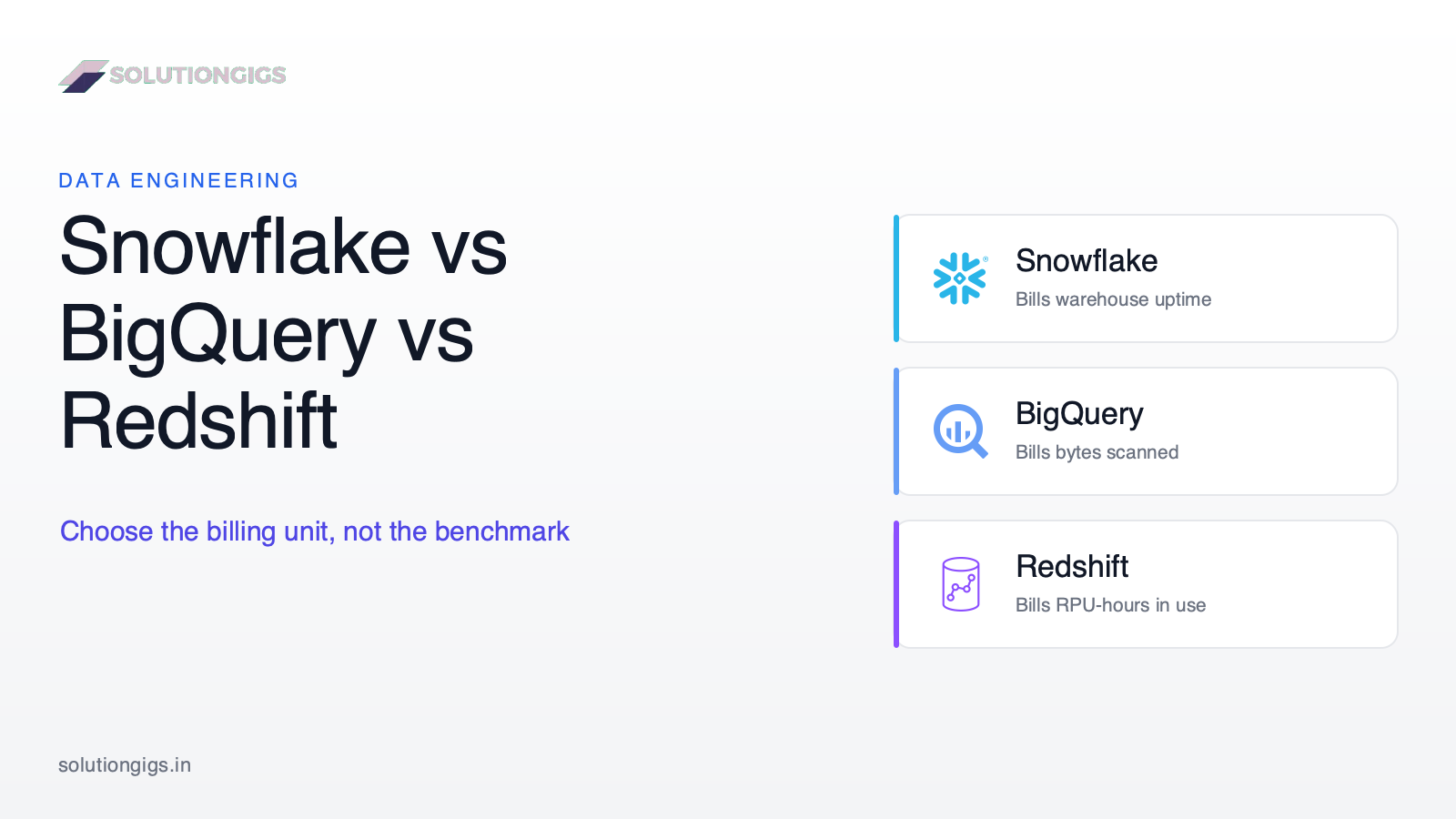
Snowflake vs BigQuery vs Redshift: How to Choose
Snowflake vs BigQuery vs Redshift, decided by the only thing that matters: what each one puts on the meter. Snowflake bills warehouse uptime, BigQuery bills bytes scanned, Redshift bills RPU-hours in use. This guide uses rates read straight from each vendor's own pricing documents, plus three break-even calculations nobody else publishes - the 1.35x Gen2 credit multiplier and the speedup it demands, BigQuery's logical-vs-physical storage crossover, and the on-demand-vs-reservation line - a worked monthly cost example, and what actually changed in 2026 with Redshift's Graviton RG nodes.
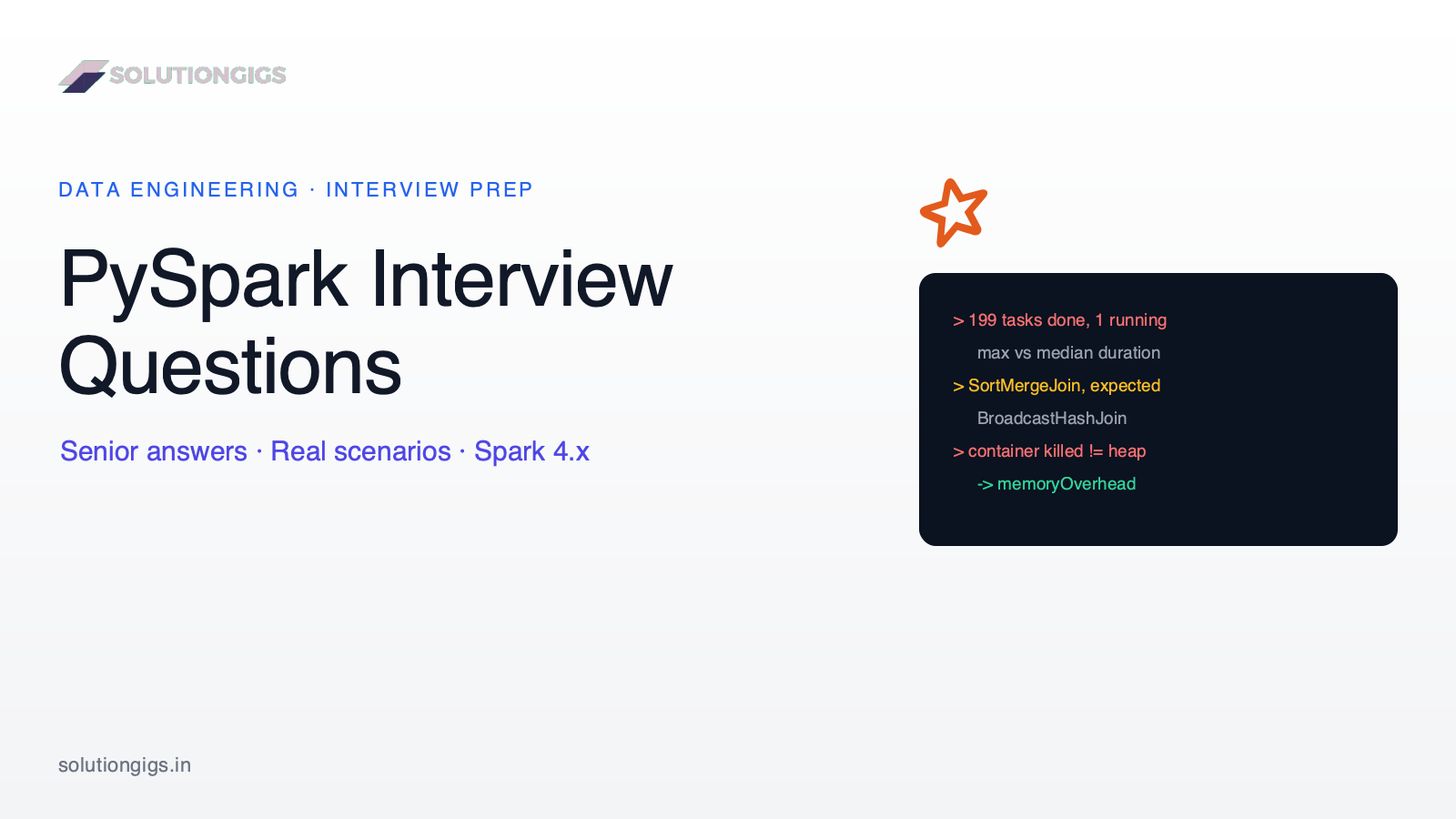
PySpark Interview Questions and Answers: Senior-Level Guide
PySpark interview questions with senior-level answers, six real debugging scenarios, how to read a physical plan, and the Spark 4.x facts most guides miss. Most guides hand you definitions — but definitions are only the screening filter. Roughly two-thirds of a mid-to-senior PySpark interview is some form of "this job got slow, what do you do?", and what scores is naming the evidence you'd look for before touching a config. Inside: every core answer in screening form and senior form side by side, six real scenarios (the 3-hour regression, the one slow task, the OOM that isn't a heap problem, 50,000 tiny files, growing Kafka lag, and a design round), and the six commonly-taught answers that are actually wrong.
Spark vs Flink: Which Stream Processing Engine to Choose
Every Spark vs Flink comparison online rests on the same claim — Spark micro-batches, Flink truly streams, so pick Flink for low latency. That claim expired: Spark 4.1 shipped Real-Time Mode with millisecond-range p99 latency, and Flink 2.0 moved state to object storage. This guide gives you the one architectural idea behind both engines, an original diagram of how a record travels through three execution models, the differences that did not converge (state, timers, recovery blast radius, backpressure), a latency ladder to test whether you need per-event processing at all, and the honest cost of running two engines — including why we chose not to adopt Flink.