
Data Engineering on AWS: S3, EMR & Glue
Data engineering on AWS explained — how S3, Glue, EMR, Athena, and Redshift fit together into a data pipeline, what each service does, and when to use which.

📚 Lesson 1 of the Cloud & Capstone track in our free Learn Data Engineering course. This is where everything you've learned runs in the cloud.
Quick Answer: Data engineering on AWS centers on five services: Amazon S3 (the data lake / storage), AWS Glue (data catalog + serverless ETL), Amazon EMR (managed Spark clusters for heavy processing), Amazon Athena (serverless SQL over S3), and Amazon Redshift (data warehouse). A pipeline stores raw data in S3, catalogs and lightly transforms it with Glue, runs heavy jobs on EMR, and serves results via Athena or Redshift. S3 is the backbone; everything else reads from and writes to it.
You've learned the concepts — ETL, Spark, warehousing, orchestration. Now: where do they actually run? For most companies, the answer is a cloud platform, and AWS is the biggest. This lesson maps the AWS data engineering stack — what each service does and how they fit together — so the cloud stops being an alphabet soup of names.
The AWS data pipeline at a glance
On AWS, S3 is the storage backbone and the other services are compute that reads from and writes to it. This separation of storage and compute is the defining pattern of cloud data engineering.
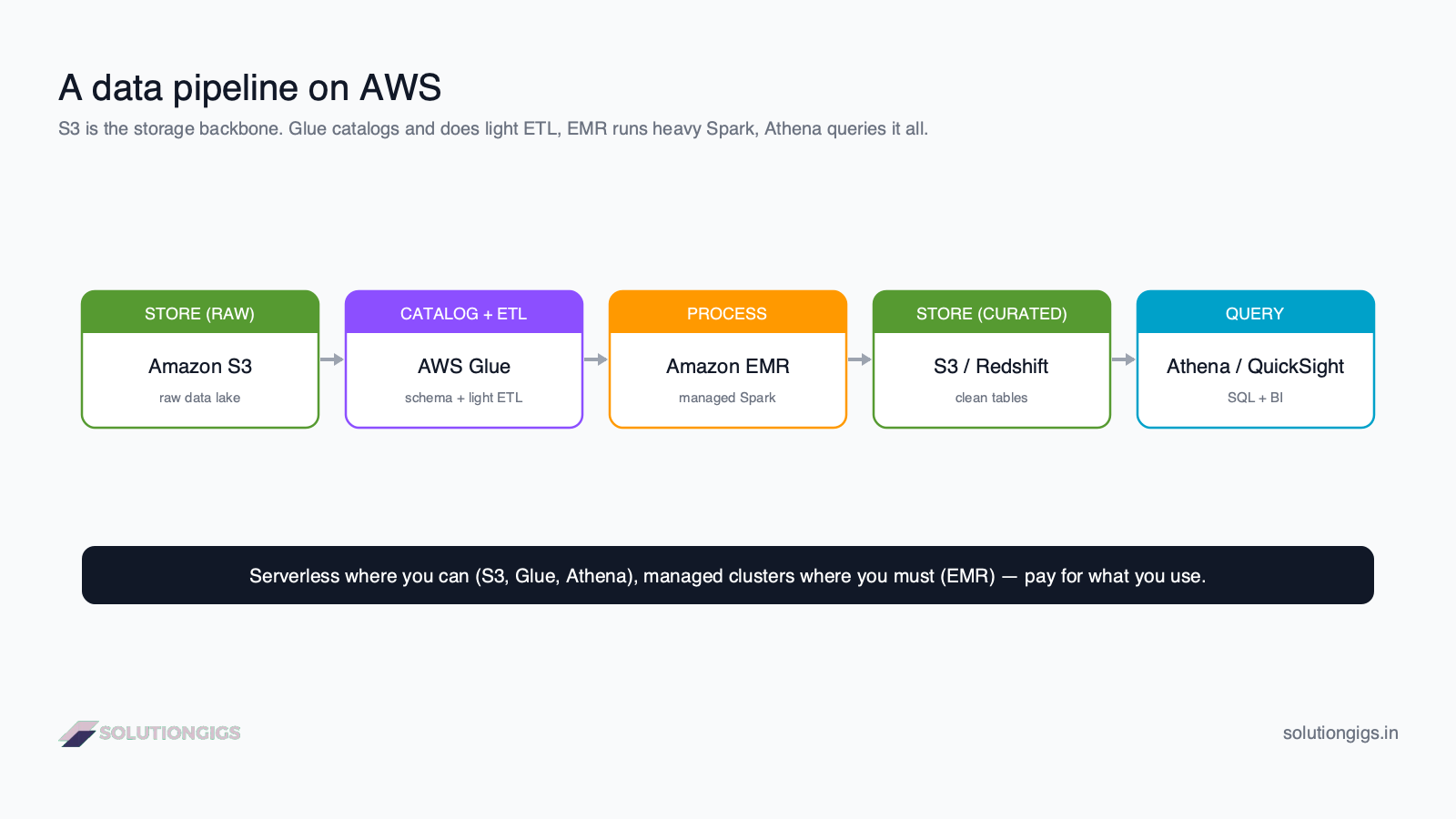
Follow the data through a typical pipeline:
- S3 — raw data lands in the data lake.
- Glue — catalogs the data (schema) and runs light ETL.
- EMR — runs heavy Spark processing when needed.
- S3 / Redshift — curated, clean data is stored.
- Athena / QuickSight — SQL queries and BI dashboards on top.
Each service is billed for what you use, and most are serverless — you don't manage servers, just submit work.
Amazon S3: the storage backbone
Amazon S3 is a cheap, durable, virtually unlimited object store — the data lake at the center of every AWS data architecture. Raw data lands here, curated data is written back here, and every compute service reads from it.
Why S3 anchors everything:
- Decouples storage from compute — store once in S3; process with Glue, EMR, Athena, or Redshift Spectrum independently.
- Cheap and durable — designed for 11 nines of durability at low cost per GB.
- Open formats — store Parquet with Iceberg or Delta Lake table formats for a real lakehouse.
Organize S3 into zones — raw/, staging/, curated/ — so data quality improves as it flows through. This is the physical home of your pipeline.
One pricing detail that shapes Glue and Athena job design: S3 charges roughly 12x more per PUT/LIST request than per GET request (list price, per-1,000-request basis). A Glue job that partition-prunes aggressively and issues thousands of small LIST calls against a deeply nested prefix structure can rack up request costs that a coarser partitioning scheme would avoid entirely — see our GCS vs S3 vs Azure Blob Storage comparison for how this plays out against the other two clouds.
AWS Glue: catalog + serverless ETL
AWS Glue is a serverless service that catalogs your data and runs Spark-based ETL without you managing any infrastructure. It has two parts worth separating:
- Glue Data Catalog — a central metadata store (databases, tables, schemas) that Athena, EMR, and Redshift all share. Glue crawlers auto-discover schemas from S3.
- Glue ETL jobs — serverless Spark jobs for transforming data. You write the logic; AWS provisions and tears down the Spark environment automatically.
Glue shines for lighter ETL and cataloging you don't want to operate. Because it's serverless, there's no cluster to size or keep running — you pay per job. The Data Catalog is especially valuable: it's the shared schema layer that makes the whole stack interoperable.
What changed for open table formats: the Glue Data Catalog now exposes an Iceberg REST endpoint, so non-AWS engines — Trino, PyIceberg, DuckDB, Spark on Kubernetes — can read and write Glue-catalogued Iceberg tables through the standard Apache Iceberg REST spec instead of an AWS-specific SDK. Amazon S3 Tables takes it further: a bucket type that stores Iceberg tables and runs compaction and snapshot expiry for you, reachable through that same endpoint.
Two limits are worth knowing before you commit: Glue's Iceberg REST endpoint does not support the Iceberg View APIs, and it caps table metadata at 50 MB (5 MB per call for federated catalogs). Both are covered in our Iceberg catalog comparison, along with when a neutral catalog like Apache Polaris is the better call.
Amazon EMR: managed Spark at scale
Amazon EMR gives you managed but configurable Spark and Hadoop clusters for heavy, large-scale processing. Where Glue is hands-off serverless, EMR is for when you need control and raw power.
Use EMR when:
- Jobs are large, long-running, or performance-critical — big Spark workloads.
- You need cluster configuration — specific instance types, Spark tuning, custom libraries.
- You're running existing Spark/Hadoop code that expects a full cluster.
EMR clusters can be transient (spin up, run a job, shut down — cost-efficient) or long-lived. The trade-off vs Glue is control vs convenience.
Glue or EMR? Reach for Glue for serverless, lighter ETL you don't want to manage. Reach for EMR when you need cluster control and maximum performance on heavy big-data jobs. Many pipelines use both.
Athena and Redshift: querying the data
Athena queries S3 directly with serverless SQL; Redshift is a dedicated warehouse for high-performance BI. These are the serving layer.
- Amazon Athena — serverless SQL straight over S3, using the Glue Data Catalog for schemas. Pay per data scanned. Perfect for ad-hoc analysis and querying the lake without loading it anywhere.
- Amazon Redshift — a full data warehouse for high-concurrency dashboards, complex joins, and consistently fast BI on curated data.
| Need | Use |
|---|---|
| Ad-hoc SQL over the data lake | Athena (serverless, pay-per-scan) |
| High-concurrency BI dashboards | Redshift (dedicated warehouse) |
| Query S3 and warehouse together | Redshift Spectrum |
You don't always need Redshift — S3 + Athena covers a lot. Add Redshift when performance and concurrency demand a dedicated warehouse.
Orchestrating it on AWS
Tie the services together with an orchestrator — Airflow (via Amazon MWAA) or AWS Step Functions. A pipeline is only complete when it runs on a schedule with dependencies and retries.
- Amazon MWAA — Managed Workflows for Apache Airflow, so you get the Airflow you learned, fully managed.
- AWS Step Functions — a native, serverless workflow orchestrator using state machines.
Either coordinates the flow: crawl with Glue → transform on EMR → load curated S3 → refresh Athena/Redshift, on a schedule.
Try it yourself — design an AWS pipeline
A retailer drops daily sales CSVs into S3 and wants dashboards.
- Which service catalogs the CSV schema so it can be queried as a table?
- The nightly transform is a large Spark job with custom tuning. Glue or EMR — and why?
- Analysts want ad-hoc SQL over the lake without a warehouse. Which service?
Show answers
- AWS Glue (a Glue crawler populates the Data Catalog with the schema, making the CSVs queryable).
- EMR — a large, custom-tuned Spark job benefits from EMR's cluster control and performance; Glue is better for lighter, hands-off ETL.
- Amazon Athena — serverless SQL directly over S3, no warehouse needed.
Common mistakes with AWS data engineering
- Treating S3 as a dumping ground. Organize into raw/staging/curated zones with open formats, or the lake becomes a swamp.
- Using EMR for everything. Running clusters for small jobs wastes money; serverless Glue/Athena is cheaper for light workloads.
- Ignoring Athena scan costs. Athena bills per data scanned — use Parquet and partitioning to cut costs dramatically.
- Skipping the Glue Data Catalog. It's the shared schema layer; without it, services can't interoperate cleanly.
- Leaving clusters running. Use transient EMR clusters (or auto-termination) so you pay only while jobs run.
Frequently Asked Questions
What AWS services are used for data engineering?
The core services are Amazon S3 (storage / data lake), AWS Glue (data catalog and serverless ETL), Amazon EMR (managed Spark clusters), Amazon Athena (serverless SQL over S3), and Amazon Redshift (data warehouse). A typical pipeline stores raw data in S3, catalogs and lightly transforms it with Glue, runs heavy processing on EMR, and queries results with Athena or Redshift.
What is the difference between AWS Glue and EMR?
Glue is serverless — AWS provisions and manages the Spark environment, ideal for lighter ETL and cataloging you don't want to operate. EMR gives you managed but configurable Spark/Hadoop clusters you control, better for heavy, long-running, or highly customized jobs. Use Glue for hands-off serverless ETL; use EMR when you need cluster control and maximum performance.
What is Amazon S3 used for in data engineering?
S3 is the storage backbone — a cheap, durable, virtually unlimited object store serving as the data lake. Raw data lands in S3, curated data is written back, and query engines read directly from it. Because compute services all read and write S3, it decouples storage from compute and sits at the center of most AWS data architectures.
What is Amazon Athena?
Athena is a serverless query service that runs standard SQL directly on data in S3 — no servers or clusters. You define schemas (often via the Glue Data Catalog) and query S3 files as tables, paying per data scanned. It's ideal for ad-hoc analysis and querying a data lake without loading data into a warehouse first.
Do I need Redshift if I have S3 and Athena?
Not always. For ad-hoc queries and moderate workloads over a lake, S3 plus Athena is often enough and cheaper (serverless, pay-per-scan). Redshift makes sense for high-concurrency BI, complex joins on large curated data, and consistently fast dashboards. Many teams use both: S3/Athena for the lake, Redshift for the performance-critical warehouse layer.
Conclusion
Data engineering on AWS is a handful of services around one backbone: S3 stores everything, Glue catalogs and lightly transforms, EMR runs heavy Spark, and Athena or Redshift serve the results. Learn where each fits — serverless where you can, managed clusters where you must, pay for what you use — and you can build a complete cloud pipeline. It's the same concepts from this whole course, now running at scale.
Next, you'll put it all together in the Learn Data Engineering capstone: an end-to-end pipeline from raw data to insight. Building a data platform on AWS right now? Tell us what you're building — S3, EMR, Glue and Athena are where we spend most of our time.
When an EMR cluster does fail, our EMR troubleshooting guide maps each failure stage to the log that actually holds its error.
Mohammed Yaseen
Founder, SolutionGigs
Mohammed builds cloud data platforms on AWS — S3, Glue, EMR, and Athena — in production and teaches the Cloud track of the free Learn Data Engineering course. LinkedIn →
More in Data Engineering
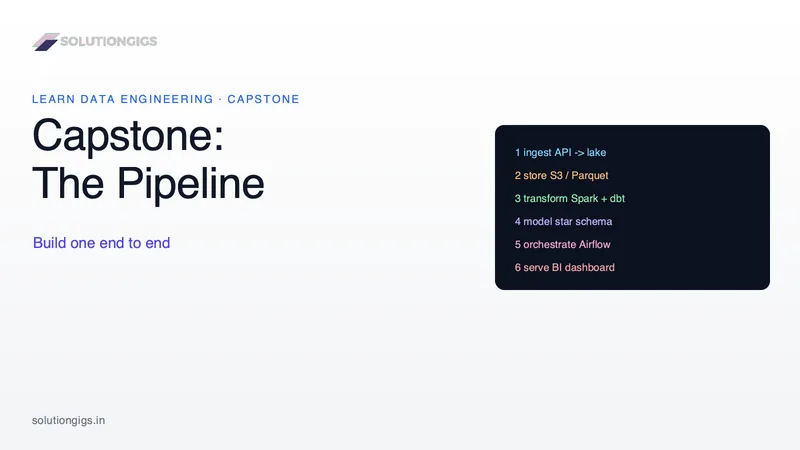
Capstone: Build an End-to-End Data Pipeline
A capstone project to build an end-to-end data pipeline — ingest, store, transform, model, orchestrate, and serve — tying together SQL, Python, Spark, modeling, and Airflow.
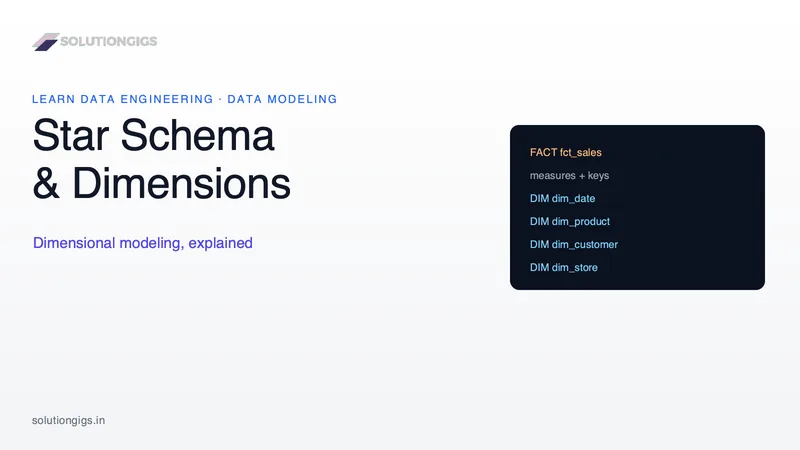
Dimensional Modeling & Star Schema Explained
Dimensional modeling and the star schema explained — fact vs dimension tables, grain, keys, star vs snowflake, and a step-by-step design method with SQL examples.

How to Become a Data Engineer: Skills, Roadmap & Salary
How to become a data engineer: the four real entry paths, a six-month roadmap with stop conditions, current US and India salary data, and the honest catch. Demand is real - Robert Half puts the US starting midpoint at $156,250 and 78% of tech leaders are adding headcount - but entry-level hiring is down about 65% against 2019, which is why finishing a course and getting no callbacks are both normal. Inside: what the primary sources actually say (including the BLS stat every guide miscites), the four doors into the field and which is shortest, a three-tier skill order, a month-by-month roadmap with stop conditions, US and India salary tables with collection dates, and the portfolio bar that gets callbacks.