
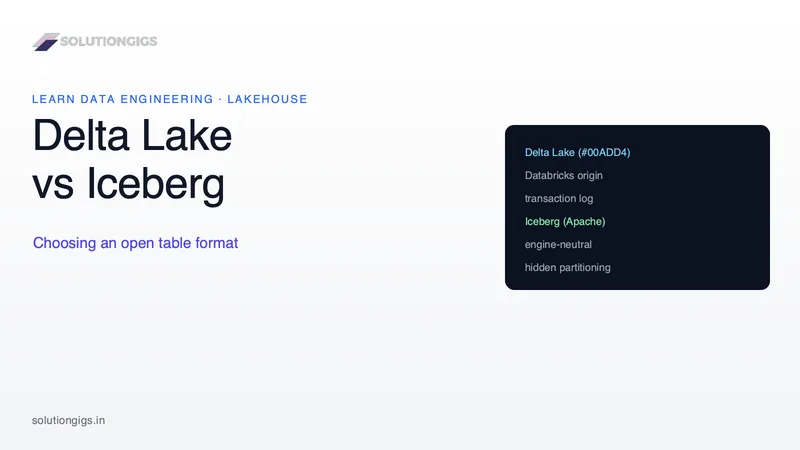
Delta Lake vs Iceberg: How to Choose
Delta Lake vs Apache Iceberg compared — architecture, features, ecosystem, and a clear decision guide for choosing an open table format for your lakehouse in 2026.

📚 Lesson in the Lakehouse & Table Formats track of our free Learn Data Engineering course. Pairs with the hands-on Apache Iceberg with PySpark guide.
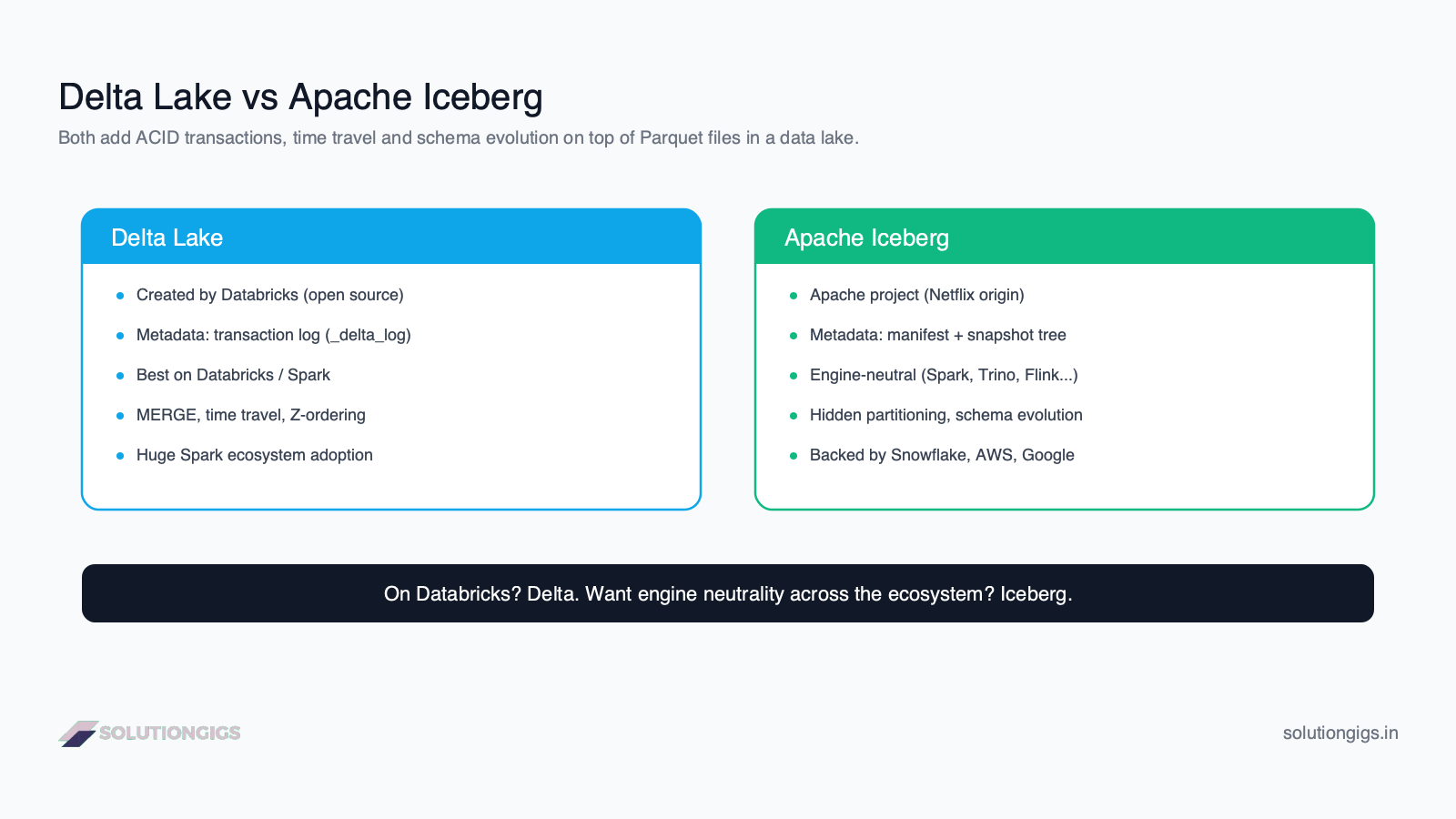
Quick Answer: Delta Lake and Apache Iceberg are both open table formats that add ACID transactions, time travel, and schema evolution to Parquet files in a data lake. The difference is origin and ecosystem: Delta Lake (created by Databricks) works best with Spark/Databricks and uses a transaction log for metadata; Apache Iceberg is a vendor-neutral Apache standard, uses a snapshot-and-manifest metadata tree, and is backed by Snowflake, AWS, and Google. On Databricks, choose Delta. For engine-neutral, multi-vendor platforms, choose Iceberg.
Table formats are the foundation of the modern lakehouse, and "Delta or Iceberg?" is now one of the biggest architecture decisions a data team makes. Both solve the same core problem, so the choice is less about features and more about your ecosystem and where you don't want lock-in. This lesson compares them fairly and gives you a clear decision rule.
What problem do table formats solve?
A data lake is just files in object storage — cheap and scalable, but with no transactions, no safe updates, and no schema guarantees. Open table formats fix that. They add a metadata layer over your Parquet files so a folder of data behaves like a real database table.
Every open table format gives you the same superpowers:
- ACID transactions — concurrent reads and writes without corrupting data.
- Time travel — query the table as it was at a past version or timestamp.
- Schema evolution — add, rename, or drop columns safely.
- Efficient updates and deletes —
MERGE/UPDATE/DELETEon lake data, which raw Parquet can't do.
This is the heart of the lakehouse: warehouse reliability on cheap lake storage. Delta Lake and Iceberg are the two dominant ways to get there.
Delta Lake: the Databricks-native format
Delta Lake is an open table format created by Databricks that stores its metadata in a transaction log (_delta_log) and is deeply integrated with Spark. Every change to a Delta table appends a JSON commit to the log, which is what provides ACID guarantees and time travel.
Its strengths:
- Best-in-class on Databricks and Spark — the integration is seamless and mature.
- Powerful operations —
MERGE(upserts), time travel, and Z-ordering for data skipping. - Huge adoption in the Spark ecosystem, with a large community and tooling.
- Unity Catalog / Databricks governance built around it.
If your platform is Databricks, Delta Lake is the path of least resistance — it's the format the whole platform is optimized for.
That said, the "Databricks means Delta" shorthand has softened. Unity Catalog now offers managed Apache Iceberg tables (Public Preview, DBR 16.4 LTS and above) with read, write and create access for external Iceberg clients — so choosing Databricks no longer forces the format choice. Note the asymmetry, though: Delta tables exposed as Iceberg via UniForm are read-only to those external clients.
Apache Iceberg: the engine-neutral standard
Apache Iceberg is a vendor-neutral open table format, originally from Netflix, that uses a tree of snapshot and manifest files for metadata and is designed to work identically across many engines. Its defining goal is to avoid lock-in: the same Iceberg table can be read and written by Spark, Trino, Flink, Snowflake, and more.
Its strengths:
- Engine neutrality — a true open standard, not tied to one vendor. This is its killer feature.
- Hidden partitioning — partitions are managed by the format, so queries don't need to know the physical layout (fewer footguns than Hive-style partitioning).
- Robust schema and partition evolution — change partitioning without rewriting data.
- Broad industry backing — Snowflake, AWS (S3 Tables, Athena, Glue), Google, and others have adopted Iceberg as a first-class format.
Iceberg won significant momentum as the neutral choice, especially for organizations that want one copy of data readable by every engine.
Delta Lake vs Iceberg: side by side
They're feature-comparable; the real differences are ecosystem, metadata design, and neutrality.
| Dimension | Delta Lake | Apache Iceberg |
|---|---|---|
| Origin | Databricks | Netflix → Apache |
| Metadata | Transaction log (_delta_log) |
Snapshot + manifest tree |
| Best fit | Databricks / Spark | Multi-engine, vendor-neutral |
| Engine support | Spark-centric (broadening) | Spark, Trino, Flink, Snowflake, … |
| Partitioning | Explicit + Z-order | Hidden partitioning |
| ACID / time travel | ✅ | ✅ |
| Schema evolution | ✅ | ✅ (plus partition evolution) |
| Backing | Databricks + community | Snowflake, AWS, Google, community |
Note the trend toward convergence: Databricks' UniForm can expose a Delta table with Iceberg-compatible metadata, so the two worlds increasingly interoperate rather than forcing an exclusive choice. Apache Iceberg v3 narrowed the gap further by adopting deletion vectors — the row-level delete mechanism Delta Lake has used for years — along with row lineage and a variant type designed to be compatible across both formats.
How to choose: a decision guide
Pick based on your platform and your tolerance for lock-in, not on a feature checklist.
- All-in on Databricks? → Delta Lake. It's native, mature, and everything is tuned for it.
- Multi-engine or vendor-neutral by design (Snowflake + Spark + Trino)? → Apache Iceberg. One table, every engine, no lock-in.
- On AWS building an open lakehouse? → Iceberg is increasingly the default (S3 Tables, Athena, Glue support it natively).
- Already invested in one and it works? → Stay put. Both are excellent; migrating without a concrete reason is wasted effort.
The honest summary: Delta and Iceberg are close on capability. The decision is strategic — which ecosystem am I committing to, and do I want the freedom to swap engines later? Iceberg buys neutrality; Delta buys Databricks-native depth.
Try it yourself — make the call
For each scenario, choose Delta Lake or Iceberg and say why:
- A company runs entirely on Databricks with Unity Catalog and heavy Spark ETL.
- A team wants the same tables queried by Snowflake, Trino, and Spark, avoiding any single vendor.
- A startup on AWS is building an open lakehouse using Athena and Glue.
Show answers
- Delta Lake — native to Databricks, deep Spark and Unity Catalog integration make it the frictionless choice.
- Iceberg — engine neutrality is its core strength; one Iceberg table readable by Snowflake, Trino, and Spark avoids lock-in.
- Iceberg — AWS treats Iceberg as a first-class format across Athena, Glue, and S3 Tables, making it the natural fit for an open AWS lakehouse.
Common mistakes when choosing a table format
- Choosing on features alone. They're near-parity; ecosystem and neutrality drive the real decision.
- Ignoring lock-in. Picking a format tightly bound to one vendor without meaning to can constrain future engine choices. And note that in practice the lock-in lands in the catalog, not the format — see our Iceberg catalog comparison.
- Running both natively for the same data. It doubles operational complexity; standardize per platform and interoperate only at the edges.
- Forgetting maintenance. Both formats accumulate small files and old snapshots — schedule compaction and snapshot expiration, or performance and cost degrade.
- Assuming it's permanent and scary to change. With tools like UniForm and format converters, the formats increasingly interoperate — don't over-agonize.
Frequently Asked Questions
What is the difference between Delta Lake and Iceberg?
Both are open table formats adding ACID transactions, time travel, and schema evolution to Parquet in a data lake. Delta Lake, from Databricks, works best with Spark/Databricks and uses a transaction log for metadata. Iceberg is an engine-neutral Apache project using a snapshot-and-manifest tree, backed by Snowflake, AWS, and Google. Delta suits Databricks stacks; Iceberg suits multi-engine, vendor-neutral ones.
What is an open table format?
An open table format is a metadata layer over data files (usually Parquet) in a data lake that makes them behave like a database table — adding ACID transactions, time travel, schema evolution, and efficient updates and deletes. Delta Lake, Apache Iceberg, and Apache Hudi are the three main formats, and they underpin the lakehouse architecture.
Is Iceberg better than Delta Lake?
Neither is universally better. Iceberg's strength is engine neutrality — a vendor-independent standard supported by Spark, Trino, Flink, Snowflake, and more, which prevents lock-in. Delta Lake's strength is deep, mature integration within Spark and Databricks. Choose Iceberg for multi-engine, vendor-neutral platforms; choose Delta if committed to Databricks and Spark.
Can I use both Delta Lake and Iceberg?
Yes, and interoperability is improving. Databricks' UniForm lets a Delta table expose Iceberg-compatible metadata so other engines read it as Iceberg, and tools can convert across formats. Running both natively for the same data adds complexity, so most teams standardize on one format per platform and use interoperability only where another engine must read the data.
What is the lakehouse architecture?
The lakehouse combines the low cost and scale of a data lake with the reliability of a data warehouse. It stores data as open Parquet files in cheap object storage and layers an open table format (Delta or Iceberg) on top for ACID transactions, schema enforcement, and SQL performance — so one copy of data serves both BI and machine learning without moving it.
Conclusion
Delta Lake and Apache Iceberg both turn a folder of Parquet files into a reliable, transactional table — the foundation of the lakehouse. They're close on features, so the choice is strategic: Delta Lake for Databricks-native depth and maturity; Iceberg for vendor-neutral, multi-engine freedom. Decide based on your platform and your appetite for lock-in, keep up with compaction, and know that the two increasingly interoperate.
Next in the free Learn Data Engineering course, get hands-on with Apache Iceberg tables in PySpark. Designing a lakehouse and unsure which format fits? Tell us what you're building on — the answer usually falls out of your engine and catalog, not the format's feature list.
Mohammed Yaseen
Founder, SolutionGigs
Mohammed builds lakehouse platforms on Delta Lake and Iceberg in production and teaches the Lakehouse track of the free Learn Data Engineering course. LinkedIn →
Learn Apache Iceberg — Free Course
Free, no signup — right in your browser.
Learn Apache Iceberg — Free Course →More in Data Engineering
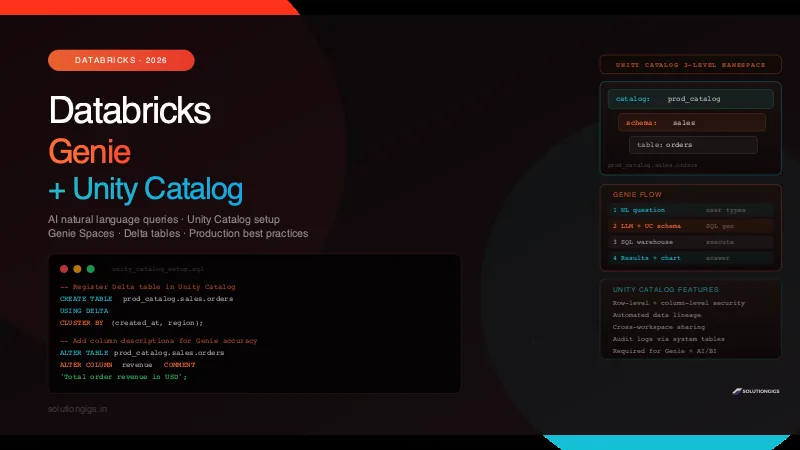
Databricks Genie Guide: Ask Your Data in Plain English
Databricks Genie lets anyone query data in plain English — no SQL needed. How it works, building Genie Spaces, Unity Catalog security, and production best practices.
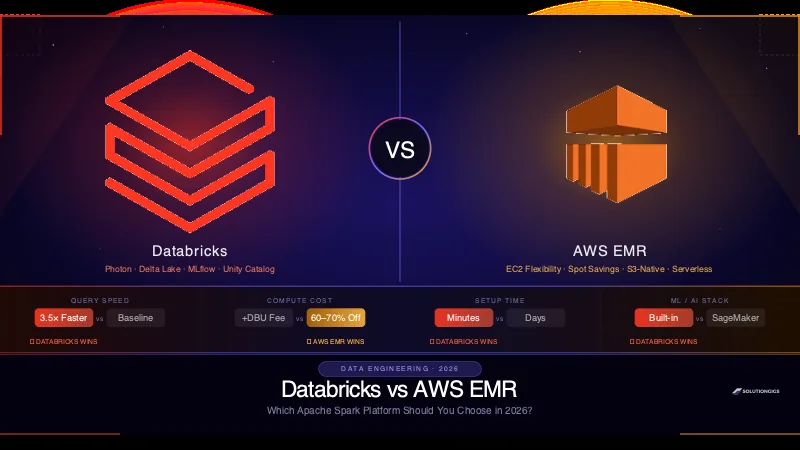
Databricks vs AWS EMR: Which Spark Platform Wins?
Databricks vs AWS EMR head-to-head across performance, cost, ML integration, and developer experience. Real cost modelling, a 5-question decision framework, and a clear verdict for 2026.
PySpark Fundamentals: DataFrames & Transformations
PySpark fundamentals for data engineers — DataFrames, transformations vs actions, lazy evaluation, and the core operations (select, filter, groupBy, join) with runnable code.