
Snowflake vs Databricks: Which Data Platform Wins?
Snowflake vs Databricks in 2026: warehouse vs lakehouse compared on architecture, pricing, performance and AI/ML — plus a clear rule for which one to pick.

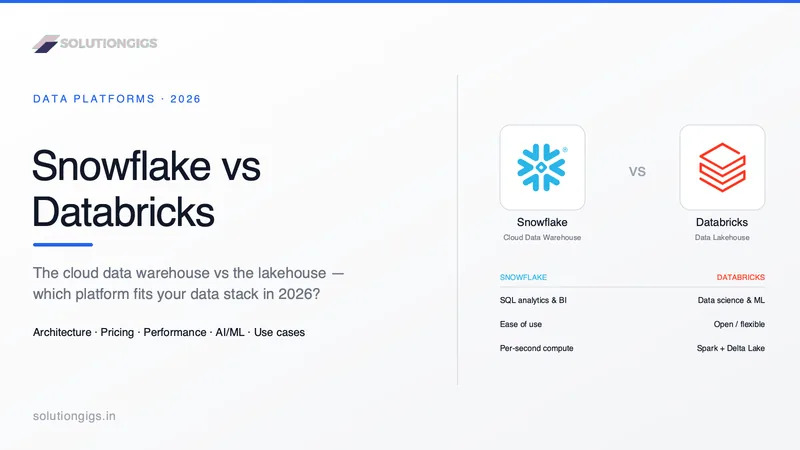
Quick Answer: The Snowflake vs Databricks decision comes down to your primary workload. Snowflake is a cloud data warehouse optimized for fast SQL analytics and business intelligence — it's simple, near-zero maintenance, and loved by analysts. Databricks is a data lakehouse built on Apache Spark and Delta Lake — it's the stronger choice for data engineering, data science, and machine learning at scale. Choose Snowflake if SQL analytics and ease of use come first; choose Databricks if AI/ML and large-scale data processing are central. Many mature teams end up using both.
The Snowflake vs Databricks rivalry is the defining battle of the modern data stack. Together they've reshaped how companies store, process, and analyze data — and if you're building a data platform in 2026, choosing between them (or deciding to use both) is one of the most consequential architecture decisions you'll make.
The confusion is understandable: both are cloud-native, both separate storage from compute, and both now claim to do everything. But they come from opposite directions — one from the warehouse, one from the lake — and that origin still shapes what each does best. This guide breaks down the real differences in architecture, pricing, performance, and AI/ML, then gives you a clear framework to decide.
What Is Snowflake?
Snowflake is a fully managed cloud data warehouse designed for fast, elastic SQL analytics.
Launched in 2012 and now one of the most successful data companies in the world, Snowflake's core promise is simplicity. You load structured and semi-structured data, write SQL, and Snowflake handles storage, scaling, tuning, and maintenance behind the scenes. There are no servers to manage and no indexes to tune.
Its standout architectural idea is the separation of storage and compute into independently scaling layers, plus virtual warehouses — compute clusters that spin up in seconds, auto-suspend when idle, and let different teams run workloads without competing for resources.
Snowflake shines at:
- SQL analytics and business intelligence
- Data sharing across organizations (the Snowflake Marketplace)
- Near-zero operational overhead
- Predictable, analyst-friendly workflows
What Is Databricks?
Databricks is a data lakehouse platform built on Apache Spark and Delta Lake, designed for data engineering, data science, and machine learning.
Founded by the original creators of Apache Spark, Databricks pioneered the lakehouse — an architecture that combines the cheap, flexible storage of a data lake with the reliability and performance of a warehouse. Its open-source Delta Lake format adds ACID transactions, schema enforcement, and time travel to plain files sitting in cloud object storage.
Where Snowflake starts from SQL, Databricks starts from code and data processing. It offers collaborative notebooks, distributed Spark compute, and a full MLOps stack (MLflow, feature stores, model serving), making it the natural home for data science teams. If you're new to Spark, our Databricks Genie guide and Databricks vs AWS EMR comparison go deeper on the ecosystem.
Databricks shines at:
- Large-scale data engineering and ETL
- Machine learning and AI workloads
- Processing unstructured and streaming data
- Open formats and flexible, code-first workflows
Snowflake vs Databricks: Head-to-Head Comparison
| Factor | Snowflake | Databricks |
|---|---|---|
| Category | Cloud data warehouse | Data lakehouse |
| Foundation | Proprietary SQL engine | Apache Spark + Delta Lake |
| Primary users | Analysts, BI teams | Data engineers, ML/AI teams |
| Core strength | Fast SQL analytics | Data engineering + ML |
| Ease of use | Very high (SQL-first) | Moderate (code-first) |
| Machine learning | Snowpark / Cortex (growing) | Native, best-in-class |
| Data types | Structured, semi-structured | All, incl. unstructured/streaming |
| Openness | More proprietary | Open source (Delta, Spark, MLflow) |
| Maintenance | Near-zero | More tuning and control |
| Pricing model | Per-second credits, auto-suspend | DBUs on your cloud compute |
| Best for | BI, analytics, data sharing | ETL, AI/ML, big-data processing |
Architecture: Warehouse vs Lakehouse
The deepest difference is philosophical.
Snowflake stores data in its own optimized, proprietary format inside its managed storage layer. This tight control is why performance is so consistent and maintenance so low — but it also means your data lives more inside Snowflake's world.
Databricks keeps data in open formats (Delta Lake / Parquet) in your cloud storage (S3, ADLS, GCS). You retain ownership and can access it with many engines, not just Databricks. The lakehouse serves BI, engineering, and ML from one copy of the data, avoiding the classic "copy everything into the warehouse" tax.
In 2026 the lines are blurring: Snowflake now supports external tables and open formats like Apache Iceberg, while Databricks keeps improving its SQL warehouse (Databricks SQL). But the DNA remains — Snowflake optimizes for the analyst; Databricks optimizes for the engineer and data scientist.
Both are OLAP systems underneath — columnar analytical engines built to scan and aggregate huge volumes, not to serve your application's transactions. If that distinction is new to you, start with OLAP vs OLTP; for the architectural categories these two platforms grew out of, see data lake vs data warehouse vs lakehouse.
Pricing: Which Is More Cost-Effective?
Neither platform is universally cheaper — it depends entirely on your workload.
Snowflake bills in per-second credits tied to virtual warehouse size. Warehouses auto-suspend when idle, so spiky BI and analytics workloads are very cost-efficient. The trade-off is less low-level control, and costs can climb if warehouses are oversized or left running.
Databricks bills in DBUs (Databricks Units) on top of your own cloud compute. For heavy, sustained data engineering and ML, this fine-grained control (spot instances, cluster tuning, autoscaling) can be more economical — but it demands more expertise to optimize.
Rules of thumb:
- Mostly SQL/BI with variable demand → Snowflake's auto-suspend model is hard to beat
- Heavy ETL, streaming, or ML on large data → Databricks can be more cost-effective with tuning
- Small team without a data engineer → Snowflake's simplicity lowers total cost of ownership
Note that a Databricks DBU rate is only part of the bill on classic compute — you also pay your cloud provider for the underlying instances, which makes rate-to-rate comparisons against Snowflake credits misleading. See how to reduce Databricks costs for the full four-term breakdown.
Not sure which platform will cost less for your workloads? That depends on your query shape and concurrency, not on list prices. Tell us what you're running and we'll model it properly.
Performance
For pure SQL analytics on structured data, Snowflake delivers excellent, remarkably consistent performance with almost no tuning — its query optimizer and micro-partitioning do the work for you.
For large-scale data processing, complex transformations, and ML pipelines, Databricks and its Spark engine (with the vectorized Photon engine) excel, especially on massive or unstructured datasets. Databricks SQL has also closed much of the gap on BI-style queries.
The honest takeaway: for a typical analytics dashboard, both are fast enough that platform fit and cost matter more than raw benchmarks. Vendor benchmarks on both sides are notoriously cherry-picked — trust a proof-of-concept on your own data over any published number.
Machine Learning & AI
This is where Databricks has a clear edge.
Databricks was built for ML. It offers native notebooks, distributed training, MLflow for experiment tracking and model lifecycle, feature stores, and model serving — a genuine end-to-end MLOps platform. For teams doing serious data science, generative AI, or RAG and vector search, it's the natural home.
Snowflake has invested heavily to catch up with Snowpark (run Python/Java/Scala inside Snowflake) and Snowflake Cortex (managed LLM and ML functions). For teams that primarily live in SQL and want ML without leaving the warehouse, this is increasingly capable — but Databricks remains the deeper, more flexible ML platform.
When to Choose Snowflake
Choose Snowflake when:
- ✅ Your primary need is SQL analytics and BI
- ✅ Your team is SQL-strong but light on data engineering
- ✅ You value simplicity and near-zero maintenance above all
- ✅ Data sharing across teams or partners is important
- ✅ You want predictable, fast analytics without tuning clusters
When to Choose Databricks
Choose Databricks when:
- ✅ Machine learning and AI are central to your roadmap
- ✅ You do heavy data engineering, ETL, or streaming
- ✅ You work with unstructured or very large datasets
- ✅ You want open formats and to avoid lock-in
- ✅ You have (or plan to hire) data engineering expertise
The Both-Platforms Reality
In practice, many mature data teams run both. A common pattern:
- Databricks ingests and processes raw data at scale, runs ETL, and powers ML.
- Curated, business-ready tables are served to Snowflake for analyst-facing BI and SQL.
With open table formats like Apache Iceberg now supported on both platforms, this interoperability keeps getting easier. Choosing "both" is a legitimate architecture — not a failure to decide — when different teams have genuinely different needs.
Common Mistakes to Avoid
| ❌ Mistake | ✅ Fix |
|---|---|
| Choosing on hype or a single benchmark | Run a POC on your own data and workloads |
| Picking Databricks with no data engineers | Match the platform to your team's skills |
| Leaving Snowflake warehouses oversized/running | Right-size and rely on auto-suspend |
| Copying all data into the warehouse | Consider a lakehouse to serve one copy |
| Ignoring total cost of ownership | Count engineering time, not just compute |
| Assuming you must pick only one | Hybrid architectures are common and valid |
Frequently Asked Questions
What is the difference between Snowflake and Databricks?
Snowflake is a cloud data warehouse built for fast SQL analytics and business intelligence, prized for simplicity and near-zero maintenance. Databricks is a data lakehouse built on Apache Spark and Delta Lake, designed for data engineering, data science, and machine learning at scale. Snowflake leads on SQL and ease of use; Databricks leads on AI/ML and open, flexible processing.
Is Databricks cheaper than Snowflake?
It depends on the workload. Databricks can be cheaper for large-scale data engineering and ML because it runs on your own cloud storage and compute with fine-grained control. Snowflake's per-second, auto-suspending compute is very cost-efficient for spiky SQL and BI workloads. Neither is universally cheaper — cost depends on usage patterns, tuning, and platform-workload fit.
Is Snowflake or Databricks better for machine learning?
Databricks is generally better for machine learning. Built by the creators of Apache Spark and MLflow, it offers native notebooks, distributed training, feature stores, and full MLOps tooling. Snowflake has expanded ML through Snowpark and Cortex, but Databricks remains the stronger end-to-end platform for data science and ML teams.
What is a data lakehouse?
A data lakehouse combines the low-cost, flexible storage of a data lake with the reliability, performance, and SQL capabilities of a data warehouse. Databricks pioneered the term, using Delta Lake to add ACID transactions and schema enforcement to open files in cloud storage — letting one platform serve BI, data engineering, and ML from the same data.
Can you use Snowflake and Databricks together?
Yes, many organizations use both. A common pattern is Databricks for heavy data engineering and ML on raw data, then serving curated tables to Snowflake for business intelligence and analyst-facing SQL. With open formats like Apache Iceberg gaining support on both platforms, interoperability is improving and hybrid architectures are increasingly practical.
Which is easier to learn, Snowflake or Databricks?
Snowflake is easier to learn, especially for teams that know SQL. It requires almost no infrastructure management — you write SQL and it handles the rest. Databricks has a steeper learning curve because it exposes Spark, notebooks, clusters, and multiple languages, offering more power in exchange for more complexity.
Conclusion
There's no universal winner in Snowflake vs Databricks — there's only the right fit for your workloads, your team, and your roadmap.
Reach for Snowflake when SQL analytics, simplicity, and analyst productivity lead your priorities. Reach for Databricks when machine learning, large-scale data engineering, and open flexibility are central. And don't rule out running both — the modern data stack increasingly blends a lakehouse for processing with a warehouse for serving.
Whatever you choose, decide with a proof-of-concept on your own data, count engineering time alongside compute cost, and match the platform to your team's real strengths. The best data platform is the one your team can actually operate well.
If your shortlist is really warehouse-versus-warehouse rather than warehouse-versus-lakehouse, the companion piece is Snowflake vs BigQuery vs Redshift, which compares the three on the thing that decides the bill — what each one puts on the meter.
Building or migrating a data platform and weighing Snowflake against Databricks? We've shipped production pipelines on both, and the honest answer usually depends on how much of your work is SQL versus Spark. Tell us what you're running today →
Mohammed Yaseen
Founder, SolutionGigs
Mohammed has architected data platforms on both Snowflake and Databricks — from SQL analytics warehouses to Spark-based lakehouses and ML pipelines. He founded SolutionGigs to connect teams with data engineers who choose the right platform for the job. LinkedIn →
Try Free Spark Config Optimizer
Free, no signup — right in your browser.
Try Free Spark Config Optimizer →More in Data Platforms
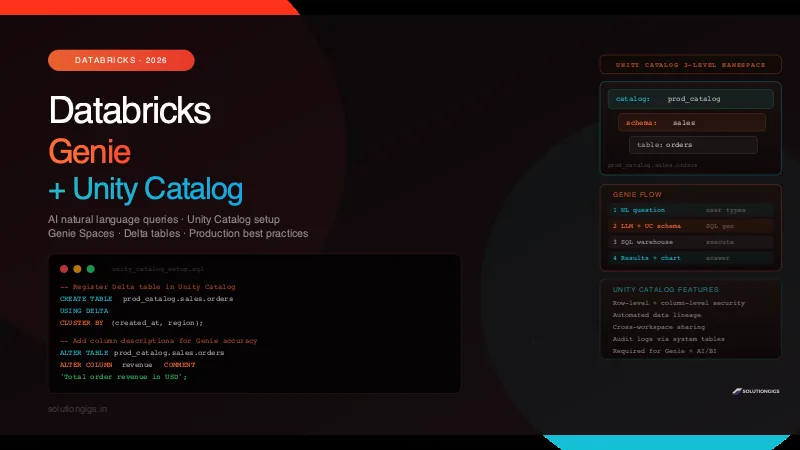
Databricks Genie Guide: Ask Your Data in Plain English
Databricks Genie lets anyone query data in plain English — no SQL needed. How it works, building Genie Spaces, Unity Catalog security, and production best practices.
Delta Lake vs Iceberg: How to Choose
Delta Lake vs Apache Iceberg compared — architecture, features, ecosystem, and a clear decision guide for choosing an open table format for your lakehouse in 2026.
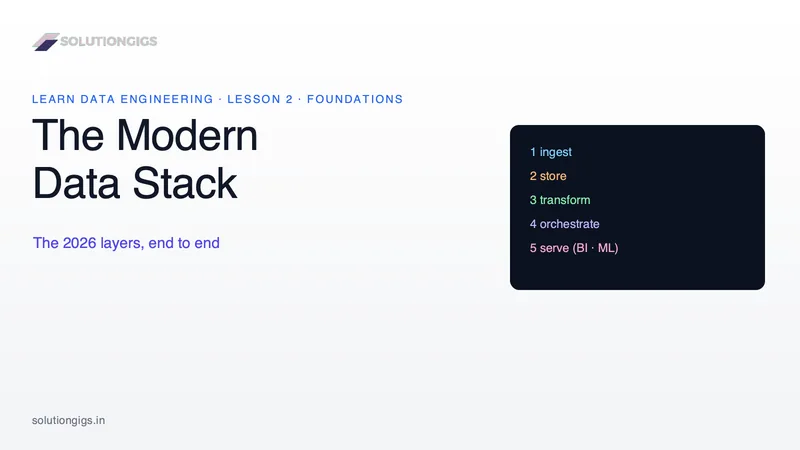
The Modern Data Stack: Architecture, Lakehouse Formats & Tool Selection
The modern data stack in 2026 explained — the five layers (ingest, store, transform, orchestrate, serve), the leading tools in each, and how a cloud warehouse and ELT tie it all together.