
Databricks vs AWS EMR: Which Spark Platform Wins?
Databricks vs AWS EMR head-to-head across performance, cost, ML integration, and developer experience. Real cost modelling, a 5-question decision framework, and a clear verdict for 2026.

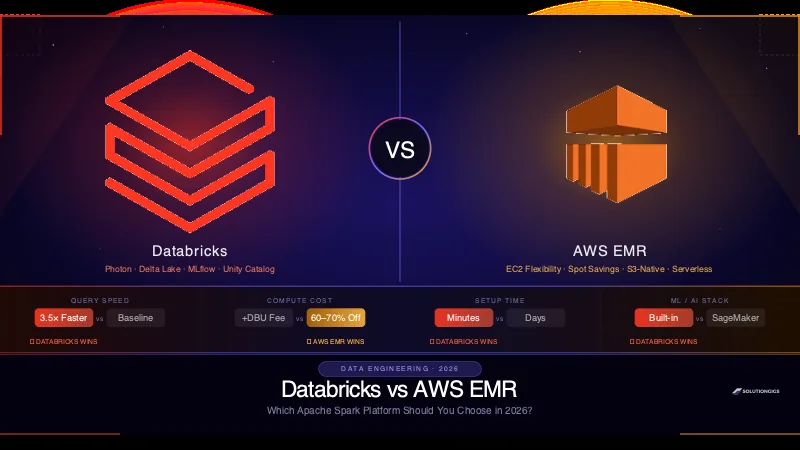
Quick Answer: Databricks wins on developer experience, ML integration, and query performance — its Photon engine runs standard Spark workloads up to 3.5× faster. AWS EMR wins on raw cost flexibility, AWS-native depth, and infrastructure control — Spot Instances alone can reduce your compute bill by 40–70%. For most startups and ML-heavy teams, Databricks is the right default. For large, cost-sensitive batch ETL workloads inside the AWS ecosystem, EMR earns its place.
Every team reaching for Apache Spark in 2026 hits the same fork in the road: Databricks or AWS EMR?
Both are mature, battle-tested platforms. Both run Spark at scale. Both have serverless options, streaming support, and enterprise security. But beneath that surface similarity, they are built for fundamentally different philosophies — and choosing the wrong one will cost you either in engineering hours or in cloud bills.
This guide cuts through the marketing noise. We compare both platforms across seven dimensions that actually matter in production: performance, cost, developer experience, ML/AI integration, ecosystem depth, operational complexity, and when each one genuinely earns its price tag. We close with a decision framework you can apply to your specific situation in under five minutes.
What Is Databricks?
Databricks is a unified data intelligence platform built on Apache Spark, Delta Lake, and MLflow — hosted on your cloud of choice.
Founded by the original creators of Apache Spark at UC Berkeley, Databricks has spent a decade extending Spark beyond what the open-source project offers. The centerpiece is Photon, a C++-rewritten vectorized query engine that replaces the default JVM-based Spark executor and delivers dramatic performance gains on SQL and ETL workloads.
Databricks operates as a SaaS layer deployed into your own cloud account. Your data never leaves your VPC. You pay AWS (or Azure/GCP) for compute, and Databricks for licensing via Databricks Units (DBUs) — a unit of processing capacity billed per hour.
What Makes Databricks Distinct
- Photon engine — C++ vectorized execution, up to 3.5× faster than standard Spark for SQL
- Delta Lake — ACID transactions, time travel, schema evolution on top of object storage
- Unity Catalog — centralised governance, fine-grained access control, data lineage across all workloads, and the foundation for AI features like Databricks Genie
- MLflow — experiment tracking, model registry, and deployment, built in
- Databricks Assistant — AI-powered notebook co-pilot for SQL, Python, and pipeline debugging
- Multi-cloud — runs on AWS, Azure, and GCP with a consistent interface
What Is AWS EMR?
AWS EMR (Elastic MapReduce) is a fully managed cloud big data platform that runs Apache Spark, Hive, Presto, and other open-source frameworks on AWS infrastructure.
EMR is AWS's answer to the managed Spark question — but it takes a deliberately open, infrastructure-first approach. You get EC2 instances, EMR runtime optimisations, and deep integration with the AWS ecosystem. What you configure, tune, and maintain is largely up to you.
In 2022, AWS launched EMR Serverless — a fully managed mode where you submit Spark jobs without provisioning clusters at all. You pay per vCPU-second and GB-second consumed. This closed a major gap with Databricks and repositioned EMR as a serious contender for serverless batch workloads.
What Makes EMR Distinct
- EC2 flexibility — choose any instance type, mix on-demand and Spot, build custom AMIs
- EMR Serverless — zero cluster management, pay-per-use, auto-scales to zero
- AWS-native integration — S3, Glue Data Catalog, Lake Formation, Athena, SageMaker, Redshift all work natively
- Open-source fidelity — standard Spark with EMR runtime optimisations; no proprietary lock-in
- Cost transparency — EC2 pricing + ~25% EMR surcharge, no DBU abstraction layer
- Spot Instances — massive cost reduction for fault-tolerant batch workloads
Head-to-Head: Databricks vs AWS EMR Across 7 Dimensions
1. Performance
Databricks is faster for SQL and mixed workloads. EMR is competitive for raw Spark jobs.
Databricks' Photon engine rewrites the Spark execution layer in C++ with vectorised columnar processing. Databricks publishes benchmarks showing 2–3.5× improvement over standard Spark on TPC-DS queries. In real-world production workloads involving SQL transformations, aggregations, and joins, Photon's gains are consistent and measurable.
AWS EMR ships its own runtime optimisations (emr-spark and emr-spark-rapids for GPU acceleration), but these are incremental improvements on the JVM Spark baseline. For pure Python-heavy workloads or custom UDFs, the gap between Databricks and EMR narrows significantly — Photon's advantage is strongest on SQL and structured data operations.
Edge: Databricks, especially for SQL-heavy analytics and ETL pipelines.
2. Cost
EMR is cheaper on paper. Databricks can be cheaper in practice.
This is the most nuanced comparison, and teams regularly make the wrong call because they only look at sticker prices.
| Cost Factor | Databricks on AWS | AWS EMR |
|---|---|---|
| Compute | EC2 rates (same as EMR) | EC2 rates |
| Platform fee | DBU licensing (~$0.07–$0.55/DBU depending on tier) | ~25% EMR surcharge on EC2 |
| Spot savings | Available, but DBUs still apply | 40–70% savings possible |
| Serverless | Databricks SQL Serverless (per DBU) | EMR Serverless (per vCPU-sec) |
| Reserved capacity | SQL Pro/Enterprise commitments | EC2 Reserved Instances |
| Idle cost | Zero (cluster auto-terminates) | Zero (serverless), EC2 hours (cluster mode) |
The Databricks offset: Photon runs jobs faster, consuming fewer DBU-hours. A job that takes 4 hours on standard Spark and 1.5 hours on Photon pays 62% fewer DBUs — partially or fully offsetting the licensing premium. Teams that migrate pure SQL pipelines to Databricks often see flat or lower total cloud spend.
The EMR offset: Spot Instances are a genuine EMR superpower. A well-configured EMR cluster using Spot Fleet can cut compute costs by 60–70% on fault-tolerant batch workloads. Databricks with Spot still charges DBUs at full rate.
Rule of thumb: For large, long-running batch ETL on predictable schedules — EMR with Spot is likely cheaper. For interactive, ML-augmented, or mixed workloads — Databricks' speed advantage often closes the cost gap.
3. Developer Experience
Databricks wins, and it's not close.
Opening a Databricks workspace for the first time feels like using a purpose-built tool. Collaborative notebooks with real-time co-editing, auto-completing SQL and Python, cluster spin-up in under 90 seconds, and a built-in job scheduler that requires no YAML configuration. The Databricks Assistant can explain failing pipelines, suggest query optimisations, and write boilerplate transformations on demand.
EMR Studio (the notebook interface for EMR) has improved significantly since 2023, but it still feels bolted-on compared to the Databricks experience. Configuring a production EMR cluster — VPC settings, IAM roles, bootstrap actions, logging, autoscaling policies — requires genuine infrastructure expertise. A new data engineer can be productive in Databricks in hours. In EMR, expect days to weeks before a production-ready pipeline is running.
Edge: Databricks, decisively. For teams without dedicated platform engineers, EMR's operational surface area is a hidden tax on every sprint.
4. ML & AI Integration
Databricks is the clear winner for anything touching machine learning.
Databricks ships MLflow natively — experiment tracking, model registry, model serving, and A/B deployment are built into the same workspace where you write your data pipelines. The Feature Store and Model Serving endpoints make the path from notebook to production model as short as it has ever been. With the launch of Mosaic AI, Databricks now also covers LLM fine-tuning, RAG pipelines, and AI gateway functionality. If you're building any kind of intelligent data product, Databricks' ML toolchain is exceptional.
AWS EMR routes ML workflows to Amazon SageMaker, which is a capable platform in its own right. But SageMaker is a separate service with separate endpoints, separate IAM permissions, separate notebooks, and a separate billing model. Stitching together an EMR data pipeline that feeds a SageMaker training job that registers a model in SageMaker Model Registry requires significant glue code and operational overhead.
If your team does pure ETL with no ML component, this dimension is irrelevant. If machine learning is part of your roadmap — even distantly — Databricks' integrated approach removes enormous friction.
Edge: Databricks.
5. Ecosystem & Integrations
EMR for AWS depth. Databricks for cross-cloud and open standards.
AWS EMR integrates natively with every AWS service you already use: S3 for storage, Glue Data Catalog as the metastore, Lake Formation for fine-grained access control, Athena for serverless SQL, Kinesis for streaming ingestion, and SageMaker for ML. If your data infrastructure is AWS-native, EMR fits like a glove — no additional connectors, no credential management headaches.
Databricks excels at open standards. Delta Lake (now donated to the Linux Foundation as Delta.io) is becoming the industry default table format. Unity Catalog federates governance across multiple clouds. And Databricks runs identically on AWS, Azure, and GCP, which matters if your organisation has a multi-cloud strategy or is considering one.
Our Apache Iceberg guide with PySpark covers the table format landscape in detail — both platforms support Iceberg, but with different levels of abstraction.
Edge: Tie, with EMR winning for pure AWS shops and Databricks winning for multi-cloud or open-format-first architectures.
6. Streaming
Both are capable. Databricks edges ahead for unified batch + streaming.
Apache Spark Structured Streaming is the common engine under both platforms. For real-time pipelines consuming from Kafka, Kinesis, or event hubs, both EMR and Databricks handle the workload competently.
Where Databricks differentiates is Delta Live Tables (DLT) — a declarative framework for building streaming and batch pipelines with built-in quality constraints, auto-scaling, and lineage tracking. DLT removes most of the operational complexity of managing Structured Streaming checkpoints, retries, and schema evolution. It's genuinely elegant — and since Apache Spark 4.1 its core engine is open source as Spark Declarative Pipelines, so the same @dp.table code now runs on EMR. What remains Databricks-only is the managed layer: expectations, Auto Loader, SCD Type 2 CDC, the pipeline UI and serverless compute.
On EMR, streaming pipelines are standard Structured Streaming applications, which you write, deploy, and manage yourself. The Spark Streaming tuning guide we published covers the performance levers available on both platforms — but EMR gives you more rope.
Edge: Databricks for teams wanting managed streaming with observability. EMR for teams with Spark expertise who want full control.
7. Security & Governance
Unity Catalog vs Lake Formation — both enterprise-grade, different philosophies.
Databricks Unity Catalog provides a three-level namespace (catalog → schema → table), column-level security, row filters, data masking, lineage tracking, and attribute-based access control — all from a single control plane that works identically across clouds and across Databricks workspaces.
AWS achieves similar governance through a combination of Lake Formation (for data lake permissions), IAM (for service-level access), Glue Data Catalog (for metadata), and Macie (for sensitive data discovery). The end result is equally powerful, but requires weaving together multiple services and IAM policies — which creates operational complexity and more surfaces for misconfiguration.
For regulated industries (finance, healthcare, government), both platforms have the certifications required (SOC 2, HIPAA, PCI DSS). The distinction is implementation overhead, not compliance coverage.
Edge: Databricks for governance simplicity. EMR for teams who want to compose AWS-native controls.
The Databricks vs EMR Cost Comparison: A Real Scenario
Let's make this concrete with a representative workload: a daily ETL pipeline processing 2 TB of raw events into a curated data lake, running for 3 hours on a 10-node cluster (r5.4xlarge, 16 vCPUs, 128 GB each).
| AWS EMR (On-Demand) | AWS EMR (Spot) | Databricks Jobs (Standard) | |
|---|---|---|---|
| EC2 cost (r5.4xlarge × 10 × 3h) | $30.60 | ~$9.18 (70% Spot saving) | $30.60 |
| Platform fee | $7.65 (25% surcharge) | $2.30 | $45.00 (DBU, ~5 DBU/hr per node) |
| Total / run | ~$38 | ~$11.50 | ~$75 |
| Total / month (30 runs) | ~$1,140 | ~$345 | ~$2,250 |
Now add the Photon factor: if Photon finishes the same job in 1.5 hours instead of 3 hours, DBU consumption halves:
| Databricks Jobs + Photon | |
|---|---|
| EC2 (1.5h) | $15.30 |
| DBU (1.5h) | $22.50 |
| Total / run | ~$38 |
| Total / month | ~$1,140 |
With Photon, Databricks and on-demand EMR land at the same monthly cost — while Databricks delivers substantially better developer experience, built-in governance, and ML capability. EMR with Spot still wins on raw economics, but requires fault-tolerant job design and Spot interruption handling.
Before you treat that gap as a reason to migrate, exhaust the levers on the Databricks side first — moving scheduled jobs off All-Purpose Compute, killing idle clusters and buying workers on Spot together cut a typical classic cluster by roughly 69% without changing platform. We work the arithmetic in how to reduce Databricks costs.
When to Choose Databricks
Choose Databricks when one or more of these are true:
- You do ML. MLflow, Feature Store, and Model Serving make Databricks the obvious choice for any team building predictive models or AI features.
- Your team is moving fast. Databricks' zero-friction developer experience means engineers spend time on data, not infrastructure.
- You have streaming and batch together. Delta Live Tables unifies both paradigms with a single declarative framework.
- You want a single platform. Databricks replaces your ETL tool, your notebook environment, your ML platform, and your data catalog. The consolidation ROI is real.
- You're multi-cloud. Databricks works identically on AWS, Azure, and GCP — Unity Catalog federates governance across all three.
- Your SQL workloads are query-intensive. Photon's performance gains pay for the DBU cost on heavy analytical SQL.
When to Choose AWS EMR
Choose EMR when one or more of these are true:
- You're all-in on AWS. If your stack is S3 + Glue + Kinesis + SageMaker, EMR integrates natively with zero friction.
- Cost is the primary constraint. For large, predictable batch workloads, Spot-optimised EMR clusters can cut your compute bill by 60–70%.
- You need full Spark control. EMR gives you unrestricted access to Spark configurations, custom dependencies, and JVM tuning that Databricks' managed environment sometimes limits.
- Your team has platform engineering depth. If you have engineers who can manage cluster lifecycle, IAM policies, and bootstrap scripts, EMR's operational surface is a feature, not a bug.
- Your workloads are pure ETL, no ML. If you never touch machine learning, Databricks' primary differentiator is irrelevant.
- You run Presto or Hive alongside Spark. EMR's multi-framework support on the same cluster is genuinely useful for organisations that haven't fully migrated to Spark.
The Decision Framework: 5 Questions
Answer these in order. The first decisive answer determines your platform.
- Does your team build ML models or AI features? → Yes: Databricks
- Is your entire infrastructure on AWS with no multi-cloud plans? → Yes: EMR
- Is raw compute cost your single most important constraint? → Yes: EMR with Spot
- Do you have dedicated platform engineers to manage infrastructure? → No: Databricks
- Are your workloads primarily SQL-heavy analytics on large datasets? → Yes: Databricks (Photon pays back)
If none of the above gives a clear answer, Databricks is the safer default for 2026 — the managed experience, unified toolchain, and AI-native roadmap give it durable advantages over a pure infrastructure platform.
A Note on Databricks vs EMR Serverless
Both platforms now offer serverless modes that eliminate cluster management entirely. Databricks SQL Serverless is the best option for ad-hoc analytics and BI tools — it's fast, scales instantly, and integrates with Tableau, Power BI, and Looker. AWS EMR Serverless is excellent for batch ETL jobs that run on a schedule — submit a job, pay for the vCPU-seconds it consumes, done.
If your organisation is only running scheduled batch jobs and occasional SQL queries — and has no need for notebooks, ML, or streaming — EMR Serverless is the most cost-effective, lowest-overhead path. No cluster management. No DBU pricing. Pay strictly for what you run.
For everything more complex than that, Databricks' broader platform value becomes the deciding factor.
At SolutionGigs, we've helped data engineering teams evaluate and implement both platforms. The teams that choose Databricks for the right reasons — ML integration, developer velocity, unified governance — are consistently happier six months in. The teams that choose EMR for the right reasons — cost control, AWS-native simplicity, Spot workloads — achieve exactly what they came for. The teams that make the wrong call usually do so because they evaluated list prices without modelling actual workload characteristics.
If you're building out a Spark data platform and want a second opinion on the architecture, tell us what you're running — we'll model it against your actual workload rather than list prices.
Frequently Asked Questions
Is Databricks better than AWS EMR?
Databricks is better for ML-integrated data platforms, developer velocity, and SQL performance. AWS EMR is better for cost-optimised batch ETL on AWS, Spot Instance workloads, and teams with deep AWS ecosystem investment. Neither is universally superior — the right choice depends on your workload profile, team expertise, and cost constraints.
What is the cost difference between Databricks and AWS EMR?
On-demand EMR costs EC2 rates + ~25% EMR surcharge. Databricks costs EC2 rates + DBU licensing, which is 20–40% higher than EMR for raw compute. However, Databricks' Photon engine runs jobs faster, reducing total DBU consumption. With Spot Instances, EMR can be 60–70% cheaper for fault-tolerant batch workloads — making it the clear cost winner for that specific use case.
What is AWS EMR Serverless and how does it compare to Databricks SQL?
EMR Serverless is a fully managed Spark runtime — no cluster management, pay per vCPU-second. Databricks SQL Serverless is equivalent for interactive queries. Databricks SQL is faster for ad-hoc analytics thanks to Photon; EMR Serverless is typically cheaper for large, long-running batch jobs.
Can Databricks run on AWS?
Yes. Databricks deploys into your AWS account, uses EC2 for compute, and S3 for storage. You pay AWS for infrastructure and Databricks for DBU licensing. You can apply AWS Reserved Instance discounts and EDP credits to the EC2 portion.
Which is easier to set up — Databricks or AWS EMR?
Databricks is far easier to set up. A workspace is ready in minutes with auto-scaling clusters and collaborative notebooks out of the box. AWS EMR requires configuring VPCs, IAM roles, security groups, bootstrap actions, and cluster sizing — a production-ready setup can take days without platform engineering expertise.
Does Databricks support Apache Iceberg?
Yes — Databricks supports Iceberg through its UniForm feature (Delta tables readable as Iceberg) and direct Iceberg table support. AWS EMR has first-class native Iceberg support. See our complete Apache Iceberg guide with PySpark for implementation details on both platforms.
When should I choose AWS EMR over Databricks?
Choose EMR when your team is AWS-native, your workloads are large predictable batch jobs, you want Spot Instance savings of 40–70%, you need full Spark configuration control, or your engineers have the expertise to manage cluster infrastructure. EMR Serverless is especially compelling for scheduled batch ETL with no interactive workload.
Conclusion
The Databricks vs AWS EMR debate is not about which platform is objectively better — it's about which platform is better for your team, your workloads, and your economics.
Databricks is the right choice when you want a unified data intelligence platform that handles engineering, ML, streaming, and governance from a single pane of glass. Its Photon engine is genuinely faster, its developer experience is industry-leading, and its AI-native roadmap positions it well for the next three to five years of data platform evolution.
AWS EMR is the right choice when cost discipline, AWS ecosystem depth, and infrastructure control are your primary objectives. With EMR Serverless and Spot Instances, AWS has closed the management gap significantly — and for the right workload profile, the economics are compelling.
The worst outcome is choosing a platform based on brand familiarity or list-price comparisons alone. Model your actual workloads. Benchmark on a pilot. Factor in the engineering hours your team will spend managing infrastructure, not just the compute bill.
And before you commit to any managed Spark platform, ask the more fundamental question: does this workload even need a cluster? For a growing share of mid-size jobs, a single-node engine is faster and far cheaper — see DuckDB vs Spark for where that line falls.
If you're at that decision point right now and want the architecture scoped properly — Databricks, EMR, or a hybrid of both — describe the workload and the budget. You get a scope and a price within one business day.
Whichever platform you pick, know its failure surface: how to find the real cause when a Databricks job fails covers the termination codes and the repair-run trap.
If you are on the EMR side, the failure surface has its own map: AWS EMR troubleshooting covers the four stages, their log paths, and the fixes that no longer work.
Mohammed Yaseen
Founder, SolutionGigs
Mohammed has architected Spark data platforms on both Databricks and AWS EMR for B2B SaaS products, and writes about distributed data engineering, Kafka, and cloud infrastructure at solutiongigs.in. LinkedIn →
Try Free Spark Config Optimizer
Free, no signup — right in your browser.
Try Free Spark Config Optimizer →More in Data Engineering
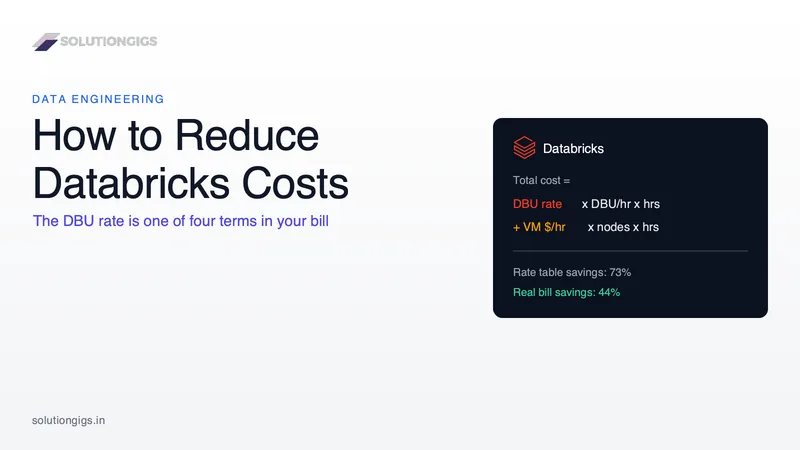
How to Reduce Databricks Costs Without Slowing Pipelines Down
Most guides to reducing Databricks costs open with a DBU rate table, but the rate is only one of four terms in your bill and the one you control least. This guide works a real cluster through all four - showing why moving scheduled jobs off All-Purpose Compute cuts the actual invoice by 44% rather than the 73% the rate table implies, why Photon must make a job 23% faster just to break even and does nothing at all for UDF-heavy code, why spot never touches the DBU line, and why a published TPC-DS benchmark found the highest-rate SKU produced the cheapest run. Plus the August 2026 predictive optimization rollout that may already be billing you twice for the same table maintenance.
Delta Lake vs Iceberg: How to Choose
Delta Lake vs Apache Iceberg compared — architecture, features, ecosystem, and a clear decision guide for choosing an open table format for your lakehouse in 2026.
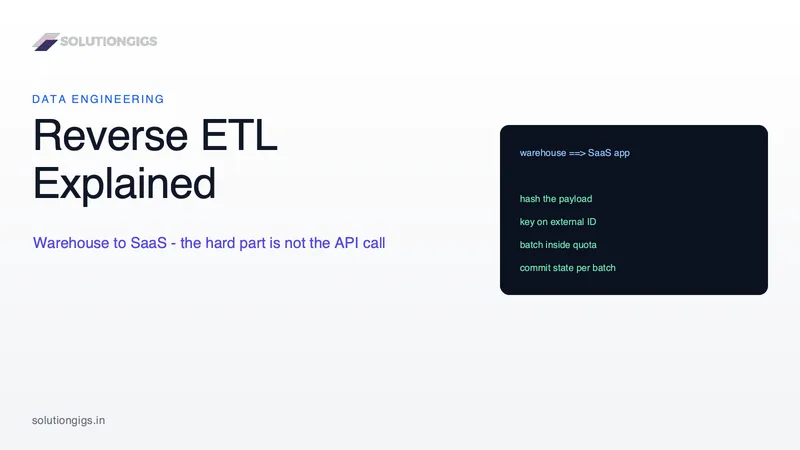
Reverse ETL Explained: Warehouse to SaaS Data Activation
Reverse ETL pushes modeled data out of your warehouse and into the SaaS tools people actually work in — Salesforce, HubSpot, Braze. It's your ELT pipeline run backwards, and the arrow in the diagram hides everything that's hard about it. This guide covers the part after the arrow: the five engineering problems every sync must solve (change detection by payload hash, stable external IDs, rate-limit math, per-batch idempotency, per-record failure handling), each with the exact way it fails; a build-vs-buy table; where the tooling market went after Fivetran absorbed Census and merged with dbt Labs; and the latency floor that tells you when reverse ETL is the wrong tool entirely.