
ETL vs ELT: What's the Difference and When to Use Each
Last Updated: August 2026 | 12 min read
Quick Answer: ETL (Extract, Transform, Load) and ELT (Extract, Load, Transform) run the same three steps — the difference is where the transformation happens. In ETL, data is transformed in a separate engine before it's loaded, so only clean, modeled data reaches the destination. In ELT, raw data is loaded first into a cloud warehouse or lakehouse, then transformed in place using the destination's own compute (SQL, usually via dbt). ELT became the default because cloud warehouses made storage cheap and compute elastic — so you load everything raw and transform on demand. ETL still wins when you must mask sensitive data before it lands, or the destination can't transform.
"ETL vs ELT" sounds like a one-letter swap, but it's the fault line that runs through every modern data platform. Reorder those two letters and you change where your data is cleaned, how much raw data you keep, what it costs, and who can see sensitive fields before they're masked. Most teams don't consciously choose — they inherit whatever their warehouse and tools nudge them toward, then hit the wall later when compliance, cost, or reprocessing forces the question. This guide explains the real difference (it's smaller and more important than the acronyms suggest), when each pattern actually fits, the tooling on both sides, and a decision framework — with the trade-offs competitors gloss over.
The core difference: where the transform runs
ETL and ELT execute the identical Extract, Transform, and Load steps; the only difference is whether the Transform runs in a separate engine before the load (ETL) or inside the destination after the load (ELT). Everything else — cost model, schema approach, raw-data retention — follows from that one choice.
In ETL, an external processing engine (Apache Spark, AWS Glue, Informatica, Talend, SSIS) pulls data from sources, cleans and reshapes it, and then writes the finished result into the warehouse. The destination only ever sees data that's already been modeled. In ELT, you extract from sources and immediately load the raw data into the destination, then run transformations there — typically SQL statements executed by the warehouse's own engine and orchestrated by a framework like dbt.
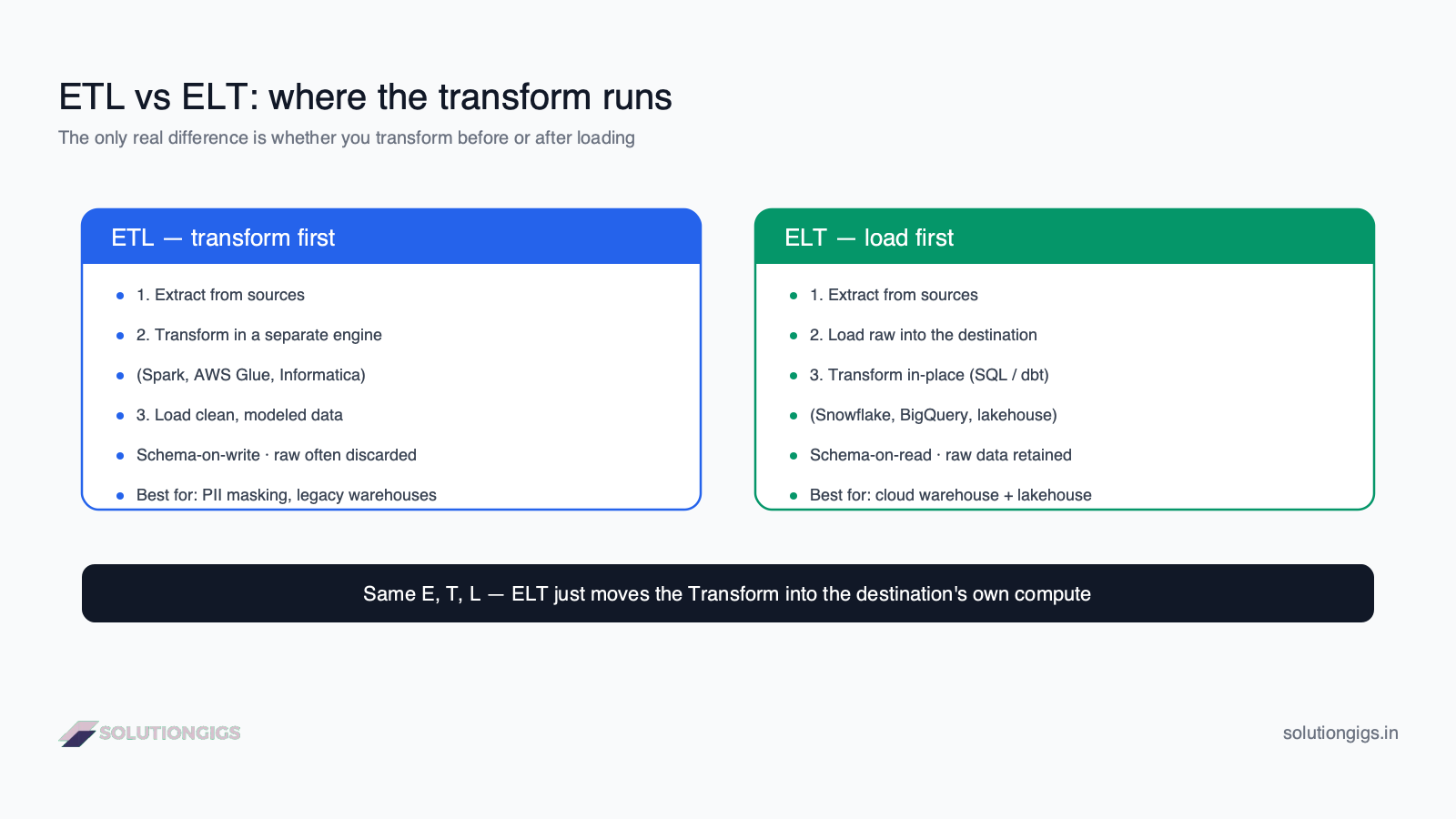
- ETL: Extract → Transform (separate engine) → Load. Clean data lands. Schema-on-write.
- ELT: Extract → Load (raw) → Transform (in the destination). Raw data lands. Schema-on-read.
Mental model: ETL cleans the ingredients before they enter the kitchen; ELT stocks the raw ingredients in the pantry and cooks on demand. Same meal — different place and time for the prep.
Why ELT took over the modern data stack
ELT became the default pattern because cloud data warehouses decoupled storage from compute and made both cheap and elastic — which flipped the economics that ETL was designed around. When storage was expensive and warehouse compute was fixed and scarce, it made sense to transform first and load only the lean, final result. Cloud changed both constraints.
Three shifts drove it:
- Storage got almost free. On Snowflake, BigQuery, Redshift, and Databricks, object storage costs cents per gigabyte. Keeping all the raw data is now affordable, and raw data is worth keeping — you can reprocess it when logic changes without re-ingesting from source.
- Compute became elastic. These warehouses run massively parallel (MPP) SQL that scales on demand. Transforming inside the warehouse is fast and you only pay while it runs.
- The tooling split cleanly. Managed extract-load tools (Fivetran, Airbyte) handle the EL, and dbt owns the T as version-controlled SQL. That division of labor is the modern data stack.
The result: for anything landing in a cloud warehouse or lakehouse, ELT is now the path of least resistance — and usually the right one.
Schema-on-write vs schema-on-read
ETL enforces schema-on-write — data must match the target schema before it's loaded — while ELT uses schema-on-read, loading raw data as-is and applying structure later at transform time. This is one of the most consequential downstream effects of the reorder.
With schema-on-write (ETL), the pipeline rejects or fixes anything that doesn't fit the model before it lands. That gives you clean, validated tables from the moment data arrives — but it also means a new source field or a schema change can break ingestion, and you've permanently lost whatever the transform dropped.
With schema-on-read (ELT), raw data lands untouched and meaning is imposed when you query or transform it. That's more flexible — you keep every column, add fields without breaking the load, and reinterpret history when requirements change — at the cost of the raw landing zone being messy and needing discipline (this is exactly what data quality tests and staging models are for).
ETL vs ELT: full comparison
The table below maps every dimension that actually differs between ETL and ELT — the transform location is the cause, and the rest are effects.
| Dimension | ETL (Extract → Transform → Load) | ELT (Extract → Load → Transform) |
|---|---|---|
| Transform runs | In a separate engine, before load | Inside the destination, after load |
| Data that lands | Clean, modeled | Raw, untransformed |
| Schema approach | Schema-on-write | Schema-on-read |
| Raw data retained | Usually no (only final result) | Yes (raw kept, reprocessable) |
| Typical destination | Any DB, legacy warehouse, on-prem | Cloud warehouse / lakehouse |
| Transform language | Engine code (Spark, Java, GUI tools) | SQL (dbt), warehouse-native |
| Compute cost sits in | The separate ETL engine | The warehouse (per transform run) |
| Time to first load | Slower (transform blocks the load) | Faster (raw loads immediately) |
| Handling PII before landing | Natural — mask before load | Requires in-warehouse governance |
| Best fit | Compliance-heavy, legacy targets, heavy pre-processing | Analytics, scale, flexible/exploratory work |
| Representative tools | Informatica, Talend, SSIS, Glue, Spark | Fivetran/Airbyte + dbt + Snowflake/BigQuery |
One-line verdict: default to ELT for cloud warehouses and lakehouses; reach for ETL when data must be transformed before it lands — for compliance, or because the destination can't transform.
When to use ETL
Use ETL when transformation must happen before data reaches the destination — most often for compliance, for destinations that can't transform, or when heavy processing belongs in a dedicated engine. ELT's popularity doesn't make ETL obsolete; it makes it a deliberate choice.
Choose ETL when:
- Sensitive data must be masked or tokenized before it lands. If regulation (GDPR, HIPAA, PCI) means raw PII can never sit in the warehouse — even briefly — transform-before-load is the safe pattern. In ELT, raw PII lands first, which is a governance liability you have to actively manage.
- The destination can't transform. A legacy on-prem warehouse, an operational database, or a downstream app that expects final, structured data has no engine to run in-place transforms. ETL delivers ready-to-use data.
- Heavy or specialized processing — complex enrichment, ML feature engineering, deduplication across huge windows, or joins better done in Apache Spark — is more efficient in a purpose-built engine than in warehouse SQL.
- You want a lean destination. Loading only the final result keeps storage small and the warehouse simple, which matters when destination storage or compute is genuinely expensive.
When to use ELT
Use ELT when your destination is a cloud data warehouse or lakehouse and you want flexibility, scale, and the ability to reprocess raw data — which covers the majority of modern analytics workloads. It's the default for a reason.
Choose ELT when:
- Your destination is Snowflake, BigQuery, Redshift, or Databricks. These are built to transform in place at scale; not using their compute wastes what you're paying for.
- You want to keep raw data. Retaining the raw landing zone lets you re-run transformations when logic changes, backfill new columns, and audit history — without re-extracting from source. (See our guide to backfilling data pipelines.)
- Analytics engineering with dbt is your workflow — version-controlled, tested, documented SQL transformations that analysts can own, not just data engineers.
- Requirements change often. Schema-on-read means new fields don't break ingestion and you can reinterpret the raw data as needs evolve.
- You're on a lakehouse. The medallion pattern — land raw in bronze, refine to silver and gold — is ELT by design. See medallion architecture explained.
At Telemetrix, we land raw device telemetry into an Apache Iceberg bronze layer completely untransformed, then transform bronze → silver → gold in place with Spark SQL — textbook ELT on a lakehouse. Keeping that raw bronze paid for itself the week a parsing bug corrupted three months of a derived metric: we reprocessed straight from bronze in an afternoon, with zero re-ingestion from Kafka. In an ETL world, that data would have been transformed-then-discarded and gone for good.
See how SolutionGigs can help
Trying to decide whether to build ETL or ELT — or migrate a tangle of legacy ETL jobs onto a modern ELT stack? Getting the pattern right early saves a painful re-platform later. SolutionGigs connects you with vetted data engineers who've built both, on Snowflake, BigQuery, Databricks, and lakehouses on AWS. See how SolutionGigs can help →
The tooling on each side
ETL tools bundle extraction, transformation, and loading into one engine; the ELT stack splits extract-load and transform into separate specialized tools. Knowing which tool sits where clears up most of the confusion.
ETL / all-in-one engines:
- Informatica, Talend, SSIS — mature enterprise ETL, often GUI-driven, common in on-prem and regulated shops.
- AWS Glue, Apache Spark — code-first engines that extract, transform (in the engine), and write final data. Glue and Spark can also power ELT patterns, so the label depends on where the transform runs, not the tool alone.
ELT stack (split responsibilities):
- Extract + Load: Fivetran, Airbyte, Stitch — managed connectors that copy raw source data into the warehouse. Change data capture tools (Debezium) also feed the load step for low-latency replication.
- Transform: dbt — the de-facto standard, running transformations as tested, version-controlled SQL inside the warehouse. dbt is purely the "T"; it never extracts or loads.
- Destination + compute: Snowflake, BigQuery, Redshift, Databricks — where both the raw data and the transform compute live.
- Orchestration: Airflow, Dagster, or Prefect schedule the EL and trigger dbt runs (see dbt vs Airflow for how these fit together).
Key point: a tool isn't inherently "ETL" or "ELT." Spark writing final tables is ETL; Spark transforming already-loaded bronze data is ELT. The pattern is defined by where the transform runs, not the logo.
Common mistakes (and how to avoid them)
- Thinking ELT means "no transformation." ELT still cleans, joins, and models data — it just does it after the load, in the warehouse. The raw landing zone is the start, not the finished product.
- Loading raw PII into the warehouse with no governance. ELT lands raw data first. If that includes sensitive fields, apply masking, tokenization, restricted schemas, and row-level security — or use ETL for that source.
- Running ETL patterns on a cloud warehouse. Transforming outside the warehouse and loading only the final result wastes elastic compute you're paying for and throws away reprocessable raw data. On Snowflake/BigQuery, prefer ELT.
- Assuming ELT is always cheaper. In-warehouse transforms bill compute on every run. Inefficient or over-scheduled dbt models are a classic source of runaway warehouse bills — model and schedule them deliberately.
- Discarding raw data in ELT. The whole advantage of ELT is a reprocessable raw layer. If you overwrite or drop it, you've kept the cost of loading raw without the benefit.
- Treating the choice as all-or-nothing. Real platforms are hybrid: ETL for compliance-sensitive or heavy sources, ELT for everything else. Pick per source, not per company.
Frequently Asked Questions
What is the difference between ETL and ELT?
ETL and ELT run the same three steps — Extract, Transform, Load — in a different order. In ETL, data is transformed in a separate engine before it's loaded, so only clean, modeled data reaches the destination. In ELT, raw data is loaded into the destination first and then transformed in place using the destination's own compute, usually with SQL and dbt. The practical difference is where the transformation runs.
Is ELT better than ETL?
Neither is universally better. ELT is the default for cloud data warehouses and lakehouses (Snowflake, BigQuery, Redshift, Databricks) because their storage is cheap and compute is elastic, so loading raw and transforming in place is fast and flexible. ETL is still the right choice when you must mask sensitive data before it lands, when the destination can't transform, or when heavy processing belongs in a dedicated engine like Spark.
Does ELT mean there is no transformation?
No. ELT still transforms the data — it just does it later, inside the destination, after the raw data is loaded. Raw data lands untouched, then cleaning, joining, deduplicating, and modeling all happen afterward as SQL transformations, commonly orchestrated with dbt. ELT moves the Transform step; it doesn't remove it.
Why did ELT become popular?
ELT became popular because cloud data warehouses separated storage from compute and made both cheap and elastic. When storage costs almost nothing, it's affordable to load and keep all raw data; when compute scales on demand, transforming inside the warehouse with SQL is fast. Managed extract-load tools like Fivetran and Airbyte plus the transformation framework dbt made the load-first pattern the standard modern data stack.
Is ELT more expensive than ETL?
It can be, but the cost sits in a different place. ELT loads all raw data, so you pay for more storage and for warehouse compute every time a transformation runs. ETL pays for a separate transformation engine and only loads final data, keeping storage lean. Because cloud storage is cheap and warehouse compute is elastic, ELT is often cheaper overall — but inefficient in-warehouse transforms are a common source of runaway bills.
Is dbt an ETL or ELT tool?
dbt is an ELT tool — specifically the "T" in ELT. It runs transformations as SQL inside a warehouse or lakehouse that already holds the loaded raw data, so it assumes Extract and Load have already happened (usually via Fivetran or Airbyte). dbt doesn't extract or load data itself; it transforms data that's already in the destination, which is the defining pattern of ELT.
Where does ELT load sensitive or PII data?
In a pure ELT pipeline, raw data — including any PII — lands in the destination untransformed, which is exactly why compliance-sensitive workloads sometimes prefer ETL. If you use ELT with sensitive data, apply governance at load: mask or tokenize columns on the way in, restrict access to the raw landing schema, and use the warehouse's dynamic masking and row-level security. When masking must happen before data lands at all, ETL is safer.
Conclusion
ETL and ELT aren't rival technologies — they're the same three steps in a different order, and the whole decision comes down to one question: should the transform run before the data lands, or after? Reorder those letters and everything else follows — schema-on-write vs schema-on-read, whether you keep raw data, where the compute cost lives, and how you handle sensitive fields.
The rules that cover almost every case:
- Cloud warehouse or lakehouse destination → ELT (load raw, transform with dbt/SQL in place).
- Must mask PII before it lands, or the destination can't transform → ETL.
- Want to reprocess history without re-ingesting → ELT (keep the raw layer).
- Heavy enrichment or ML feature work → ETL in a dedicated engine like Spark.
- Real platform → hybrid: choose per source, not per company.
Get the pattern right for each source and your platform stays flexible, affordable, and compliant instead of fighting the tooling. If you're deciding between ETL and ELT — or untangling legacy ETL jobs onto a modern stack — get matched with a vetted data engineer on SolutionGigs. It's free to post your project.

Mohammed Yaseen
Founder, SolutionGigs
Mohammed builds data platforms at Telemetrix, running ELT on a lakehouse — raw device telemetry landing in Apache Iceberg on S3, then transformed bronze → silver → gold with Spark SQL. He's migrated legacy ETL jobs onto modern ELT stacks and kept the ones that had to stay ETL for compliance. LinkedIn →