
The Modern Data Stack: Architecture, Lakehouse Formats & Tool Selection
The modern data stack in 2026 explained — the five layers (ingest, store, transform, orchestrate, serve), the leading tools in each, and how a cloud warehouse and ELT tie it all together.

📚 Lesson 2 of the Foundations track in our free Learn Data Engineering course. Builds on what data engineering is.
Quick Answer: The modern data stack is a set of cloud-based, modular tools that collect, store, transform, and serve data — organized into five layers: ingest → store → transform → orchestrate → serve. A cloud data warehouse or lakehouse sits at the center, and each layer is a swappable component. The defining shift from older systems is ELT: load raw data into the warehouse first, then transform it there with SQL. This is the architecture nearly every data team assembles in 2026.
If data engineering is the discipline of building reliable data pipelines, the modern data stack is the toolbox it uses. But "modern data stack" gets thrown around without definition. This lesson gives you the real map: the five layers, what each does, the leading tools in each, and — most importantly — why the stack is shaped this way. By the end you'll be able to look at any company's data setup and place every tool in its layer.
What is the modern data stack?
The modern data stack is a cloud-native, modular collection of tools that together move data from source systems to analytics and machine learning. Instead of one monolithic platform, teams compose best-in-class tools — each responsible for one layer — around a central cloud data warehouse.
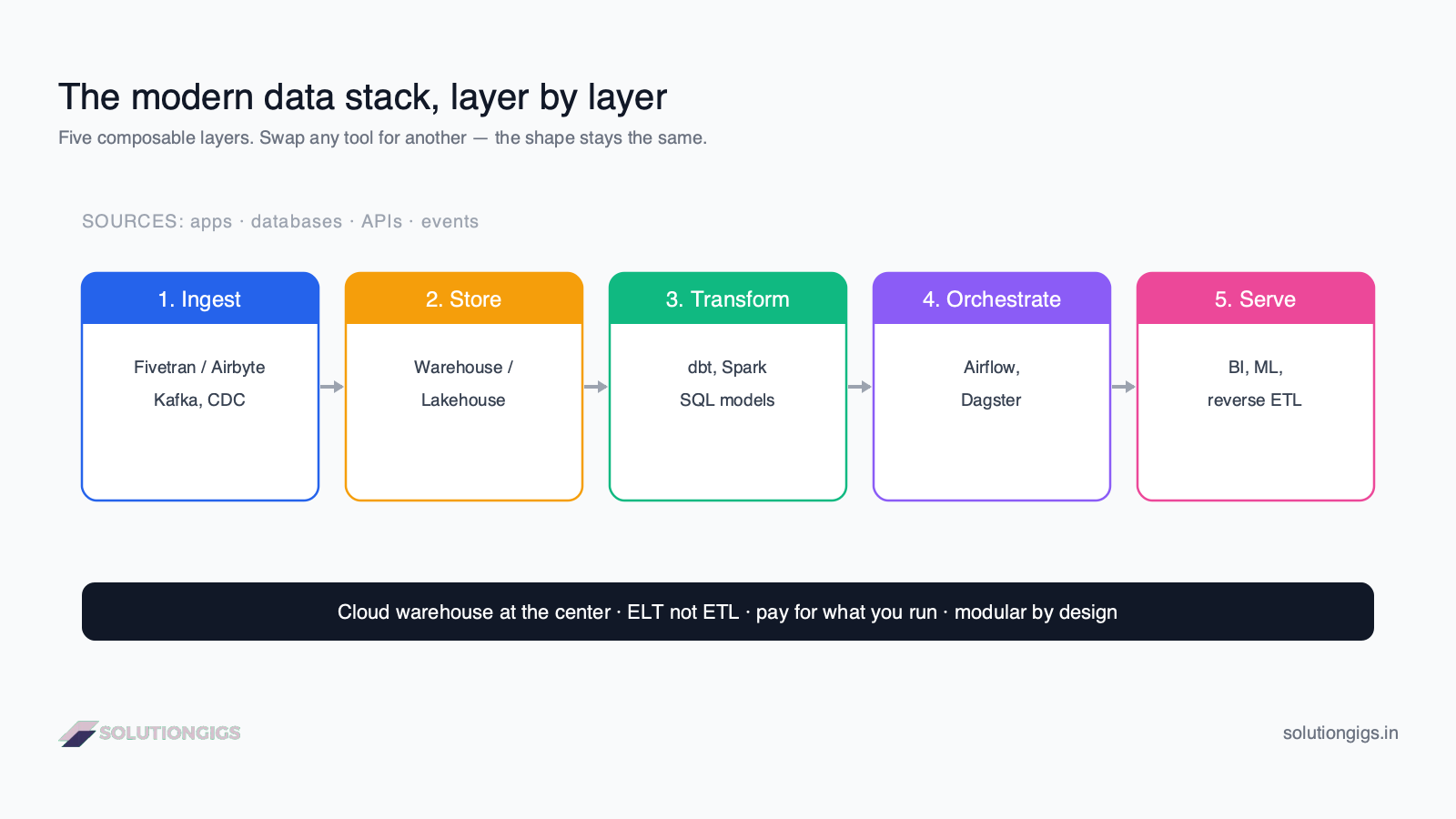
Three properties define it:
- Cloud-native — everything runs as a managed cloud service; you don't rack servers.
- Modular — each layer is a swappable component. Don't like your ingestion tool? Replace it without touching the rest.
- Pay-per-use — you pay for compute and storage you actually consume, not a fixed license.
The modern data stack replaced the old world of one giant, tightly-coupled ETL platform you bought and hosted yourself. Its superpower is composability: assemble the exact stack you need, and evolve it one piece at a time.
The five layers of the modern data stack
Data flows through five layers in order: ingest, store, transform, orchestrate, and serve. Here's what each does and the tools that lead it in 2026.
1. Ingestion — get data in
The ingestion layer moves raw data from source systems (application databases, SaaS APIs, files, event streams) into your storage layer. Managed connectors handle the tedious work of API auth, schema changes, and incremental syncs.
- Batch / connectors: Fivetran, Airbyte
- Change data capture (CDC): Debezium
- Real-time events: Apache Kafka
2. Storage — the center of gravity
The storage layer is the cloud data warehouse or lakehouse where all data lands and lives. This is the heart of the stack — everything else revolves around it.
- Cloud warehouses: Snowflake, Google BigQuery, Amazon Redshift
- Lakehouse: Databricks, or a data lake with open table formats like Apache Iceberg and Delta Lake
3. Transformation — make data useful
The transformation layer cleans, joins, and models raw data into trustworthy tables — inside the warehouse, using its compute. This is where dbt dominates by letting teams transform data with tested, documented SQL.
- SQL transformation: dbt (data build tool)
- Heavy / big-data transformation: Apache Spark
Layer consolidation to watch: the "modular, swappable tools" premise of this stack is under pressure from vendor consolidation. Fivetran (ingestion) and dbt Labs (transformation) completed a merger on June 1, 2026, putting layers 1 and 3 under one company — with dbt Core v2.0 and the new Fusion engine still open source under Apache 2.0. Modularity is now a choice you have to make deliberately, not a property you get for free.
4. Orchestration — schedule and connect
The orchestration layer runs pipelines on a schedule and manages dependencies ("run C only after A and B succeed"). Without it, you have disconnected scripts; with it, you have a coordinated system.
- Orchestrators: Apache Airflow, Dagster, Prefect
5. Serving — deliver the value
The serving layer delivers modeled data to the people and systems that use it: dashboards, notebooks, ML feature stores, and even back into operational tools (reverse ETL).
- BI: Tableau, Power BI, Looker
- ML / apps: feature stores, notebooks, reverse ETL (Hightouch; Census is now Fivetran Activations after Fivetran's 2025 acquisition)
Why the stack looks this way: the ELT shift
The modern data stack exists because cloud warehouses made ELT cheaper and faster than ETL. In the old model (ETL — Extract, Transform, Load), you transformed data before loading it, on infrastructure you managed, because storage and compute were expensive.
Cloud warehouses flipped this. Storage became cheap and compute became elastic, so the winning pattern became ELT — Extract, Load raw data first, then Transform it in the warehouse with SQL:
| Traditional ETL | Modern ELT (the stack) | |
|---|---|---|
| Order | Transform, then load | Load raw, then transform |
| Where transform runs | Separate servers you manage | Inside the cloud warehouse |
| Coupling | One monolithic platform | Modular, swappable tools |
| Cost model | Fixed license + hardware | Pay per use |
| Transform language | Proprietary / custom code | Mostly SQL (dbt) |
This is why ETL vs ELT is worth understanding: ELT is the assumption baked into the entire modern data stack.
You don't need every layer on day one
A capable starter stack is just three pieces: an ingestion tool, a cloud warehouse, and dbt. The modular design means you add layers only when a real need appears:
- Minimal stack: Fivetran/Airbyte → Snowflake/BigQuery → dbt. This alone powers many companies.
- Add orchestration (Airflow) when you have many pipelines with dependencies.
- Add Spark when data outgrows what SQL in the warehouse handles comfortably.
- Add streaming (Kafka) when you need real-time instead of scheduled batches — the subject of the next lesson, batch vs streaming.
Resist buying the whole stack up front. Over-engineering a data platform for a startup is a classic mistake. Start minimal; the stack is designed to grow with you.
Try it yourself — check your understanding
- Place each tool in its layer: dbt, Fivetran, Snowflake, Airflow, Tableau.
- What does the "L before T" in ELT mean, and why did cloud warehouses make it the default?
- A 5-person startup wants analytics fast. Which three layers form a sensible minimal stack?
Show answers
- Fivetran = ingestion, Snowflake = storage, dbt = transformation, Airflow = orchestration, Tableau = serving.
- Load raw data before transforming it. Cloud warehouses made storage cheap and compute elastic, so it became cheaper and faster to load everything and transform in place with SQL than to pre-transform on separate servers.
- Ingestion + storage (warehouse) + transformation (dbt) — e.g. Airbyte → BigQuery → dbt.
Common mistakes with the modern data stack
- Buying every layer immediately. Start with ingestion + warehouse + dbt; add the rest on real need.
- Treating the warehouse as an afterthought. It's the center of gravity — choose it deliberately.
- Skipping orchestration once pipelines multiply. Disconnected cron jobs become unmanageable fast.
- Ignoring cost. Pay-per-use is a benefit and a trap — unmonitored warehouse compute bills add up.
- Confusing ETL and ELT. The stack assumes ELT; designing it around old ETL habits fights the tools.
Frequently Asked Questions
What is the modern data stack?
The modern data stack is a set of cloud-based, modular tools that collect, store, transform, and analyze data — organized into five layers: ingestion, storage, transformation, orchestration, and serving. A cloud warehouse or lakehouse sits at the center, and each layer is a swappable component, so teams assemble the stack that fits their needs.
What are the layers of the modern data stack?
Five layers. Ingestion moves data from sources into storage (Fivetran, Airbyte, Kafka). Storage is the cloud warehouse or lakehouse (Snowflake, BigQuery, Databricks). Transformation cleans and models data in place (dbt, Spark). Orchestration schedules the pipelines (Airflow, Dagster). Serving delivers data to BI, ML, and apps.
What is the difference between the modern data stack and traditional ETL?
Traditional ETL transformed data before loading it, on servers you managed, in one coupled system. The modern data stack uses ELT: load raw data into a cloud warehouse first, then transform it there with SQL. It's cloud-native, modular, and pay-per-use — made possible because cloud warehouses turned large-scale in-place transformation cheap and fast.
Do I need every layer of the modern data stack?
No. A small team can run a capable stack with just an ingestion tool, a cloud warehouse, and dbt. Orchestration and advanced serving are added as complexity grows. The stack is modular — start minimal and add layers only when a real need appears.
Is dbt part of the modern data stack?
Yes. dbt is the de facto transformation layer. It lets teams build, test, and document data models using plain SQL that runs inside the warehouse, and it popularized the ELT pattern. It's one of the tools most associated with the modern data stack.
Conclusion
The modern data stack is five modular, cloud-native layers — ingest, store, transform, orchestrate, serve — assembled around a central cloud warehouse, running on ELT. Once you see the layers, every data tool has an obvious place, and every architecture decision becomes "which component, in which layer, and do I need it yet?" Start with a minimal stack and grow it deliberately.
Next in the free Learn Data Engineering course, we go deeper on one of the biggest architecture choices inside this stack: batch vs streaming — when scheduled pipelines are enough and when you need real-time. Building out a data platform now? Tell us what you're assembling — we'll scope the smallest version of this stack that actually solves your problem.
Mohammed Yaseen
Founder, SolutionGigs
Mohammed designs modern data stacks in production — warehouses, dbt, orchestration and streaming — and teaches the free Learn Data Engineering course. LinkedIn →
More in Data Engineering
dbt vs Airflow: Where Each Fits
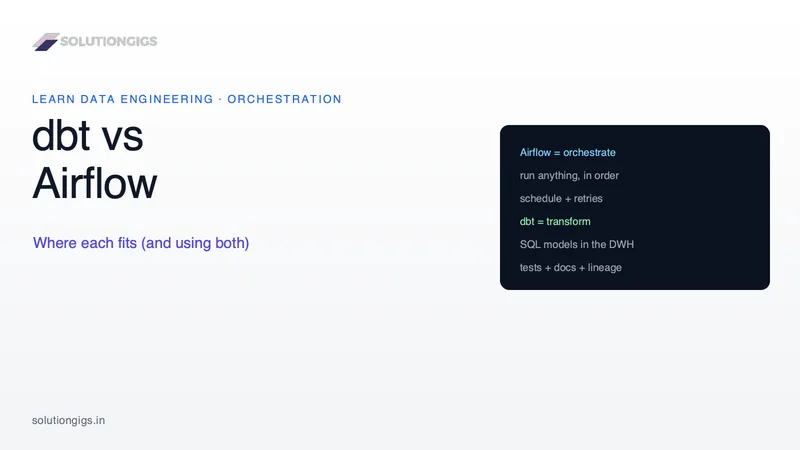
dbt vs Airflow explained — why they solve different problems (transformation vs orchestration), when to use each, and how teams use them together, with a clear decision guide.
ETL vs ELT: What's the Difference and When to Use Each
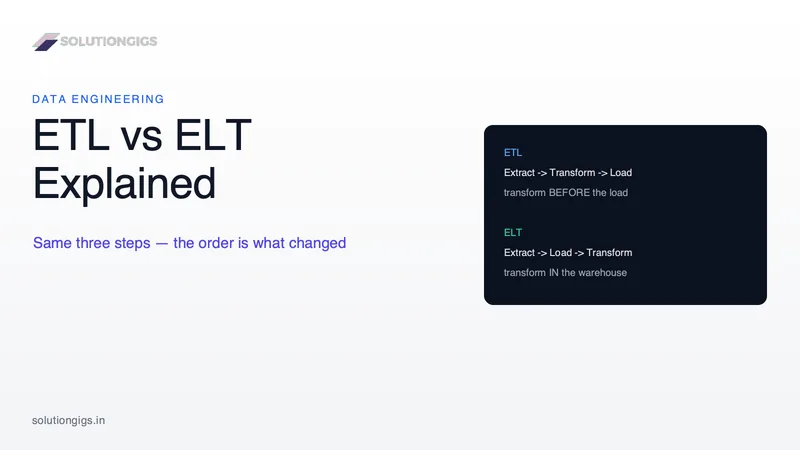
"ETL vs ELT" sounds like a one-letter swap, but it's the fault line running through every modern data platform. Reorder those letters and you change where data is cleaned, how much raw data you keep, what it costs, and who can see sensitive fields before they're masked. The only real difference: whether the Transform runs in a separate engine before the load (ETL) or inside the destination after it (ELT). This guide covers schema-on-write vs schema-on-read, the full cost and PII trade-offs, the tooling on each side (dbt, Fivetran, Spark, Glue), and a decision framework — with a real lakehouse ELT example.
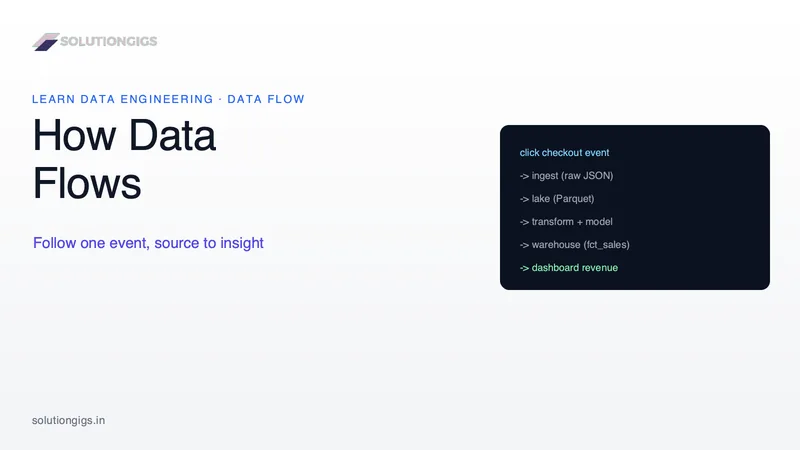
How Data Flows Through a Data Engineering Pipeline
Follow one checkout event as it flows through a data engineering pipeline — source, ingest, lake, transform, model, and serve — changing shape at every stage until it is a number on a dashboard.