
What Is Data Engineering? The Role Explained
What is data engineering? A clear explanation of the role — what a data engineer does day to day, the tools they use, how it differs from data science and analytics, and how to start.

📚 Lesson 1 of the Foundations track in our free Learn Data Engineering course. Start here — everything else builds on this.
Quick Answer: Data engineering is the practice of building and operating the systems that move data from where it's created to where it creates value. A data engineer designs pipelines that ingest raw data (from databases, APIs, and event streams), store it in a lake or warehouse, model it into clean, reliable tables, and serve it to analytics, dashboards, and machine learning. If a data scientist is a chef, the data engineer builds the kitchen and stocks it with fresh ingredients — reliably, and on schedule.
Every dashboard you've seen, every recommendation an app has made, every AI model trained on company data sits on top of a data pipeline someone built. That someone is a data engineer. In this first lesson of the free Learn Data Engineering course, we'll answer the question plainly — what the role actually is, what a data engineer does day to day, how it differs from data science and analytics, and the exact path to start. No hype, just the shape of the job.
What is data engineering, really?
Data engineering is the discipline of designing, building, and maintaining the pipelines and systems that make data usable at scale. Raw data is messy, scattered, and constantly changing. Data engineering turns that chaos into clean, trustworthy, well-organized data that the rest of the company can rely on.
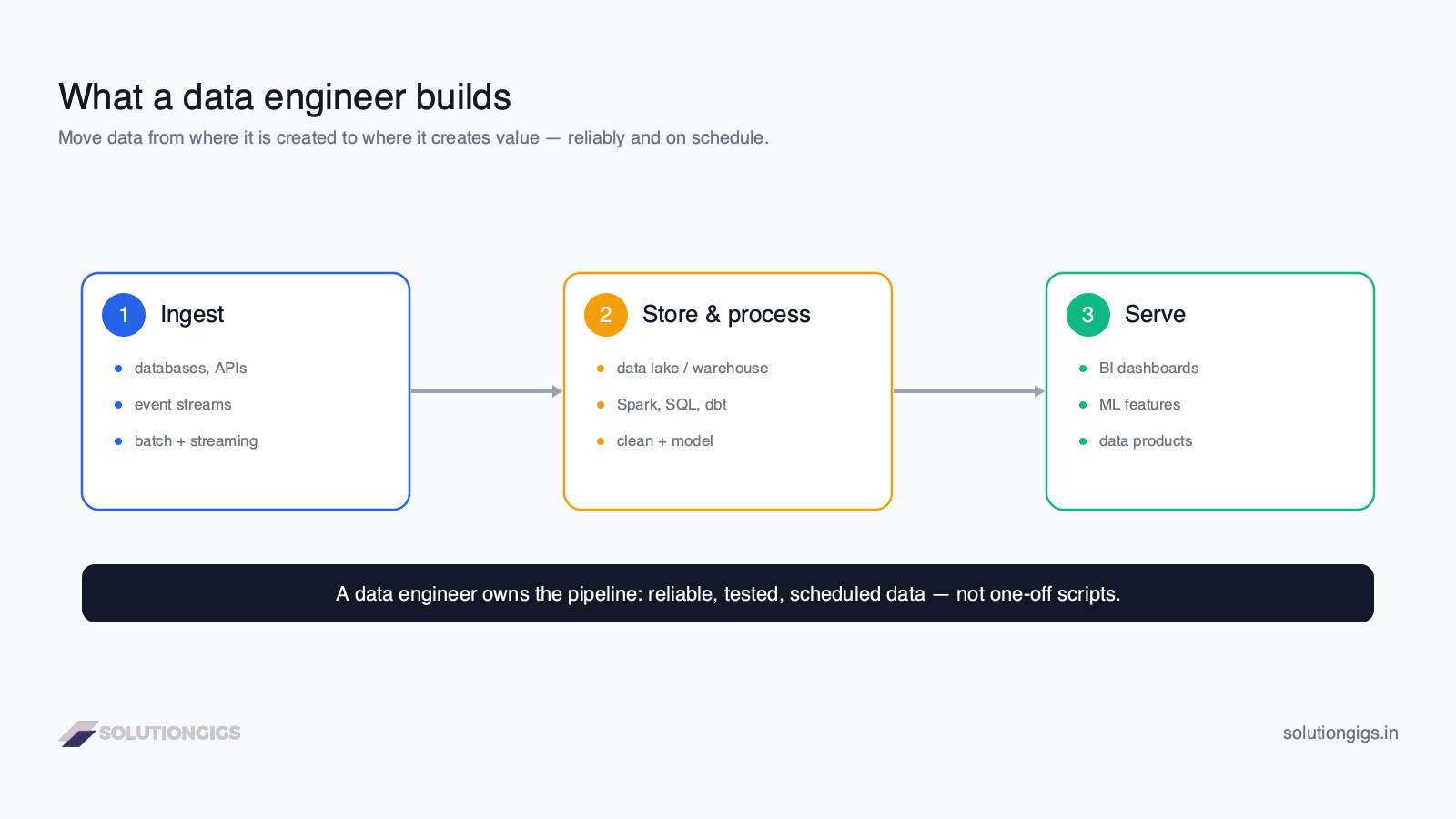
The job breaks into four repeating stages:
- Ingest — pull data from its sources: application databases, third-party APIs, files, and real-time event streams.
- Store — land it somewhere durable and queryable: a data lake, a data warehouse, or a lakehouse.
- Model — clean it, fix types, deduplicate, join, and shape it into reliable tables that mean what they say.
- Serve — deliver it to the people and systems that use it: BI dashboards, analysts, and ML models.
The single word that separates data engineering from "writing a script that pulls some data" is reliable. Anyone can extract data once. A data engineer makes it happen every day, correctly, with monitoring, tests, and recovery when something breaks.
What does a data engineer actually do?
A data engineer spends most of their time building data pipelines, modeling data, and keeping both running in production. A typical week includes:
- Building pipelines — writing code that moves and transforms data on a schedule (this is ETL/ELT).
- Modeling data — designing tables and schemas so queries stay fast, correct, and cheap.
- Ensuring data quality — adding tests and checks so bad data is caught before it reaches a dashboard.
- Optimizing performance — tuning Spark jobs and warehouse queries to run faster and cost less.
- Operating systems — monitoring pipelines, fixing failures, and handling issues like Kafka consumer lag.
The through-line: a data engineer is a software engineer whose product is trustworthy data. The code exists to serve the data, not the other way around.
Data engineer vs data scientist vs data analyst
The difference comes down to who moves the data, who analyzes it, and who reports on it. These roles are often confused, so here's the clean split:
| Role | Core job | Primary tools | Analogy |
|---|---|---|---|
| Data engineer | Build pipelines & infrastructure that deliver clean data | SQL, Python, Spark, Airflow, cloud | Builds & stocks the kitchen |
| Data scientist | Build models & find insight from data | Python, ML libraries, statistics | The chef inventing dishes |
| Data analyst | Answer business questions, build reports | SQL, BI tools (Tableau, Power BI) | The food critic explaining it |
The key relationship: data science and analytics depend entirely on data engineering. A brilliant model trained on broken, stale, or duplicated data produces confident nonsense. That's why "80% of a data scientist's time is spent cleaning data" is a cliché — and why good data engineering is what frees them from it.
The modern data engineering toolkit
Data engineers work across a stack of tools, but a handful form the core in 2026. You don't need all of them on day one — this is the map, and it mirrors the tracks in this course:
- SQL — the language of data. Non-negotiable. (Start with SELECT, WHERE, ORDER BY.)
- Python & pandas — for building pipelines and manipulating data. (pandas essentials.)
- Apache Spark — distributed processing for data too big for one machine.
- Apache Kafka — real-time event streaming.
- A warehouse or lakehouse — Snowflake, BigQuery, or Redshift, Databricks, or open table formats like Iceberg and Delta Lake. Warehouses differ far less in speed than in what they bill you for — uptime, bytes scanned, or capacity in use — which is the first thing to understand about any of them.
- An orchestrator — Airflow or dbt, to schedule and connect pipelines.
- A cloud platform — AWS, GCP, or Azure, where all of this runs.
You learn this stack in layers, not all at once. Every data engineer started by writing a SQL query and a Python script. The rest is added as the problems get bigger.
Why data engineering matters more than ever
AI made data engineering the bottleneck for the entire company. Large language models, recommendation systems, and analytics are only as good as the data feeding them — and that data has to be collected, cleaned, and served by a pipeline. As organizations bet on AI, the demand shifts to the people who can supply reliable data at scale.
This is why data engineering is consistently among the highest-paid and fastest-growing roles in tech. The work is durable, too: models and dashboards come and go, but the pipelines that feed them are foundational infrastructure.
Try it yourself — check your understanding
- For each task, name the role: (a) building a nightly pipeline that loads sales into the warehouse, (b) training a churn-prediction model, (c) building a weekly revenue dashboard.
- In the four-stage pipeline (ingest → store → model → serve), which stage would a broken API most directly affect?
- Name the two core programming languages every data engineer must know.
Show answers
- (a) Data engineer — building a scheduled pipeline. (b) Data scientist — training a model. (c) Data analyst — building a report/dashboard.
- Ingest — the API is a data source, so a break there stops data from entering the pipeline at all.
- SQL and Python.
Common misconceptions about the role
- "Data engineering is just moving files around." The hard part isn't moving data once — it's making it correct, tested, and reliable every run, at scale.
- "You need a PhD or heavy math." You don't. Data engineering is software and systems work; strong SQL and Python matter far more than advanced statistics.
- "It's the same as being a data scientist." Different job. Engineers build the pipelines; scientists analyze the output. They're partners, not the same role.
- "SQL is old and optional." SQL is the single most important skill in data engineering, and its importance is growing with SQL-based tools like dbt.
How to start learning data engineering
Start with SQL, add Python, then build a real pipeline — in that order. The path that works:
- Learn SQL until joins, aggregations, and window functions feel natural.
- Learn Python and pandas for manipulating data in code.
- Build a small ETL pipeline that ingests, cleans, and stores data end to end.
- Learn data modeling, then a distributed engine (Spark), streaming (Kafka), and orchestration (Airflow) as your data grows.
That is exactly the sequence of this free course. You can follow the whole path, in order, on the Learn Data Engineering page.
Frequently Asked Questions
What is data engineering?
Data engineering is the practice of building and operating the systems that move data from where it's created to where it creates value. A data engineer designs pipelines that ingest raw data, store it in a lake or warehouse, model it into reliable tables, and serve it to analytics and machine learning — reliably and on schedule.
What is the difference between a data engineer and a data scientist?
A data engineer builds the infrastructure and pipelines that make clean, reliable data available. A data scientist uses that data to build models and extract insight. Data engineers move and shape data; data scientists analyze it. Data science depends on data engineering — without reliable pipelines, models are built on broken data.
Do data engineers need to know how to code?
Yes. The two core languages are SQL, for querying and transforming data, and Python, for building pipelines. Beyond those you'll use Spark, Airflow, cloud platforms, and often dbt. You don't need heavy computer-science theory, but you do need solid, testable code.
Is data engineering a good career in 2026?
Yes. As companies pour data into AI and analytics, demand for engineers who can supply clean, reliable data at scale keeps rising. It's consistently one of the highest-paid, fastest-growing data roles, because every model, dashboard, and AI feature depends on the pipelines a data engineer builds.
How do I start learning data engineering?
Start with SQL, then Python and pandas, then build a small ETL pipeline. From there, learn data modeling, Spark, Kafka, and Airflow. The free Learn Data Engineering course on SolutionGigs follows exactly this path with runnable lessons and exercises. For the career side of that question — the entry paths, timelines and salary ranges — see how to become a data engineer.
Conclusion
Data engineering is the discipline of building reliable pipelines that turn raw, messy data into clean, trustworthy data the whole company can use. It's the foundation the rest of the data world stands on — analytics, dashboards, and every AI model included. The role is software and systems work centered on one goal: the right data, in the right shape, delivered reliably.
If that sounds like the kind of engineering you want to do, this is lesson one of the journey. If you're weighing it against the other title everyone is talking about, data engineer vs AI engineer compares the two on scope, salary and skill overlap. Continue the free Learn Data Engineering course to pick up SQL, Python, Spark, and the rest — in a structured, hands-on order. Need a pipeline built rather than learned? Tell us what you're moving.
Mohammed Yaseen
Founder, SolutionGigs
Mohammed builds and operates production data pipelines and teaches the free Learn Data Engineering course, starting from exactly this question. LinkedIn →
Learn Data Engineering — Free Course
Free, no signup — right in your browser.
Learn Data Engineering — Free Course →More in Data Engineering
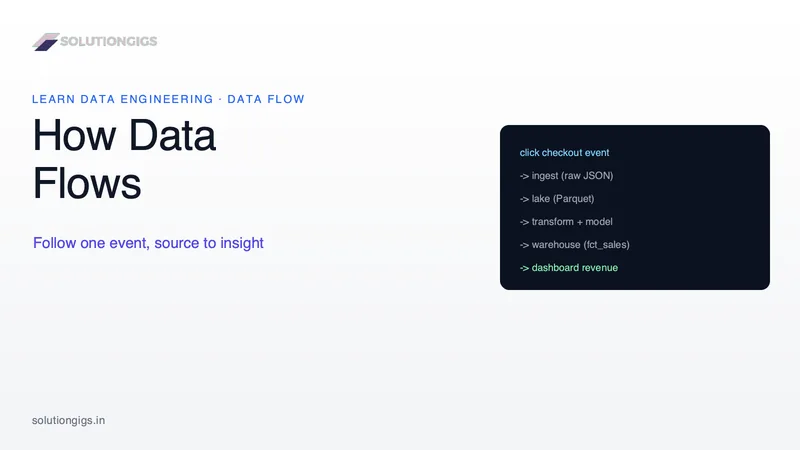
How Data Flows Through a Data Engineering Pipeline
Follow one checkout event as it flows through a data engineering pipeline — source, ingest, lake, transform, model, and serve — changing shape at every stage until it is a number on a dashboard.
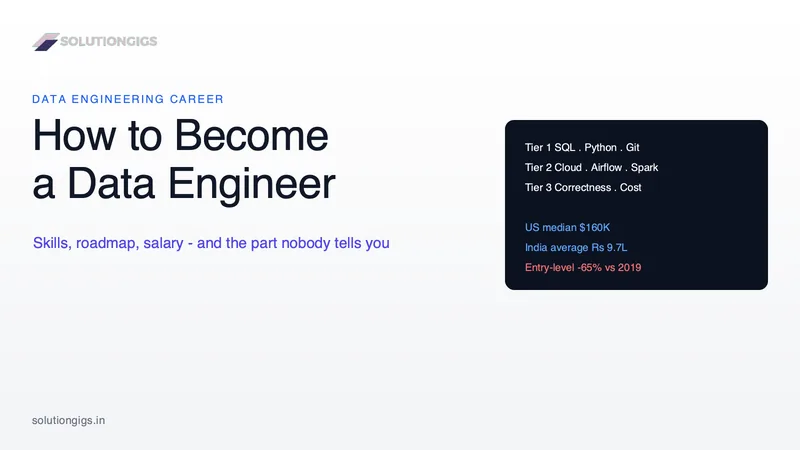
How to Become a Data Engineer: Skills, Roadmap & Salary
How to become a data engineer: the four real entry paths, a six-month roadmap with stop conditions, current US and India salary data, and the honest catch. Demand is real - Robert Half puts the US starting midpoint at $156,250 and 78% of tech leaders are adding headcount - but entry-level hiring is down about 65% against 2019, which is why finishing a course and getting no callbacks are both normal. Inside: what the primary sources actually say (including the BLS stat every guide miscites), the four doors into the field and which is shortest, a three-tier skill order, a month-by-month roadmap with stop conditions, US and India salary tables with collection dates, and the portfolio bar that gets callbacks.
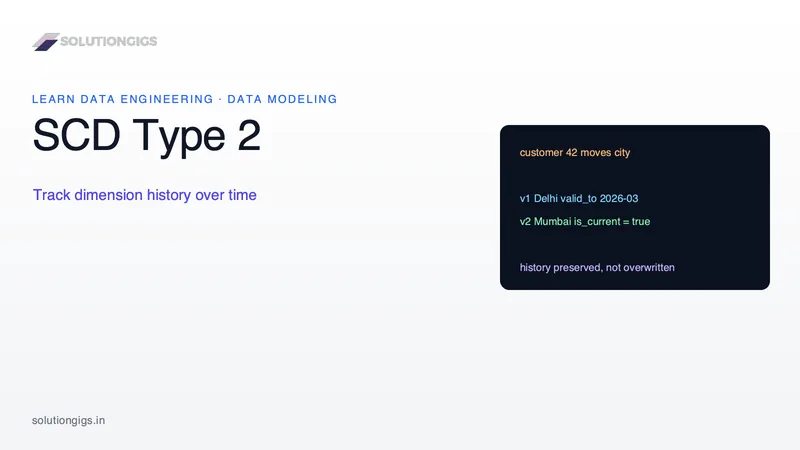
Slowly Changing Dimensions (SCD Type 2) Explained
Slowly Changing Dimensions (SCD Type 2) explained — track dimension history with valid_from, valid_to and is_current, the SCD types compared, and SQL to implement it.