
Data Lake vs Data Warehouse vs Lakehouse: The Real Differences
Last Updated: August 2026 | 11 min read
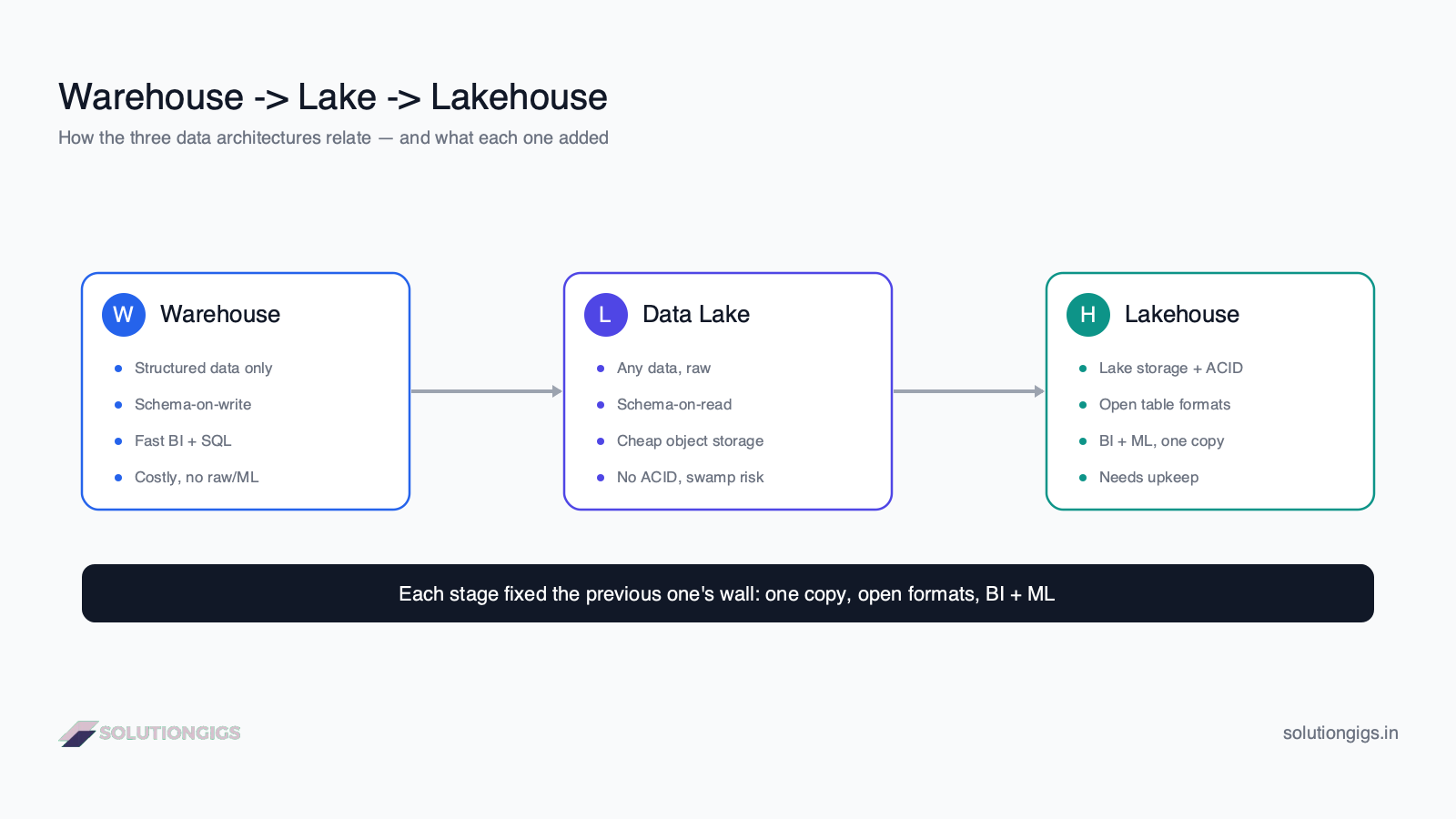
Quick Answer: A data warehouse stores structured, cleaned data using schema-on-write and is optimized for BI and SQL. A data lake stores raw data of any type on cheap object storage using schema-on-read, and is favored for machine learning and exploration. A lakehouse adds a transactional table layer — Delta Lake, Apache Iceberg, or Apache Hudi — on top of the data lake, so the same cheap open storage gains warehouse features (ACID transactions, schema enforcement, fast SQL) in one system. Warehouse = structured and strict; lake = raw and flexible; lakehouse = one platform trying to be both.
The three terms get thrown around as if they were competing products you pick off a shelf. They are not. They are three stages in how the industry solved the same problem — "where do we put all our data so we can actually use it?" — and each one exists because the previous one hit a wall. Understand why each appeared and the choice between them stops being a buzzword contest and becomes an architecture decision you can defend.
This guide gives you the one-line difference, a full side-by-side comparison, the history that explains the lakehouse, a decision framework, and the mistakes that quietly cost teams money. It's written from the data-engineering trenches, not a vendor brochure.
Data lake vs data warehouse vs lakehouse: the one-line difference
The single idea that separates all three is when and where structure is applied to your data.
- A data warehouse applies structure before data lands — clean in, clean out.
- A data lake applies structure when you read — everything in, sort it out later.
- A lakehouse keeps the lake's cheap, open storage but adds a table layer that makes reads behave like a warehouse.
Everything else — cost, performance, which workloads run well, who can use it — flows from that one decision. Here's the shape of it before we go deep:
| Data Warehouse | Data Lake | Lakehouse | |
|---|---|---|---|
| One-line role | Structured analytics engine | Raw storage for everything | Lake storage + warehouse features |
| Schema | Schema-on-write | Schema-on-read | Schema-on-read + enforcement |
| Data types | Structured | Structured, semi-, unstructured | Structured, semi-, unstructured |
| Storage | Proprietary, coupled to compute | Cheap object storage | Cheap object storage |
| Best at | BI, dashboards, SQL | ML, data science, cheap archive | Both BI and ML from one copy |
What is a data warehouse?
A data warehouse is a system that stores structured, pre-modeled data and is optimized for fast analytical SQL queries and business intelligence. It is the oldest of the three, and still the gold standard for reporting.
The defining trait is schema-on-write: you define tables, columns, and types up front, and the warehouse rejects anything that doesn't conform. Data is cleaned, joined, and modeled — usually through an ETL or ELT pipeline — before it ever lands. That discipline is the point. When a finance team runs the quarterly revenue dashboard, every row is trustworthy because bad data never made it in.
The trade-offs are equally clear. Warehouses were traditionally expensive because storage and compute were bundled, and they struggle with unstructured data — you can't drop a folder of images or raw JSON logs into a warehouse table and expect it to cope. Modern cloud warehouses — Snowflake, Google BigQuery, Amazon Redshift, Azure Synapse — separated storage from compute and eased the cost problem, but the schema-on-write, structured-first model remains their DNA.
Use a warehouse when your data is mostly structured, your primary job is BI and SQL analytics, and reliability matters more than flexibility.
What is a data lake?
A data lake is a central repository that stores raw data of any type — structured, semi-structured, and unstructured — on cheap, scalable object storage, and applies structure only when the data is read.
The data lake was the industry's answer to two things the warehouse couldn't do: store everything (logs, images, clickstream, IoT, video) and store it cheaply. By using object storage — Amazon S3, Azure Data Lake Storage (ADLS), Google Cloud Storage — a lake decouples storage from compute entirely. You dump data in its native format for cents per gigabyte, then point an engine like Apache Spark, Presto, or Trino at it when you need answers. This is schema-on-read: no structure is enforced on the way in.
That flexibility is the lake's superpower and its curse. Because nothing is enforced, a data lake with no governance degrades into a "data swamp" — thousands of files nobody can find, trust, or query efficiently. Lakes also historically lacked transactions: two jobs writing the same dataset could corrupt it, there was no reliable way to update or delete a single row (a real problem for GDPR), and a reader could see a half-written table.
Use a lake when you need to cheaply store large volumes of varied or raw data, feed machine learning and data science, and keep options open — accepting that you'll need governance to avoid the swamp.
What is a data lakehouse?
A lakehouse is a data architecture that adds a transactional metadata and table layer on top of a data lake, giving cheap open object storage the reliability and performance features of a data warehouse — in a single system.
The term was formalized in the January 2021 research paper "Lakehouse: A New Generation of Open Platforms that Unify Data Warehousing and Advanced Analytics" by Michael Armbrust, Ali Ghodsi, Reynold Xin, and Matei Zaharia (the Databricks/UC Berkeley team behind Apache Spark). Their argument: you shouldn't need two separate systems — one lake for ML, one warehouse for BI — with data copied between them.
The magic is the open table format. Instead of leaving loose Parquet files on S3, a lakehouse tracks them with a transactional layer — Delta Lake, Apache Iceberg, or Apache Hudi — that adds:
- ACID transactions — safe concurrent reads and writes, no half-written tables.
- Schema enforcement and evolution — the lake finally rejects bad data, and can add columns safely.
- Row-level updates, deletes, and MERGE — real upserts and GDPR deletes on the lake (see our Apache Iceberg guide).
- Time travel — query the table as it looked at a past snapshot.
- Fast SQL — data skipping, statistics, and compaction give warehouse-class query speed.
Crucially, the data stays in open formats on your own object storage — no vendor lock-in, and any engine (Spark, Trino, Snowflake, Amazon Athena, DuckDB) can read it. Most teams organize a lakehouse with the medallion architecture: bronze (raw) → silver (cleaned) → gold (business-ready).
Data lake vs data warehouse vs lakehouse: full comparison
Here is the complete side-by-side. This is the table to bookmark.
| Dimension | Data Warehouse | Data Lake | Lakehouse |
|---|---|---|---|
| Schema approach | Schema-on-write | Schema-on-read | Schema-on-read + enforcement |
| Data structure | Structured only | Any (raw, unstructured) | Any (with table layer) |
| Storage | Proprietary format | Open files on object storage | Open table formats on object storage |
| Storage cost | Higher | Lowest | Lowest (same as lake) |
| Transactions (ACID) | Yes | No (natively) | Yes (via Delta/Iceberg/Hudi) |
| Primary users | Analysts, BI teams | Data scientists, engineers | Both |
| Primary workloads | BI, reporting, SQL | ML, exploration, archive | BI + ML unified |
| Data quality | High (enforced) | Variable (swamp risk) | High (enforced) |
| Query performance | Fast, mature | Slower, engine-dependent | Fast (with optimization) |
| Row-level update/delete | Yes | Hard / no | Yes (MERGE) |
| Governance & security | Mature | Bolt-on, harder | Unified catalog (e.g. Unity, Polaris) |
| Vendor lock-in | Higher | Low | Low (open formats) |
| Examples | Snowflake, BigQuery, Redshift | S3 / ADLS / GCS + Spark/Trino | Databricks, Iceberg/Hudi on S3 |
Why the lakehouse emerged: the "two-system tax"
Here's the part most comparison articles skip — and the reason the lakehouse exists at all.
Through the 2010s, serious data teams ran both a lake and a warehouse. Raw data landed in the lake for data science and cheap storage; a curated slice was then copied into a warehouse for BI. That two-system setup carried a hidden "two-system tax": you paid to store the same data twice, you built and maintained brittle pipelines to copy it between systems, the two copies constantly drifted out of sync, and your ML models (reading the lake) and your dashboards (reading the warehouse) could disagree about the same number.
The lakehouse is the attempt to collapse that into one copy of the data, in open formats, that serves both audiences. When it works, you delete an entire class of copy-pipelines and reconciliation bugs.
At SolutionGigs, this is exactly the path our infrastructure-monitoring platform, Telemetrix, took. We started by landing raw device telemetry as files on object storage — a classic lake — and quickly hit the swamp: no transactions, painful GDPR deletes, and BI queries that scanned millions of tiny files. Moving that raw zone onto Apache Iceberg tables (a lakehouse) gave us ACID writes, row-level MERGE for late-arriving corrections, and fast SQL for dashboards — without copying anything into a separate warehouse. The single biggest win wasn't performance; it was deleting the sync pipeline between our lake and our reporting layer entirely. That's the two-system tax, refunded.
The honest caveat: the lakehouse is younger and less turnkey than a managed warehouse. You take on more responsibility for table maintenance — compaction, partitioning, and snapshot expiration — that a warehouse hides from you. Openness has an operational price.
When to use each: a decision guide
You rarely choose in a vacuum, but these rules hold up:
-
Choose a data warehouse if your data is mostly structured, your main job is BI and SQL analytics, your volumes are moderate, and you value a managed, low-effort, governed experience over openness. Snowflake or BigQuery will get a small analytics team productive fastest.
-
Choose a data lake (raw, no table layer) only as a landing and archive zone, or for pure large-scale ML/data-science workloads where you genuinely don't need transactions or SQL reliability. In 2026, a bare lake is rarely the final destination — it's the bronze layer of a lakehouse.
-
Choose a lakehouse if you have large or varied data, need to serve both BI and machine learning, want to avoid paying to store data twice, and care about open formats and avoiding lock-in. For most new data platforms today, this is the default.
A useful heuristic: if you're only doing BI on structured data, a warehouse is simplest. The moment you need ML, unstructured data, huge scale, or you find yourself copying data lake → warehouse, the lakehouse earns its keep.
If you're weighing specific platforms, our Snowflake vs Databricks comparison and Delta Lake vs Iceberg guide go a level deeper than this architectural overview.
Common mistakes to avoid
- Treating them as strict competitors. A lakehouse is built on a data lake; many warehouses now read lakehouse tables. They blend more than they compete.
- Building a lake with no governance. Schema-on-read is not "no schema ever." Without a catalog, ownership, and quality checks, your lake becomes a swamp within a year.
- Adopting a lakehouse and ignoring table maintenance. Open table formats need compaction and snapshot cleanup, or small-files and stale metadata will quietly wreck query performance and cost.
- Copying data lake → warehouse out of habit. If you're already on open table formats, that copy is often the exact "two-system tax" the lakehouse was designed to remove.
- Picking the trendiest option, not the fitting one. A five-person analytics team with 50 GB of clean sales data does not need a lakehouse. A warehouse is the right, boring answer.
How SolutionGigs helps
Getting this architecture right is the difference between a data platform that compounds value and one that quietly bleeds money on duplicate storage and sync pipelines. At SolutionGigs, we've built and run these systems in production — from raw object-storage lakes to Iceberg-based lakehouses feeding both dashboards and ML. If you're deciding between a warehouse, a lake, or a lakehouse — or untangling a setup that grew into all three by accident — we can help you choose the architecture that fits your data, not the hype.
Frequently Asked Questions
What is the difference between a data lake, a data warehouse, and a lakehouse?
A data warehouse stores structured, cleaned data using schema-on-write and is optimized for BI and SQL. A data lake stores raw data of any type on cheap object storage using schema-on-read, favored for machine learning and exploration. A lakehouse adds a transactional table layer (Delta Lake, Apache Iceberg, or Apache Hudi) on top of the lake so the same cheap open storage gains warehouse features — ACID, schema enforcement, and fast SQL — in one system.
Is a lakehouse better than a data warehouse?
Not automatically. A lakehouse usually wins when you have large, varied data, need both BI and ML from one copy, and want to avoid storing data twice. A managed cloud warehouse like Snowflake or BigQuery can still win on pure SQL/BI performance, governance maturity, and ease of use for smaller, mostly-structured workloads. The lakehouse trades turnkey simplicity for openness, scale, and lower storage cost.
Is Snowflake a data warehouse or a lakehouse?
Snowflake began as a cloud data warehouse and has added lakehouse-style features — it can read and write open Apache Iceberg tables and query external lake files. Databricks came from the opposite direction, starting as a lake platform and adding warehouse features. The categories are converging, so the label now matters less than whether a platform reads open table formats and serves both SQL and ML.
What is schema-on-read vs schema-on-write?
Schema-on-write means you define and enforce structure before data is loaded — the warehouse rejects anything that doesn't fit. Schema-on-read means you store raw data as-is and apply structure only at query time — the lake accepts everything and defers interpretation. Schema-on-write gives reliability and clean data; schema-on-read gives flexibility and cheap ingestion but risks becoming a data swamp.
Do I still need a data lake if I have a lakehouse?
No — a lakehouse is built on top of a data lake, so you already have one. The lakehouse uses the same object storage (S3, ADLS, GCS) as the raw landing zone and layers open table formats over the curated data. You don't run a separate lake and lakehouse; the lakehouse is what your lake becomes once you add a transactional table layer and governance.
What are examples of each?
Data warehouses: Snowflake, Google BigQuery, Amazon Redshift, Azure Synapse. Data lakes: raw files on Amazon S3, Azure Data Lake Storage, or Google Cloud Storage queried with Spark, Presto, or Trino. Lakehouses: Databricks (Delta Lake), or an open stack of Apache Iceberg or Apache Hudi tables on object storage queried by Spark, Trino, Snowflake, or Athena.
Conclusion
The progression from data warehouse to data lake to lakehouse isn't a fashion cycle — it's the industry solving one weakness after another. The warehouse gave us reliability but couldn't hold everything cheaply. The lake gave us cheap, all-you-can-store flexibility but lost reliability and turned into a swamp. The lakehouse puts the warehouse's guarantees back on top of the lake's cheap open storage, so one copy of your data can serve both a finance dashboard and a machine-learning model.
For most new platforms in 2026, the lakehouse is the sensible default — but a warehouse is still the right, simple answer for smaller structured workloads, and a raw lake is a fine landing zone. Match the architecture to your data and your team, not to the loudest vendor. And if you'd rather have engineers who've run all three in production make that call with you, talk to us at SolutionGigs — it's free to start.

Mohammed Yaseen
Founder, SolutionGigs
Mohammed builds and runs production data platforms — from raw object-storage lakes to Apache Iceberg lakehouses feeding both BI and ML. He writes about the architecture decisions that actually move the needle for data teams. LinkedIn →