Data Contracts in Data Engineering: What They Are and How to Implement Them
Last Updated: July 2026 | 11 min read
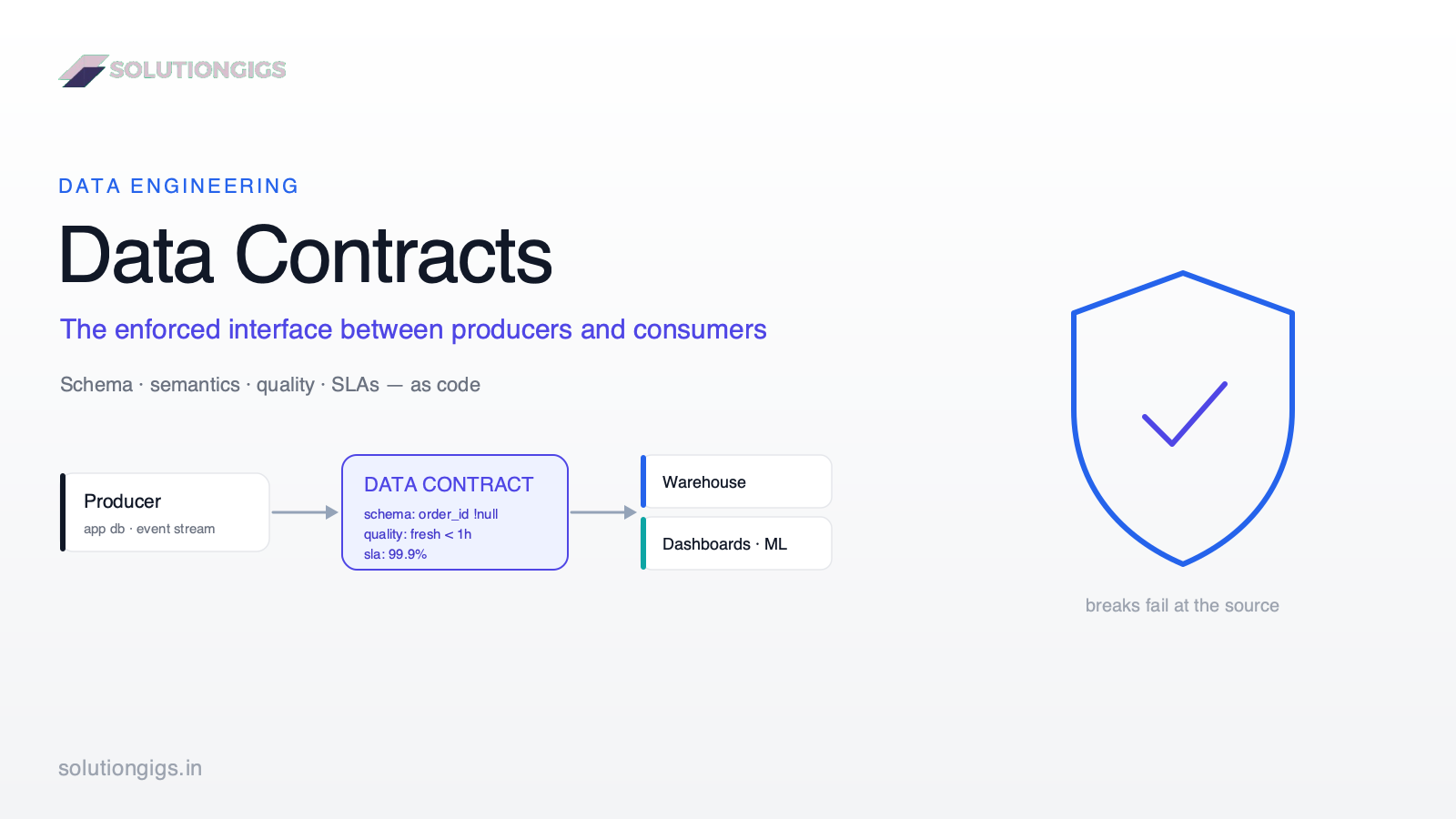
Quick Answer: A data contract is a formal, version-controlled agreement between a data producer and its consumers that defines a dataset's schema, semantics, quality rules, and SLAs — usually written as YAML so it is both human-readable and machine-enforceable. It does for data what an API contract does for software: it turns a fragile, implicit dependency into an explicit interface. The whole point is to shift breakage left — a renamed column or a suddenly-null field fails the producer's build or a CI check before the bad data ever reaches a warehouse table, a dashboard, or an ML model. The emerging common format is the Open Data Contract Standard (ODCS), and you enforce a contract with tools like dbt model contracts, a schema registry, and a CI gate.
Here's the incident every data engineer knows: a backend developer renames a column from user_id to customer_id in an application database. Their app tests pass. Their deploy is green. Nobody tells you. Six hours later your ingestion job is loading nulls, three dbt models downstream have quietly broken, and the revenue dashboard the CEO checks every morning is wrong. No error fired anywhere — the data just silently rotted. Data contracts exist to make that class of change impossible to ship unnoticed. This guide covers what a data contract actually is, what goes inside one, and the concrete mechanisms teams use to enforce them in 2026.
What Is a Data Contract?
A data contract is an explicit, enforceable agreement that specifies the structure, meaning, quality, and reliability guarantees of a dataset, so that consumers can depend on it and producers can't break it by accident. It is the interface between whoever creates data and whoever uses it.
The most useful mental model is the API — an analogy IBM's data-contract overview draws explicitly. When a software team publishes a REST or GraphQL API, the contract (the endpoints, the request/response schema) is a promise: "you can build on this, and I won't change it without a versioning process." That promise is exactly what lets teams move fast independently. Data has historically had no such promise — consumers reach directly into producers' tables and event streams, and any change silently breaks them.
A data contract closes that gap. It says, in a form machines can check:
- This is the schema — these columns, these types, these constraints.
- This is what the fields mean —
statusis one ofactive | churned | trial, not free text. - These are the guarantees —
order_idis unique and never null; the table is fresh within one hour. - This is who owns it — a named team, with a support channel and a process for changes.
Because the contract is written as code (YAML or JSON) and kept in version control, it becomes actionable: a tool can read it, compare reality against it, and fail a build when they diverge.
Anatomy of a Data Contract (with a Real Example)
A data contract has a handful of standard sections — identity, schema, quality, SLAs, and ownership — and the industry is converging on the Open Data Contract Standard (ODCS) to express them. ODCS is an open YAML spec governed by Bitol, a Linux Foundation AI & Data project; its current release is v3.1.0 (December 2025).
Here is a trimmed, realistic contract for an orders table, in ODCS-style YAML:
apiVersion: v3.1.0
kind: DataContract
id: orders-fact-contract
name: Orders
version: 1.4.0
status: active
domain: commerce
description:
  purpose: Cleaned order events consumed by finance and ML.

# WHO owns and supports it
team:
  - role: owner
    channel: "#data-commerce"
tags: [tier-1, revenue-critical]

# THE SCHEMA — the structural promise
schema:
  - name: orders
    physicalType: table
    properties:
      - name: order_id
        logicalType: string
        physicalType: uuid
        required: true
        unique: true          # breaking-change guard
      - name: customer_id
        logicalType: string
        required: true
      - name: status
        logicalType: string
        enum: [active, churned, trial, cancelled]
      - name: amount
        logicalType: number
        required: true
        minimum: 0            # amounts are never negative

# QUALITY — the correctness promise
quality:
  - rule: freshness
    property: updated_at
    mustBeLessThan: 1h
  - rule: rowCount
    mustBeGreaterThan: 1000

# SLA — the reliability promise
slaProperties:
  - property: availability
    value: 99.9
    unit: percent
  - property: retention
    value: 3
    unit: years
Read top to bottom, the contract answers every question a consumer actually has: What columns exist? What do they mean? What's guaranteed? How fresh? Who do I ping when it breaks? Compare that to the status quo — a consumer reverse-engineering a table by running SELECT * and hoping — and you can see why the pattern spread.
Why Data Contracts Matter: Shift-Left for Data
Data contracts move quality enforcement upstream to the producer — "shift-left" — instead of leaving consumers to discover broken data after the damage is done. This single idea is the reason the pattern exists.
Without contracts, data quality is a downstream problem. The consumer builds data quality tests, monitoring, and alerting to detect breakage — but detection happens after the bad data has already landed and, often, after a wrong number has already been seen. You're always cleaning up.
With a contract, the breaking change is caught at the source:
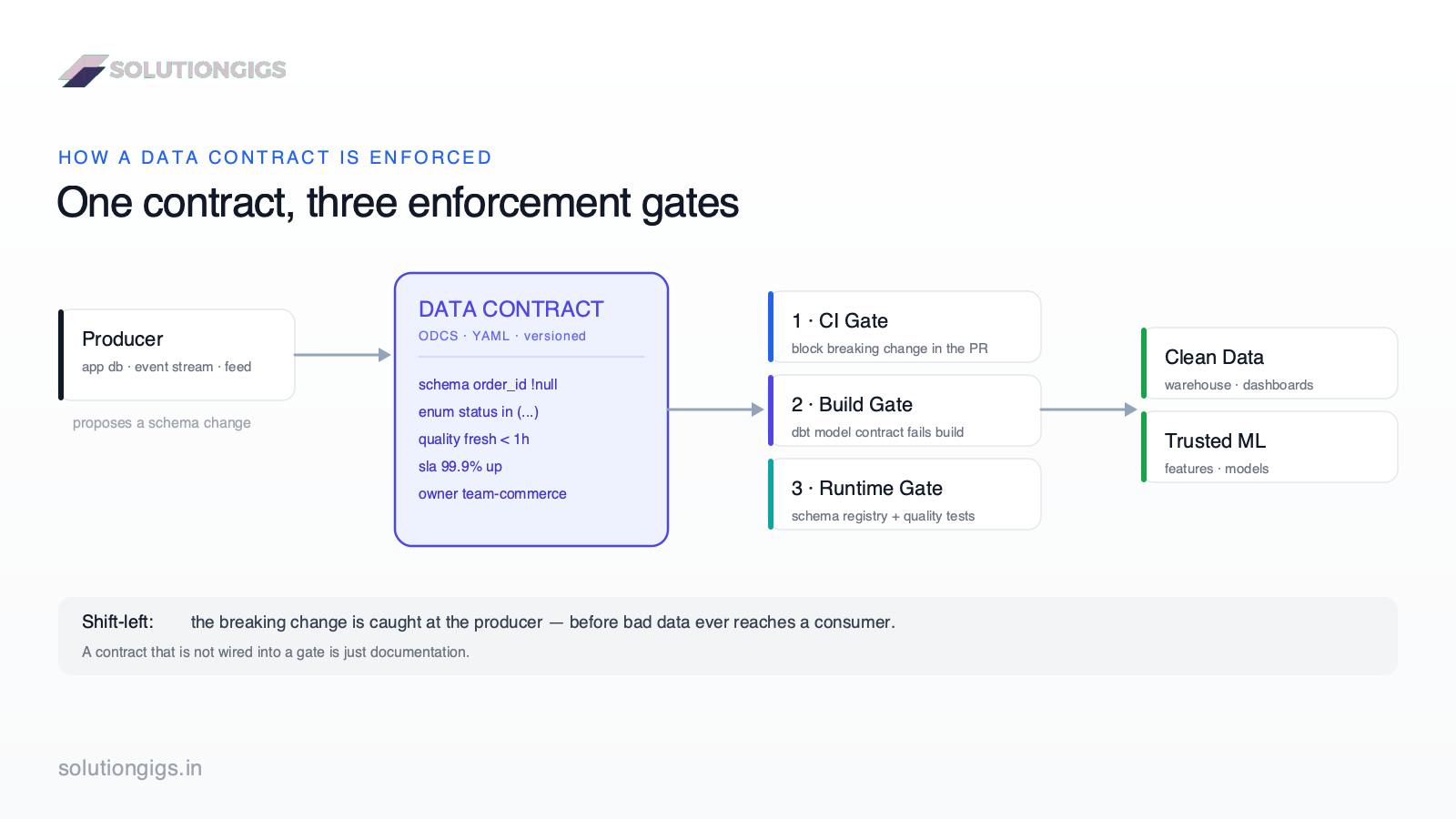
- A producer's CI pipeline validates their schema change against the contract and blocks the pull request if it's incompatible.
- A streaming producer's message is rejected on write by a schema registry before it ever enters the topic.
- The producer team owns the contract, so the cost of a breaking change lands on the people who can actually prevent it.
This flips the economics. In the shift-left model, the bad column rename never merges; the on-call data engineer never gets paged; the dashboard is never wrong. The cost curve of a data bug — cheap at the source, ruinous at the dashboard — is the entire business case.
The mindset shift: stop treating upstream data as weather you react to, and start treating it as an interface you negotiate. A contract turns "the data broke again" from an accepted fact of life into a shipped bug that had an owner and a preventable cause.
How to Implement and Enforce a Data Contract
A contract that isn't enforced is just documentation. Enforcement happens at the point of production through four mechanisms, and mature teams combine a CI gate with at least one runtime check. Here's each, and when to use it.
1. dbt Model Contracts (warehouse schema enforcement)
If your transformations live in dbt, model contracts are the fastest on-ramp. You declare the expected columns and types in the model's config, and dbt build fails if the model's output doesn't match:
models:
  - name: fct_orders
    config:
      contract:
        enforced: true
    columns:
      - name: order_id
        data_type: string
        constraints:
          - type: not_null
          - type: unique
      - name: amount
        data_type: numeric
Now a transformation change that drops order_id or flips amount to text breaks the build, not the dashboard. This is schema enforcement inside the modern data stack with almost no new tooling.
2. Schema Registry (streaming enforcement)
For event streams, the contract is enforced by a schema registry. In a Kafka setup, the Confluent Schema Registry stores an Avro or Protobuf schema per topic and enforces a compatibility mode:
- Backward compatible — new schema can read old data (safe to add optional fields).
- Forward compatible — old consumers can read new data.
A producer trying to publish a message with an incompatible schema is rejected at write time. The broken event never enters the topic, so no consumer ever sees it. This is the streaming equivalent of a compile error.
3. The CI Gate (catch it in the pull request)
The highest-leverage enforcement point is CI on the producer's repository. When a developer proposes a schema change, a CI job diffs the new schema against the committed contract and fails the PR on a breaking change — a dropped column, a type change, a widened nullability. Tools like the Data Contract CLI run exactly this check against Snowflake, BigQuery, Databricks, and others.
This is where the user_id → customer_id rename from the intro gets stopped: the check runs before merge, and the fix is a five-minute conversation instead of a six-hour incident.
4. Quality Checks (assert the contract on real data)
Finally, the contract's quality and freshness rules are asserted against live data with dbt tests or Great Expectations — the runtime safety net that catches what static schema checks can't, like an amount that's technically numeric but implausibly large, or a table that stopped refreshing.
Data Contract vs Data Quality Test vs Schema
These three terms get conflated constantly. Here's the precise distinction.
| Concept | What it is | When it acts | Owned by |
|---|---|---|---|
| Schema | The structural shape of data (columns, types) | Passive definition | Producer (often implicitly) |
| Data quality test | An assertion about values in existing data | After data lands | Usually the consumer |
| Data contract | The full agreement: schema + semantics + quality + SLA + ownership | At production / in CI | The producer, explicitly |
The one-line verdict: a schema describes shape, a quality test inspects values after the fact, and a data contract is the enforceable promise that governs both — plus who's accountable when it's broken. A contract typically contains a schema and generates quality tests, but adds the two things neither has on its own: breaking-change rules and clear ownership.
Data Contract Tools in 2026
You don't need a platform to start — you need a format and one enforcement point. Here's the landscape.
| Category | Tools | Use for |
|---|---|---|
| Standard / format | ODCS, Data Contract CLI, datacontract.com |
Writing & validating contracts as code |
| Warehouse enforcement | dbt model contracts | Schema enforcement in the warehouse |
| Streaming enforcement | Confluent/Kafka Schema Registry, Avro, Protobuf | Compatibility on event streams |
| Quality assertions | Great Expectations, dbt tests, Soda | Validating rules on real data |
| Lifecycle & catalog | Gable, Collibra, Databricks Unity Catalog | Ownership, approvals, discovery at scale |
Start with ODCS YAML + one enforcement mechanism that matches your stack (dbt contracts if you're warehouse-first, a schema registry if you're streaming-first). Add lifecycle tooling only when you have enough contracts that managing them by hand hurts.
Common Mistakes to Avoid
- Contracting everything. Putting a contract on every internal staging table is governance theater. Contract the boundaries you don't control and the tier-1 tables whose breakage causes incidents. Nothing else, at first.
- Writing a contract you don't enforce. A YAML file nobody validates is documentation that will rot. If it isn't wired into CI or a build, it isn't a contract.
- Making the consumer own the contract. The whole value is producer accountability. If the consuming team writes and maintains it, you've just relocated the cleanup work, not eliminated it.
- No versioning or change process. Contracts will need to change. Without a version bump and a deprecation path, your "contract" is just a different way to break people. Treat breaking changes like an API v1 → v2 migration.
- Confusing a contract with monitoring. Data observability tells you after something broke. A contract's job is to prevent the break. You want both, but don't mistake one for the other.
The SolutionGigs Advantage
Rolling out data contracts is as much an organizational change as a technical one — it changes who's accountable when data breaks, and that's where most implementations stall. If your team is drowning in silent data breakages and wants to introduce contracts without boiling the ocean, the vetted data engineers on solutiongigs.in have shipped exactly this: identifying the two or three boundaries worth contracting first, wiring ODCS checks into CI, and enforcing schema in dbt and Kafka. Post your project on solutiongigs.in and get matched with an expert who's done it before — it's free to post.
Frequently Asked Questions
What is a data contract in data engineering?
A data contract is a formal, version-controlled agreement between a data producer and its consumers that specifies the schema, semantics, quality guarantees, and SLAs of a dataset. It's usually written as YAML or JSON so it's human-readable and machine-enforceable. Its purpose is to make a breaking change — a renamed column, a field going null — fail at the producer's build or in CI, before the broken data reaches any downstream table, dashboard, or model.
What is the difference between a data contract and a data quality test?
A data quality test checks values in data that already exists — is this column null, is this ID unique. A data contract is the agreement that defines what "correct" is in the first place: schema, types, allowed values, ownership, and SLAs. The contract is the specification; tests are one way it's enforced. A contract also governs schema evolution and breaking-change rules that a standalone test never covers.
What is the Open Data Contract Standard (ODCS)?
ODCS is an open YAML specification for data contracts, governed by Bitol under the Linux Foundation AI & Data. Its current release is v3.1.0 (December 2025). It defines standard sections for schema, quality, servers, SLAs, teams, and support so a contract written once can be validated and enforced by any compatible tool. It's the closest thing to a common industry format for data contracts.
How do you enforce a data contract?
You enforce it at production, not consumption. The four mechanisms are: dbt model contracts (fail the build if output doesn't match declared columns/types); a schema registry (reject incompatible message schemas on write); a CI gate (diff the proposed schema against the contract and block breaking changes in the PR); and quality frameworks like Great Expectations or dbt tests (assert the contract's rules on real data). Most teams combine a CI gate with one runtime check.
Do small data teams need data contracts?
Not everywhere, and not on day one. Contracts pay off at boundaries you don't control — an app database feeding your warehouse, an event stream from another team, a third-party feed. Put contracts on the two or three most business-critical of those first. Contracting every internal table is over-engineering; contracting nothing means every upstream change is a surprise.
Are data contracts the same as APIs?
They're the data equivalent. An API contract lets software teams change internal code freely as long as the interface stays stable; a data contract does the same for datasets. Both turn an implicit, fragile dependency into an explicit, versioned interface with clear ownership and a defined process for breaking changes.
Conclusion
Data contracts solve the oldest, most demoralizing problem in data engineering: being broken by an upstream change you never agreed to and never saw coming. By turning an implicit dependency into an explicit, enforceable interface — a schema, its meaning, its guarantees, and its owner, written as code and checked in CI — they shift breakage left, to the one place it's cheap to fix: the producer's build.
You don't need a platform or a governance committee to start. Pick the one boundary that's hurt you most this quarter, write a short ODCS contract for it, and wire a single check into CI. Enforce schema with dbt contracts or a schema registry, back it with quality tests, and expand from there. The goal isn't a wall of YAML — it's a world where "the data broke again" becomes a bug with an owner instead of a fact of life.
Need help introducing data contracts without over-engineering it? Get matched with a vetted data engineer on solutiongigs.in — it's free to post your project.

Mohammed Yaseen
Founder, SolutionGigs
Mohammed builds production data platforms on Spark, Kafka, dbt and Airflow, and has spent years cleaning up the silent breakages that data contracts are designed to prevent. LinkedIn →