
REST API vs GraphQL: Differences & When to Use Each
REST API vs GraphQL — the real differences, performance and caching trade-offs, code examples, and a clear framework for choosing the right API style in 2026.

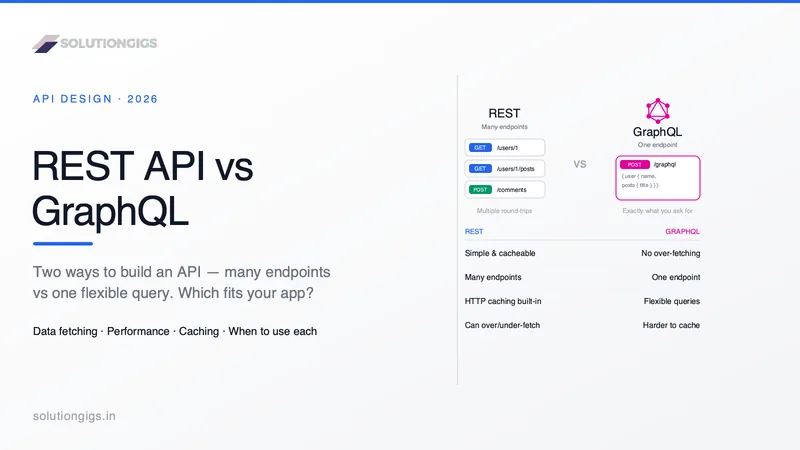
Quick Answer: The REST API vs GraphQL choice comes down to how clients fetch data. REST exposes many endpoints, each returning a fixed data structure over standard HTTP — it's simple, mature, and easy to cache. GraphQL exposes a single endpoint where the client asks for exactly the fields it needs in one request, eliminating over-fetching and under-fetching. Choose REST for simple, public, or cache-heavy APIs; choose GraphQL when clients need flexible, precise data from many sources. Both are excellent — and many teams use them together.
The REST API vs GraphQL debate is one of the most searched questions in backend and API development — and for good reason. The choice shapes how every client talks to your server, how fast your app feels, and how much your team fights the data layer for years to come.
REST has powered the web for two decades. GraphQL, created by Facebook in 2015, promised to fix REST's pain points around data fetching. Both are excellent — but they solve the problem differently, and picking the wrong one for your situation creates friction that's hard to undo. This guide breaks down the real differences with code examples, the performance and caching trade-offs, and a clear framework for choosing.
What Is a REST API?
A REST API is an architectural style that exposes data through multiple endpoints, each representing a resource, accessed using standard HTTP methods.
REST (Representational State Transfer) organizes your API around resources — users, orders, products — each with its own URL. You interact with them using HTTP verbs: GET to read, POST to create, PUT/PATCH to update, and DELETE to remove.
GET    /users/1          → fetch user 1
GET    /users/1/posts    → fetch that user's posts
POST   /comments         → create a comment
DELETE /posts/42         → delete post 42
Each endpoint returns a fixed data structure defined by the server. REST is stateless, built on standard HTTP, and benefits from decades of tooling, conventions, and built-in HTTP caching.
REST is great for:
- Simple, resource-oriented APIs
- Public APIs consumed by many clients
- Services that benefit from HTTP/CDN caching
- Teams that want simplicity and mature tooling
What Is GraphQL?
GraphQL is a query language and runtime for APIs that exposes a single endpoint, letting clients request exactly the data they need in one request.
Instead of many endpoints returning fixed shapes, GraphQL has one endpoint (usually /graphql). The client sends a query describing precisely which fields it wants, and the server returns exactly that — no more, no less.
# One request, exactly the fields you need
query {
  user(id: 1) {
    name
    posts {
      title
    }
  }
}
That single query replaces what might be two or three REST calls, and returns only name and post title — nothing extra. GraphQL is defined by a strongly typed schema that acts as a contract between client and server.
GraphQL is great for:
- Complex frontends and mobile apps
- Clients with varied, precise data needs
- Combining multiple data sources in one request
- Reducing over-fetching on limited bandwidth
REST API vs GraphQL: Head-to-Head Comparison
| Factor | REST | GraphQL |
|---|---|---|
| Endpoints | Many (one per resource) | One (/graphql) |
| Data shape | Fixed by server | Chosen by client |
| Over/under-fetching | Common | Eliminated |
| Requests needed | Often multiple | Usually one |
| Caching | Easy (HTTP/CDN) | Harder (needs tooling) |
| Learning curve | Low | Moderate |
| Versioning | Explicit (/v1, /v2) | Evolve the schema |
| File uploads | Native | Needs extra setup |
| Error handling | HTTP status codes | Errors in response body |
| Best for | Simple & public APIs | Flexible client data needs |
The Core Difference: Fixed Responses vs Client-Shaped Queries
The heart of the REST API vs GraphQL difference is who decides the shape of the response.
In REST, the server decides. Each endpoint returns a predefined structure. If the mobile app only needs a user's name but the /users/1 endpoint returns 30 fields, you over-fetch the other 29. If it needs the user and their posts, and those live at different endpoints, you under-fetch and make multiple round-trips.
In GraphQL, the client decides. It asks for exactly the fields it wants — across related resources — in one query. No over-fetching, no under-fetching, one round-trip.
This single distinction drives almost every other trade-off between the two.
Performance & Caching Trade-Offs
Data Fetching Performance
GraphQL often wins on network efficiency: one request returns precisely the needed data, which matters most on slow mobile connections and data-heavy screens. Fewer round-trips can make an app feel noticeably snappier.
REST can require several requests to assemble a screen's data — but each is simple and predictable.
Caching
This is where REST shines. Because REST uses standard HTTP GETs with URLs, responses are trivially cached by browsers, CDNs, and proxies out of the box. A cached REST response can be served in milliseconds without touching your server.
GraphQL typically uses POST to a single endpoint, so standard HTTP caching doesn't apply. You need client-side caching libraries (like Apollo or Relay) or persisted queries to get similar benefits — more power, more setup.
See how SolutionGigs can help → Deciding on an API architecture that won't box you in later? Post your project on solutiongigs.in and get matched with a backend engineer who has shipped both REST and GraphQL at scale.
When to Use REST
Choose REST when:
- ✅ Your API is resource-oriented and straightforward (CRUD)
- ✅ You're building a public API for many third-party clients
- ✅ HTTP/CDN caching is important for performance
- ✅ You want simplicity and the largest tooling ecosystem
- ✅ Your team is new to API design and wants a proven path
Classic REST use cases: public developer APIs, simple web/mobile backends, microservice-to-microservice communication, and webhook-style integrations. REST pairs naturally with a microservices architecture, where each service exposes its own endpoints.
When to Use GraphQL
Choose GraphQL when:
- ✅ Clients need flexible, precise data and you want to avoid over-fetching
- ✅ You have multiple frontends (web, iOS, Android) with different data needs
- ✅ A screen combines data from many sources in one view
- ✅ Mobile bandwidth makes wasted data expensive
- ✅ You want a strongly typed schema as a client-server contract
Classic GraphQL use cases: complex dashboards, social feeds, e-commerce product pages, and any rich frontend where the data requirements vary widely between screens.
The Both-Approaches Reality
You don't have to pick one for your whole company. REST and GraphQL happily coexist, and large organizations routinely run both:
- REST for simple, public, and cache-heavy services
- GraphQL as a flexible layer for frontend teams, often sitting in front of REST APIs and databases
A common pattern is a GraphQL "gateway" that aggregates several underlying REST microservices into one flexible API for clients. This is especially powerful in microservices systems and pairs well with modern AI backends that also expose data to RAG pipelines and agents.
Both are usually deployed in containers today — see our Docker vs Kubernetes guide for running API services in production.
Common Mistakes to Avoid
| ❌ Mistake | ✅ Fix |
|---|---|
| Choosing GraphQL just because it's newer | Match the API style to client data needs |
| Using GraphQL for a simple CRUD API | REST is simpler and cacheable here |
| Ignoring caching with GraphQL | Add Apollo/Relay or persisted queries |
| Building deeply nested GraphQL with no limits | Add query depth/complexity limits |
| Versioning REST poorly | Use clear /v1, /v2 conventions |
| Assuming it's all-or-nothing | Run both; a GraphQL gateway over REST works |
A Simple Decision Framework
Ask these questions:
- Is your API simple, public, or cache-heavy? → REST.
- Do clients need flexible, precise, varied data? → GraphQL.
- Do you have many frontends with different needs? → GraphQL.
- Do you need both? → Use REST for simple services and a GraphQL layer for flexible client fetching.
For most teams starting out, REST is the pragmatic default — it's simpler, well-understood, and easy to cache. Reach for GraphQL when client data complexity genuinely justifies it.
Frequently Asked Questions
What is the difference between REST API and GraphQL?
REST is an architectural style that exposes many endpoints, each returning a fixed data structure, using standard HTTP methods. GraphQL is a query language with a single endpoint where the client asks for exactly the data it needs in one request. REST is simpler and cacheable; GraphQL eliminates over-fetching and under-fetching by letting clients shape the response.
Is GraphQL better than REST?
Neither is universally better — they suit different needs. GraphQL is better when clients need flexible, precise data from many sources in one request, such as complex mobile or frontend apps. REST is better for simpler APIs, public-facing services, and cases where HTTP caching and simplicity matter. Many teams use both, choosing per use case.
Is GraphQL faster than REST?
GraphQL can feel faster because it fetches exactly the needed data in one request, avoiding multiple round-trips and over-fetching. However, REST is easier to cache at the HTTP and CDN level, which can make it faster for repeated requests. Real performance depends on your data patterns, caching strategy, and implementation.
What is over-fetching and under-fetching?
Over-fetching is when an API returns more data than the client needs — common in REST, where endpoints return fixed structures. Under-fetching is when one endpoint doesn't return enough, forcing extra requests. GraphQL solves both by letting the client request exactly the fields it needs, no more and no less, in a single query.
Does GraphQL replace REST?
No. GraphQL does not replace REST — it's an alternative that fits certain problems better, especially complex client data needs. REST remains extremely popular, simpler to build, and easier to cache. Many organizations run both: REST for straightforward and public APIs, GraphQL for flexible frontend data fetching.
When should you use GraphQL instead of REST?
Use GraphQL when clients need flexible, precise data, when you have many frontends with different data needs, when you want to combine multiple data sources in one request, or when mobile bandwidth makes over-fetching costly. Use REST for simple CRUD APIs, public APIs, and services where HTTP caching and low complexity are priorities.
Conclusion
REST API vs GraphQL isn't a fight to crown a winner — it's about matching the API style to how your clients actually consume data. REST gives you simplicity, maturity, and effortless caching, making it the pragmatic default for most APIs. GraphQL gives you precise, flexible data fetching in a single request, making it powerful for complex, multi-frontend applications.
Start with REST when the API is simple, public, or cache-heavy. Reach for GraphQL when client data needs are genuinely varied and complex. And remember you can run both — a GraphQL layer over REST services is a proven, flexible architecture.
Choose based on your clients' real data patterns, not the trend of the moment, and your API will stay a pleasure to build on for years.
Designing an API and unsure whether REST or GraphQL fits best? SolutionGigs connects you with vetted backend engineers who have built and scaled both. Post your project on solutiongigs.in today — it's free to post →
Mohammed Yaseen
Founder, SolutionGigs
Mohammed has designed and scaled both REST and GraphQL APIs across web and mobile products. He founded SolutionGigs to connect teams with engineers who pick the right API architecture for the job. LinkedIn →
More in API Design
Excel to JSON & CSV Converter — Free Online, No Install
Convert Excel (.xlsx) files to JSON, CSV, or XML online for free. Also convert JSON/CSV back to Excel with styled headers. No account, no software needed.
Free Audio Transcription to Text: The Complete Workflow
Free audio transcription to text is good enough for real work now — but the recording, not the model, decides whether your transcript is usable. This guide explains how AI transcription actually works, how word error rate is measured (with a calculator you can run on your own text), the four things that destroy accuracy, the hallucination problem nobody warns beginners about, the difference between TXT, SRT and VTT, why free tools do not label speakers, and how to turn a raw transcript into meeting notes, chapters or subtitles.
Free Cron Expression Tester — Validate & Decode Cron Jobs Online
Stop guessing your cron schedules. This free cron expression tester validates any cron syntax, shows the next 10 run times, and explains it in plain English — no login needed.