
Microservices vs Monolith: Which to Choose (Full Guide)
Microservices vs monolith — which architecture should you choose? A practical 2026 decision guide covering trade-offs, scaling, team size, cost, and when a monolith still beats microservices.

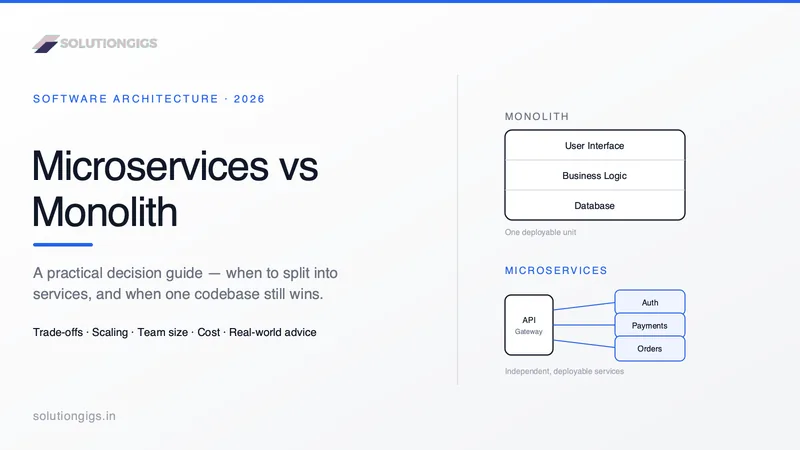
Quick Answer: The microservices vs monolith decision comes down to scale, team size, and complexity — not hype. A monolith is a single application with one codebase that deploys as a unit; it's simpler, faster to build, and cheaper to run. Microservices split the app into small independent services that scale and deploy separately, which pays off for large organizations with many teams but adds heavy operational complexity. For most teams in 2026, the right answer is to start with a well-structured modular monolith and extract microservices later, only when real pain justifies it.
Few debates in software have caused as many expensive mistakes as microservices vs monolith. For a decade, "microservices" was treated as the obvious sign of a serious engineering team — and countless startups adopted them far too early, drowning in complexity before they had a product worth scaling.
The industry has since matured. In 2026, the smartest teams choose architecture based on their actual constraints, not fashion. This guide gives you a clear, practical framework: what each architecture really is, the honest trade-offs, when to use which, and how to migrate safely if you outgrow your monolith.
What Is a Monolithic Architecture?
A monolith is a single, unified application where all functionality lives in one codebase and is deployed as one unit.
The user interface, business logic, and data-access layers are all part of the same project and run as a single process (or a set of identical copies behind a load balancer). When you deploy, you deploy the whole thing.
This is how most applications have always been built — and for good reason. A monolith is:
- Simple to develop — one codebase, one repository, one place to look
- Easy to test — run the whole app locally and test end to end
- Straightforward to deploy — one artifact, one pipeline
- Fast for internal calls — functions call each other directly in memory, no network hops
Companies like Shopify, Instagram, Basecamp, and Stack Overflow have run enormous, successful businesses on monoliths. A monolith is not a beginner's mistake — it's often the correct engineering decision.
What Is a Microservices Architecture?
Microservices split an application into many small, independent services, each owning a single business capability and communicating over the network.
Instead of one large codebase, you have separate services — say, auth, payments, orders, notifications — each with its own codebase, database, and deployment pipeline. They talk to each other through APIs (REST, gRPC) or asynchronous messaging (Kafka, RabbitMQ), usually behind an API gateway.
The defining property is independence: each service can be developed, deployed, scaled, and even written in a different language by a different team, without coordinating a single big release.
This independence is powerful — but it comes at the cost of turning your application into a distributed system, which introduces an entirely new category of hard problems.
Microservices vs Monolith: Head-to-Head Comparison
| Factor | Monolith | Microservices |
|---|---|---|
| Codebase | Single | Many independent services |
| Deployment | One unit | Each service separately |
| Scaling | Scale the whole app | Scale individual services |
| Development speed (early) | Fast | Slower (more setup) |
| Operational complexity | Low | High |
| Team structure | One or few teams | Many autonomous teams |
| Fault isolation | A crash can affect all | Failures can be contained |
| Data consistency | Simple (one database) | Hard (distributed data) |
| Technology flexibility | One stack | Per-service choice |
| Infrastructure cost | Lower | Higher |
| Debugging | Straightforward | Requires distributed tracing |
| Best for | Small–mid teams, most startups | Large orgs, high scale |
The Real Trade-Offs (What Nobody Tells You)
Microservices Don't Reduce Complexity — They Move It
The biggest misconception is that microservices make systems simpler. They don't. They take the complexity that lived inside your code and move it into the network between services.
Suddenly you must handle: network failures, retries, timeouts, versioned APIs, distributed transactions, eventual consistency, service discovery, and much more. A function call that was once instant and reliable becomes a network request that can fail, time out, or arrive twice.
Distributed Data Is Genuinely Hard
In a monolith, a single database transaction keeps your data consistent. Across microservices, each service owns its own data, and there is no easy global transaction. Keeping data correct requires patterns like sagas, event sourcing, and idempotency — real engineering effort that a monolith simply doesn't need.
Observability Becomes Mandatory, Not Optional
When one user request flows through eight services, a single log file tells you nothing. You need distributed tracing, centralized logging, and metrics across every service just to answer "why is this slow?" This is why observability platforms matter so much in a microservices world — see our guides on what Datadog is and how to use it and the best Datadog alternatives for keeping monitoring costs sane.
But Microservices Genuinely Solve Real Problems
None of this means microservices are bad. When you have dozens of engineers, they let teams ship independently without stepping on each other. When one part of your system needs 50× the capacity of the rest, you scale just that service instead of the whole app. For the right organization, these benefits are transformative.
When to Choose a Monolith
Choose a monolith (ideally a modular monolith) when:
- ✅ You're a startup or small-to-mid team (roughly under 15–20 engineers)
- ✅ You're building an MVP or still finding product-market fit
- ✅ Your app has modest, uniform scaling needs
- ✅ You want to ship features fast with minimal infrastructure
- ✅ You want low operational cost and a small team to run it
The default recommendation for 2026: build a modular monolith. Organize your codebase into clear, loosely coupled modules with well-defined boundaries. You get clean separation and maintainability without the distributed-systems tax — and if you ever need to extract a module into a service, the clean boundaries make it far easier.
Not sure whether to refactor your monolith or split it? That decision is usually about team boundaries rather than technology. Tell us how your team is organised and we'll tell you which one actually fits.
When to Choose Microservices
Choose microservices when you have concrete, present-day evidence you need them:
- ✅ Many teams need to deploy independently without blocking each other
- ✅ Different components need wildly different scaling (e.g., video processing vs a settings page)
- ✅ Your monolith's build and test times have become unbearable
- ✅ Different parts need different technologies (Python for ML, Go for high-throughput APIs)
- ✅ You need strong fault isolation so one failing feature can't take down everything
- ✅ You have the DevOps maturity — CI/CD, containers, orchestration, and observability — to run a distributed system
Notice these are all scaling and organizational problems. If you don't have them yet, microservices will cost you far more than they return. Microservices are typically deployed with containers and orchestration — if that's your path, our Docker vs Kubernetes guide explains exactly when you need each.
The Middle Path: Modular Monolith First
The false choice is "monolith OR microservices from day one." The proven path used by most successful companies is a progression:
- Start with a modular monolith. One deployable app, clean internal module boundaries.
- Grow and observe. Let real usage and team growth reveal genuine bottlenecks.
- Extract services surgically. When a specific module needs independent scaling or ownership, carve that one out — not everything.
This is exactly how Amazon, Shopify, and Netflix evolved. None of them started with hundreds of microservices; they grew into them because specific, measurable pain forced the change.
What makes a modular monolith actually modular is the same skill one level down: clean seams between components. A module that talks to another through a narrow interface rather than reaching into its internals is the boundary you will later extract a service along — and the classic patterns for drawing those seams (Adapter at a vendor boundary, Facade over a subsystem, Bridge where two dimensions grow independently) are exactly the ones that survive in modern languages. If your module boundaries are vague, see which design patterns still matter — the nine that survived are all about relationships between components, which is precisely the problem a modular monolith has to solve before extraction is even possible.
How to Migrate From a Monolith to Microservices
If you've genuinely outgrown your monolith, migrate incrementally — never with a big-bang rewrite (those famously fail).
The Strangler-Fig Pattern
Named after a vine that gradually grows around a tree, this pattern replaces a monolith piece by piece:
- Identify a bounded context — a self-contained capability like "notifications" with clear edges.
- Build it as a new service alongside the monolith.
- Route traffic for that capability to the new service via the API gateway.
- Remove the old code from the monolith once the service is proven.
- Repeat for the next bounded context.
At every step you have a working system. You're never betting the company on a months-long rewrite with no shippable milestones.
Get the Foundations First
Before extracting a single service, make sure you have: containerization, an automated CI/CD pipeline, centralized logging, and distributed tracing. Without these, microservices will be chaos. If your data layer is involved, patterns like vector databases and RAG for AI features are typically their own service too.
Common Mistakes to Avoid
| ❌ Mistake | ✅ Fix |
|---|---|
| Starting with microservices for a new product | Start with a modular monolith |
| Splitting by technical layer (UI service, DB service) | Split by business capability |
| Making services too small ("nano-services") | Right-size around bounded contexts |
| Sharing one database across services | Each service owns its data |
| Ignoring observability | Add tracing and centralized logs from day one |
| Big-bang rewrite | Use the strangler-fig pattern |
| Adopting microservices for résumé appeal | Choose based on real constraints |
Real-World Examples
- Amazon famously started as a monolith and migrated to services as it scaled to thousands of engineers — driven by team-coordination pain, not trend-chasing.
- Shopify runs one of the world's largest and most successful modular monoliths (Ruby on Rails), proving monoliths scale enormously when well-structured.
- Netflix is the canonical microservices success story — but it moved there to handle planet-scale streaming with hundreds of teams, a context almost no startup shares.
The lesson is consistent: architecture should follow scale and organizational reality, not the other way around.
Frequently Asked Questions
What is the difference between microservices and a monolith?
A monolith is a single, unified application where all features share one codebase and deploy together. Microservices split an application into many small, independent services that each own one capability and deploy separately. The monolith is simpler to build and run; microservices offer independent scaling and deployment at the cost of significant operational complexity.
Should I start with microservices or a monolith?
Almost always start with a monolith — ideally a well-structured modular monolith. Most successful companies, including Shopify, Instagram, and early Amazon, began as monoliths. Microservices solve scaling and team-coordination problems you may never have. Split into services later, once real pain points actually appear.
Are microservices better than a monolith?
Neither is universally better — it depends on scale, team size, and complexity. Microservices excel for large organizations with many teams needing independent deployment and per-service scaling. Monoliths win for small-to-medium teams that value simplicity, faster development, and lower operational cost. The right choice matches your current stage, not a trend.
What is a modular monolith?
A modular monolith is a single deployable application organized into well-defined, loosely coupled internal modules with clear boundaries. It gives you much of the maintainability of microservices — separation of concerns and clear ownership — without the operational overhead of a distributed system. It's the recommended default for most teams in 2026.
When should you move from a monolith to microservices?
Move when specific pain appears: teams blocking each other on deployments, parts of the system needing very different scaling, build and test times becoming unbearable, or components requiring different technologies. Migrate incrementally with the strangler-fig pattern — extract one service at a time rather than rewriting everything.
Do microservices cost more than a monolith?
Yes, usually. Microservices add infrastructure cost (multiple services, orchestration, networking), tooling cost (CI/CD, observability, service mesh), and engineering time for distributed-systems concerns like retries, tracing, and data consistency. For small applications this overhead often outweighs the benefits, which is why monoliths are more cost-effective at smaller scale.
Conclusion
The microservices vs monolith debate has a refreshingly practical answer in 2026: start simple, and let real problems — not trends — drive your architecture.
For the vast majority of teams, a well-structured modular monolith is the right starting point. It ships faster, costs less, and is dramatically easier to operate. Microservices are a powerful tool for a specific situation — many teams, high scale, and the DevOps maturity to run distributed systems — and they shine brightly when you genuinely reach that point.
The teams that win aren't the ones with the most services or the trendiest architecture. They're the ones who match their architecture to their actual scale and ship value to users. Choose deliberately, evolve incrementally, and never adopt complexity you haven't earned.
Deciding between a monolith, a modular monolith, or microservices for your product? We've built and scaled both, and we'll happily tell you when the answer is "stay a monolith". Tell us about the product and the team →
Mohammed Yaseen
Founder, SolutionGigs
Mohammed has designed and scaled both monolithic and microservices systems across startups and enterprise platforms. He founded SolutionGigs to connect teams with engineers who make the right architecture calls — not the trendiest ones. LinkedIn →
Try Free Docker Compose Generator
Free, no signup — right in your browser.
Try Free Docker Compose Generator →More in Software Architecture

Which Design Patterns Still Matter — and Which Your Language Already Absorbed
Peter Norvig said 16 of 23 GoF design patterns vanish in a dynamic language. We rewrote all 23 in 7 languages to check, and counted 14. This guide gives the verdict pattern by pattern — the 4 your language already ships, the 10 that collapse into a single function, and the 9 you still have to write by hand — plus why those 9 survived, what changes when you switch language, and the three comparisons interviewers actually ask about.

How to Learn Design Patterns Without Memorising 23 UML Diagrams
Most developers learn design patterns twice: once from a book, and again two years later in a code review. This guide closes that gap with a six-week path through all 23 Gang of Four patterns — the order to take them in, the six mechanisms that turn 23 concepts into 6, a 40-minute study loop per pattern, the nine confusion pairs you must learn together, and a four-question test for whether one actually stuck.
Free Invoice Generator Online — Download PDF, No Login, No Watermark
Create and download professional invoices in seconds — completely free, no account, no watermark. Add line items, set tax and discount, and export to PDF with one click.