
Data Engineer vs AI Engineer: Skills, Scope, Salary and Which to Pick
Data engineer vs AI engineer, decided on evidence: the WEF projects big data specialists at 110% growth to 2030 against 85% for AI and ML specialists, while Robert Half puts AI pay 9% ahead at the midpoint. Wider scope on one side, bigger premium on the other. Inside: a 12-row comparison table, US and India pay bands with their caveats, the stat every career post miscites, an original map showing a RAG pipeline IS an ETL pipeline stage for stage, an honest ledger of what transfers and what does not, and a 90-day plan to move from data to AI.

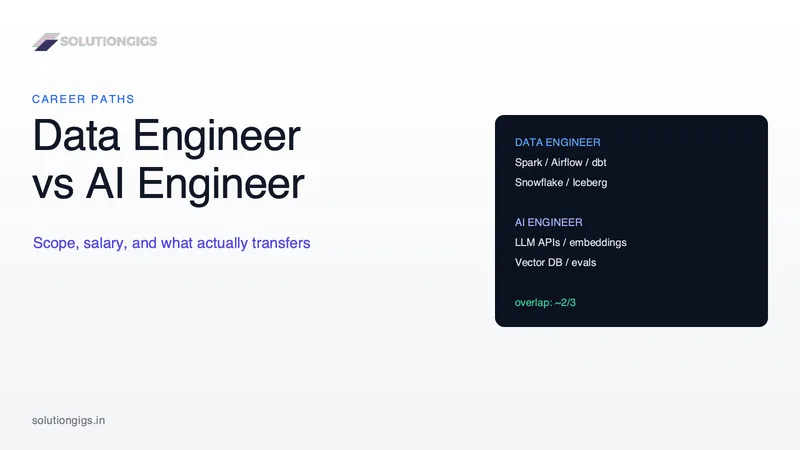
Quick Answer: A data engineer builds the systems that make data trustworthy — ingestion, transformation, storage, quality and orchestration. An AI engineer builds product features on top of models someone else trained — retrieval, prompting, tool calling, evaluation and cost control. AI engineering pays about 9% more at the US midpoint, but the World Economic Forum projects big data specialists to grow 110% by 2030 against 85% for AI and machine learning specialists. So the premium favours AI engineering; the raw scope still favours data engineering. The two roles overlap by roughly two-thirds, which is why moving from data to AI is a 90-day project, not a career restart.
Everyone in a data team is quietly asking the same question right now: is my job the one with a future, or is the person writing prompts next to me in the better seat? The honest answer is more interesting than either side of the argument, and it does not match the vibe on LinkedIn.
This post compares the two roles on the four things that actually decide a career move — what the work is, what the market data says about scope, what each pays, and what transfers if you switch. It includes an overlap map I have not seen published anywhere else: a side-by-side showing that a retrieval-augmented generation pipeline is an ETL pipeline with different nouns. If you are still choosing your first data role, start with how to become a data engineer and come back here.
Data engineer vs AI engineer at a glance
The one-line difference: a data engineer's output is a table or a stream that other systems trust; an AI engineer's output is a behaviour a user experiences. Everything else in this table follows from that.
| Dimension | Data engineer | AI engineer |
|---|---|---|
| Primary output | Trusted tables, streams, warehouses | Model-powered product features |
| Core question | "Is this data correct, fresh and affordable?" | "Is this answer useful, safe and fast enough?" |
| Determinism | Deterministic — same input, same output | Non-deterministic — same input, different output |
| Definition of done | Tests pass, SLA met, costs flat | Eval score clears the bar at acceptable latency and cost |
| Typical stack | Python, SQL, Spark, Airflow/dbt, Kafka, Snowflake/BigQuery, Iceberg | Python, LLM APIs, embeddings, vector DBs, LangChain/LlamaIndex, eval harnesses |
| Failure mode | Silent data corruption discovered weeks later | Confident wrong answers discovered by a customer |
| Who consumes the work | Analysts, ML teams, finance, downstream services | End users, directly |
| Budget line | Operational — hard to switch off | Discretionary — first to be cut, fastest to grow |
| Maturity of the title | ~15 years, standardised | ~3 years, still means different things at different companies |
| US midpoint salary (Robert Half 2026) | $156,250 | $170,750 |
| WEF growth to 2030 | 110% (big data specialists) | 85% (AI & ML specialists) |
| Hardest part of the job | Correctness at scale under changing schemas | Measuring quality when there is no single right answer |
Two rows in that table deserve to be read together: AI engineering pays more and is projected to grow more slowly. That is not a contradiction. Higher pay with slower headcount growth is the signature of a scarce, newly defined role. Wider headcount growth at a lower midpoint is the signature of a role that has become infrastructure.
What a data engineer actually does all day
A data engineer is responsible for the correctness, freshness and cost of data that other people depend on. The job is 20% writing pipelines and 80% making sure they keep being right when the world changes underneath them.
A realistic week looks like this: a source system adds a column and quietly changes a currency field from paise to rupees; a partition skews because one customer sent 40× their normal volume; a downstream finance dashboard disagrees with the source by 0.4% and someone needs to know why by Friday. None of that is glamorous. All of it is why the role exists.
The technical spine is stable and well documented:
- Ingestion — batch loads, change data capture, streaming from Kafka
- Transformation — SQL and Spark, modelled into layers (see medallion architecture)
- Storage — lakehouse tables, partitioning, file layout, compaction
- Orchestration — Airflow, dbt, retries, backfills, idempotency
- Quality and contracts — tests, data quality gates, schema agreements
- Cost — the part nobody teaches and every senior gets judged on
The senior signal in data engineering is not knowing more tools. It is being the person who can say "that number is wrong and here is why" before a stakeholder says it first.
What an AI engineer actually does all day
An AI engineer builds application features on top of hosted models, and spends most of their time on everything except the model. The model is an API call. The job is what surrounds it.
The role as it is actually hired in 2026 breaks down roughly like this: retrieval and context assembly, prompt and tool design, evaluation, and latency-and-cost engineering. Note that only one of those four is what people picture when they hear "AI engineer."
- Retrieval — chunking documents, generating embeddings, querying a vector database, re-ranking results
- Context assembly — deciding what goes into the window and, more importantly, what stays out (context engineering is now the highest-leverage skill in the role)
- Tool calling and agents — letting a model act, then constraining what it can do
- Evaluation — building the test harness that tells you whether last night's prompt change made things better or worse
- Cost and latency — prompt caching, model routing, streaming, token budgets
The distinction that trips people up: AI engineering is not machine learning engineering. ML engineering means training, serving and monitoring models — GPUs, loss curves, feature stores. AI engineering means composing existing models into products. The second is a much larger and faster-growing job market than the first, and it requires much less mathematics than the title implies.
Which role has more scope in the market?
On the largest published projection, data engineering has more scope, and it is not close. The World Economic Forum's Future of Jobs Report 2025 — a survey of 1,043 employers representing 14.1 million workers — ranks the fastest-growing jobs to 2030 as:
| Rank | Role | Projected growth to 2030 |
|---|---|---|
| 1 | Big data specialists | 110% |
| 2 | FinTech engineers | 95% |
| 3 | AI and machine learning specialists | 85% |
| 4 | Software and applications developers | 60% |
This is the single most counterintuitive fact in the comparison, and almost every career article on this topic omits it: the data role is projected to grow faster than the AI role. The mechanism is straightforward once you see it. Every AI feature a company ships creates new data obligations — documents to index, interactions to log, outputs to evaluate, PII to govern. AI adoption is a demand driver for data engineering, not a substitute for it.
What the salary data says
Growth and pay are different questions, and here AI engineering wins:
| Role | Starting | Midpoint | High end |
|---|---|---|---|
| AI / ML engineer | $134,000 | $170,750 | $193,250 |
| Data engineer | — | $156,250 | — |
Source: Robert Half 2026 Salary Guide, US national figures. Robert Half also reports AI, ML and data science roles taking 4.1% starting-salary growth in 2026, against 1.6% across tech overall — the highest of any specialty it tracks.
In India, the reliable public numbers are thinner and come from self-reported aggregators, so treat them as bands rather than figures. The consistent pattern across sources: data engineers land roughly ₹6–45 LPA across the experience curve, AI and ML engineers roughly ₹6–60 LPA, with the gap opening mainly at senior product-company level rather than at entry. At 3–5 years the two are close enough that the deciding factor is the company, not the title.
The caveat every article skips
Neither "data engineer" nor "AI engineer" exists as an occupation in official labour statistics. The US Bureau of Labor Statistics tracks data scientists at 34% growth for 2024–34 and database administrators and architects at just 4%. You will see both numbers quoted as "the data engineer outlook." Neither is. Data engineering work is scattered across three different BLS categories, which is exactly why the WEF employer survey — which asks companies about the titles they actually hire — is the better instrument here.
Be suspicious of any career post that gives you a precise growth percentage for either role without saying where the taxonomy came from.
The overlap nobody maps: a RAG pipeline is an ETL pipeline
This is the part that changes the decision for most people. Retrieval-augmented generation, the core workload of AI engineering, is structurally the same thing as an ETL pipeline — the nouns change, the engineering does not.
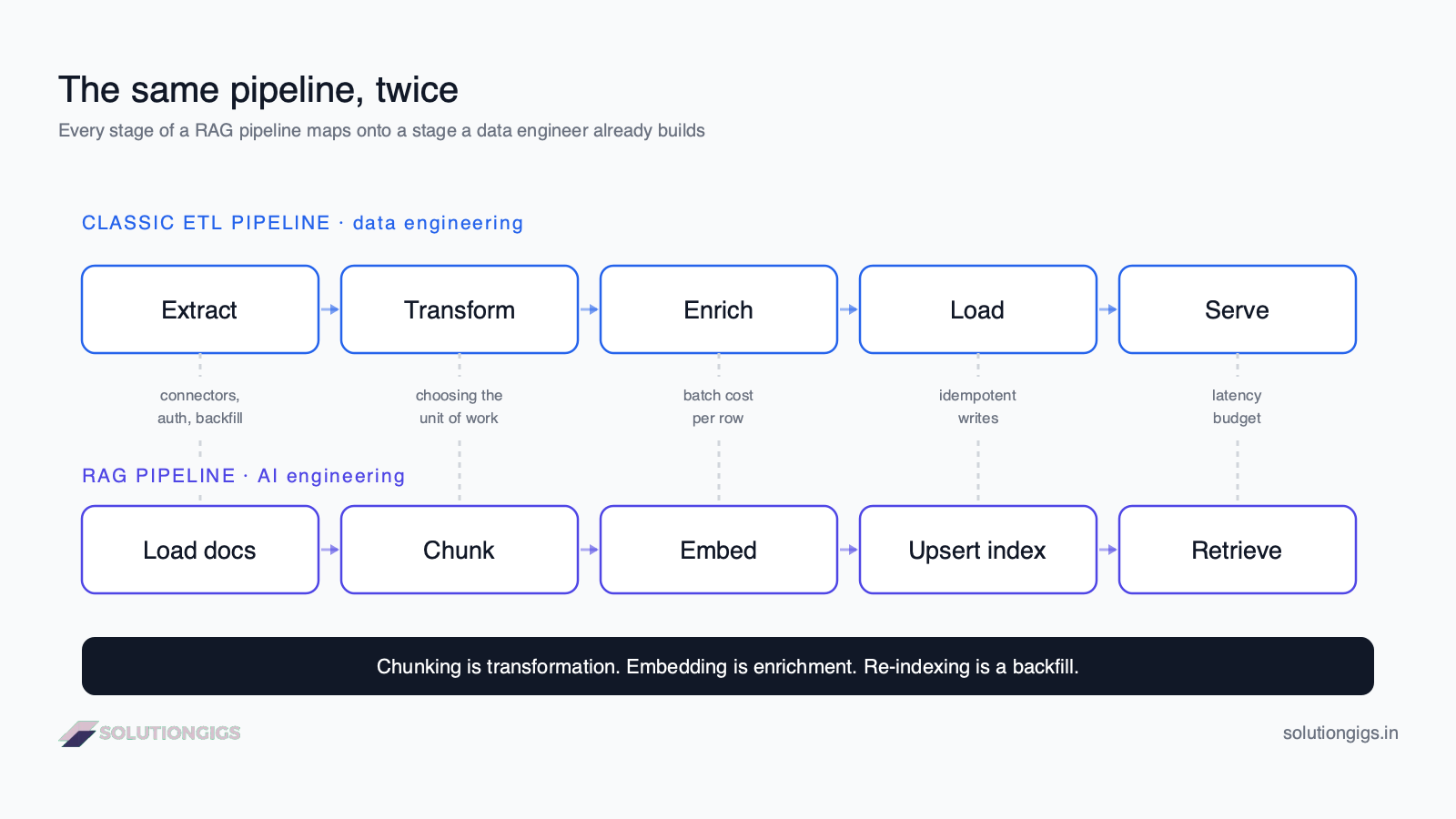
| ETL / data engineering stage | RAG / AI engineering equivalent | Same underlying problem |
|---|---|---|
| Extract from source systems | Load documents, crawl, sync | Connectors, rate limits, auth, incremental pulls |
| Transform / normalise | Chunk and clean | Deciding the unit of processing |
| Enrich with derived columns | Generate embeddings | Batch throughput and cost per row |
| Load into warehouse table | Upsert into vector index | Idempotent writes, no duplicates |
| Partition and index for query | Choose index type, metadata filters | Read performance vs write cost |
| Serving layer / BI query | Retrieve, re-rank, assemble context | Latency budget at the edge |
| Backfill after a logic change | Re-index after a chunking change | Reprocessing history without downtime |
| Data quality tests | Evals | Proving the output is still good |
| Freshness SLA | Index staleness | How wrong is "yesterday's data"? |
I did not arrive at this table academically. When we built the AI assistant and the resume checker on SolutionGigs, every single production problem we hit was a data engineering problem wearing a costume. Duplicate chunks in the index because the re-ingest was not idempotent. Stale answers because nothing invalidated the index when a post was edited. A cost spike because we embedded the whole corpus instead of the diff. Not one of those was a model problem, and not one required knowing how a transformer works.
If you have ever debugged a duplicate-rows bug in a MERGE statement, you are already qualified to debug the most common failure in a production RAG system. That is the real answer to "can I switch."
What transfers, and what genuinely does not
Being honest about the second column is what makes the first column useful.
Transfers directly (roughly two-thirds of the job):
- Python, SQL, and comfort in a terminal
- Pipeline thinking — stages, retries, idempotency, backfills
- Batch vs streaming trade-offs, and knowing which one a problem needs
- Cost awareness per unit processed
- Schema and contract discipline
- Observability instincts: what to log, what to alert on
- Cloud fundamentals, containers, CI/CD
- The thing that matters most — knowing what "correct" means and refusing to ship without it
Does not transfer; you have to learn it new:
- Non-determinism. Your test suite can no longer assert equality. This is the single biggest mental adjustment, and it takes weeks, not days.
- Evaluation design. Writing an eval set is a genuine skill: it is closer to designing an exam than writing a unit test. Read AI and data quality for why this is where projects actually die.
- Context engineering. More context makes agents worse, not better. Every instinct that says "retrieve more, just in case" is wrong.
- Prompt and tool design. Underrated as engineering, and it is not "writing nicely."
- Per-token economics. Cost scales with the shape of the conversation, not the number of rows.
- Product judgment. You are now shipping something a user reads, so "technically correct" stops being sufficient.
The role actually growing fastest is the hybrid
The highest-leverage position in 2026 is not either pure role — it is the AI data engineer: the person who builds the pipelines that feed AI systems. This is the job most companies are hiring for even when the posting says something else.
The work is unglamorous and in extremely short supply: document ingestion pipelines with proper incremental sync, embedding jobs that are idempotent and cheap, index freshness SLAs, eval datasets versioned like any other table, PII governance on everything a model can see, and cost attribution per feature.
If you are a data engineer wondering whether to jump, this is the answer for most people: do not jump, extend. You keep the scope and defensibility of the data role and pick up the premium and optionality of the AI role. Every project on the modern data stack now has an AI-serving edge; owning that edge is the promotion.
A 90-day plan to move from data engineering to AI engineering
Built from the transfer map above — it skips everything you already know, which is why it is 90 days and not a year.
Days 1–30: build one honest RAG system, end to end. Not a notebook. A pipeline. Ingest a real corpus you care about, chunk it deliberately, embed it in batches, upsert into a vector store with a stable key so re-runs do not duplicate, and serve it behind an API. Follow the RAG pipeline tutorial if you want a scaffold. Success condition: you can re-run the whole ingest twice and the index is byte-identical.
Days 31–60: make it measurable. Write 50 real questions with expected answers. Score retrieval and generation separately — most "the model is bad" complaints are retrieval failures. Then change one thing (chunk size) and prove with numbers whether it helped. This is the month that makes you employable, and it is the month most people skip.
Days 61–90: make it cheap, fast and safe. Add caching, cut the context down until quality drops and then add back the minimum, measure p95 latency, handle failures and refusals, and log every call with its cost. Then write up the numbers — before and after — publicly.
That last artefact is worth more than a certificate. Hiring managers for AI roles are drowning in people who have finished courses and starving for people who have shipped an evaluated system.
Common mistakes when choosing between them
| ❌ Mistake | ✅ Better move |
|---|---|
| Chasing the title because it pays more | Compare the work; the pay gap is ~9% at the midpoint, which is one good negotiation |
| Assuming AI engineering means training models | It means composing hosted models; ML engineering is the training job, and it is a smaller market |
| Abandoning data engineering "before AI takes it" | AI adoption increases data work; the WEF projection says the data role grows faster |
| Learning frameworks instead of fundamentals | LangChain will churn; retrieval, evaluation and cost reasoning will not |
| Building a demo with no evaluation | An unevaluated demo signals nothing; 50 scored questions signals everything |
| Treating vector search as magic | It is an index with a recall/latency trade-off, exactly like every other index you have tuned |
| Ignoring the boring hybrid role | It is where the unmet demand actually is |
So which one should you pick?
| Your situation | Pick |
|---|---|
| Starting out, no production experience | Data engineering. It has more entry doors, clearer standards, and everything transfers later |
| 3+ years in data, feeling stagnant | Extend into AI data engineering. Highest return, lowest risk |
| Backend or full-stack developer wanting in | AI engineering. Your product and API skills transfer faster than they would into data |
| You want maximum salary in 24 months | AI engineering, at a product company, with an evaluated system in your portfolio |
| You want stability through a downturn | Data engineering. Operational budgets survive; innovation budgets do not |
| You dislike ambiguity | Data engineering. "Correct" is definable. In AI it is negotiated |
| You like shipping things users touch | AI engineering. Your work is visible in a way pipelines never are |
There is no wrong answer on this list. There is only a wrong reason — picking on salary alone, when the gap between the two is smaller than the gap between a good company and a bad one in either role.
Building either capability and short on people? SolutionGigs connects teams with vetted data and AI engineers, and it is free to post a project.
Frequently Asked Questions
Which has more scope, data engineering or AI engineering?
By the largest published projection, data engineering. The World Economic Forum's Future of Jobs Report 2025 puts big data specialists at 110% growth to 2030, ahead of AI and machine learning specialists at 85%. AI engineering pays more today — Robert Half's 2026 midpoint is $170,750 against $156,250 — but it is a newer, less defined title with more volatility. Scope favours data; premium favours AI.
What is the difference between a data engineer and an AI engineer?
A data engineer moves and shapes data so other systems can trust it: ingestion, transformation, storage, quality and orchestration. An AI engineer builds product features on top of models someone else trained: retrieval, prompting, tool calling, evaluation and cost control. The data engineer's output is a table or a stream. The AI engineer's output is a user-facing behaviour.
Can a data engineer become an AI engineer?
Yes, and it is the shortest common path into the role. Roughly two-thirds of AI engineering is pipeline work a data engineer already does — chunking is transformation, embedding is enrichment, a vector index is a serving layer, re-indexing is a backfill. What must be learned new is evaluation, non-determinism, prompt and context design, and per-token cost control. Ninety days of deliberate work is realistic.
Does AI engineering pay more than data engineering?
In the United States, yes, by roughly 9% at the midpoint. Robert Half's 2026 Salary Guide lists AI and ML engineers at $134,000 starting, $170,750 at the midpoint and $193,250 at the high end, against a $156,250 midpoint for data engineers. In India the gap is wider at senior levels, but aggregator salary data there is self-reported and should be read as a range, not a figure.
Will AI replace data engineers?
No, and the demand data points the other way. Every AI feature a company ships increases the amount of data that must be collected, cleaned, versioned and served reliably — which is data engineering work. What AI does replace is the slow parts of the job: boilerplate SQL, first-draft DAGs, schema translation. The role shifts from writing pipelines to specifying, reviewing and guaranteeing them.
Do you need machine learning knowledge to be an AI engineer?
Far less than the title suggests. AI engineering as hired in 2026 is mostly application engineering against hosted models: API integration, retrieval, tool use, evaluation, latency and cost. You need to understand what an embedding is and why models hallucinate, but rarely backpropagation, loss functions or GPU training. That is machine learning engineering — a separate and smaller market.
Which role is safer in a downturn?
Data engineering, because it sits on a cost line that is hard to switch off. Reporting, billing, compliance and finance pipelines must keep running whether or not the AI roadmap survives budget review. AI engineering is funded from discretionary innovation budgets, which move first when spending tightens. The trade-off is that discretionary budgets are also where the fastest salary growth is.
Conclusion
The framing that makes this decision easy: data engineering is the wider road, AI engineering is the faster lane on it. The WEF projects the data role growing 110% to 2030 against 85% for AI and ML specialists, while Robert Half puts AI pay about 9% ahead at the midpoint. Wider scope, smaller premium, on one side; narrower and newer, larger premium, on the other.
For most people already doing data work, the right move is neither a leap nor a hold — it is extending into the hybrid the market is quietly desperate for: the engineer who can build pipelines that feed AI systems and prove, with numbers, that the output is good. The overlap is about two-thirds, so that extension is measured in months.
If you want a concrete first project in that hybrid space, building an AI data pipeline that keeps a retrieval index in sync is the most transferable version of it.
Pick the work you would still choose if the salaries were identical, then get very good at the part that does not transfer. If you are earlier in the journey, the data engineering roadmap is the place to start, and what is data engineering covers the ground beneath both roles.
Hiring for either side of this? Post your project on solutiongigs.in and get matched with vetted data and AI engineers. It is free to post.
Mohammed Yaseen
Founder, SolutionGigs
Mohammed builds production data platforms on Spark, Kafka and Iceberg, and ships the AI features on SolutionGigs — which is how he learned that most "AI problems" are pipeline problems in disguise. LinkedIn →
More in Data Engineering
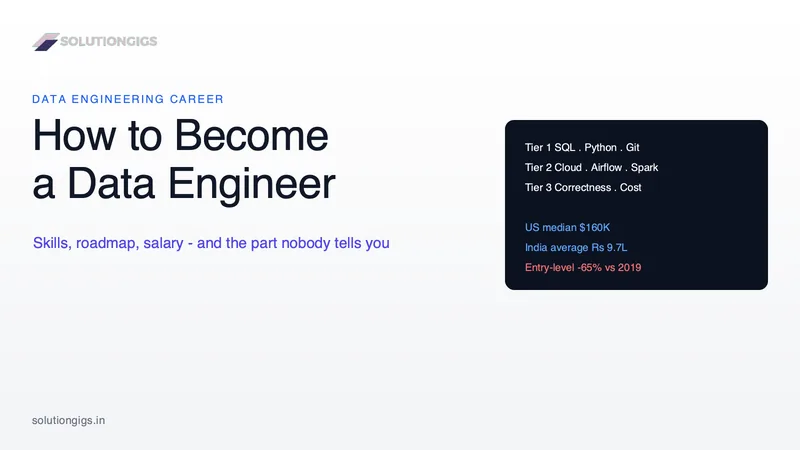
How to Become a Data Engineer: Skills, Roadmap & Salary
How to become a data engineer: the four real entry paths, a six-month roadmap with stop conditions, current US and India salary data, and the honest catch. Demand is real - Robert Half puts the US starting midpoint at $156,250 and 78% of tech leaders are adding headcount - but entry-level hiring is down about 65% against 2019, which is why finishing a course and getting no callbacks are both normal. Inside: what the primary sources actually say (including the BLS stat every guide miscites), the four doors into the field and which is shortest, a three-tier skill order, a month-by-month roadmap with stop conditions, US and India salary tables with collection dates, and the portfolio bar that gets callbacks.
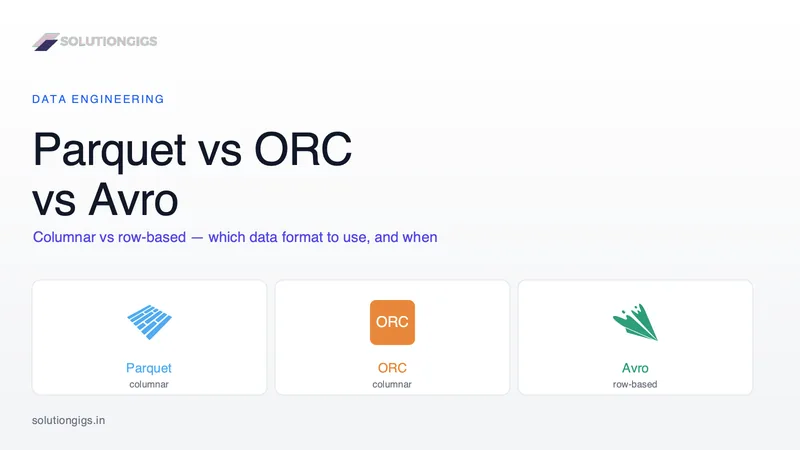
Parquet vs ORC vs Avro: Which Data Format to Use
Pick the wrong file format and everything downstream pays: queries scan 10x more data than they need, storage bills balloon, and schema changes become migrations. The real answer to "Parquet, ORC, or Avro?" is precise and comes down to one design decision — row-based vs columnar storage. This guide shows how each format stores data on disk, compares them on compression, schema evolution, and ecosystem, and gives a decision rule you can apply to any pipeline.
Polars vs Pandas: Which DataFrame Library to Use
For fifteen years, working with data in Python meant Pandas. But if you've watched a Pandas script crawl through a 5 GB CSV on a single core while fifteen others sit idle, you've felt its limits. Polars is the Rust-powered answer — built on Apache Arrow with multi-threaded, lazy execution that runs 5-50x faster on far less memory. This is the honest comparison: how they differ, the same code in both, when to use each, and how to migrate without leaving the Pandas ecosystem behind.