
Parquet vs ORC vs Avro: Which Data Format to Use
Last Updated: July 2026 | 14 min read
Quick Answer: Parquet, ORC, and Avro are the three dominant big-data file formats, and the choice comes down to one split: columnar vs row-based. Parquet and ORC are columnar — they store each column together, giving excellent compression and fast analytical scans, which makes them the right choice for data lakes and query engines. Avro is row-based — it stores whole records together and has best-in-class schema evolution, which makes it the right choice for streaming and write-heavy workloads like Kafka. The practical rule: Parquet for lake/analytics (the default on Spark, Athena, Snowflake), ORC in the Hive ecosystem, and Avro for streaming ingestion.
Pick the wrong file format and everything downstream pays for it — queries scan 10× more data than they need, storage bills balloon, and schema changes turn into migration nightmares. Yet "should I use Parquet, ORC, or Avro?" gets answered with vague hand-waving far too often. The real answer is precise and grounded in one design decision: does the format store data by row or by column? Get that idea and the entire comparison falls into place. This guide explains how each format actually stores data on disk, compares them across the dimensions that matter — compression, schema evolution, ecosystem, read/write pattern — and gives you a decision rule you can apply to any pipeline.
The one idea that explains everything: row vs columnar storage
The single most important difference is physical layout: Avro stores data row-by-row (all fields of a record together), while Parquet and ORC store data column-by-column (all values of a field together). Every other trade-off flows from this.
Take a simple table:
| id | name | country |
|---|---|---|
| 1 | Ana | IN |
| 2 | Bo | US |
| 3 | Cy | UK |
- Row-based (Avro) writes it as:
(1,Ana,IN)(2,Bo,US)(3,Cy,UK)— each record is one contiguous block. - Columnar (Parquet/ORC) writes it as:
(1,2,3)(Ana,Bo,Cy)(IN,US,UK)— each column is one contiguous block.
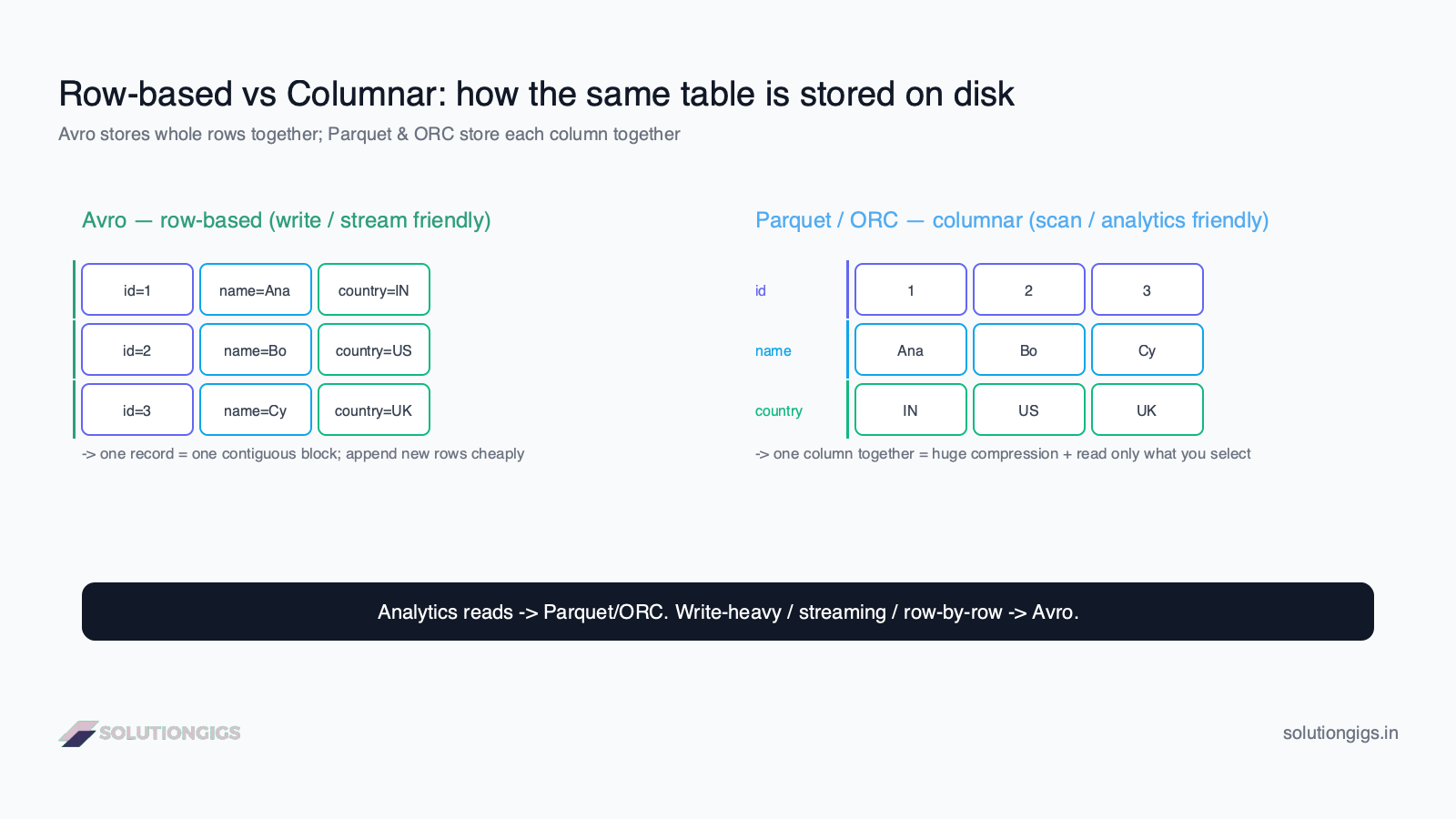
This layout choice decides performance:
- A query like
SELECT AVG(id) FROM tablein a columnar format reads only theidblock and skipsnameandcountryentirely — less I/O, faster scan. And because a column holds one data type with similar values, compression is far more effective. - Reading or writing an entire record in a row-based format touches one contiguous block — ideal for streaming a message or appending a new row, where you always want the whole record.
The takeaway in one line: columnar (Parquet/ORC) wins when you read a few columns across many rows (analytics); row-based (Avro) wins when you write or read whole records (streaming, ingestion).
Apache Parquet: the data lake default
Parquet is a columnar format and the de facto standard for analytical data lakes — it has the widest ecosystem support, excellent compression, and rich features like predicate pushdown and nested-data handling. If you're unsure, Parquet is almost always the safe default.
Parquet organizes data into row groups (horizontal slices of rows), and within each row group, data is stored by column chunk, each split into pages with their own encoding and statistics (min/max/count). Those statistics enable predicate pushdown: a query with WHERE year = 2026 can skip entire row groups whose min/max range excludes 2026, without reading them.
Parquet's strengths:
- Ubiquitous support — the native/default format for Apache Spark, Databricks, AWS Athena, Amazon Redshift Spectrum, Snowflake, DuckDB, pandas, and Trino.
- Great compression with dictionary, run-length, and bit-packing encodings, plus a codec (Snappy/Zstd/Gzip).
- First-class nested data — handles complex/struct/array types cleanly via its Dremel-style encoding.
- The storage layer under modern table formats — Apache Iceberg and Delta Lake both store their data as Parquet files by default.
# Writing Parquet in PySpark with a modern codec
(df.write
   .option("compression", "zstd")     # smaller than snappy, similar speed
   .mode("overwrite")
   .parquet("s3://bucket/events/"))
Apache ORC: the Hive-native columnar format
ORC (Optimized Row Columnar) is a columnar format born in the Hive/Hadoop ecosystem that often achieves slightly better compression than Parquet on some workloads and has mature support for ACID transactions in Hive. It's a strong choice when your stack is Hive-centric.
ORC stores data in stripes (analogous to Parquet's row groups), with lightweight indexes, and supports bloom filters on columns for fast point-lookup skipping. Its heritage is Hortonworks/Hive, so it integrates deeply there.
ORC's strengths:
- Excellent compression — its built-in indexes and encodings frequently edge out Parquet on Hive-style data, though the gap is workload-dependent and small.
- Hive ACID — ORC is the format behind Hive's transactional (insert/update/delete) tables.
- Bloom filters — efficient for high-cardinality point lookups.
- Strong in the Hive/Hadoop world — the native default for Hive.
The practical reality: Parquet and ORC are technically very close. Both are columnar, both compress well, both support predicate pushdown. The decision is almost always about ecosystem, not raw benchmarks — and outside of Hive, the broader industry has largely standardized on Parquet.
Apache Avro: the streaming and schema-evolution champion
Avro is a row-based format that stores the schema alongside the data and was designed around schema evolution, making it the standard choice for Kafka messages and write-heavy ingestion. When records change shape over time and you write whole rows, Avro is the right tool.
Avro serializes each record as a compact binary row and embeds (or references) the writer's schema, defined in JSON. Because the schema travels with the data, a reader using a different compatible schema version can still deserialize it — added fields fall back to defaults, removed fields are ignored, renames work via aliases.
Avro's strengths:
- Best-in-class schema evolution — add, remove, and rename fields with forward/backward compatibility, ideal for long-lived message contracts.
- Row-based = write-friendly — appending and streaming whole records is cheap; no columnar reassembly needed.
- The Kafka standard — paired with the Confluent Schema Registry, Avro lets Kafka producers and consumers evolve independently. This underpins reliable data contracts between teams.
- Compact and fast to serialize — smaller than JSON, with a strongly-typed schema.
Where Avro is the wrong choice: analytical queries that scan a few columns over billions of rows. Being row-based, Avro must read every field of every row even if you only need one column — exactly the workload columnar formats crush.
Parquet vs ORC vs Avro: the comparison table
Here's the head-to-head across the dimensions that actually drive the decision.
| Dimension | Parquet | ORC | Avro |
|---|---|---|---|
| Storage layout | Columnar | Columnar | Row-based |
| Best for | Analytics, data lakes | Analytics in Hive | Streaming, ingestion |
| Read pattern | Few columns, many rows | Few columns, many rows | Whole records |
| Write pattern | Batch | Batch | Streaming / append |
| Compression | Excellent | Excellent (often best) | Good |
| Schema evolution | Good | Good | Best |
| Predicate pushdown | Yes (row-group stats) | Yes (stripe indexes, bloom) | No |
| Nested data | Excellent | Good | Good |
| Splittable | Yes | Yes | Yes |
| Ecosystem | Spark, Athena, Snowflake, Trino, everywhere | Hive/Hadoop | Kafka, streaming |
| Schema location | In file footer | In file footer | With data / registry |
One-line verdict: Parquet for the analytical lake (the safe default), ORC if you live in Hive, Avro for streaming and evolving message formats.
How to choose: a decision guide
Match the format to the workload, not to hype. The question is always: how is this data written, and how is it read? Walk this in order:
- Is it a streaming pipeline / Kafka messages / write-heavy ingestion where you handle whole records? → Avro. Row-based writes and schema evolution win here.
- Is it an analytical table in a data lake queried by Spark, Athena, Snowflake, Trino, or DuckDB? → Parquet. Widest support, columnar scans, the format under Iceberg/Delta.
- Are you deep in the Hive/Hadoop ecosystem, or need Hive ACID transactions? → ORC. Native fit, mature transactional support.
- Building a modern lakehouse? → Use Iceberg or Delta (see Delta Lake vs Iceberg), which store as Parquet underneath — so you're on Parquet anyway, with table-level features on top.
A very common real architecture combines them: ingest events as Avro through Kafka (row-based, evolvable), then land and compact them into Parquet tables in the lake for analytics. Avro for the pipe, Parquet for the pool. At Telemetrix, that's exactly our shape — device telemetry flows as Avro over Kafka and is written to Parquet-backed Iceberg tables on S3, so ingestion stays cheap and evolvable while analytics stays fast and compressed. The trade-offs of laying those Parquet files out well are covered in the data partitioning strategies guide.
Common mistakes (and how to avoid them)
- Using CSV or JSON for analytical tables. Row-based, uncompressed, no pushdown — slow and expensive. Convert to Parquet; it commonly cuts storage 70–90%.
- Using Avro for a data-lake analytics table. Row-based means every query reads every column. Use a columnar format for scan-heavy tables.
- Using Parquet for Kafka messages. Columnar formats are batch-oriented; per-message streaming needs row-based Avro.
- Obsessing over Parquet-vs-ORC benchmarks. The difference is small and workload-dependent. Pick based on ecosystem (Spark/lake → Parquet; Hive → ORC), not a 3% compression delta.
- Ignoring the compression codec. Sticking with defaults leaves savings on the table — Zstandard often beats Snappy on size at similar speed. Use Gzip only for cold archives.
- Tiny Parquet files. Many small columnar files kill read performance and defeat compression. Compact them — see the small files problem.
- Forgetting a schema registry with Avro. Avro's evolution superpower needs a registry (e.g. Confluent) to enforce compatibility; without it, producers and consumers drift and break.
See how SolutionGigs can help
Designing a pipeline and not sure whether to land data as Avro, Parquet, or a lakehouse table — or fighting slow queries from the wrong format? SolutionGigs connects you with vetted data engineers who've built production lakes and streaming systems on exactly these formats. See how SolutionGigs can help →
Frequently Asked Questions
What is the difference between Parquet, ORC, and Avro?
Parquet and ORC are columnar formats that store each column together, giving fast analytical scans and excellent compression — ideal for data lakes. Avro is a row-based format that stores whole records together, making it fast for writes and streaming. In short: Parquet or ORC for analytics, Avro for write-heavy and streaming workloads like Kafka messages.
Is Parquet or ORC better?
Both are columnar and very close in performance; the choice comes down to ecosystem. Parquet is the default across Spark, Databricks, Athena, Snowflake, and Trino, with the widest support. ORC fits the Hive/Hadoop world, sometimes compresses slightly better, and supports Hive ACID transactions. On Spark or a modern lakehouse, choose Parquet; deep in Hive, choose ORC.
Why is Avro better for schema evolution?
Avro stores the full schema with the data and was built around evolution, so readers and writers can use different compatible schema versions. It handles added fields with defaults, removed fields, and renames via aliases cleanly, which is why it pairs with a schema registry in Kafka pipelines. Parquet and ORC support evolution too, but Avro's row-based, schema-with-data design makes evolving message formats smoothest.
Which format is best for Kafka?
Avro is the most common Kafka message format, usually with the Confluent Schema Registry. Kafka is a row-at-a-time streaming system where you read and write whole records — exactly what row-based Avro optimizes for — and its schema evolution lets producers and consumers change independently. Columnar Parquet and ORC are batch-oriented and a poor fit for per-message streaming.
Does Parquet compress better than CSV or JSON?
Yes, dramatically. Because Parquet stores each column together, similar values sit adjacent, so encodings like dictionary and run-length plus a codec like Snappy or Zstd shrink files far more than row-based CSV or JSON. Converting CSV/JSON to Parquet commonly cuts storage 70–90% and speeds up queries because engines read only the columns and row groups they need.
What compression codec should I use with Parquet?
Snappy is the common default — fast compress/decompress with a modest ratio. Zstandard (zstd) is increasingly preferred because it compresses smaller at similar speed, cutting storage and scan cost; it's a great modern default. Gzip compresses smaller but decompresses slower, so reserve it for cold, rarely-read archival data rather than hot analytical tables.
Are Parquet, ORC, and Avro all splittable?
Yes. All three are splittable, meaning a large file can be processed in parallel by multiple tasks — essential for distributed engines like Spark. Parquet splits on row groups, ORC on stripes, and Avro on sync markers between blocks. This is a key reason all three beat plain compressed CSV/JSON (a single Gzip file isn't splittable and forces one task to read it).
Conclusion
Choosing between Parquet, ORC, and Avro isn't about which is "best" in the abstract — it's about matching storage layout to workload. The whole decision collapses to one question: are you reading a few columns across many rows (analytics), or writing and reading whole records (streaming)?
The rule that covers almost every case:
- Analytics / data lake → Parquet — columnar, universally supported, the format under Iceberg and Delta.
- Hive ecosystem or Hive ACID → ORC — columnar, native to Hive.
- Streaming / Kafka / evolving messages → Avro — row-based, best schema evolution.
- Modern lakehouse → Iceberg/Delta on Parquet — you get Parquet plus table-level features.
- The common real shape → Avro in the pipe, Parquet in the pool.
Nail the format and you get cheaper storage, faster queries, and painless schema changes — for free, just by choosing well up front. If you're architecting a pipeline and want an expert to sanity-check your format and storage-layout decisions, get matched with a vetted data engineer on SolutionGigs. It's free to post your project.

Mohammed Yaseen
Founder, SolutionGigs
Mohammed builds data pipelines on AWS EMR at Telemetrix, ingesting device telemetry as Avro over Kafka and landing it in Parquet-backed Iceberg tables on S3. He's made the row-vs-columnar and format-choice calls this guide covers — and paid for the wrong ones — in production, not in theory. LinkedIn →