
Normalization vs Denormalization: Where You Pay for a Relationship
Last Updated: August 2026 | 12 min read
Quick Answer: Normalization stores every fact exactly once and rebuilds relationships at read time using joins. Denormalization stores some facts more than once so reads don't need those joins. The real difference isn't table count — it's when you pay for a relationship. A normalized schema pays on every read; a denormalized schema pays on every write, because one changed source value must be rewritten everywhere it was copied. The size of that rewrite — the fan-out — is the number that should decide the question, and almost nobody computes it before denormalizing.
Most explanations of normalization vs denormalization stop at "normalization reduces redundancy, denormalization improves read speed," hand you the 1NF/2NF/3NF ladder, and leave. That's a definition, not a decision procedure. It doesn't tell you which column to denormalize, how to know if you'll regret it, or why the advice you learned for MySQL is partly wrong on Snowflake and Spark.
This guide gives you the cost model, the five denormalization patterns with the maintenance bill attached to each, the one rule that has saved us the most pain (denormalize immutable attributes, join mutable ones), the escalation ladder to climb before you duplicate anything, and the mistakes that turn a clever optimization into a two-day backfill.
What is database normalization?
Database normalization is the process of structuring tables so that every fact is stored in exactly one place, with relationships expressed by keys rather than by copying values around. It was formalized by Edgar F. Codd alongside the relational model in his 1970 paper "A Relational Model of Data for Large Shared Data Banks", and its goal was never performance — it was correctness.
The reasoning is simple. If a fact lives in one row, there is exactly one row to change when it changes, and the database can never contradict itself. If a fact lives in 40,000 rows, there are 40,000 rows to change, and any failure partway through leaves the database holding two versions of the truth.
Normalization proceeds in stages called normal forms, each removing a specific class of redundancy:
| Normal form | Rule | What it prevents |
|---|---|---|
| 1NF | Every column holds a single atomic value; no repeating groups or comma-lists | phone_numbers = "555-01, 555-02" — unqueryable, unindexable |
| 2NF | Every non-key column depends on the whole composite key, not part of it | Storing product_name in an order-line table keyed by (order_id, product_id) |
| 3NF | No non-key column depends on another non-key column (no transitive dependency) | Storing city and state when state is determined by city |
| BCNF | Every determinant is a candidate key — a stricter 3NF | Rare overlapping-candidate-key anomalies |
| 4NF / 5NF | Removes multi-valued and join dependencies | Edge cases you will likely never meet in application code |
Practical guidance: 3NF is where you stop. Operational schemas that reach third normal form have removed essentially every anomaly that causes real production incidents. BCNF, 4NF and 5NF address situations rare enough that pursuing them usually costs more in join complexity than it returns in safety.
The three anomalies, on one small table
Abstract definitions of "update anomaly" never land. Here's the concrete version. Suppose you skip normalization and store customer details directly on each order:
| order_id | customer_id | customer_email | customer_city | amount |
|---|---|---|---|---|
| 1001 | C-7 | asha@example.com | Bengaluru | 2,400 |
| 1002 | C-7 | asha@example.com | Bengaluru | 890 |
| 1003 | C-9 | ravi@example.com | Pune | 1,250 |
Three failure modes fall out immediately:
- Update anomaly — Asha changes her email. You must find and rewrite every order row she has ever placed. Miss one, or crash halfway, and the database now says she has two email addresses.
- Insert anomaly — A customer signs up but hasn't ordered yet. There is nowhere to put them; you'd have to invent a fake order row to record a real customer.
- Delete anomaly — Order 1003 gets deleted for being a test record. Ravi's email and city vanish from the database with it, even though the customer still exists.
Normalizing splits this into a customers table and an orders table holding only customer_id. All three anomalies disappear, because the email now exists in exactly one row. That is the entire value proposition of normalization, and it is a large one.
What is denormalization?
Denormalization is the deliberate introduction of redundancy into a normalized schema to make reads cheaper or simpler. The key word is deliberate. Denormalization isn't "forgetting to normalize" — it's normalizing first, understanding the relationships, then choosing specific places to copy data because the read pattern justifies it.
The trade you're making is precise:
- You gain: fewer joins per query, simpler SQL for consumers, and often a large drop in query latency on row-store engines.
- You pay: more storage, a maintenance job that keeps the copies in sync, and exposure to every anomaly normalization was designed to prevent — now your problem to prevent instead of the schema's.
That last cost is the one teams underestimate. Denormalization doesn't remove the work of maintaining consistency; it moves that work from the database's constraint system into your pipeline code, where nothing enforces it automatically.
The one idea: where do you pay for a relationship?
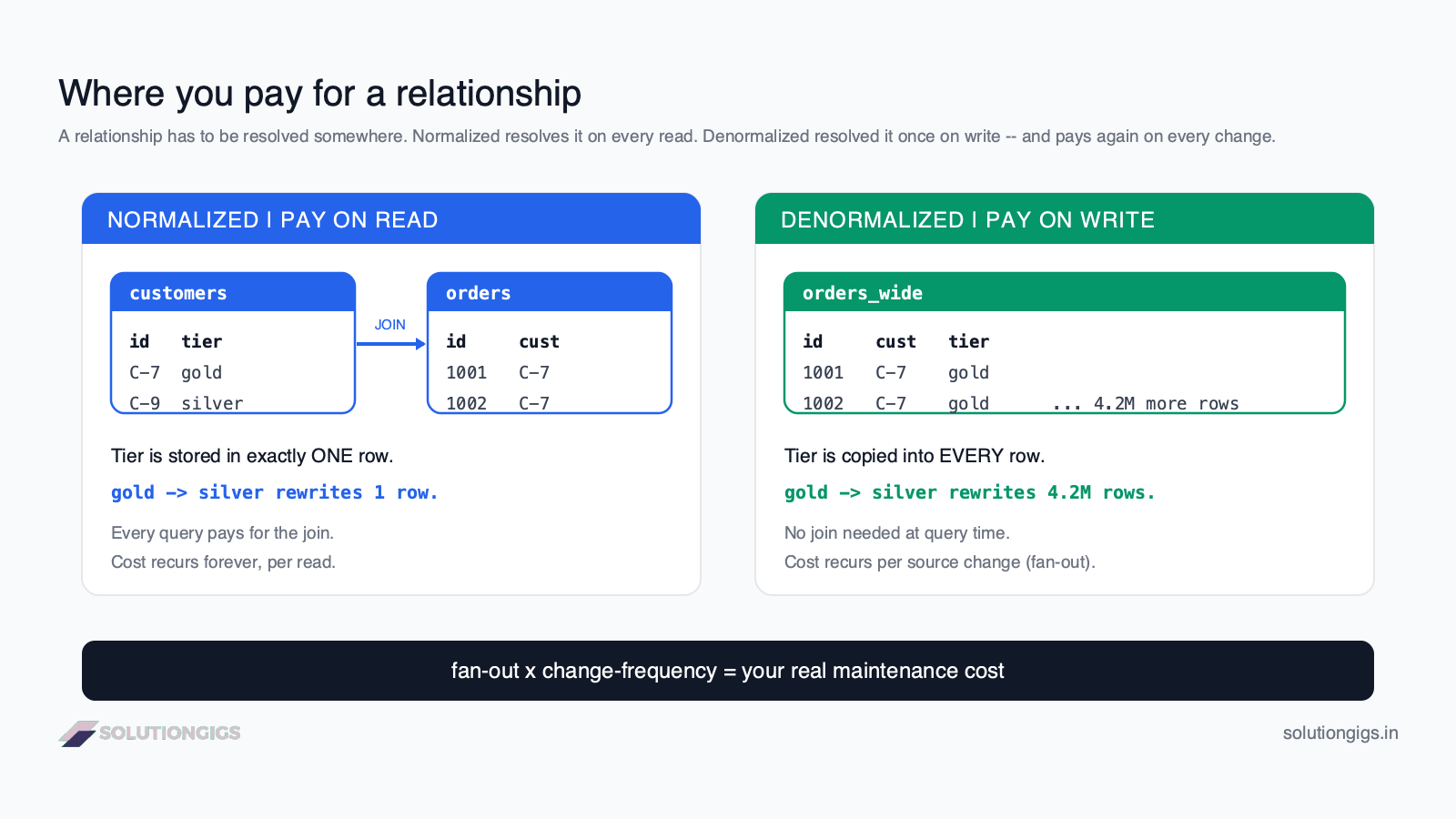
Every argument about normalization vs denormalization collapses into one question: a relationship between two entities has to be resolved somewhere — do you resolve it at read time or at write time?
- Normalized = pay at read time. The relationship is resolved by a JOIN, every single time someone queries. Cost is per-query, and it recurs forever.
- Denormalized = pay at write time. The relationship was resolved once, when you copied the value in. Cost is per-change to the source value, and it's proportional to how many rows hold the copy.
Once you see it this way, the decision stops being philosophical and becomes arithmetic.
The fan-out number nobody computes
Before you copy any column, compute its fan-out: how many rows must be rewritten when one source value changes?
fan-out = rows in target table per single row of the source table
Concrete cases:
| Denormalized column | Source | Fan-out | Verdict |
|---|---|---|---|
order_currency copied to order_lines |
1 order | ~5 lines | Trivial. Safe. |
product_category copied to order_lines |
1 product | thousands of lines | Risky if categories get reorganized |
customer_tier copied to events |
1 customer | millions of events | Dangerous — unless it's point-in-time (see below) |
company_name copied to invoices |
1 company | all their invoices, forever | Dangerous — companies rename |
The rule this gives you: fan-out × change-frequency = your true maintenance cost. A high fan-out on an immutable attribute is fine — it never changes, so the rewrite never happens. A low fan-out on a volatile attribute is also fine. High fan-out on a volatile attribute is where teams get hurt, and it's the exact combination the generic advice ("denormalize for read-heavy workloads") fails to warn you about.
The rule that has saved us the most: denormalize immutable, join mutable
At SolutionGigs we run Telemetrix, an infrastructure-monitoring platform whose metrics fact table carries billions of rows. Early on we denormalized both device_id and device_name into that table so dashboards wouldn't need a dimension join.
It worked beautifully until a customer bulk-renamed their fleet during a datacenter migration. device_name was a mutable attribute with a fan-out measured in hundreds of millions of rows. A rename that took milliseconds in the source system turned into a multi-hour backfill on our side — and until it finished, two dashboards disagreed about what the same machine was called.
The fix was small and we've applied it everywhere since:
Denormalize the key. Join the label. Copy attributes that can never change (surrogate keys, event timestamps, the amount that was actually charged). Leave attributes that can change (names, tiers, statuses, addresses) in a dimension table and resolve them at query time — where a rename costs one row.
The device_id stayed denormalized, because a surrogate key is immutable by construction. The device_name moved back into a dimension. Query latency barely moved — because on a columnar engine that dimension join is a broadcast join against a table small enough to fit in memory.
Why columnar engines changed the rules
The classic case for denormalization — "avoid joins because joins are expensive" — was built on row-store databases and 1990s disk economics, and it is substantially weaker on modern analytical engines. This is the single biggest gap in the standard explanation of this topic, and it changes real decisions.
Two things shifted:
1. A wide table is no longer expensive to read. On a columnar format like Parquet or ORC, a query reads only the columns it references. A 200-column denormalized table queried for 4 columns costs roughly what a 4-column table costs. The old penalty for wide tables — dragging unused bytes off disk on every scan — mostly disappeared. (This is the same storage physics that separates OLAP from OLTP.)
2. Dimension joins are usually free. When one side of a join is small enough to fit in memory, Spark, Snowflake, BigQuery and DuckDB all broadcast it to every worker and do a hash lookup with no shuffle. Joining a billion-row fact table to a 50,000-row customer dimension is not the expensive operation the old advice assumes. The joins that genuinely hurt are large-to-large joins — and denormalizing usually doesn't remove those anyway.
So on a modern lakehouse, "reduce I/O" is no longer a good reason to denormalize. Two good reasons remain:
- Point-in-time semantics. The copied value is not redundant data — it's history. More on this next.
- Consumer safety. A single wide table is one an analyst cannot join incorrectly. Every fan-trap and duplicate-row bug caused by a wrong join key is a bug a pre-joined table cannot produce. This is a real, underrated engineering benefit.
The point that resolves the whole debate for analytics
Here's the subtlety that generic articles miss entirely: in an analytical fact table, a copied attribute usually isn't redundant at all — because it means something different from the source.
When you store customer_tier = 'gold' on an order from March, you are not caching the customer's tier. You are recording the tier they had when the order was placed. If the customer is downgraded to silver in June, the March order must still say gold, or your historical revenue-by-tier report silently rewrites the past every time someone's status changes.
The source table holds current state. The fact table holds as-of state. Two different facts, stored once each — which means this isn't a normalization violation in the first place. It's the same insight that drives Slowly Changing Dimensions Type 2 and its Iceberg MERGE implementation, and it's why star schemas denormalize dimensions without apology.
Test to apply: ask whether a change to the source value should propagate to existing rows. If yes, it's a cache and you owe it a sync job. If no, it's a point-in-time fact and it belongs in the row permanently.
The five denormalization patterns (and what each one costs to maintain)
"Denormalize" isn't one technique — it's five, with very different maintenance bills. Pick the cheapest one that solves your problem.
| # | Pattern | What it does | Maintenance cost |
|---|---|---|---|
| 1 | Redundant column | Copy one attribute from parent into child (customer_tier on orders) |
Sync job or trigger on every source change; fan-out sized |
| 2 | Pre-joined / wide table | Materialize the join of several tables into one | Full pipeline; must rebuild or merge on any source change |
| 3 | Derived / pre-computed column | Store a computed value (line_total = qty × price) |
Recompute on write; drifts if inputs change independently |
| 4 | Aggregate / summary table | Store rollups (daily_revenue_by_region) |
Scheduled job; needs late-arriving-data handling |
| 5 | Nested / repeated column | Embed a 1:N child as an array<struct> in the parent row |
Rewrite the parent row only — no row fan-out |
Pattern 5 deserves attention because it's absent from almost every article on this topic. In columnar formats that support nested types — Parquet, and therefore Iceberg and Delta — you can denormalize a one-to-many relationship without multiplying rows:
-- Instead of one row per line item (fan-out on every order-level change),
-- keep one row per order with the lines nested inside it.
CREATE TABLE orders_wide (
  order_id      BIGINT,
  order_ts      TIMESTAMP,
  customer_id   BIGINT,
  customer_tier STRING,          -- point-in-time, immutable once written
  lines ARRAY<STRUCT<
    sku        : STRING,
    qty        : INT,
    unit_price : DECIMAL(12,2)
  >>
) USING iceberg;

-- Reads stay simple, and no join is needed to get the lines:
SELECT order_id, l.sku, l.qty
FROM orders_wide
LATERAL VIEW explode(lines) t AS l
WHERE order_ts >= current_date() - INTERVAL 7 DAYS;
This gives you the read simplicity of denormalization with the write cost of the parent table's row count, not the child's. It's the right shape for order/line-items, event/properties, and request/spans data, and it's how most event schemas should be modelled on a lakehouse.
The escalation ladder: what to try before you denormalize
Denormalization should be the fourth thing you try, not the first. A slow query is far more often a missing index than a structural problem, and every rung you climb here is cheaper to reverse than the one above it.
- Index the join and filter columns. Astonishingly often, "the join is slow" means "the foreign key isn't indexed." Free, reversible, no redundancy.
- Use a covering index. If a query reads three columns, an index containing all three answers it without touching the table at all. Still zero duplication in your schema's logical model.
- Add a materialized view. The database maintains the redundancy for you, with defined refresh semantics — see the PostgreSQL materialized views documentation for the refresh model. This is denormalization with the consistency problem still owned by the engine rather than by you — strictly better than hand-rolling it.
- Denormalize a single column, with a maintained pipeline. Now you own consistency. Only do this once you've computed the fan-out and confirmed the attribute is immutable or point-in-time.
- Build a full pre-joined wide table. A separate, pipeline-owned read model — typically the gold layer of a medallion architecture. Correct at scale, but it's a new dataset with its own SLA, tests, and backfill story.
Never skip rungs 1–3 to reach rung 4. Denormalizing to compensate for a missing index gives you the same query plan you could have had for free, plus a permanent consistency liability. We've reviewed pipelines where an entire wide-table build existed to work around one un-indexed foreign key.
Normalization vs denormalization: full comparison
| Dimension | Normalized | Denormalized |
|---|---|---|
| Core goal | Correctness — one fact, one place | Read speed and query simplicity |
| Relationship resolved | At read time (JOIN) | At write time (copy) |
| Redundancy | Minimal by design | Deliberate and controlled |
| Write cost | Low — one row per change | Proportional to fan-out |
| Read cost | Joins on every query | Few or no joins |
| Storage | Smaller | Larger (often much) |
| Update anomalies | Prevented structurally | Prevented only by your pipeline |
| Schema evolution | Easier — change one table | Harder — copies must all migrate |
| Consistency owner | The database (constraints, FKs) | Your ETL/ELT code |
| Typical home | OLTP: Postgres, MySQL, app databases | OLAP: warehouses, lakehouses, read models, caches |
| Query complexity for consumers | Higher — must know the join keys | Lower — one table, hard to get wrong |
| Best for | Frequent writes, transactional integrity | Read-heavy analytics, dashboards, event data |
One-sentence verdict: normalize your system of record, denormalize your read paths, and let a pipeline — not application code — be the thing that connects them.
Where each belongs in a real data platform
The question "should this be normalized?" has a different answer at each layer, and a healthy platform contains both. This is why ETL vs ELT and layered architectures matter: they give the redundancy a place to live with an owner attached.
- Operational database (OLTP) — Normalized to 3NF. This is the system of record; correctness beats everything. Postgres, MySQL, your application's schema.
- Raw / bronze layer — Whatever shape the source produced. Don't remodel here; fidelity to the source is the point.
- Silver / cleaned layer — Conformed and typically still fairly normalized. Deduplicated, typed, quality-checked.
- Gold / serving layer — Denormalized on purpose. Star schemas, wide tables, aggregates — shaped for the questions people actually ask.
- Application read models / caches — Aggressively denormalized, rebuilt from the system of record, and treated as disposable.
The healthiest rule of thumb: redundancy is acceptable downstream of a pipeline, and dangerous upstream of one. If a job rebuilds the copy, drift is self-healing. If two application code paths are supposed to keep two copies in sync, drift is inevitable.
Embedding vs referencing in NoSQL is the same trade
MongoDB's embed-vs-reference decision and DynamoDB's single-table design are this exact question wearing different clothes. Embedding is denormalization; referencing is normalization — and the fan-out rule transfers unchanged.
Embed when the child is owned by the parent, read with the parent, and bounded in size — order line items, address sub-documents, a post's tags. Reference when the child is shared across parents, mutated independently, or unbounded — a customer profile, a product catalog entry, a comment thread that can grow forever. Embedding a customer profile in every order is the document-database version of putting customer_email on every order row, and it fails for identical reasons. Our SQL vs NoSQL guide covers where each engine fits.
Common mistakes to avoid
1. Denormalizing before measuring. The most common one. Read the query plan first. If the plan shows a sequential scan, an index fixes it; the join was never the problem.
2. Denormalizing a mutable attribute with unbounded fan-out. Names, statuses, tiers, and addresses change. Copying them into a billion-row table means one business event triggers a billion-row rewrite. This is the Telemetrix mistake above.
3. Dual writes from application code. "We'll just update both places in the service." Two writes without a transaction spanning them will diverge — on a deploy, a timeout, a retry, a partial failure. If redundancy must exist, one job should own producing it, derived from a single source.
4. No reconciliation check. Every denormalized column needs a test that compares it against its source and alerts on drift. Without it you don't have redundancy, you have two numbers and no idea which is right. Add it to your data quality tests as a row-level equality assertion against the dimension.
5. Treating a wide table as a substitute for a data model. A 300-column table nobody can explain isn't denormalization, it's a schema that lost an argument. Model the entities and grain first, then flatten deliberately.
6. Over-normalizing analytical dimensions. The mirror-image error. Snowflaking a dimension into eight lookup tables to save a few megabytes forces every analyst to write eight joins and get one of them wrong. In a warehouse, dimension storage is cheap and analyst error is expensive.
7. Forgetting that denormalized tables need backfills. Adding a column to a wide table means recomputing history, not just writing it forward. Budget for it — and make the job idempotent before you need it at 2am.
The decision checklist
Run through these before duplicating any column. If you can't answer all six, you're not ready to denormalize.
- What's the read pattern? Which specific query is slow, and how often does it run?
- Have I climbed rungs 1–3? Index, covering index, materialized view — tried and ruled out?
- What's the fan-out? How many rows change when one source value changes?
- Is the attribute mutable? If yes, is that mutation rare enough to absorb the fan-out?
- Is it point-in-time? Should a source change propagate to old rows? If no, it isn't really redundancy.
- Who owns keeping it correct? Name the job, and name the reconciliation test that catches drift.
Building a data platform and want a second pair of eyes on the model before it's carrying production load? See how solutiongigs.in can help →
Frequently Asked Questions
What is the difference between normalization and denormalization?
Normalization stores every fact exactly once and reconstructs relationships at read time with joins. Denormalization stores some facts more than once so reads don't need those joins. The difference isn't table count — it's when you pay for a relationship. A normalized schema pays on every read; a denormalized schema pays on every write, because one changed source value must be rewritten everywhere it was copied.
When should you denormalize a database?
Denormalize when reads dominate writes, when the copied attribute is immutable or point-in-time by design, and when you've measured that joins — not missing indexes — are the actual bottleneck. Analytical fact and dimension tables, event logs, and read models serving a specific screen are good candidates. Don't denormalize a frequently-updated attribute that fans out to millions of rows.
What are the normal forms 1NF, 2NF, and 3NF?
1NF requires every column to hold a single atomic value with no repeating groups. 2NF requires that every non-key column depend on the whole composite primary key, not just part of it. 3NF requires that no non-key column depend on another non-key column. In practice 3NF is where most operational schemas stop — BCNF and higher forms solve edge cases that are rare in real applications.
Is denormalization bad practice?
No — denormalization is bad practice only when it's accidental. Deliberate, documented, pipeline-maintained redundancy is standard in analytics, caching, and read models; a star schema is denormalized by design. What's bad is redundancy nobody owns: a copied column with no sync job, no reconciliation test, and two code paths that are supposed to stay in agreement.
Do columnar databases still need denormalization?
Less than row stores do, and for different reasons. On Snowflake, BigQuery, Spark, or Parquet-backed Iceberg, a scan reads only referenced columns and small-dimension joins are broadcast joins that cost almost nothing — so the "avoid joins to save I/O" motive mostly disappears. The reasons that survive are correctness and semantics: freezing point-in-time values, and giving analysts a table they can't join incorrectly.
What is an update anomaly?
An update anomaly happens when a fact is stored in more than one row and an update changes some copies but not all, leaving the database contradicting itself. If a customer's city lives in every order row, changing it means rewriting every row; a failure partway through gives that customer two cities. Insert and delete anomalies are the related failures — being unable to record a fact, or losing one as collateral damage.
Should I embed or reference documents in MongoDB?
Embedding is denormalization and referencing is normalization, so the same rule applies. Embed when the child is owned by the parent, read with the parent, and bounded in size — an order's line items. Reference when the child is shared, independently mutated, or unbounded — a customer profile inside every order fans out across every order document ever written.
How do I keep denormalized tables in sync?
Give one pipeline sole ownership of producing the denormalized table from its sources — never dual writes from application code. Use an idempotent MERGE keyed on a stable identifier so reruns are safe, drive incremental updates from change data capture where the source supports it, and add a reconciliation test that compares the copy against its source on a schedule and alerts on drift.
Conclusion
The normalization vs denormalization debate has a bad reputation for being theoretical, but the decision is concrete once you stop asking "how many tables?" and start asking "where do I want to pay for this relationship, and how big is the bill when the source changes?"
Normalize your system of record — 3NF, foreign keys, one fact in one place. Let the database enforce correctness where correctness matters most. Then denormalize your read paths deliberately: compute the fan-out first, prefer immutable and point-in-time attributes, climb the index → covering index → materialized view ladder before duplicating anything, and make sure a pipeline owns every copy along with a test that catches drift.
And if you're working on a columnar lakehouse, update the mental model you inherited: wide tables are cheap to scan and small joins are nearly free, so the reason to flatten is no longer I/O — it's history and consumer safety. That single correction changes what you build.
If you're designing a data platform, hiring for one, or want an experienced engineer to review the model before it's carrying production traffic, post your project on solutiongigs.in and get matched with a vetted expert — it's free to post.

Mohammed Yaseen
Founder, SolutionGigs
Mohammed builds data platforms on Spark, Kafka and Iceberg, and has spent more late nights than he'd like backfilling denormalized tables that seemed like a good idea at the time. LinkedIn →