
Prompt Engineering: Production Techniques, System Prompts & Guardrails
Master prompt engineering in 2026. Learn the anatomy of a perfect prompt, zero-shot vs few-shot, chain-of-thought, role prompting, and 12 proven techniques to get expert results from ChatGPT, Claude, and Gemini.

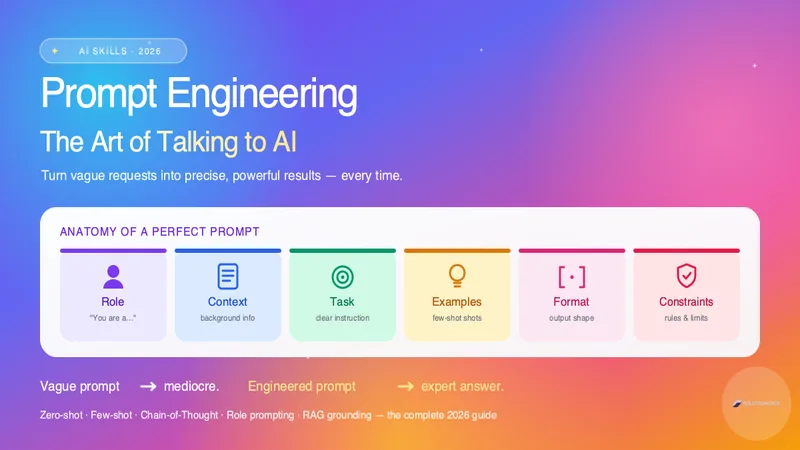
Quick Answer: Prompt engineering is the practice of crafting clear, structured instructions that get accurate, high-quality results from AI models like ChatGPT, Claude, and Gemini. The difference between a mediocre answer and an expert one is rarely the model — it's the prompt. A well-engineered prompt specifies six things: role, context, task, format, examples, and constraints. Master those, layer in techniques like few-shot and chain-of-thought prompting, and you can reliably turn any capable model into a domain expert on demand.
Here is a truth that took the industry years to accept: the same AI model can produce garbage or brilliance depending entirely on how you ask.
Type "write me a marketing email" and you'll get something generic that reads like every other AI email on the internet. But give the model a role, an audience, a goal, a tone, an example, and a set of constraints — and it will write something you'd actually send.
That gap is prompt engineering. It's the highest-leverage skill of the AI era, and unlike coding, anyone can learn it. This guide distills the field into a practical, ordered system: the mental model, the anatomy of a perfect prompt, twelve proven techniques, real before-and-after examples, and the mistakes that quietly sabotage your results.
Prefer to learn by doing? Take our free, hands-on interactive Prompt Engineering course — edit real prompts and run them against a live AI model right in your browser, then test yourself with graded missions. No signup.
What Is Prompt Engineering?
Prompt engineering is the discipline of designing inputs to AI language models so they reliably produce the outputs you want.
A large language model (LLM) is not a search engine and not a mind reader. It's a prediction engine that continues text in the most probable way based on what you give it. That means the quality, structure, and specificity of your input directly shapes the output.
Think of it like briefing a brilliant but extremely literal freelancer who has no context about your business, your audience, or your standards — but who can instantly become an expert in any field the moment you tell them to. Prompt engineering is the art of writing that brief.
Why It Matters More Than the Model
Teams often obsess over which model to use — ChatGPT vs Claude vs Gemini — when the bigger lever is usually the prompt. A well-structured prompt on a mid-tier model routinely beats a lazy prompt on a frontier model. The prompt controls:
- Accuracy — how correct and grounded the answer is
- Format — whether you get clean JSON, a table, or a wall of text
- Tone — professional, casual, technical, persuasive
- Reliability — whether you get the same quality every single time
The Anatomy of a Perfect Prompt
Almost every high-performing prompt contains some combination of these six building blocks. You don't always need all six, but knowing them turns prompting from guesswork into engineering.
1. Role
Tell the model who it is. This activates the right knowledge, vocabulary, and standards.
"You are a senior financial analyst with 15 years of experience in SaaS metrics."
2. Context
Give it the background it needs — your situation, audience, data, or goals. The model can't use information it doesn't have.
"Our startup sells project management software to small marketing agencies in India. Our churn rose from 3% to 6% last quarter."
3. Task
State exactly what you want done — clearly and unambiguously. Use action verbs.
"Identify the three most likely causes of this churn increase and recommend one experiment to test each."
4. Format
Specify how the output should be structured. This is one of the most underused, highest-impact levers.
"Return a markdown table with columns: Cause, Evidence to look for, Experiment, Success metric."
5. Examples
For nuanced tasks, show the model what good looks like. One or two examples often beat a paragraph of description.
"Example of the tone I want: 'Churn is a symptom, not a disease. Let's find the disease.'"
6. Constraints
Set the rules and limits — length, tone, what to avoid, what to assume.
"Keep it under 200 words. Avoid jargon. Do not recommend anything that costs more than ₹10,000 to test."
Put those together and you've transformed "why are we losing customers?" into a prompt that returns a boardroom-ready analysis.
Zero-Shot vs Few-Shot Prompting
These two terms describe how many examples you give the model, and choosing correctly is fundamental.
Zero-Shot Prompting
You give an instruction with no examples. Modern models are strong enough that zero-shot works well for common, well-understood tasks.
Classify the sentiment of this review as Positive, Negative, or Neutral:
"The app is fast but crashes every time I export a PDF."
Zero-shot is fast and clean. Use it when the task is simple and the model clearly understands what you want.
Few-Shot Prompting
You provide two or more examples of the input-output pattern before the real task. This teaches the model the exact format, style, and edge-case handling you expect.
Classify sentiment and extract the main issue. Follow these examples:

Review: "Love the design, but it's too expensive."
→ Sentiment: Mixed | Issue: Pricing

Review: "Works perfectly, no complaints!"
→ Sentiment: Positive | Issue: None

Review: "The app is fast but crashes when exporting a PDF."
→
Few-shot dramatically improves consistency for structured outputs, custom formats, and nuanced judgment tasks. When you need the same shape of answer every time, use few-shot.
12 Proven Prompt Engineering Techniques
Here are the techniques that consistently move results from "okay" to "excellent."
1. Assign a Specific Role
"You are an expert X" primes the model with the right expertise. Be specific: "senior React developer" beats "programmer."
2. Use Chain-of-Thought (Ask It to Reason)
For math, logic, and multi-step problems, tell the model to think step by step before answering. This alone can turn wrong answers into right ones.
Work through this step by step, showing your reasoning, then give the final answer.
The model's intermediate reasoning acts as scratch space, sharply improving accuracy on complex problems. This is the same principle behind AI reasoning models, which do this automatically.
3. Provide Examples (Few-Shot)
Show, don't just tell. Two good examples often outperform three paragraphs of instructions.
4. Specify the Output Format
Ask explicitly for JSON, markdown, a table, or a numbered list. For applications, request strict JSON:
Respond ONLY with valid JSON matching this schema:
{ "sentiment": "string", "confidence": 0-1, "issues": ["string"] }
5. Break Complex Tasks Into Steps
Instead of one giant request, decompose it. "First summarize the document. Then extract action items. Then draft an email." Sequential structure reduces errors.
6. Give the Model an "Out"
Tell it what to do when unsure: "If the answer isn't in the provided text, say 'Not found in the document.'" This dramatically reduces hallucinations.
7. Use Delimiters to Separate Sections
Wrap inputs in clear markers so the model knows what's data versus instruction:
Summarize the text between the triple backticks.
[user content here]
8. Set the Tone and Audience
"Explain like I'm a beginner" versus "Explain for a PhD audience" produces completely different, appropriately-pitched answers.
9. Ask for Multiple Options
"Give me three distinct approaches, each with a trade-off" surfaces better thinking than asking for a single answer.
10. Iterate and Refine
Treat the first output as a draft. "Make it more concise," "add a counter-argument," "rewrite in a warmer tone." Prompting is a conversation, not a one-shot.
11. Use System Prompts for Persistent Rules
In apps and APIs, put stable instructions (role, tone, rules) in the system prompt and the specific request in the user message. This keeps behavior consistent across a whole conversation.
12. Ground It With Real Data (RAG)
For factual, up-to-date, or private information, don't rely on the model's memory — feed it the source material. This is Retrieval-Augmented Generation, and it's how you make AI answer accurately about your data. See our guides on building a RAG pipeline and vector databases for the full picture.
Before and After: Prompts in Action
Nothing teaches prompt engineering like a direct comparison.
Example 1: Writing
❌ Weak prompt:
Write a LinkedIn post about our new feature.
Result: A generic, forgettable post that could belong to any company.
✅ Engineered prompt:
You are a B2B content strategist. Write a LinkedIn post announcing our new one-click PDF export feature. Audience: busy operations managers at mid-size companies. Goal: drive trial sign-ups. Tone: confident but not salesy. Structure: a relatable pain-point hook, three short benefit lines, one soft CTA. Keep it under 120 words. Avoid buzzwords like "revolutionary" or "game-changer."
Result: A post you'd actually publish.
Example 2: Coding
❌ Weak prompt:
Fix this function.
✅ Engineered prompt:
You are a senior Python developer. This function throws a KeyError when the
userdict is missing an
Example 3: Analysis
❌ Weak prompt:
Analyze this data.
✅ Engineered prompt:
You are a data analyst. Below is our monthly revenue for the last 12 months. Identify the top three trends, flag any anomaly, and state one hypothesis for what caused it. Present findings as a bulleted executive summary under 150 words, then a short table of the numbers you referenced.
The pattern is always the same: specificity in, quality out.
Context Engineering: What Prompting Grew Into
As AI moved from chat toys to production systems and autonomous agents, prompt engineering evolved into a broader discipline: context engineering.
Where prompt engineering focuses on the wording of a single instruction, context engineering focuses on managing everything the model sees at inference time:
- The system prompt (persistent rules and role)
- Retrieved documents from a vector database (RAG)
- Conversation history and summaries
- Tool outputs from function calls
- Memory of past interactions
For anyone building AI applications or AI agents, context engineering is now the core skill. The prompt is just one input; the real craft is assembling the right context, in the right order, within the model's context window — and, more often than people expect, removing context rather than adding it. Our full guide to context engineering covers the research on why long contexts degrade and the four techniques that fix it. If you're building agents, our guide on AI agent skills goes deeper on structuring reusable capabilities.
See how SolutionGigs can help → If you're building an AI product and need someone who understands prompting, RAG, and agent design, post your project on solutiongigs.in and get matched with a vetted AI engineer.
Common Prompt Engineering Mistakes to Avoid
| ❌ Mistake | ✅ Fix |
|---|---|
| Being vague ("make it better") | Specify exactly what "better" means |
| No role or context | Assign expertise and give background |
| Asking for too much at once | Break into sequential steps |
| Not specifying format | Request JSON, tables, or structure explicitly |
| Ignoring hallucinations | Give an "out" and ground with real data |
| One-and-done prompting | Iterate — treat outputs as drafts |
| Burying the instruction | Put the key task up front and use delimiters |
| Over-explaining instead of showing | Provide 1–2 concrete examples |
Prompt Engineering Across Different Models
The core principles are universal, but each model has a personality:
- ChatGPT (OpenAI): Excellent all-rounder; responds well to explicit structure and system prompts.
- Claude (Anthropic): Strong at long-context tasks, nuanced writing, and following detailed instructions; responds well to XML-style tags for structure.
- Gemini (Google): Deeply integrated with Google's ecosystem and strong at multimodal tasks.
- Image models (Midjourney, GPT Image, FLUX): The same rule applies, but the failure mode inverts: text models reward structure and length, image models reward one plain descriptive sentence and punish keyword piles ("8k, masterpiece, trending"). Control comes from parameters rather than instructions — aspect ratio, stylize, style references — which is why they deserve their own grammar; our Midjourney AI guide has an interactive builder that teaches it.
A well-engineered prompt is largely portable across all three text models — which is exactly why the skill is worth investing in. Learn the fundamentals once, apply them everywhere. If you want to run models locally and experiment freely, see our Ollama tutorial and best open-source LLMs guides.
Frequently Asked Questions
What is prompt engineering?
Prompt engineering is the practice of designing clear, structured instructions to get accurate, useful outputs from AI language models like ChatGPT, Claude, and Gemini. It involves specifying the role, context, task, format, and constraints so the model produces exactly what you need instead of a vague or generic answer.
What is role prompting in AI?
Role prompting tells the model who it is before giving a task — for example, "You are a senior financial analyst." This activates the right knowledge, vocabulary, and reasoning standards. Specific roles consistently outperform generic ones: "senior React developer" produces sharper code than "programmer" because it narrows the model's prior toward expert-level output.
What is zero-shot vs few-shot prompting?
Zero-shot prompting gives the model an instruction with no examples; it works well for simple, well-understood tasks. Few-shot prompting provides two or more input-output examples first, teaching the model the exact format, edge-case handling, and style you expect. Use few-shot whenever you need consistent structure or nuanced judgment in the output.
What is chain-of-thought prompting?
Chain-of-thought prompting asks the model to reason step by step before giving a final answer. Adding "Work through this step by step" or "Show your reasoning" forces the model to use intermediate steps as scratch space, which dramatically improves accuracy on math, logic, and multi-step problems where jumping straight to an answer produces errors.
How do I write a system prompt for Claude or ChatGPT?
A system prompt sets the persistent role, tone, and rules for the entire conversation. Include: the model's persona, the audience it serves, output format defaults, what to avoid, and an escape instruction for uncertainty (e.g., "If unsure, say so"). Keep it focused — a tight 150-word system prompt outperforms a rambling 600-word one in consistency and reliability.
What is one-shot prompting and when is it useful?
One-shot prompting provides exactly one example of the desired input-output pattern before the real task. It sits between zero-shot (no examples) and few-shot (two or more). Use it when you have a clear, simple format to demonstrate but want to keep the prompt short — ideal for tone-setting or custom output structures with low variance.
Conclusion
Prompt engineering is the closest thing the AI era has to a superpower: a learnable skill that multiplies what every model can do for you. The models will keep getting smarter, but the fundamental leverage never disappears — the clearer and more structured your instructions, the more expert the output.
Start with the anatomy: role, context, task, format, examples, constraints. Layer in chain-of-thought for hard problems, few-shot for consistency, and grounding for facts. Treat every output as a draft and iterate. Do this, and you'll consistently pull expert-level work out of any AI you touch.
The people who thrive in the AI era won't be the ones who resist it — they'll be the ones who learn to communicate with it precisely. Want to build your coding and AI logic fundamentals? Explore our hands-on guide to learning programming interactively or dive directly into the free Interactive Programming Handbooks.
Building an AI-powered product and need real expertise in prompting, RAG, and agent design? SolutionGigs connects you with vetted AI engineers who ship production AI systems. Post your project on solutiongigs.in today — it's free to post →
Mohammed Yaseen
Founder, SolutionGigs
Mohammed builds AI products and has written prompts and context pipelines for chatbots, RAG systems, and autonomous agents in production. He founded SolutionGigs to connect teams with engineers who understand how to make AI actually work. LinkedIn →
More in AI & Machine Learning
Role Prompting: Give Your AI a Job Title and Watch It Perform
Role prompting assigns a specific expert persona to an AI model — 'Act as a senior data engineer' or 'You are a skeptical CFO' — so it responds from that professional frame. Why it works, 12 copy-paste role prompts for technical and non-technical tasks, common mistakes, and how to combine it with few-shot and chain-of-thought for expert-level output.
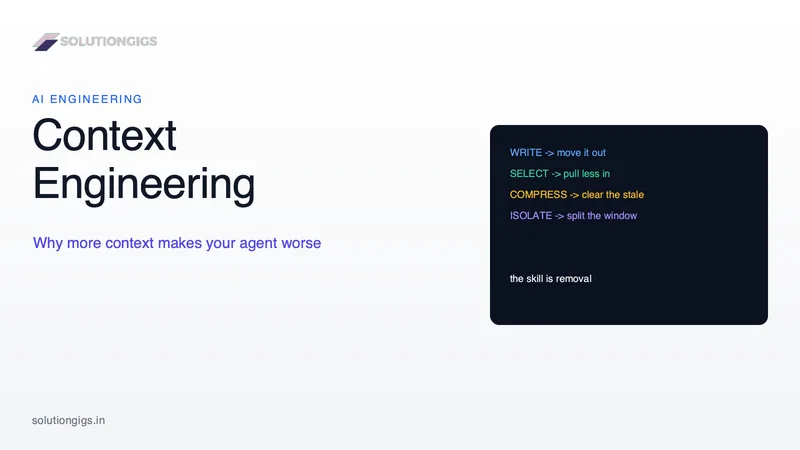
Context Engineering: The Skill That Replaced Prompt Engineering
Context engineering replaced prompt engineering as the core AI skill, and its central finding is counterintuitive: more context usually makes an agent worse. This guide covers the research behind context rot (Chroma's 18-model study), the four failure modes you'll actually hit in production, the write/select/compress/isolate techniques that fix each one, a worked token budget showing where your context really goes, and Anthropic's measured 29%/39% gains from clearing stale context. Every number cited.
10 Free AI Developer Tools (No Signup)
10 free AI developer tools with no signup — generate SQL, Docker Compose, Kubernetes YAML, Terraform, MCP servers, READMEs and more from plain English. Try them free.