
Best Open Source LLMs: Free Models Ranked
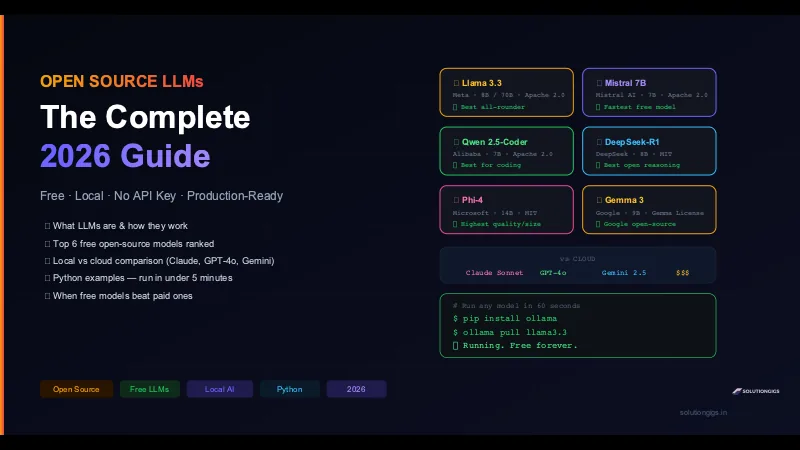
The best free open-source LLMs of 2026, ranked: Llama 3.3, Qwen 2.5-Coder, DeepSeek-R1, Phi-4, Mistral & Gemma — with Python examples and when they beat GPT-4o.

Quick Answer
LLMs (Large Language Models) are AI systems trained on massive text datasets to understand and generate human language. As of mid-2026, the open-weight frontier is led by the DeepSeek V4, GLM-5, Qwen 3.5/3.6, Kimi K2, MiniMax M3 and Llama 4 families, with Gemma 3 and Phi-4 the easiest to self-host on consumer hardware. Most run locally for free via Ollama. For the hardest tasks, proprietary frontier models — Claude Opus 5 and Claude Sonnet 5 (Anthropic), and the current OpenAI and Google flagships — still lead, though the gap has narrowed considerably over the past year.
In 2024, running a capable LLM meant paying OpenAI. In 2026, the open-source ecosystem has caught up to a degree that would have seemed impossible two years ago.
Updated July 2026 — read this before the model rankings below. This space moves faster than any static ranking survives. The specific versions named in the sections that follow (Llama 3.3, Qwen 2.5, DeepSeek-R1, Mistral 7B) were the leaders when this guide was first written, and the reasoning about how to choose still holds — but each has been superseded. The current open-weight frontier is the DeepSeek V4, GLM-5, Qwen 3.5/3.6, Kimi K2, MiniMax M3 and Llama 4 families. Treat the model names below as illustrative and check a live leaderboard — Artificial Analysis or the Hugging Face Open LLM Leaderboard — before committing to one. The durable lesson: pick by license, VRAM budget and task fit, not by whichever model topped a benchmark the week you read about it. To work out your VRAM budget properly rather than guessing from a table, see our local LLM hardware sizing guide — weights are roughly
params_B × 0.62at Q4_K_M, and the KV cache is often larger than the model itself.
Meta released the Llama 4 family, including Scout with its very large context window. Alibaba's Qwen line reached 3.5 and 3.6 under Apache 2.0. DeepSeek followed R1 with the V4 series under MIT. Zhipu's GLM-5 series and Moonshot's Kimi K2 pushed agentic coding further. Microsoft's Phi models and Google's Gemma remain the strongest small models for consumer GPUs.
Developers have figured out that for the majority of real tasks, you don't need to pay per token — and the gap between the best open-weight models and the proprietary frontier has narrowed markedly over the past year, though it has not closed.
This guide explains what LLMs actually are, ranks the best free options in 2026, shows you how to run them in Python in under five minutes, and gives you a clear framework for deciding when free is good enough — and when it isn't.
What Is an LLM? (Plain English)
LLM stands for Large Language Model.
It's a type of artificial intelligence trained on enormous amounts of text — web pages, books, code, scientific papers, forums — to learn the patterns of human language.
How training works:
During training, the model sees billions of text fragments and learns to predict the next word given everything before it. If the input is "The capital of France is", the model learns that "Paris" should come next. Repeated trillions of times across trillions of examples, the model develops something that functions like language understanding, reasoning, and knowledge.
Training (done once, by the model creator):
  Huge text dataset → Neural network → Predict next token → Adjust weights → Repeat

Inference (done by you, every time you use it):
  Your prompt → Model → Generated response
What "large" means:
The "large" in LLM refers to the number of parameters — the numerical weights that encode everything the model learned. Modern models range from:
| Size | Parameters | Example | Typical RAM |
|---|---|---|---|
| Small | 1B–7B | Phi-4 mini, Mistral 7B | 4–8GB |
| Medium | 8B–32B | Llama 3.3 8B, Phi-4 14B | 8–20GB |
| Large | 70B–405B | Llama 3.3 70B, Llama 3.1 405B | 40GB+ |
| Frontier | Unknown (est. 1T+) | GPT-4o, Claude Sonnet, Gemini 2.5 | Cloud only |
More parameters generally means better quality — but the gap between a well-trained 8B model and a frontier model is much smaller than it was two years ago.
What's the Difference Between Open Source, Open Weight, and Closed LLMs?
This distinction matters when you're deciding which model to use in production.
Open weight (commonly called "open source"): The trained model weights are publicly released. You can download, run, and fine-tune the model. The training data and full code may not be released. Examples: Llama 3.3, Mistral, Qwen 2.5, Phi-4.
Fully open source: Weights + training code + training data are all public under an open license. Examples: OLMo (Allen AI), Falcon 2 (TIIUAE). Rarer, because releasing training data is expensive to curate and legally complex.
Closed / proprietary: Weights are never released. Access is only through a paid API. Examples: GPT-4o (OpenAI), Claude Sonnet (Anthropic), Gemini 2.5 Pro (Google).
For most developers, "open weight" is good enough. You get the full model — you just don't get the recipe used to bake it.
The 6 Best Free Open Source LLMs in 2026
1. Llama 3.3 — Meta's Best Open Model
Best for: General use, chat, summarization, instruction following
ollama pull llama3.3        # 4.7GB, 8B parameters
ollama pull llama3.3:70b    # 40GB, 70B parameters (GPU recommended)
Meta's Llama 3.3 is the most widely deployed open-source LLM in 2026. The 8B version fits in 8GB RAM and handles the majority of real-world tasks — summarization, Q&A, drafting, basic code, classification — at a quality level competitive with GPT-3.5.
The 70B version narrows the gap with GPT-4o significantly, especially on reasoning-heavy tasks.
License: Llama 3 Community License (free for commercial use under 700M monthly active users)
Quick Python example:
from openai import OpenAI

client = OpenAI(base_url="http://localhost:11434/v1", api_key="ollama")

response = client.chat.completions.create(
    model="llama3.3",
    messages=[
        {"role": "system", "content": "You are a concise technical assistant."},
        {"role": "user", "content": "Summarize the key differences between REST and GraphQL."}
    ]
)
print(response.choices[0].message.content)
2. Qwen 2.5-Coder — Alibaba's Coding Specialist
Best for: Code generation, debugging, code review, SQL
ollama pull qwen2.5-coder       # 4.7GB, 7B parameters
ollama pull qwen2.5-coder:32b   # 19GB, 32B parameters
Qwen 2.5-Coder consistently outperforms Llama 3.3 on coding benchmarks. On HumanEval (Python code generation), the 7B model scores 88% — higher than GPT-3.5 Turbo. On real-world software engineering tasks (SWE-bench), the 32B version approaches Claude Sonnet's performance.
If you're building a coding assistant, code reviewer, or SQL generator — start with Qwen 2.5-Coder, not Llama.
License: Apache 2.0 (fully commercial-friendly)
response = client.chat.completions.create(
    model="qwen2.5-coder",
    messages=[{
        "role": "user",
        "content": "Write a Python function to validate an email address using regex. Include docstring and edge case handling."
    }]
)
print(response.choices[0].message.content)
3. DeepSeek-R1 — The Free Reasoning Model
Best for: Math, logic puzzles, multi-step reasoning, algorithm design
ollama pull deepseek-r1:8b   # 4.9GB, 8B parameters
ollama pull deepseek-r1:32b  # 19GB, 32B parameters
DeepSeek-R1 is the open-source world's answer to OpenAI o3. Like Claude's extended thinking and OpenAI's o-series, it generates an internal chain of thought before producing a final answer — letting it tackle problems that trip up standard fast models.
On MATH benchmark, DeepSeek-R1 8B scores within 5 percentage points of Claude Sonnet — remarkable for a free, locally-runnable model.
License: MIT (most permissive possible — fully open for any use)
# The model thinks before answering — responses take longer but are more accurate
response = client.chat.completions.create(
    model="deepseek-r1:8b",
    messages=[{
        "role": "user",
        "content": "A train leaves Chicago at 60 mph. Another leaves New York at 80 mph. They are 800 miles apart. When and where do they meet? Show your working."
    }]
)
# The model will show its reasoning before the final answer
print(response.choices[0].message.content)
Read more about how reasoning models work in our AI reasoning models guide.
4. Phi-4 — Microsoft's Efficiency Champion
Best for: High-quality output when GPU RAM is limited, instruction following
ollama pull phi4 # 9.1GB, 14B parameters
Phi-4 is Microsoft's most impressive model in terms of quality-per-parameter. The 14B model consistently outperforms many 32B models from other providers on reasoning and instruction-following benchmarks.
The insight behind Phi: most large models are trained on enormous amounts of low-quality web text. Phi is trained on carefully curated, high-quality "textbook-quality" data — doing more with less.
License: MIT
response = client.chat.completions.create(
    model="phi4",
    messages=[
        {"role": "system", "content": "You are an expert technical writer."},
        {"role": "user", "content": "Explain how a database index works to a junior developer, using a real-world analogy."}
    ]
)
print(response.choices[0].message.content)
5. Mistral 7B — The Fast Baseline
Best for: High-throughput pipelines, quick responses, low-RAM environments
ollama pull mistral # 4.1GB, 7B parameters
Mistral 7B was the model that proved small open-source LLMs could be genuinely useful. It generates faster than Llama 3.3 and uses slightly less RAM, making it the right choice when you're running many parallel requests or have tight latency requirements.
Quality is slightly below Llama 3.3 on most benchmarks, but the speed difference is meaningful in production pipelines.
License: Apache 2.0
6. Gemma 3 — Google's Open Model
Best for: Google ecosystem integration, multimodal tasks, long context
ollama pull gemma3     # 5.5GB, 9B parameters
ollama pull gemma3:27b # 17GB, 27B parameters
Google's Gemma 3 series is the open-source counterpart to Gemini. The 27B model handles 128K token context windows — excellent for long document analysis. It's also the best-supported model for integration with Google's tooling ecosystem.
License: Gemma Terms of Use (free for most uses, review for high-scale commercial deployment)
Open Source vs Cloud LLMs: Honest Comparison
This is the decision most developers actually need to make.
| Criterion | Open Source (Local) | Cloud (GPT-4o / Claude / Gemini) |
|---|---|---|
| Cost | Free after hardware | $0.002–$0.015 per 1K tokens |
| Quality (simple tasks) | 85–95% of cloud | 100% baseline |
| Quality (complex reasoning) | 70–85% of cloud | 100% baseline |
| Privacy | 100% — data never leaves | Data sent to provider |
| Latency | 5–80 tok/sec (hardware-dependent) | 50–150 tok/sec (varies) |
| Rate limits | None | Provider-imposed |
| Context window | 8K–128K depending on model | 128K–1M |
| Setup | 5 minutes | Instant (just an API key) |
| Multimodal | Some models (LLaVA, Gemma) | Full support (images, audio, video) |
The practical rule at solutiongigs.in: Use a free local model for prototyping and for tasks where it scores >90% of your quality bar. Move to GPT-4o or Claude Sonnet when you need frontier accuracy, multimodal input, or very long context.
Run Any Open Source LLM in Python — 5-Minute Setup
Step 1: Install Ollama
curl -fsSL https://ollama.com/install.sh | sh  # macOS / Linux
# Windows: download installer from ollama.com
Step 2: Pull a model
ollama pull llama3.3        # general use
ollama pull qwen2.5-coder   # coding
ollama pull deepseek-r1:8b  # reasoning
Step 3: Call from Python
pip install openai
from openai import OpenAI

client = OpenAI(
    base_url="http://localhost:11434/v1",
    api_key="ollama"
)

def ask_local_llm(model: str, prompt: str) -> str:
    response = client.chat.completions.create(
        model=model,
        messages=[{"role": "user", "content": prompt}],
        temperature=0.7
    )
    return response.choices[0].message.content

# Try different models on the same prompt
prompt = "What are the pros and cons of microservices architecture?"

print("=== Llama 3.3 ===")
print(ask_local_llm("llama3.3", prompt))

print("\n=== Mistral ===")
print(ask_local_llm("mistral", prompt))

print("\n=== Phi-4 ===")
print(ask_local_llm("phi4", prompt))
For a complete guide including streaming, structured output, and local RAG, see the Ollama Python tutorial.
When to Use Which Model: Decision Framework
Is the task simple? (summarize, classify, extract, draft)
  └─ YES → Llama 3.3 8B or Mistral (fast, free, good enough)

Is the task coding or SQL?
  └─ YES → Qwen 2.5-Coder (best local coding model)

Does it require multi-step reasoning or math?
  └─ YES → DeepSeek-R1 8B (reasoning model, slower but much better)

Do you have 16GB RAM and want the best local quality?
  └─ YES → Phi-4 14B (punches well above its parameter count)

Is data privacy critical? (medical, legal, financial)
  └─ YES → Any local model — data never leaves your machine

Is the task extremely hard? (complex agent, frontier reasoning)
  └─ YES → Claude Sonnet 4.6 or GPT-4o (cloud, best quality)

Do you need vision / multimodal?
  └─ YES → Gemma 3 (local) or GPT-4o / Claude (cloud)
Build a Free Local Chatbot in 20 Lines
Here's a fully working interactive chatbot using a local LLM — zero API cost, zero cloud dependency:
from openai import OpenAI

client = OpenAI(base_url="http://localhost:11434/v1", api_key="ollama")

MODEL = "llama3.3"  # change to any pulled model
SYSTEM = "You are a helpful assistant. Be concise and accurate."

conversation = [{"role": "system", "content": SYSTEM}]

print(f"Chatting with {MODEL} — type 'quit' to exit\n")

while True:
    user_input = input("You: ").strip()
    if user_input.lower() in ("quit", "exit", "q"):
        break
    if not user_input:
        continue

    conversation.append({"role": "user", "content": user_input})

    response = client.chat.completions.create(
        model=MODEL,
        messages=conversation,
        stream=True
    )

    print("LLM: ", end="", flush=True)
    full_response = ""
    for chunk in response:
        token = chunk.choices[0].delta.content or ""
        print(token, end="", flush=True)
        full_response += token

    print()  # newline
    conversation.append({"role": "assistant", "content": full_response})
Run it:
python3 chatbot.py
Full conversation history is maintained automatically — the model remembers everything said in the session. To add document Q&A, see our RAG pipeline tutorial.
LLMs in Production: What Actually Runs at Scale
For reference, here is what the major cloud providers run in production:
| Provider | Model | Strengths | API Cost (output) |
|---|---|---|---|
| Anthropic | Claude Sonnet 4.6 | Best at coding + reasoning, safest outputs | ~$15/M tokens |
| OpenAI | GPT-4o | Fastest frontier model, great tool calling | ~$10/M tokens |
| Gemini 2.5 Pro | Best long-context (1M tokens), multimodal | ~$7/M tokens | |
| Meta | Llama 3.3 70B | Best open-weight, free to self-host | Free (self-host) |
| Mistral | Mistral Large 2 | European alternative, strong multilingual | ~$2/M tokens |
Search interest in Anthropic is up +60% — driven by Claude Sonnet 4.6's dominance on coding benchmarks. Gemini is up +30% — Google's aggressive pricing and the 1M context window are converting developers. Both are worth evaluating alongside open-source options.
Frequently Asked Questions
What is an LLM?
An LLM (Large Language Model) is an AI trained on massive text datasets to understand and generate human language. It works by learning to predict the next word given everything before it — repeated billions of times until the model develops language understanding, reasoning, and knowledge. GPT-4o, Claude, Gemini, Llama 3.3, and Mistral are all LLMs.
What are the best free open source LLMs in 2026?
The top free open-source LLMs in 2026 are: Llama 3.3 (Meta, best all-rounder), Qwen 2.5-Coder (best for code), DeepSeek-R1 (best reasoning, MIT license), Phi-4 (Microsoft, best quality-per-parameter), Mistral 7B (fastest), and Gemma 3 (Google, best long context). All run locally via Ollama with no API cost.
What does LLM stand for?
LLM stands for Large Language Model. "Large" = billions of parameters. "Language" = trained on text. "Model" = a neural network (specifically the Transformer architecture). In technology contexts it always refers to AI. The legal abbreviation LLM (Master of Laws) is a separate, unrelated term.
Can I run an LLM locally for free?
Yes. Install Ollama, run ollama pull llama3.3, and call it from Python via the OpenAI-compatible API at localhost:11434. 8GB RAM handles 7B parameter models. No internet required after the initial download, no API key, no usage cost.
How do open source LLMs compare to GPT-4o and Claude?
On simple tasks (summarization, extraction, drafting), Llama 3.3 70B and Qwen 2.5 72B are within 10–15% of GPT-4o and Claude Sonnet. On complex reasoning and hard coding, the gap is 20–30%. DeepSeek-R1 closes the reasoning gap significantly. Use free local models for the 80% of tasks where they're good enough; use cloud for the 20% that require frontier accuracy.
What is the difference between open source and open weight LLMs?
Open weight means the trained model weights are publicly released (you can download and run them), but training data may not be. Open source means weights + training code + training data are all public. Most models called "open source" (Llama, Mistral, Qwen) are technically open weight. The distinction rarely matters for developers — you can run, fine-tune, and deploy open-weight models freely.
What is the best LLM for coding in 2026?
For free/local models: Qwen 2.5-Coder 7B — outperforms Llama 3.3 on HumanEval and SWE-bench. DeepSeek-R1 8B for algorithmic problems. For cloud: Claude Sonnet 4.6 leads on real-world software engineering tasks. For IDE integration: GitHub Copilot or Continue.dev with a local Ollama model.
Conclusion
The open-source LLM ecosystem in 2026 is genuinely competitive with where GPT-3.5 was 18 months ago. For most production workloads, a free local model is a legitimate option — not a compromise.
The practical starting point:
- General tasks →
ollama pull llama3.3 - Coding →
ollama pull qwen2.5-coder - Reasoning / math →
ollama pull deepseek-r1:8b - Highest local quality →
ollama pull phi4 - Need the frontier → Claude Sonnet 4.6 or GPT-4o
The right approach isn't "pick one model forever" — it's building a pipeline that routes tasks to the cheapest model that handles them well, and escalates to a cloud model only when needed.
To go deeper, see our guides on running LLMs locally with Ollama, building a RAG pipeline in Python, and understanding AI reasoning models.
Need help choosing or deploying the right LLM stack for your product? SolutionGigs connects you with AI engineers who have shipped production LLM systems — free to post.
Mohammed Yaseen
Founder, SolutionGigs
Mohammed builds AI-powered developer tools and has shipped production LLM pipelines using both open-source and cloud models. He evaluates new models regularly across real engineering tasks — not just benchmarks. LinkedIn →
More in AI Development
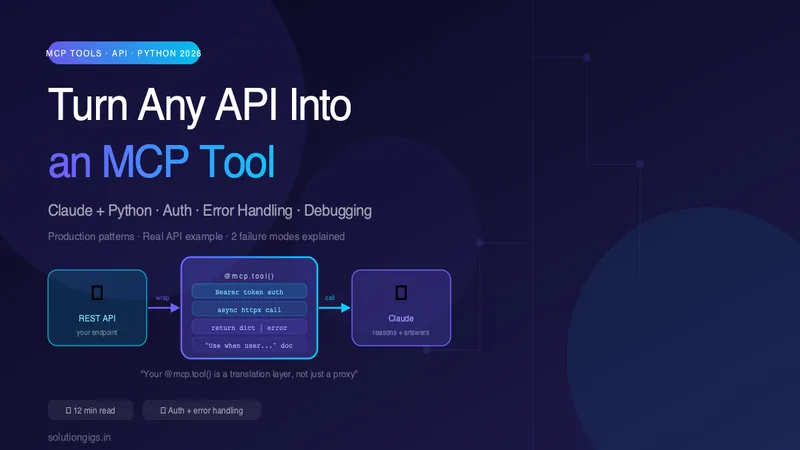
Turn Any API Into an MCP Tool: Claude + Python Tutorial
Got an existing API? Wrap it as an MCP tool so Claude can call it directly — real example with Bearer token auth, structured error returns, and the 2 failure modes that break most MCP servers in production.
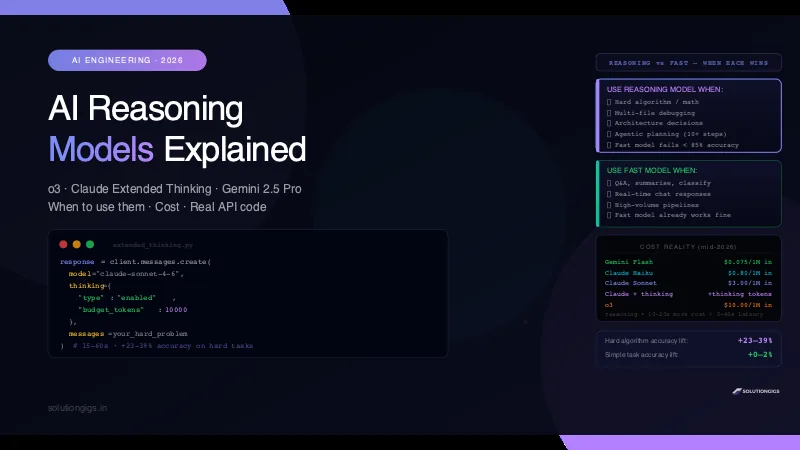
AI Reasoning Models Explained: When to Use Them
o3, Claude extended thinking, Gemini 2.5 Pro thinking mode — what AI reasoning models actually do, when they beat fast models by 23–39% accuracy, when they're overkill, real API code, and a decision framework for production.
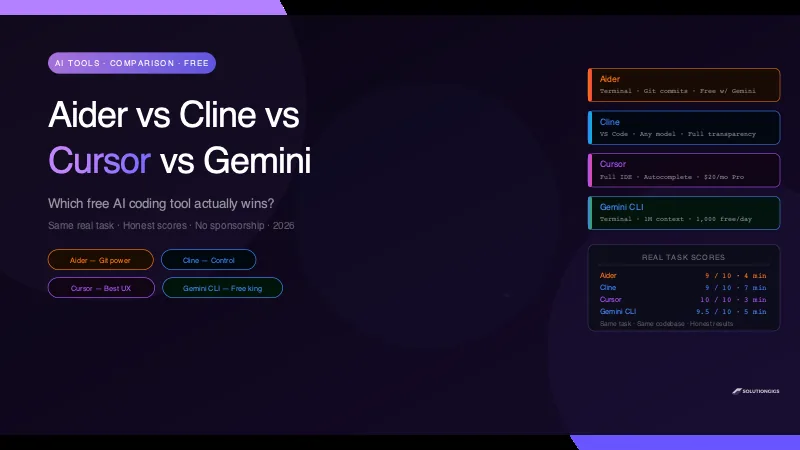
Aider vs Cline vs Cursor vs Gemini CLI: Which Free AI Coding Tool Wins?
I gave Aider, Cline, Cursor, and Gemini CLI the exact same real task and scored them on speed, quality, cost, and ease of setup. Honest results — no sponsorship, including where each tool breaks.