
What Are AI Agents? Types, Intelligence & Rational Agents Explained
AI agents perceive their environment and take actions to reach goals. Discover the 5 types, rational agents, intelligent agents, logical agents, and more. Full 2026 guide.

Quick Answer
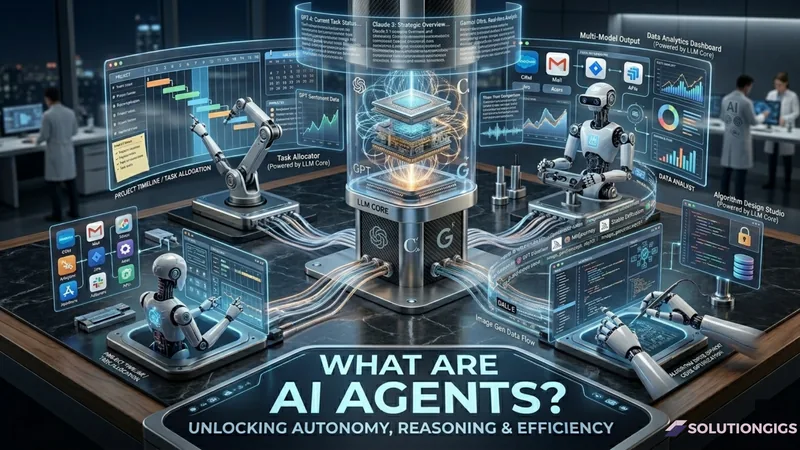
AI agents are autonomous software programs that perceive their environment, reason about it, and take actions to achieve goals — without needing step-by-step human instructions.
There are 5 types: Simple Reflex, Model-Based, Goal-Based, Utility-Based, and Learning agents. Each varies in intelligence, memory, and decision-making ability.
The question "what are AI agents?" has become one of the most-searched tech topics of 2026. Whether you're a student studying for an AI exam, a developer building intelligent systems, or a business leader evaluating AI automation — this guide explains everything from first principles to the cutting edge.
We'll cover what an AI agent is, the PEAS framework, all 5 agent types with architecture diagrams, what makes an agent rational or intelligent, logical agents, and what future agents will look like.
What Are AI Agents?
AI agents are defined as: autonomous software entities that perceive inputs from their environment through sensors, process that information using an internal program, and produce actions through actuators — all in pursuit of a goal.
The term "agent" comes from the Latin agere — to act. An AI agent acts on the world rather than simply responding to a single command.
Think of an AI agent as a closed feedback loop:
This loop repeats continuously. A self-driving car agent perceives road conditions (sensors), decides to brake (agent program), and applies the brakes (actuators) — thousands of times per second.
What Is an Agent in Artificial Intelligence? The PEAS Framework
In AI, every agent is formally described using the PEAS framework, introduced by Russell and Norvig in their landmark textbook Artificial Intelligence: A Modern Approach — the most widely used AI textbook in the world.
PEAS stands for:
| Letter | Stands For | Example (Self-Driving Car) |
|---|---|---|
| P | Performance Measure | Safety record, speed, fuel efficiency, passenger comfort |
| E | Environment | Roads, traffic, weather, pedestrians, other vehicles |
| A | Actuators | Steering wheel, throttle, brakes, horn, signals |
| S | Sensors | Cameras, lidar, radar, GPS, accelerometers |
Before designing any AI agent, you must define all four PEAS components. Without a clear performance measure, there is no way to determine if the agent is behaving correctly.
What Is Agent and Environment in Artificial Intelligence?
The agent and environment are inseparable in AI — they define each other.
The environment is everything outside the agent that the agent can perceive and potentially affect. Environments are classified along four dimensions:
| Dimension | Types | Example |
|---|---|---|
| Observable | Fully observable vs. Partially observable | Chess (full) vs. Poker (partial) |
| Deterministic | Deterministic vs. Stochastic | Calculator (det.) vs. Weather (stoch.) |
| Episodic | Episodic vs. Sequential | Image classification (ep.) vs. Chess (seq.) |
| Static / Dynamic | Static vs. Dynamic | Crossword (static) vs. Stock market (dynamic) |
| Discrete / Continuous | Discrete vs. Continuous | Chess moves (disc.) vs. Driving speed (cont.) |
| Agents | Single-agent vs. Multi-agent | Solitaire (single) vs. Chess vs. human (multi) |
What Is a Fully Observable Environment in Artificial Intelligence?
A fully observable environment is one where the agent's sensors give it complete, accurate information about the entire state of the environment at every moment. Chess is fully observable — both players can see the entire board. Poker is partially observable — you can't see your opponent's cards.
Most real-world AI problems are partially observable, which is why AI agents need internal memory and world models.
What Are the Different Types of Agents in AI?
There are 5 types of agents in artificial intelligence, ordered from simplest to most capable. Each builds on the previous.
1. What Is a Simple Reflex Agent in Artificial Intelligence?
A simple reflex agent is the most basic type. It maps a current percept directly to an action using condition-action rules (if-then rules). It has no memory — it cannot consider what happened before the current moment.
How it works:
IF percept = X → THEN action = Y
Architecture:
Real-world example: A thermostat. IF temperature < 20°C → turn on heating. IF temperature > 22°C → turn off heating. The thermostat has no memory of yesterday's temperature — it only reacts to right now.
Limitation: Fails in partially observable environments. If a sensor is blocked, the agent acts incorrectly with no fallback.
2. What Is a Model-Based Reflex Agent in Artificial Intelligence?
A model-based reflex agent solves the simple reflex agent's core problem: it maintains an internal state — a model of the world — that records what it can't currently see.
How it works:
- Receives new percept
- Updates its internal world model based on the percept AND knowledge of how the world changes over time
- Applies condition-action rules using the updated world model
Real-world example: A robot vacuum. Even when moving under furniture (out of sight), it maintains a map of the room and knows where it has already cleaned.
3. What Is a Goal-Based Agent in Artificial Intelligence?
A goal-based agent adds explicit goal information to its decision-making. Rather than reacting to the current state, it asks: "What sequence of actions will get me to my goal?"
This requires search and planning algorithms. The agent considers future states, not just the current one.
Key difference from model-based: A model-based agent reacts. A goal-based agent plans.
Real-world example: A GPS navigation system. Given a destination (goal), it searches through possible routes and selects the one that achieves the goal. If a road is blocked, it replans.
4. What Is a Utility-Based Agent in Artificial Intelligence?
Goals are binary — achieved or not achieved. But many real decisions involve competing goals with different degrees of desirability. A utility-based agent replaces the simple goal with a utility function that assigns a numeric value to every possible state.
The agent selects the action that leads to the state with the highest expected utility.
Real-world example: An AI flight booking system. The goal "get from Delhi to London" could be achieved many ways. The utility function weighs price, duration, number of stops, and airline preference — and selects the best overall option.
5. What Is a Learning Agent in AI?
A learning agent is the most powerful and sophisticated type. It can improve its own performance over time by learning from experience — even in environments the designer didn't anticipate.
A learning agent has four key components:
| Component | Role |
|---|---|
| Learning element | Makes improvements based on feedback |
| Performance element | Selects actions (the agent's core program) |
| Critic | Evaluates how well the agent is doing against a performance standard |
| Problem generator | Suggests exploratory actions to gain new experience |
Real-world examples: AlphaGo (learned to play Go better than any human), spam filters (learn from user feedback), recommendation engines (Netflix, Spotify).
What Are Intelligent Agents in Artificial Intelligence?
An intelligent agent is a rational, autonomous agent capable of perceiving complex environments and taking flexible, adaptive actions toward goals.
The term "intelligent" adds several properties beyond basic agents:
- Reactivity — responds to changes in the environment in real time
- Proactiveness — takes initiative to achieve goals, not just reacts
- Social ability — communicates and cooperates with other agents or humans
- Adaptability — changes behaviour based on experience
Examples of intelligent agents you use every day:
| Intelligent Agent | What It Does |
|---|---|
| Siri / Google Assistant | Voice-driven task execution and Q&A |
| ChatGPT / Claude | Natural language reasoning and generation |
| Recommendation engines | Predicts what you want before you ask |
| Spam filters | Learns to identify new spam patterns |
| Fraud detection systems | Flags unusual transactions in real time |
| Whisper AI transcription | Converts speech to text autonomously |
What Is a Rational Agent in AI?
A rational agent is defined as: an agent that, for each possible percept sequence, selects the action that is expected to maximize its performance measure — given the evidence from the percept sequence and whatever built-in knowledge the agent has.
This is one of the most important definitions in AI. Several critical points:
- Rational ≠ omniscient. A rational agent acts on the best available information — it doesn't need perfect knowledge.
- Rational ≠ clairvoyant. The agent acts to maximize expected outcome, not guaranteed outcome.
- Rational ≠ successful. An agent can act rationally and still fail if circumstances are unlucky.
- Rationality is relative to the performance measure. Change the measure, change what's rational.
Example: A chess-playing AI that always makes the move with the highest expected win probability is rational. Even if it sometimes loses due to opponent surprises, it is still rational — because it made the best decision with available information.
What Are Logical Agents in Artificial Intelligence?
Logical agents use formal logic — propositional logic or first-order predicate logic — to represent knowledge about the world and make inferences.
Rather than hard-coded condition-action rules, a logical agent has:
- A knowledge base (KB) — a set of sentences in formal logic
- An inference engine — applies logical rules to derive new sentences
How a logical agent decides:
TELL(KB, percept)           → add new observation to KB
ASK(KB, "what action to take?") → query KB for the best action
Classic example — The Wumpus World: A logical agent explores a grid cave containing gold, pits, and a deadly Wumpus. It uses logic to deduce the Wumpus's location from indirect evidence (smells and breezes) before acting. For a deeper look at the formal foundations, Wikipedia's logical agent article provides a solid academic overview.
Types of logic used in AI:
| Logic Type | Description | Use Case |
|---|---|---|
| Propositional logic | True/false statements | Simple rule systems |
| First-order logic (FOL) | Objects, relations, quantifiers | Complex knowledge representation |
| Temporal logic | Reasoning over time | Planning, scheduling |
| Fuzzy logic | Degrees of truth (not just 0/1) | Control systems, appliances |
What Is an Agent Program in AI?
The agent program is the actual implementation — the code or algorithm that takes a percept as input and returns an action.
function AGENT-PROGRAM(percept) returns action
    persistent: state, model, goal, performance_measure

    state ← UPDATE-STATE(state, percept, model)
    goal  ← FORMULATE-GOAL(state, performance_measure)
    plan  ← FORMULATE-PROBLEM(state, goal)
    action ← plan[0]

    return action
The agent program lives inside the agent architecture — the physical or virtual machine that runs it. Together, the architecture and program form the complete agent.
A simple reflex agent has a lookup-table program. A learning agent has a program that updates itself with each experience.
What Are AI Agents Good At?
AI agents excel in specific conditions:
Best use cases:
- High-volume, repetitive decisions — trading bots execute thousands of trades per second with consistent logic
- Dangerous or inaccessible environments — autonomous drones inspecting power lines, underwater robots
- 24/7 operation without fatigue — customer service chatbots, monitoring systems
- Pattern recognition at scale — fraud detection scanning millions of transactions, spam filtering
- Multi-step planning in complex state spaces — logistics optimization, game playing
- Real-time reaction — autonomous vehicle collision avoidance systems
Where AI agents struggle:
- True common-sense reasoning
- Novel situations with no training precedent
- Tasks requiring deep emotional intelligence
- Explaining their own decisions (interpretability)
At SolutionGigs, we use AI agent principles in our audio transcription tool (Whisper AI agents process audio segments autonomously) and our auto video caption generator (AI agents detect speech timing and generate word-by-word captions without human input). See also our post on how to transcribe audio to text free for a practical walkthrough.
What Is Software Agent in AI?
A software agent is an AI agent that exists purely in software — no physical robot body. It runs on a computer and interacts with digital environments: file systems, APIs, web browsers, databases.
Examples:
- Web crawlers (Google's bot indexing the web)
- Email auto-responders
- Trading bots
- Test automation agents (Selenium)
- LLM-based task agents (AutoGPT, Claude, Copilot)
Software agents are the most common type you'll encounter. Unlike robotic agents that need physical actuators (motors, wheels), a software agent's "actuators" are API calls, file writes, and database queries.
What Will Future Intelligent Agents Be Like?
The trajectory of AI agent development in 2026 points clearly toward several major shifts:
1. Multi-Modal Perception
Future agents won't just process text or images — they'll seamlessly integrate text, images, audio, video, and sensor data simultaneously. Today's frontier models already accept text, images and audio natively; the open problem is acting on all of them coherently within one task, not perceiving them.
2. Proactive, Not Just Reactive
Today's agents respond to prompts. Future agents will proactively monitor situations, identify opportunities, and take action before being asked — like a chief of staff who surfaces important issues before they become problems.
3. Multi-Agent Collaboration
Instead of one powerful agent, future systems will be networks of specialized agents — a research agent, a writing agent, a fact-checking agent — collaborating on complex tasks, each contributing its specialization.
4. Continuous Self-Improvement
Learning agents that continuously update on new data without catastrophic forgetting, using techniques like continual learning and constitutional AI feedback loops.
5. Tool-Use and Autonomy
LLM-based agents (like Claude and GPT-4) can already use external tools: search engines, calculators, code interpreters, APIs. The next generation will autonomously chain dozens of tools to complete multi-day tasks.
The IBM Institute for Business Value projects that by 2030, AI agents will handle 30%+ of routine knowledge work decisions autonomously — fundamentally changing how businesses operate.
The Real Constraint on Agents Today Is Context, Not Intelligence
The limiting factor for production agents in 2026 is not model capability — it is what you put in front of the model. An agent that runs for fifty turns accumulates tool schemas, prior results and conversation history, and quality degrades as that window fills. The engineering discipline that addresses this is context engineering, and it is now a larger part of building agents than prompt wording ever was.
This is also why the people shipping agents are increasingly data engineers rather than researchers: the hard parts are retrieval quality, freshness and cost per call. Data engineer vs AI engineer maps how much of that work transfers directly from a pipeline background.
Frequently Asked Questions
What are AI agents?
AI agents are autonomous software programs that perceive their environment through sensors, process information using an internal program, and take actions via actuators to achieve defined goals — without continuous human instruction. Examples range from simple thermostats to complex systems like self-driving cars and LLM-based assistants.
What is an agent in AI?
In AI, an agent is any entity that perceives its environment and acts on it. It is formally described using the PEAS framework: Performance measure, Environment, Actuators, and Sensors. Agents vary from completely rule-based (simple reflex) to fully learning systems that improve with experience.
What are the different types of agents in artificial intelligence?
There are five types: (1) Simple Reflex Agent — acts on current percept with condition-action rules; (2) Model-Based Reflex Agent — maintains an internal world model; (3) Goal-Based Agent — plans toward explicit goals; (4) Utility-Based Agent — maximizes a numeric utility function; (5) Learning Agent — improves from experience. Each type is more capable than the last.
What is a rational agent in AI?
A rational agent always selects the action expected to maximize its performance measure given its current knowledge. Rationality does not mean perfection — it means making the best possible decision with available information. A rational agent can still fail due to incomplete information or unpredictable environments.
What is an intelligent agent in AI?
An intelligent agent is a rational, adaptive agent that can perceive complex environments, reason about them, communicate with other agents, and take goal-directed actions autonomously. It exhibits reactivity, proactiveness, and social ability. Modern LLMs like ChatGPT and Claude are sophisticated software intelligent agents.
What are logical agents in artificial intelligence?
Logical agents use formal logic (propositional or first-order) to represent knowledge about the world and use inference to decide on actions. They maintain a knowledge base (KB) and an inference engine. The Wumpus World is the classic teaching example: the agent deduces the Wumpus's location from indirect evidence before acting.
What will future intelligent agents be like?
Future intelligent agents will be multi-modal (text + image + audio + video), proactive rather than reactive, able to collaborate in multi-agent networks, continuously self-improving, and capable of autonomously using tools to complete complex multi-step tasks. Frontier models from Anthropic, OpenAI and Google already ship native multi-modal input and tool use; the frontier now is reliability over long horizons, not capability in a single turn.
Conclusion
AI agents are the backbone of modern artificial intelligence. Understanding them — from the simple thermostat following an if-then rule to the learning agent that trains itself on new data — gives you a framework for understanding every AI system you'll encounter.
The key things to remember:
- Every AI agent has sensors, an agent program, and actuators
- PEAS defines any agent: Performance, Environment, Actuators, Sensors
- The 5 types build on each other: Simple → Model-Based → Goal-Based → Utility-Based → Learning
- Rational = maximizing expected performance with available knowledge
- Intelligent = reactive, proactive, and socially capable
- Future agents will be multi-modal, autonomous, and collaborative
The tools we build at SolutionGigs — from AI audio transcription to automatic video captions to our AI-powered resume checker — are practical examples of AI agents at work in your browser, right now, for free.
📹 Video Recommendation: A 4-minute animated explainer of the 5 agent types (using the hierarchy diagram above) would significantly boost dwell time and earn a second SERP slot on YouTube. Recommended: narrate the agent type pyramid with a voiceover explanation of each tier.
Mohammed Yaseen
Founder, SolutionGigs
Full-stack developer with a background in AI systems and cloud tooling. Mohammed has been building AI-powered SaaS tools since 2018 and writes about artificial intelligence, developer tools, and applied machine learning. LinkedIn →
More in Technology
What Does SaaS Stand For? Business Models, Architecture & DSL
SaaS stands for Software as a Service — cloud-hosted software you access in a browser, no install needed. Plus: what DSL stands for in internet, modems, and programming. Full breakdown with diagrams.
M4A to MP3 Converter — Convert iPhone Audio Free Online
Convert M4A files to MP3 online for free. Works with iPhone voice memos, GarageBand exports, and iTunes downloads. No software, no account, universal compatibility.
MP3 vs FLAC vs WAV: The Complete Audio Format Guide
MP3, FLAC, WAV, M4A, OGG — which audio format should you use? This guide covers quality, file size, compatibility and when to convert between them.