
LangChain vs LlamaIndex: Which to Use for RAG
LangChain vs LlamaIndex — the real differences, when each wins for RAG and agents, code examples, and a clear framework for choosing the right LLM framework in 2026.

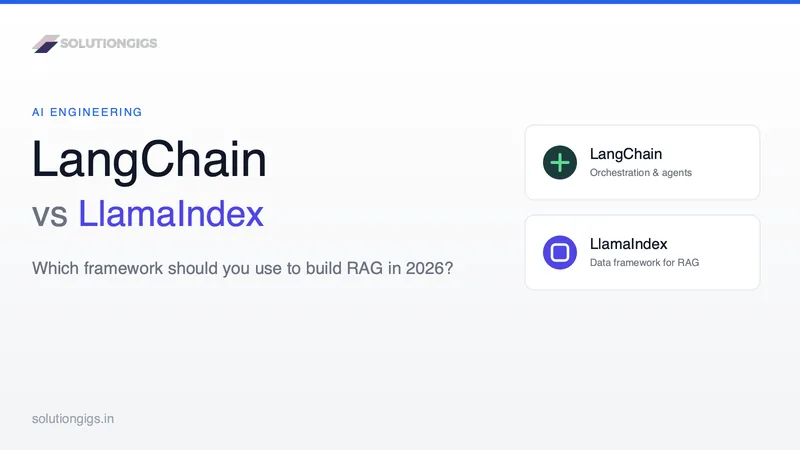
Quick Answer: The LangChain vs LlamaIndex choice comes down to scope. LangChain is a broad orchestration framework for building LLM apps — chains, agents, tools, and memory across many providers. LlamaIndex is a data framework laser-focused on connecting your data to LLMs: ingestion, indexing, and advanced retrieval for RAG. Choose LlamaIndex when the hard part is your data and retrieval quality; choose LangChain when the hard part is orchestrating agents, tools, and multi-step logic. They're interoperable — and many production teams use both together.
The LangChain vs LlamaIndex question is one of the most common forks in the road when you start building anything serious with large language models. Both are excellent, both are open source, and both can build a working RAG pipeline — so the internet is full of "it depends" answers that don't actually help you decide.
This guide fixes that. We'll break down what each framework is really for, show the same RAG task in both, compare them head-to-head, and give you a clear decision framework. By the end you'll know exactly which to reach for — or when to use them together.
What Is LangChain?
LangChain is a general-purpose orchestration framework for building applications powered by large language models.
Think of LangChain as the glue for LLM apps. It gives you composable building blocks — prompts, chains, agents, tools, memory, and retrievers — and lets you wire them into workflows that can reason, call functions, and take multiple steps. It abstracts over dozens of model providers (OpenAI, Anthropic, Google, open models via Ollama) so you can swap the underlying LLM without rewriting your app.
In 2026, its sibling project LangGraph has become the go-to for building stateful, controllable agents — graphs of steps with branching, loops, and durable state.
# LangChain: a retriever plugged into a chain
from langchain_openai import ChatOpenAI
from langchain_core.prompts import ChatPromptTemplate
from langchain_core.runnables import RunnablePassthrough

prompt = ChatPromptTemplate.from_template(
    "Answer using only this context:\n{context}\n\nQuestion: {question}"
)
chain = (
    {"context": retriever, "question": RunnablePassthrough()}
    | prompt
    | ChatOpenAI(model="gpt-4o")
)
chain.invoke("What is our refund policy?")
LangChain is great for:
- Agents that call tools and take multiple steps
- Workflows that combine LLMs with APIs, databases, and logic
- Apps that need memory and conversation state
- Swapping between many model providers
What Is LlamaIndex?
LlamaIndex is a data framework focused on connecting your own data to LLMs — ingestion, indexing, and retrieval for RAG.
Where LangChain is wide, LlamaIndex is deep on data. It was purpose-built for the retrieval side of RAG: loading documents from 160+ sources, chunking them intelligently, building indexes, and — crucially — doing advanced retrieval (re-ranking, recursive retrieval, auto-merging, metadata filtering) that lifts answer quality.
Its high-level API gets you a working question-answering engine over your documents in just a few lines.
# LlamaIndex: index documents and query in ~5 lines
from llama_index.core import VectorStoreIndex, SimpleDirectoryReader

documents = SimpleDirectoryReader("./docs").load_data()
index = VectorStoreIndex.from_documents(documents)
query_engine = index.as_query_engine()

print(query_engine.query("What is our refund policy?"))
LlamaIndex is great for:
- Data-centric RAG over documents, PDFs, and databases
- High retrieval quality with advanced indexing strategies
- Fast time-to-first-answer on a knowledge base
- Search and Q&A over large, messy document sets
LangChain vs LlamaIndex: Head-to-Head Comparison
| Factor | LangChain | LlamaIndex |
|---|---|---|
| Primary purpose | Orchestration of LLM apps | Data → LLM connection (RAG) |
| Core strength | Agents, tools, chains, memory | Ingestion, indexing, retrieval |
| Scope | Broad | Focused/deep on data |
| Agents | First-class (LangGraph) | Supported, less central |
| Retrieval depth | Good | Excellent (advanced strategies) |
| Time to first RAG | Moderate | Very fast |
| Learning curve | Steeper (large surface) | Gentler for RAG |
| Data connectors | Many | Many (LlamaHub, 160+) |
| Best for | Complex agentic workflows | Data-heavy RAG & search |
The Core Difference: Orchestration vs Data
The heart of the LangChain vs LlamaIndex decision is what your hard problem is.
If your hard problem is the data — you have thousands of PDFs, wikis, or database rows and you need an LLM to answer accurately over them — then LlamaIndex's retrieval-first design gives you better answers with less effort.
If your hard problem is the orchestration — your app needs to decide, call tools, take multiple steps, remember context, and coordinate several LLM calls — then LangChain (with LangGraph) gives you the control structures to build it.
RAG lives at the intersection, which is why both frameworks can do it. But each optimizes a different side of the same problem, and that shapes every other trade-off. A solid RAG system also depends on a good vector database underneath — both frameworks integrate with all the major ones.
Building the Same RAG App in Both
Both frameworks follow the same underlying RAG steps: chunk → embed → store → retrieve → generate. The difference is how much they do for you.
LlamaIndex bundles those steps behind a high-level API, so a basic pipeline is genuinely five lines (see above). You reach for its lower-level modules only when you want to customize chunking, retrieval, or re-ranking.
LangChain exposes each step as an explicit, composable piece. That's more code for plain RAG, but it means the retriever you build slots naturally into a larger agent, tool, or multi-step chain — RAG becomes one node in a bigger graph rather than the whole app.
See how SolutionGigs can help → Building a RAG or agent system and not sure which stack fits? Post your project on solutiongigs.in and get matched with an AI engineer who has shipped both LangChain and LlamaIndex in production.
When to Use LangChain
Choose LangChain when:
- ✅ You're building agents that call tools and take multiple steps
- ✅ Your app needs memory and conversational state
- ✅ RAG is one part of a larger workflow, not the whole app
- ✅ You need to orchestrate several LLM calls, APIs, and logic
- ✅ You want LangGraph for stateful, controllable agent graphs
Classic LangChain use cases: customer-support agents, research assistants, workflow automation, and any app where the LLM must decide and act, not just answer. If you're comparing agent approaches, see our guide on building a multi-agent AI system in Python.
When to Use LlamaIndex
Choose LlamaIndex when:
- ✅ Your app is fundamentally RAG over your own data
- ✅ You need high retrieval quality (re-ranking, recursive retrieval)
- ✅ You want a fast path from documents to a working Q&A engine
- ✅ You're indexing large, varied document sets (PDFs, wikis, DBs)
- ✅ Search and grounded answers are the core product, not a side feature
Classic LlamaIndex use cases: documentation chatbots, internal knowledge search, contract and report Q&A, and any product where answer accuracy over your data is the whole point.
The Use-Both Reality
You don't have to pick one and marry it. LangChain and LlamaIndex are interoperable, and a very common production pattern combines them:
- LlamaIndex handles ingestion, indexing, and advanced retrieval
- LangChain / LangGraph wraps that retriever inside an agent with tools and memory
In practice, LlamaIndex exposes its index as a retriever or query engine that LangChain can call like any other tool. You get LlamaIndex's retrieval quality and LangChain's orchestration — the strongest piece from each. This mirrors the broader lesson from RAG vs fine-tuning: the best systems combine techniques rather than betting everything on one.
Common Mistakes to Avoid
| ❌ Mistake | ✅ Fix |
|---|---|
| Picking LangChain for simple RAG | LlamaIndex is faster and more focused |
| Forcing LlamaIndex to run complex agents | Use LangChain/LangGraph for orchestration |
| Adding a framework before you need one | Start with a direct API + vector DB call |
| Ignoring retrieval quality | Invest in chunking and re-ranking early |
| Treating it as either/or | Combine both — LlamaIndex retrieval + LangChain agent |
| Chasing abstractions you don't understand | Read the generated prompts and calls |
A Simple Decision Framework
Ask these questions in order:
- Is your app fundamentally search/RAG over your own data? → LlamaIndex.
- Does your app need agents, tools, memory, and multi-step logic? → LangChain.
- Do you need both great retrieval and orchestration? → Use both — LlamaIndex for retrieval, LangChain for the agent.
- Is your use case tiny and simple? → Consider no framework — call the LLM API and vector DB directly.
For most data-heavy RAG projects, LlamaIndex is the pragmatic starting point. For agentic apps, LangChain earns its complexity. And the moment you need both done well, reach for the combination.
Frequently Asked Questions
What is the difference between LangChain and LlamaIndex?
LangChain is a broad orchestration framework for building LLM applications — chains, agents, tools, and memory across many providers. LlamaIndex is a data framework focused specifically on connecting your data to LLMs: ingestion, indexing, and retrieval for RAG. LangChain is wider; LlamaIndex is deeper on the data and retrieval layer. Many teams use both together.
Is LlamaIndex better than LangChain for RAG?
For pure retrieval-augmented generation, LlamaIndex is often the more focused and productive choice — it was built around ingestion, indexing, and advanced retrieval. LangChain can absolutely build RAG too, but it shines when RAG is only one part of a larger agentic workflow with tools and multi-step logic. Choose LlamaIndex for data-centric RAG, LangChain for orchestration-heavy apps.
Can you use LangChain and LlamaIndex together?
Yes, and many production teams do. A common pattern uses LlamaIndex for document ingestion, indexing, and retrieval, then plugs that retriever into a LangChain agent that handles tools, memory, and multi-step reasoning. The two frameworks are interoperable, so you can pick the strongest piece from each rather than committing entirely to one.
Which is easier to learn, LangChain or LlamaIndex?
LlamaIndex is usually faster to get a working RAG pipeline running — its high-level API can index documents and answer questions in a handful of lines. LangChain has a larger surface area and more abstractions, so it is more flexible but steeper to learn. For a first RAG project, most beginners find LlamaIndex quicker; for complex agents, LangChain's depth pays off.
Is LangChain still worth using in 2026?
Yes. Despite criticism about abstraction overhead, LangChain remains one of the most widely used LLM frameworks in 2026, with LangGraph adding robust, stateful agent orchestration. It is worth using when you need agents, tool calling, memory, and multi-step workflows across many model providers. For simple RAG alone, a lighter tool may be enough.
Do I even need a framework like LangChain or LlamaIndex?
Not always. For a simple app you can call an LLM API and a vector database directly with very little code. Frameworks pay off when you need reusable retrieval pipelines, agents, tool calling, memory, and provider-swapping without rewriting everything. Start simple, and adopt LangChain or LlamaIndex when the glue code becomes the hard part.
Conclusion
LangChain vs LlamaIndex isn't about crowning a winner — it's about matching the framework to where your real difficulty lies. LlamaIndex is the data specialist: if your challenge is turning a pile of documents into accurate, grounded answers, it gets you there faster and with better retrieval. LangChain is the orchestrator: if your challenge is coordinating agents, tools, memory, and multi-step logic, it gives you the control structures to build it.
Start with LlamaIndex when your product is fundamentally RAG. Reach for LangChain when your product is fundamentally an agent. And when you need both — great retrieval and smart orchestration — combine them, using LlamaIndex for the data layer and LangChain for the reasoning layer.
Pick based on your actual bottleneck, not the framework with the loudest fans, and you'll build something that stays maintainable as it grows.
Building a RAG system or AI agent and want it done right the first time? SolutionGigs connects you with vetted AI engineers who have shipped both LangChain and LlamaIndex in production. Post your project on solutiongigs.in today — it's free to post →
Mohammed Yaseen
Founder, SolutionGigs
Mohammed builds RAG pipelines and LLM agents with both LangChain and LlamaIndex, and founded SolutionGigs to connect teams with AI engineers who pick the right stack for the job. LinkedIn →
Try Free Python Code Explainer
Free, no signup — right in your browser.
Try Free Python Code Explainer →More in AI & Machine Learning
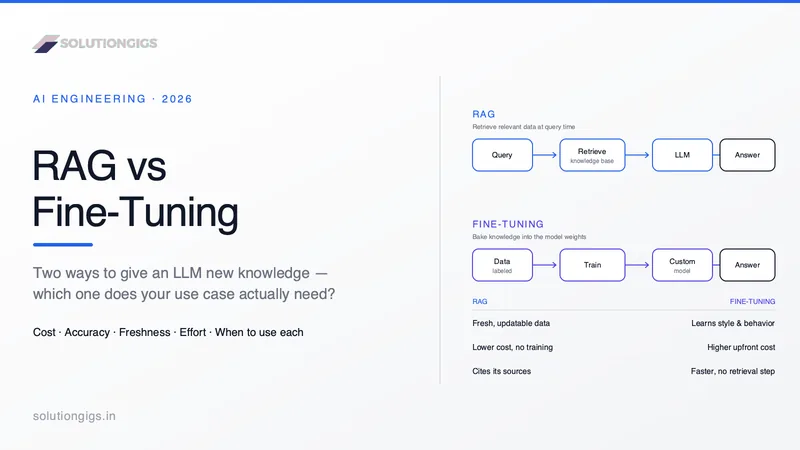
RAG vs Fine-Tuning: Which to Use for Your LLM App
RAG vs fine-tuning explained — the real difference, cost and accuracy trade-offs, and a clear decision framework for choosing how to give your LLM new knowledge in 2026.
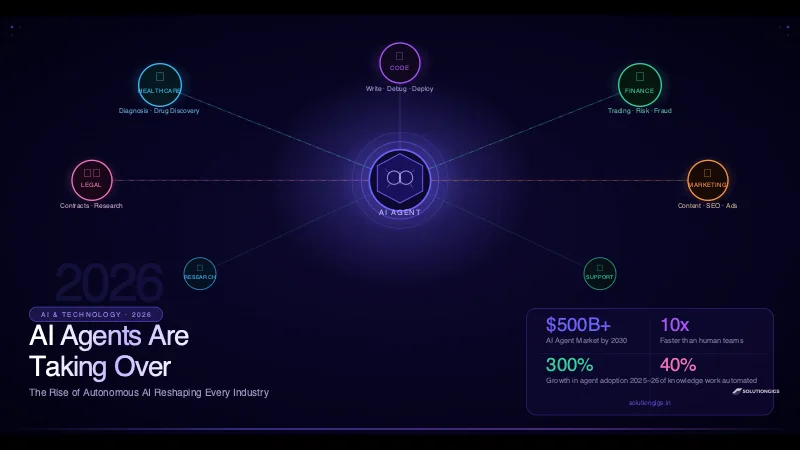
AI Agents: How Autonomous AI Is Changing the World
AI agents are autonomously handling healthcare, finance, legal, and software tasks in 2026. Learn how they work, which industries they're transforming, the top platforms, and how to build your first agent.
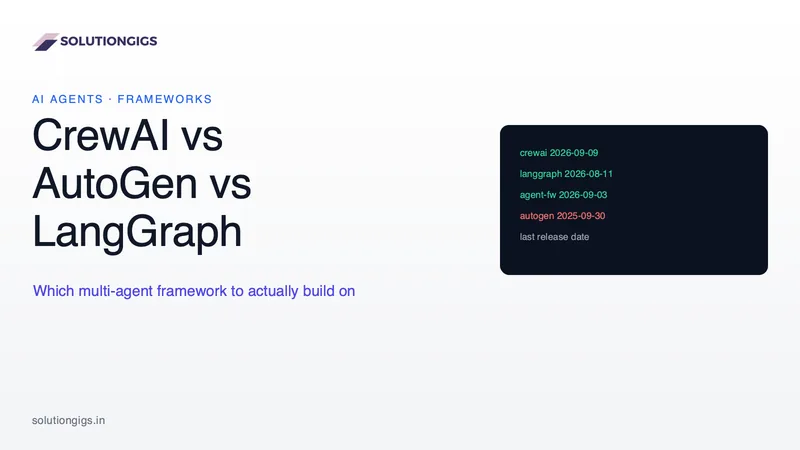
CrewAI vs AutoGen vs LangGraph: Which Multi-Agent Framework Should You Actually Use?
AutoGen is in maintenance mode and most comparison articles still miss it. We checked release dates on PyPI and GitHub, then compared CrewAI, LangGraph and Microsoft Agent Framework on architecture, failure behaviour and token cost — with a decision tree that tells you which to use, and when you need no framework at all.