
RAG vs Fine-Tuning: Which to Use for Your LLM App
RAG vs fine-tuning explained — the real difference, cost and accuracy trade-offs, and a clear decision framework for choosing how to give your LLM new knowledge in 2026.

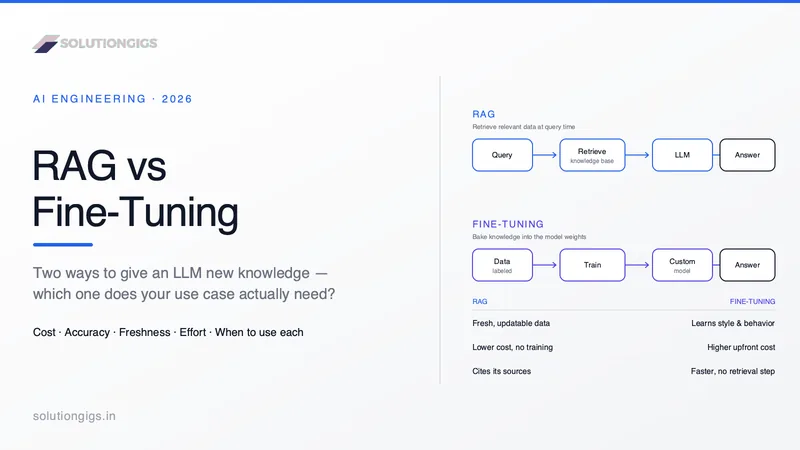
Quick Answer: The RAG vs fine-tuning choice depends on what you're trying to teach the model. RAG (Retrieval-Augmented Generation) gives an LLM new knowledge at query time by fetching relevant documents and adding them to the prompt — ideal for facts, private data, and information that changes. Fine-tuning changes the model's behavior by continuing its training on your data — ideal for a specific tone, format, or specialized skill. Rule of thumb: use RAG to change what the model knows, fine-tuning to change how the model acts. Many production systems combine both.
Every team building with large language models eventually hits the same fork in the road: the model doesn't know your data, or doesn't behave the way you need. Two paths promise a fix — RAG vs fine-tuning — and picking the wrong one wastes months and money.
The confusion is understandable. Both "customize" an LLM. But they work in fundamentally different ways and solve fundamentally different problems. Choose fine-tuning when you actually needed RAG, and you'll spend a fortune retraining every time your data changes. Choose RAG when you needed fine-tuning, and the model will still refuse to sound or behave the way you want.
This guide makes the decision simple: how each works, the real trade-offs in cost and accuracy, when to use which, and why the best systems often use both.
What Is RAG (Retrieval-Augmented Generation)?
RAG is a technique that gives an LLM new knowledge at query time by retrieving relevant information and injecting it into the prompt — without changing the model itself.
Here's the flow: a user asks a question, your system searches a knowledge base for the most relevant documents, and those documents are added to the prompt as context. The LLM then answers using that supplied information rather than relying only on what it memorized during training.
The retrieval step usually relies on embeddings and a vector database — the question is converted into a vector, and the closest matching chunks of your documents are pulled back. For the full mechanics, see our guides on building a RAG pipeline in Python and vector databases explained.
RAG is ideal for:
- Factual, knowledge-based answers
- Private or proprietary company data
- Information that changes frequently
- Answers that must cite their sources
- Reducing hallucinations by grounding responses
What Is Fine-Tuning?
Fine-tuning is the process of continuing an LLM's training on your own dataset, permanently updating the model's weights to change how it behaves.
Where RAG adds knowledge around the model, fine-tuning changes the model itself. You provide many examples of the input-output behavior you want, and training adjusts the model so it internalizes that pattern — a particular tone, a strict output format, a specialized task, or domain-specific language.
Modern fine-tuning is often done efficiently with techniques like LoRA and QLoRA, which update only a small set of parameters, dramatically lowering the compute needed compared to full retraining.
Fine-tuning is ideal for:
- A consistent brand voice or writing style
- Strict, reliable output formats (e.g., always valid JSON)
- Specialized tasks the base model struggles with
- Domain-specific language and jargon
- Lower latency (no retrieval step at query time)
RAG vs Fine-Tuning: Head-to-Head Comparison
| Factor | RAG | Fine-Tuning |
|---|---|---|
| What it changes | The prompt (adds knowledge) | The model (changes behavior) |
| Best for | Facts & fresh knowledge | Style, format & skills |
| Data freshness | Update anytime (just re-index) | Requires retraining |
| Setup cost | Lower | Higher |
| Expertise needed | Moderate | High (ML/training) |
| Hallucinations | Reduced (grounded + cites) | Not directly reduced |
| Latency | Adds a retrieval step | Fast (no retrieval) |
| Source citations | Yes | No |
| Data changes often? | Excellent fit | Poor fit |
The Core Difference: Knowledge vs Behavior
The single most useful mental model:
- RAG changes what the model knows.
- Fine-tuning changes how the model acts.
If your problem is "the model doesn't know our latest product docs / policies / customer data," that's a knowledge problem → RAG. Facts live outside the model, get retrieved on demand, and update the moment you re-index.
If your problem is "the model doesn't sound like us / won't reliably output the format we need / can't do this specialized task well," that's a behavior problem → fine-tuning. You're teaching the model a skill or style, not a fact.
Getting this distinction right resolves 90% of the RAG vs fine-tuning confusion.
Cost & Accuracy Trade-Offs
Cost
RAG is usually cheaper to start and maintain. You pay for embeddings, a vector database, and inference — but no training runs. When your data changes, you simply re-index; there's no expensive retraining cycle.
Fine-tuning carries higher upfront cost: preparing labeled training data, compute for training, and evaluation. Crucially, every time your underlying knowledge changes, a fine-tuned model can go stale — and re-fine-tuning repeatedly gets expensive.
The cost RAG teams underestimate is the pipeline, not the tokens. "Just re-index" is a data engineering job: incremental sync so you embed the diff and not the corpus, idempotent upserts so re-runs don't duplicate chunks, and an invalidation path so an edited document doesn't serve a stale answer for a week. Budget for that pipeline the way you'd budget for any production ETL — it is structurally the same thing, as data engineer vs AI engineer sets out stage by stage.
Accuracy & Trust
RAG shines on factual accuracy because answers are grounded in retrieved sources, and it can cite those sources — which is why it's the go-to for reducing hallucinations. Good prompting on top amplifies this; see our prompt engineering guide.
Fine-tuning improves accuracy on behavioral consistency — reliably matching a format, tone, or task — but it doesn't inherently make the model more truthful about facts, and it can't cite where an answer came from.
See how SolutionGigs can help → Not sure whether your problem needs RAG, fine-tuning, or both? Post your project on solutiongigs.in and get matched with an AI engineer who has shipped both in production.
When to Use RAG
Choose RAG when:
- ✅ The model needs facts, documents, or private data it wasn't trained on
- ✅ Your information changes often (policies, prices, inventory, docs)
- ✅ You need answers that cite sources and are verifiable
- ✅ Reducing hallucinations is a priority
- ✅ You want a faster, cheaper path to production
Classic RAG use cases: documentation chatbots, customer support assistants, internal knowledge search, research tools, and any "chat with your data" product.
When to Use Fine-Tuning
Choose fine-tuning when:
- ✅ You need a consistent tone, voice, or persona
- ✅ You need strict, reliable output formats every time
- ✅ The base model struggles with a specialized task or domain
- ✅ You need low latency and can't afford a retrieval step
- ✅ You have quality labeled examples of the behavior you want
Classic fine-tuning use cases: brand-voice copy generation, structured data extraction, classification, code in a house style, and narrow domain tasks.
The Best Answer Is Often Both
In demanding production systems, RAG and fine-tuning are not either/or — they're complementary.
A powerful pattern:
- Fine-tune a model so it masters your domain's tone, format, and reasoning style.
- Use RAG to feed that fine-tuned model accurate, up-to-date facts at query time.
The result is a model that both behaves exactly how you want and knows current, grounded information. Think of a support assistant fine-tuned to sound on-brand and follow your response structure, while RAG supplies the live product details it cites in every answer.
This layered approach is increasingly common in AI agents and enterprise assistants, where both behavior and knowledge must be exactly right.
Common Mistakes to Avoid
| ❌ Mistake | ✅ Fix |
|---|---|
| Fine-tuning to add facts | Use RAG for knowledge that changes |
| Using RAG to fix tone/format | Fine-tune for behavior and style |
| Jumping to fine-tuning first | Start with RAG + prompting; it's cheaper |
| Re-fine-tuning on every data change | Put changing facts in RAG, not weights |
| Ignoring retrieval quality in RAG | Invest in chunking and embeddings |
| Assuming it's either/or | Combine both when the problem needs it |
| Blaming the model for wrong answers | Check the corpus first — bad data breaks both approaches |
A Simple Decision Framework
Ask these questions in order:
- Can better prompting solve it? Try prompt engineering first — it's free and instant.
- Is it a knowledge problem? (Model lacks facts/data) → RAG.
- Is it a behavior problem? (Model won't act/sound right) → Fine-tuning.
- Is it both? → Fine-tune for behavior + RAG for knowledge.
Most teams should reach for prompting, then RAG before considering fine-tuning. Fine-tuning is powerful but is rarely the first tool you need.
Frequently Asked Questions
What is the difference between RAG and fine-tuning?
RAG gives an LLM new knowledge at query time by retrieving relevant documents and adding them to the prompt — nothing about the model changes. Fine-tuning changes the model itself by continuing training on your data, baking new behavior and style into its weights. RAG is best for facts and fresh data; fine-tuning is best for style, format, and specialized behavior.
Is RAG better than fine-tuning?
Neither is universally better — they solve different problems. RAG is better when you need up-to-date, factual, or private knowledge with citations, and it's cheaper and faster to build. Fine-tuning is better when you need the model to adopt a specific tone, format, or skill. Many production systems use both together.
Is RAG cheaper than fine-tuning?
Generally, yes. RAG avoids the cost and expertise of training a model — you only pay for embeddings, a vector database, and inference. Fine-tuning requires labeled data, training compute, and repeated retraining whenever your data changes. For most knowledge-based use cases, RAG has a lower total cost of ownership.
When should you fine-tune an LLM instead of using RAG?
Fine-tune when you need the model to consistently adopt a specific style, tone, or output format, follow a specialized task it struggles with, or when low latency matters and you can't afford a retrieval step. Fine-tuning teaches the model how to behave — it's not the right tool for injecting frequently changing facts. Use RAG for that.
Can you use RAG and fine-tuning together?
Yes, and it's a powerful combination. Fine-tune a model to master a domain's tone, format, and reasoning style, then use RAG to feed it accurate, up-to-date facts at query time. This gives you both specialized behavior and current knowledge — the best of both approaches for demanding production applications.
Does RAG reduce hallucinations?
Yes. RAG significantly reduces hallucinations by grounding answers in retrieved source documents rather than relying only on the model's trained memory. Because the model can cite its sources, answers are more accurate and verifiable — which is why RAG is the standard approach for factual, knowledge-based AI assistants.
Conclusion
RAG vs fine-tuning isn't a battle to crown a winner — it's a diagnosis. Identify whether your problem is about knowledge or behavior, and the right tool becomes obvious.
Use RAG to give your model current, factual, grounded knowledge it can cite — the cheaper, faster, and more flexible default for most applications. Use fine-tuning to teach your model a consistent style, format, or specialized skill. And when you need both a specialist's behavior and current knowledge, layer them together.
Start simple: prompt first, add RAG next, and fine-tune only when behavior genuinely demands it. That order will save you time and money while getting you to a reliable AI product faster.
Building an LLM application and weighing RAG against fine-tuning? SolutionGigs connects you with vetted AI engineers who have shipped production RAG systems and fine-tuned models alike. Post your project on solutiongigs.in today — it's free to post →
Mohammed Yaseen
Founder, SolutionGigs
Mohammed builds production LLM applications — from RAG pipelines and vector search to fine-tuned models and AI agents. He founded SolutionGigs to connect teams with engineers who pick the right approach for the problem. LinkedIn →
More in AI & Machine Learning
LangChain vs LlamaIndex: Which to Use for RAG
LangChain vs LlamaIndex — the real differences, when each wins for RAG and agents, code examples, and a clear framework for choosing the right LLM framework in 2026.
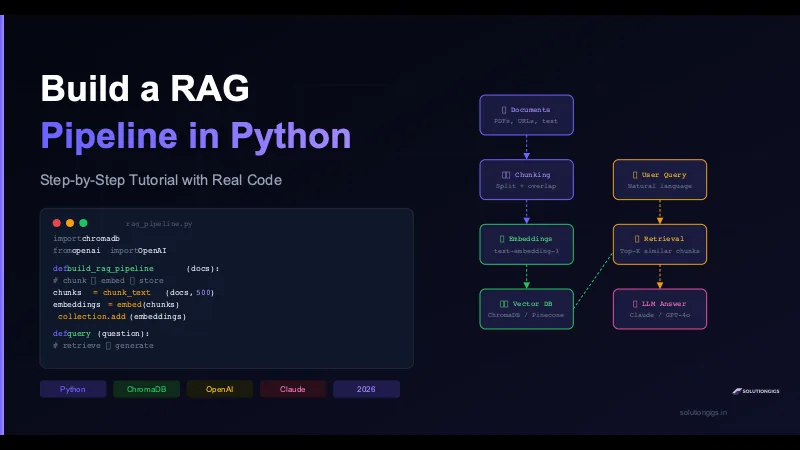
Build a RAG Pipeline in Python: Step-by-Step Tutorial
Build a RAG pipeline in Python from scratch — chunk documents, create embeddings, store in ChromaDB, and generate grounded answers with GPT-4o or Claude. Full working code, common mistakes, and production upgrades.
Claude vs GPT vs Gemini: Which LLM for Which Job
Claude vs GPT vs Gemini in 2026 — the real strengths of each LLM, a job-by-job recommendation table, a pricing snapshot, and a clear framework for choosing the right model.