
AI Agents: How Autonomous AI Is Changing the World
AI agents are autonomously handling healthcare, finance, legal, and software tasks in 2026. Learn how they work, which industries they're transforming, the top platforms, and how to build your first agent.

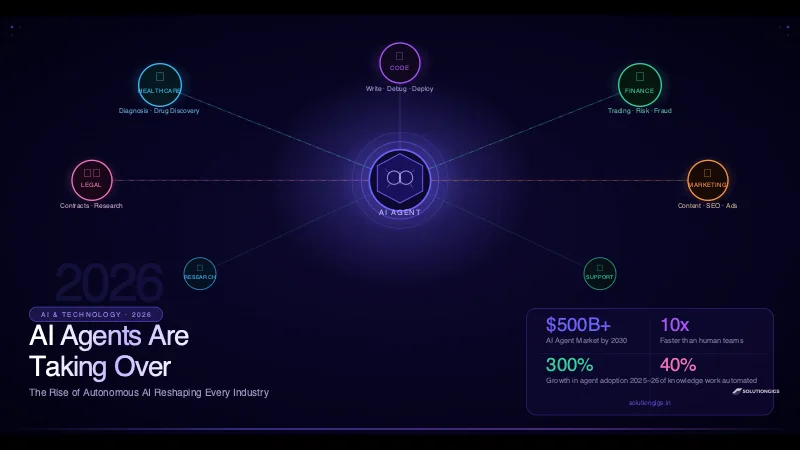
Quick Answer: AI agents are autonomous AI systems that perceive, reason, plan, and act across multi-step tasks — without needing a human to supervise every move. In 2026, they are no longer research prototypes. They are booking appointments, writing and deploying code, diagnosing disease, managing trading portfolios, reviewing legal contracts, and running customer support — 24 hours a day, at machine speed. This guide explains exactly how AI agents work, which industries they are transforming, and what every professional needs to know to stay relevant.
The first time most people interacted with AI, it was a chatbot. You asked a question. It answered. That was the whole transaction.
AI agents in 2026 are something fundamentally different.
An AI agent doesn't wait for your next message. It takes a goal — "research our top five competitors and produce a pricing analysis" — and autonomously runs web searches, reads websites, pulls data, compares figures, writes the report, and emails it to you. The entire task, from goal to finished document, happens without a single follow-up prompt.
Goldman Sachs estimates that AI agents could automate the equivalent of 300 million full-time jobs globally over the next decade. McKinsey puts 40% of current knowledge work tasks within reach of 2026-era agents. OpenAI, Anthropic, Google, and Microsoft have all announced that "agentic AI" is their primary strategic focus for the next three years.
This is not a future trend. It is happening right now, in production, at scale.
This guide gives you the complete picture: what AI agents actually are, how they work under the hood, which industries are being transformed, which platforms to build on, and what the global implications are for workers, businesses, and society.
What Are AI Agents? The Definitive 2026 Definition
An AI agent is an autonomous system that perceives its environment, reasons about goals, selects actions, uses tools, and executes multi-step tasks with minimal human supervision.
The word "agent" comes from computer science and philosophy — it describes any entity that acts on behalf of another. AI agents are software entities that act on behalf of humans, but at computer speed and scale.
The crucial distinction from earlier AI:
| Traditional AI / Chatbots | AI Agents |
|---|---|
| Single input → single output | Goal input → multi-step execution |
| Reactive only | Proactive planning |
| No tools | Uses tools: search, code, APIs, browsers |
| One-shot | Iterative: observe, act, observe, correct |
| Stateless | Maintains memory across steps |
| Needs human for each step | Runs autonomously until task is done |
The Perception-Reasoning-Action Loop
Every AI agent runs on the same core loop:
- Perceive — Receive a goal and gather context (memory, documents, tool outputs)
- Reason — Decompose the goal into steps using an LLM as the "brain"
- Plan — Decide which tools to use and in what order
- Act — Execute actions: call APIs, run code, search the web, write files
- Observe — Read the results of actions
- Iterate — Update the plan based on results and continue until the goal is complete
This loop is why agents can handle tasks that were previously impossible to automate. Any task that requires dynamic decision-making based on intermediate results — which is most interesting work — now becomes within reach of a well-designed agent.
Why 2026 Is the Year of the AI Agent
The idea of autonomous AI agents is not new. Research on software agents dates back to the 1990s. What changed in 2024–2026 was the convergence of three capabilities that finally made production-grade agents viable:
1. Reasoning Models That Actually Plan
The jump from GPT-3 to GPT-4, and then to o3, Claude 3.5/4, and Gemini 2.5, was not just a jump in knowledge. It was a jump in reasoning ability. Modern frontier models can decompose complex goals into sub-tasks, identify when they're stuck, backtrack and try alternative approaches, and maintain coherent plans across dozens of steps. This planning capability is the engine of every serious agent.
2. Tool Use Became Reliable
Earlier models could theoretically call tools, but did so erratically. In 2025–2026, tool use stabilised. Models can now reliably call web search, execute Python code, interact with databases, call REST APIs, fill out web forms, and use computer interfaces — with error rates low enough to build production systems. The MCP (Model Context Protocol) standardised how AI models connect to external tools, dramatically accelerating ecosystem development.
3. Agent Infrastructure Matured
Frameworks like LangGraph and CrewAI moved from early-stage experiments to production-ready infrastructure. AutoGen went the other way: Microsoft placed it in maintenance mode in October 2025 and shipped Microsoft Agent Framework 1.0 as its successor in April 2026 — see our CrewAI vs AutoGen vs LangGraph comparison for the current picture. Managed platforms like Anthropic's Claude Agents API, OpenAI Assistants, and Amazon Bedrock Agents gave enterprises secure, observable, scalable ways to deploy agents without building infrastructure from scratch.
The result: every major technology company on the planet launched an agentic product in 2025 or 2026.
The 5 Types of AI Agents Dominating 2026
Not all agents are the same. Understanding the taxonomy helps you identify which type applies to your use case.
1. Reactive Agents
The simplest type — they respond to immediate inputs without planning or memory. Modern AI assistants and customer service bots are often reactive agents. Fast and cheap, but limited to single-interaction tasks.
2. Planning Agents
These agents receive a complex goal and decompose it into a sequence of steps before executing. They can handle multi-stage tasks but typically work through steps sequentially. Most single-purpose enterprise agents (research assistants, code reviewers, document processors) fall here.
3. Memory-Augmented Agents
Agents equipped with long-term memory — the ability to remember context across sessions. They recall past conversations, user preferences, and prior outcomes. This makes them feel more like a dedicated assistant than a tool. Platforms like n8n with AI workflows enable persistent memory through external databases.
4. Multi-Agent Systems
Multiple specialised agents collaborate on a shared task. A research agent gathers data. A writing agent structures the content. A fact-checking agent validates claims. A manager agent orchestrates all three. Multi-agent architectures handle tasks too complex for any single agent. Our complete guide to multi-agent systems in Python covers implementation in detail.
5. Autonomous / Long-Horizon Agents
The cutting edge: agents that operate over hours or days, handling tasks that require dozens or hundreds of sequential decisions. Examples include agents that autonomously manage a software project from specification to deployment, or agents that continuously monitor market data and execute trades based on real-time conditions. These are the agents that most concern researchers and most excite businesses.
How AI Agents Are Transforming Every Major Industry
Healthcare: From Diagnosis Assistant to Drug Discovery Engine
Healthcare is experiencing the most profound agent-driven transformation of any industry.
Clinical Documentation: Ambient AI agents now sit in on medical consultations, transcribe the conversation in real-time, extract structured clinical data, and auto-populate electronic health records. This eliminates 2–3 hours of daily documentation burden for the average physician — time that goes back to patient care.
Diagnostic Assistance: Google's Med-PaLM 2 agent passed the US Medical Licensing Exam at expert-level performance in 2025. Radiology agents now screen chest X-rays, MRIs, and CT scans for anomalies at speeds no human radiologist can match, flagging cases for specialist review with 94%+ sensitivity on key conditions.
Drug Discovery: This may be agents' most consequential healthcare contribution. Traditional drug discovery takes 10–15 years and costs over $2 billion per approved compound. AI agents are compressing the early stages dramatically — autonomously running literature reviews across millions of papers, generating candidate molecules, predicting binding affinity, and designing experimental protocols. DeepMind's AlphaFold 3, extended with agentic workflows, has accelerated protein structure work by an order of magnitude.
Patient Follow-Up: Post-discharge agents monitor patient vitals through wearables, send medication reminders, schedule follow-up appointments, triage symptoms through conversational interfaces, and escalate to human care coordinators only when needed.
Finance: Agents That Never Sleep and Never Miss a Signal
Financial services adopted AI agents faster than almost any other sector, driven by the immediate, measurable ROI of even small performance improvements.
Algorithmic Trading: Agent-driven trading systems now process real-time market data, news sentiment, social signals, and macroeconomic indicators simultaneously, executing trades in microseconds. The shift from rule-based algorithms to reasoning-capable agents means these systems can adapt to novel market conditions that no rule anticipated.
Fraud Detection and Prevention: Banks use agents to monitor transaction patterns across hundreds of variables in real-time, identifying anomalous behaviour with far lower false-positive rates than traditional models. JPMorgan reports their AI fraud agent reduced false positives by 60% while catching 15% more genuine fraud.
Risk Management: Agents continuously stress-test portfolios against thousands of economic scenarios, flagging concentration risks and suggesting rebalancing actions. What previously required a team of analysts working overnight can now be done in minutes.
Financial Research: Investment research agents read earnings calls, 10-Ks, analyst reports, and news simultaneously, synthesising findings into structured reports. Junior analyst productivity has tripled at firms deploying these tools.
Software Development: The Agentic IDE Era
The software development transformation is both the most visible and the most personally relevant to the solutiongigs.in community.
From Copilot to Agent: 2023's AI coding tools completed single lines. 2024's tools completed functions. In 2026, AI coding agents complete entire features — given a specification, they write the code, write tests, run the tests, fix failing tests, check code style, and open a pull request. Tools like Cursor Agents, Devin (Cognition AI), and Claude Agents with computer use are already doing this in production.
End-to-End Software Generation: Vibe coding — which we covered in our complete guide to building apps with AI — has evolved from "prompting a model to write functions" to "describing a product and watching an agent build it." Non-developers are shipping real applications. The productivity ceiling for trained developers has moved dramatically upward.
CI/CD Agents: Agents now monitor build pipelines, diagnose failures, trace them to specific commits, attempt automatic fixes, and re-run tests — reducing the mean time to resolution on broken builds from hours to minutes.
Security Agents: Autonomous security agents continuously scan codebases for vulnerabilities, attempt exploits in sandboxed environments to verify severity, generate patches, and submit them for human review. This is shifting application security from a periodic audit activity to a continuous process.
Legal: From Billable Hours to Autonomous Document Processing
Law is famously resistant to automation — legal judgment is complex, context-dependent, and high-stakes. Yet AI agents are making significant inroads in specific, well-defined tasks.
Contract Review: Agents can read a 200-page commercial contract, extract all key terms, flag non-standard clauses, compare against a client's standard positions, and produce a redline and risk summary — in under ten minutes. A task that billed 8–12 associate hours now takes a senior lawyer 30 minutes to review the agent's output.
Legal Research: Finding relevant case law, statutes, and secondary sources across vast legal databases was one of the most time-consuming tasks for junior lawyers. Agents now handle this autonomously, producing structured research memos with citations that partners review and annotate.
Due Diligence: M&A due diligence requires reviewing thousands of documents across multiple workstreams. AI agents can process an entire data room — reading, categorising, and flagging items requiring human attention — in days rather than weeks, at a fraction of the cost.
Regulatory Compliance: Compliance agents continuously monitor regulatory updates, assess their impact on a company's operations, and generate gap analyses and remediation recommendations.
Marketing: Personalisation at Impossible Scale
Marketing was one of the first business functions to adopt AI, and agent architectures are now taking that adoption to a new level.
Autonomous Content Pipelines: Agents research trending topics, identify content gaps in a brand's publishing calendar, draft articles optimised for SEO, generate accompanying visuals, and schedule publication — creating a continuous content operation that runs without a content team managing every post.
Hyper-Personalised Campaigns: Agents can generate thousands of personalised ad variations, test them across audiences in real-time, identify winning combinations, scale spend to winners, and pause underperformers — within hours of campaign launch rather than days of A/B testing cycles.
Customer Lifecycle Management: Agents monitor every customer's behaviour signals — pages visited, emails opened, support tickets raised, purchase history — and trigger personalised interventions at exactly the right moment. Retention, upsell, and reactivation campaigns become event-driven and individualised rather than batch and generic.
Customer Service: The Agent-First Support Model
The customer service industry is undergoing the most visible agent-driven disruption, simply because the change is consumer-facing.
First-generation AI chatbots frustrated customers with rigid scripts and failure modes. Agent-based support systems in 2026 are categorically different — they access account data in real-time, reason about problems, take actions (issue refunds, modify orders, escalate to specialists), and maintain context across long conversations. Resolution rates for tier-1 and tier-2 issues now exceed 80% without human involvement.
The Leading AI Agent Platforms in 2026
| Platform | Best For | Underlying Model | Key Strength |
|---|---|---|---|
| Claude Agents (Anthropic) | Enterprise, complex reasoning | Claude Sonnet/Opus 4 | Best reasoning, safest tool use |
| OpenAI Assistants API | General purpose | GPT-4o | Huge ecosystem, code interpreter |
| Google Vertex AI Agents | GCP-native enterprise | Gemini 2.5 Pro | Multimodal, Google Workspace integration |
| Amazon Bedrock Agents | AWS-native enterprise | Multiple models | Best AWS integration |
| LangGraph | Custom production agents | Any LLM | Stateful, observable, production-ready |
| AutoGen (Microsoft) | ⚠️ Maintenance mode — use Microsoft Agent Framework instead | — | No PyPI release since Sep 2025 |
| CrewAI | Role-based agent teams | Any LLM | Best abstraction for team-style tasks |
| n8n + AI nodes | No-code/low-code agents | Multiple | Visual workflow, self-hostable |
Choosing a platform depends on three factors: your team's technical depth, your cloud infrastructure, and the complexity of the reasoning your agent needs to perform. For the most demanding reasoning tasks, Claude-based agents consistently outperform alternatives on benchmarks involving multi-step planning and tool use. Our guide to Claude's agent skill architecture explains the implementation patterns in depth.
AI Agents vs Traditional Automation: What's Actually Different
This is a question we get often at solutiongigs.in: "Isn't this just RPA with a different name?"
No. The difference is fundamental.
Traditional automation (RPA, scripts, workflows) works by following pre-defined rules. Every path must be anticipated by the developer. The moment an unexpected condition arises — a webpage changes its layout, a document arrives in an unfamiliar format, a decision requires judgment — traditional automation fails. It requires a human to intervene and a developer to update the rules.
AI agents handle novelty. Because they reason about the goal rather than follow rules, they can adapt to conditions the developer never anticipated. An agent asked to "extract all invoice amounts from these documents" doesn't fail when it encounters a new invoice format it's never seen — it reads the document, reasons about what "invoice amount" means in this context, and extracts the right number.
This distinction explains why agents are expanding automation into domains that were previously considered too complex, too variable, or too judgment-intensive to automate.
The Global Impact: Jobs, Skills, and the New Economy
What Agents Are Actually Automating
The jobs most exposed to AI agent automation share specific characteristics:
- High information volume, low variability — Processing large volumes of structured data according to defined rules (data entry, basic report generation, standard document review)
- Expertise that can be fully codified — Tasks where the "right answer" is deterministic and can be expressed in rules or learned from examples
- Single-domain specialisation — Jobs that require deep expertise in one domain without needing to navigate uncertainty or build relationships
Roles in acute risk: junior data analysts, tier-1 customer support agents, basic legal researchers, routine accounting processors, entry-level content writers, standard report writers.
What Agents Are Not Automating
Jobs that combine multiple of the following characteristics are durable:
- Cross-domain judgment — Problems that require synthesising expertise from multiple fields simultaneously
- High-stakes uncertainty — Decisions made with incomplete information where errors have significant consequences
- Physical presence and dexterity — Tasks requiring manipulation of the physical world in unstructured environments
- Relationship and trust — Roles where the human relationship is itself the service (therapy, leadership, sales for complex enterprise deals)
- Creative originality — Not content generation (agents do this now), but genuinely novel creative work that requires a distinctive human perspective
The New Skill Premium: Agent Builders and Directors
The emerging professional advantage in every field belongs to people who can effectively use, build, and direct AI agents. A lawyer who knows how to design a contract review agent workflow is worth dramatically more than one who doesn't. An engineer who can build and debug agentic systems is one of the highest-demand professionals on the market in 2026.
For Indian developers and freelancers specifically, the AI agent wave represents a significant opportunity. Global companies are hiring remote AI engineers at senior rates, and building expertise in LangGraph, Anthropic's API, or enterprise agent deployment puts you in a very small pool of candidates for very large contracts.
How to Build Your First AI Agent: A Practical Starting Point
You don't need to understand every detail of an agent framework to build something useful. Here's the fastest path from zero to a working agent:
Step 1: Define the task precisely. The number-one cause of agent failure is an ambiguous goal. "Help with marketing" is not an agent task. "Research the top 10 blog posts ranking for 'AI tools for small business India' and produce a content gap analysis against our existing posts" is.
Step 2: Identify the tools the agent needs. Web search? Database access? Code execution? Email sending? List every capability the agent needs to complete the task.
Step 3: Choose your platform. For no-code: n8n or Zapier AI. For low-code: Relevance AI. For full control: LangGraph + Claude API or OpenAI Assistants.
Step 4: Build a minimal version first. The temptation is to build a fully autonomous agent on day one. Start with a single-step agent that does one thing reliably, then extend it.
Step 5: Add human checkpoints. Production agents should have "human in the loop" checkpoints at high-stakes decision points — especially for actions that are hard to reverse (sending emails, making purchases, publishing content).
If you want to build custom AI agents for your business or product and need expert implementation support, the data engineering and AI specialists at solutiongigs.in can help you design, build, and deploy production-grade agent systems. Post your project for free →
The Risks Nobody Is Talking About Enough
The opportunity is real. So are the risks, and intellectual honesty requires addressing both.
Hallucination in agent chains: When a single AI response contains an error, a human catches it. When that error is fed as input into the next step of an agent chain, and the next, and the next, errors compound. Agent systems need explicit fact-verification steps and human review of outputs before consequential actions are taken. This is a specific failure mode of poorly managed context — once a hallucinated fact enters the conversation history it becomes established truth for every later turn, which is why context engineering treats pruning history as a correctness measure, not just a cost one.
Unpredictable emergent behaviour: Multi-agent systems can develop unexpected behaviour that no individual agent was programmed to exhibit. This is especially concerning in financial and healthcare applications where unexpected actions carry severe consequences.
Security and prompt injection: Malicious content in the environment — a rogue webpage, a crafted email, a poisoned document — can attempt to hijack an agent's behaviour by embedding instructions. Prompt injection is the OWASP top concern for AI agent security in 2026. Crucially, no prompt or filter fixes it; the containment has to be architectural, which is why AI agent security comes down to the lethal trifecta — private data, untrusted content, and a way to send data out. Remove one leg and a successful injection has nothing left to steal.
Bad data upstream: The most under-discussed agent risk is not the model at all — it is the data the agent reads. An agent grounded on a stale policy document or a duplicated knowledge-base article will act on it confidently, and nothing in your monitoring will go red, because the failure produces a fluent answer rather than an error. See why AI data quality decides whether AI works for the four gates where this breaks and a live lab that demonstrates it.
Accountability gaps: When an AI agent makes a decision that harms a customer or client, who is responsible? The developer? The company deploying the agent? The model provider? Legal frameworks are still catching up, but the direction is already visible: in Moffatt v. Air Canada (2024) a Canadian tribunal held the airline liable for a bereavement policy its own chatbot invented, rejecting the argument that the bot was a separate entity responsible for its own statements.
Over-automation risk: The efficiency gains from agents are real. So is the risk of automating away the organisational knowledge and human judgment that provides resilience when the agent fails. The best-run organisations in 2026 are not replacing humans wholesale — they are restructuring how humans and agents work together.
Frequently Asked Questions
What are AI agents and how do they work?
AI agents are autonomous AI systems that perceive their environment, reason about goals, make decisions, and take actions without human intervention at every step. They work through a continuous loop: receive a task, plan the steps, use tools (web search, code execution, APIs) to gather information and execute actions, observe results, and iterate until the goal is complete. Unlike chatbots that answer questions, agents complete multi-step tasks end-to-end.
What is the difference between an AI agent and a chatbot?
A chatbot responds to one input with one output and stops. An AI agent takes a goal and executes the multiple steps needed to achieve it autonomously. A chatbot asked to "book a flight to Mumbai" would explain how to book one. An AI agent would search options, compare prices, select the best itinerary, and complete the booking — all without further input.
Which AI agent frameworks are best in 2026?
The top frameworks in 2026 are LangGraph (best for stateful production agents), AutoGen (best for multi-agent systems), CrewAI (best for role-based agent teams), Claude Agents via the Anthropic API (best reasoning and tool use), and OpenAI Assistants. For no-code agents, n8n and Zapier AI are leading options.
Will AI agents replace human jobs?
AI agents will automate specific tasks within jobs rather than eliminating entire roles outright. McKinsey estimates 40% of knowledge work tasks are automatable by current agents. High-risk tasks involve repetitive information processing. The strongest career protection in 2026 is the ability to build, direct, and quality-check AI agent systems — professionals who develop this skill are dramatically outperforming peers.
How are AI agents being used in healthcare?
Healthcare agents handle clinical documentation (real-time transcription of consultations), diagnostic assistance (radiology image analysis), drug discovery (autonomous literature search and molecular simulation), and patient follow-up (reminders, triage, appointment scheduling). Google's Med-PaLM 2 agent passed the US Medical Licensing Exam at expert level in 2025.
Can I build my own AI agent without being a developer?
Yes. Platforms like n8n, Zapier AI, and Relevance AI enable non-developers to build capable agents through visual interfaces. For more sophisticated agents, Python knowledge and familiarity with frameworks like LangGraph or the Anthropic API are needed. The barrier to entry has dropped dramatically since 2024.
What is a multi-agent system?
A multi-agent system uses multiple specialised AI agents that collaborate — one researches, one writes, one fact-checks, a manager agent coordinates all three. They outperform single agents on complex tasks requiring parallelism or specialised expertise. See our full guide to multi-agent systems in Python for implementation details.
Conclusion
The AI agent revolution is not coming. It is here.
Every industry we've covered — healthcare, finance, software, legal, marketing, customer service — is running production agent systems today. The companies and individuals who understand agents, build with them, and integrate them into their workflows are compounding an advantage that will be very hard for late adopters to close.
The skills that matter most right now: knowing how to define agentic tasks precisely, knowing which tools and frameworks to use, knowing where to put human checkpoints, and knowing how to evaluate agent output quality. These skills don't require a PhD. They require deliberate learning and practical experimentation.
For organisations that want to build AI agent capabilities without building a full AI engineering team, solutiongigs.in connects you with vetted AI engineers who specialise in exactly this: agent design, LangGraph deployment, Claude API integration, and multi-agent system architecture. Post your project free today →
The future of work is not human versus AI. It's humans who understand AI agents, directing them, vs. humans who don't. Choose which side you're on.
Mohammed Yaseen
Founder, SolutionGigs
Mohammed builds AI-powered B2B products and has deployed production AI agent systems across data engineering, monitoring, and scheduling platforms. He writes about autonomous AI, agent frameworks, and the future of software development at solutiongigs.in. LinkedIn →
Try Free MCP Server Generator
Free, no signup — right in your browser.
Try Free MCP Server Generator →More in AI & Technology
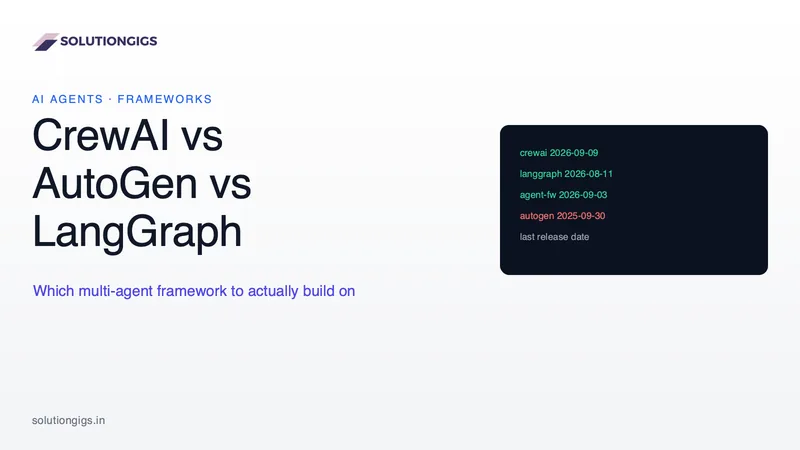
CrewAI vs AutoGen vs LangGraph: Which Multi-Agent Framework Should You Actually Use?
AutoGen is in maintenance mode and most comparison articles still miss it. We checked release dates on PyPI and GitHub, then compared CrewAI, LangGraph and Microsoft Agent Framework on architecture, failure behaviour and token cost — with a decision tree that tells you which to use, and when you need no framework at all.
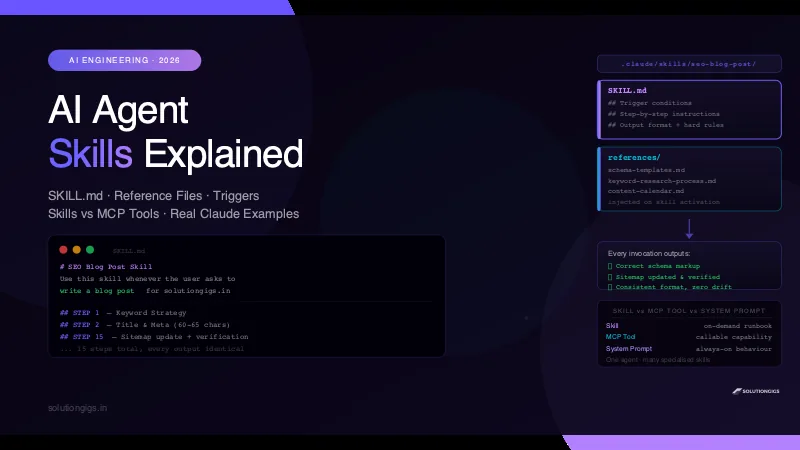
AI Agent Skills Explained: Build Reusable Claude Skills
AI agent skills turn good one-off AI interactions into repeatable systems. Learn what skills are, how Claude Code loads SKILL.md files, how to write your own skill with reference files, and when to use skills vs MCP tools vs system prompts — with real examples.
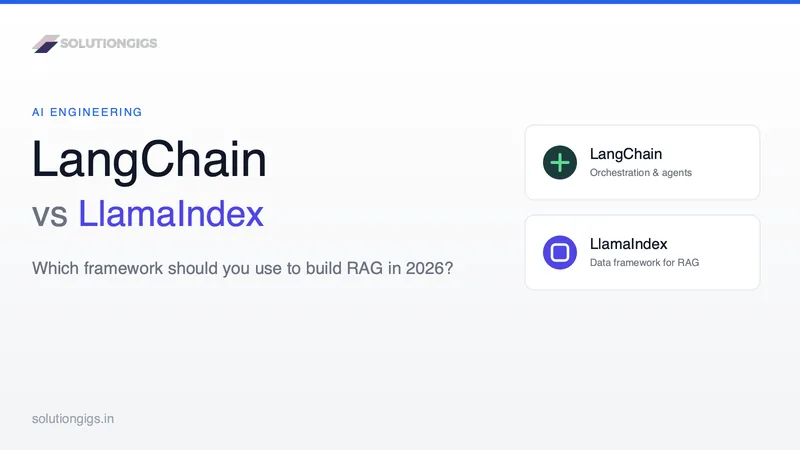
LangChain vs LlamaIndex: Which to Use for RAG
LangChain vs LlamaIndex — the real differences, when each wins for RAG and agents, code examples, and a clear framework for choosing the right LLM framework in 2026.