
Claude vs GPT vs Gemini: Which LLM for Which Job
Claude vs GPT vs Gemini in 2026 — the real strengths of each LLM, a job-by-job recommendation table, a pricing snapshot, and a clear framework for choosing the right model.

Quick Answer: There is no single best model in the Claude vs GPT vs Gemini debate — the right choice depends on the job. In 2026, Claude (Anthropic) leads on coding, long-horizon agents, and natural writing. GPT (OpenAI) is the strongest all-rounder with the biggest tool and integration ecosystem. Gemini (Google) wins on price-to-performance, native multimodal understanding, and long-context work. Route each task to the model that fits it best rather than marrying one brand.
Every week a founder asks us the same thing: "Just tell me which AI is best — Claude, ChatGPT, or Gemini?" The honest answer frustrates people at first: the wrong question is "which is best," and the right question is "best at what?" By mid-2026 the three flagships are close enough in raw quality that the smart move is picking the right tool per task — and often using more than one. This guide breaks down where each model wins, gives you a job-by-job recommendation table, a current pricing snapshot, and a decision framework you can actually use.
Meet the Three Families (2026)
Claude, GPT, and Gemini are the three leading large language model (LLM) families from Anthropic, OpenAI, and Google respectively — each shipped as a tiered lineup rather than a single model.
You rarely choose "Claude" or "GPT" — you choose a tier within a family. Understanding the tiers matters more than the brand:
- Claude (Anthropic) — Led by Claude Opus (the most capable tier), Claude Sonnet (the balanced workhorse), and Claude Haiku (fast and cheap). Anthropic's models are known for coding, instruction-following, and autonomous agent runs.
- GPT (OpenAI) — The GPT-5 family, spanning a premium flagship, a mainstream default, and mini/nano budget tiers, plus Codex variants tuned for software engineering. The broadest ecosystem of tools, plugins, and integrations.
- Gemini (Google) — Gemini 3 Pro at the top, Gemini 3 Flash for speed and value, and Flash-Lite for the cheapest workloads. Built natively multimodal and tightly wired into Google Cloud and Workspace.
Each family releases new point versions every few weeks, so treat specific version numbers below as a July 2026 snapshot.
Claude vs GPT vs Gemini: Head-to-Head
At the flagship level, the three models are close on general benchmarks — the meaningful differences show up in specialization, price, and ecosystem.
| Factor | Claude (Anthropic) | GPT (OpenAI) | Gemini (Google) |
|---|---|---|---|
| Best at | Coding, agents, writing | General reasoning, all-round | Multimodal, long context, value |
| Flagship tier | Claude Opus | GPT-5 (premium) | Gemini 3 Pro |
| Coding | Strongest | Very strong (Codex) | Strong, great value |
| Agentic / long tasks | Strongest | Very strong | Strong |
| Writing quality | Most natural, least "AI-sounding" | Strong, versatile | Strong |
| Native multimodal | Text + vision | Text + vision + audio | Text + image + audio + video (deepest) |
| Context window | ~1M tokens | ~1M tokens | ~1M tokens |
| Ecosystem / integrations | Growing, dev-focused | Largest | Google Cloud + Workspace |
| Price position | Premium | Mid-to-premium | Best price/performance |
| Free tier (API) | Limited | Limited | Generous free tier |
The takeaway: there is no row where one model wins everything. The best pick flips depending on whether your bottleneck is code quality, cost, multimodal input, or ecosystem fit.
Which LLM for Which Job? (The Recommendation Table)
This is the section people actually want. Here is our job-to-model recommendation, based on shipping all three in production for clients at SolutionGigs:
| Your job | First pick | Why | Budget alternative |
|---|---|---|---|
| Writing/refactoring production code | Claude Opus/Sonnet | Best at full-file edits and architectural consistency | GPT-5 Codex |
| Autonomous, long-horizon agents | Claude Opus | State-of-the-art at multi-step tasks that run without hand-holding | GPT-5 |
| General chatbot / assistant | GPT-5 | Best all-round reasoning + huge integration ecosystem | Gemini 3 Flash |
| High-volume, cost-sensitive API calls | Gemini 3 Flash / Flash-Lite | Lowest cost per token at strong quality | Claude Haiku / GPT-5 nano |
| Video, audio, or image-heavy tasks | Gemini 3 Pro | Deepest native multimodal understanding | GPT-5 |
| Long-document / long-context analysis | Gemini 3 Pro | Strong at very long inputs at a good price | Claude Opus |
| Natural, human-sounding copywriting | Claude | Least generic prose, follows style precisely | GPT-5 |
| Google Workspace / Cloud-native apps | Gemini | Tightest integration with Docs, Sheets, Vertex AI | GPT-5 |
| Broadest third-party tool/plugin support | GPT-5 | Largest ecosystem and community | Claude |
Use this as a starting point, not gospel — always validate against your own evaluation set before committing.
Where Claude Wins
Claude is the model to reach for when code quality, agent reliability, and writing tone are the hard part.
Anthropic has leaned hard into software engineering and agentic execution. In 2026, Claude models are the ones most teams trust for full-file refactors, overnight autonomous coding runs, and multi-step agents that need to stay coherent across dozens of tool calls without going off the rails. Claude also produces the most natural prose of the three — it follows style instructions closely and avoids the generic filler that makes AI text obvious.
Choose Claude when:
- You're building agents or coding assistants where reliability matters more than raw cost
- You need writing that doesn't sound machine-generated
- Your workflow is instruction-heavy and you want the model to follow it literally
If you're building agents, our guide to AI agents in 2026 and our walkthrough on building a multi-agent system in Python pair well with a Claude backend.
Where GPT Wins
GPT is the safest default when you need a strong generalist and the widest ecosystem.
OpenAI's GPT-5 family remains the most versatile all-rounder — excellent at general reasoning, summarization, math, and creative tasks, with the deepest bench of integrations, SDKs, plugins, and community tooling. If your product needs to do a bit of everything, or you want the largest pool of engineers and libraries that already speak your model's API, GPT is the low-risk choice. Its Codex variants also make it a top-tier coding option, and the mini and nano tiers give you a cheap path for simpler calls.
Choose GPT when:
- You want one dependable generalist across many task types
- Ecosystem, integrations, and hiring availability matter
- You need a smooth range from cheap (nano) to premium (flagship) within one API
Where Gemini Wins
Gemini is the value and multimodal champion — the best pick for cost-sensitive scale, long context, and anything involving images, audio, or video.
Google built Gemini natively multimodal, and it shows: it's the strongest of the three at reasoning over video, audio, screenshots, and mixed media in a single prompt. It's also the aggressive price leader — the Flash and Flash-Lite tiers deliver a lot of quality per rupee (or dollar), and Google keeps a genuinely usable free tier. For teams already on Google Cloud or Workspace, Gemini's integration with Vertex AI, Docs, and Sheets is a real productivity multiplier.
Choose Gemini when:
- You're running high-volume workloads and cost per token is decisive
- Your inputs are multimodal — documents, images, audio, or video
- You need long-context analysis at a friendly price, or you live in Google's ecosystem
Pricing Snapshot (July 2026)
On price, Gemini's budget tiers are the cheapest, Claude and GPT sit at a premium, and all three flagships land in a similar range for top-tier quality.
Approximate API list prices per 1 million tokens (input / output), as of July 2026. Prices change often — confirm on each provider's official page before budgeting.
| Model | Input | Output | Context |
|---|---|---|---|
| Claude Opus 4.8 | ~$5.00 | ~$25.00 | 1M |
| Claude Sonnet 5 | ~$3.00 | ~$15.00 | 1M |
| Claude Haiku 4.5 | ~$1.00 | ~$5.00 | 200K |
| GPT-5 (premium) | ~$5.00 | ~$30.00 | 1M |
| GPT-5 (mainstream) | ~$2.50 | ~$15.00 | ~1M |
| GPT-5 nano | ~$0.20 | ~$1.25 | large |
| Gemini 3 Pro | ~$2.00 | ~$12.00 | 1M |
| Gemini 3 Flash | ~$0.50 | ~$3.00 | 1M |
| Gemini 3 Flash-Lite | ~$0.25 | ~$1.50 | large |
Watch the output price, not just input. Chatbots and agents often generate far more tokens than they read, so a low input price with a high output price can still be expensive. Model your real input:output ratio and factor in cached-input discounts (all three offer them) and batch pricing (typically ~50% off) before you decide.
For exact, current numbers, see the official pages from Anthropic, OpenAI, and Google.
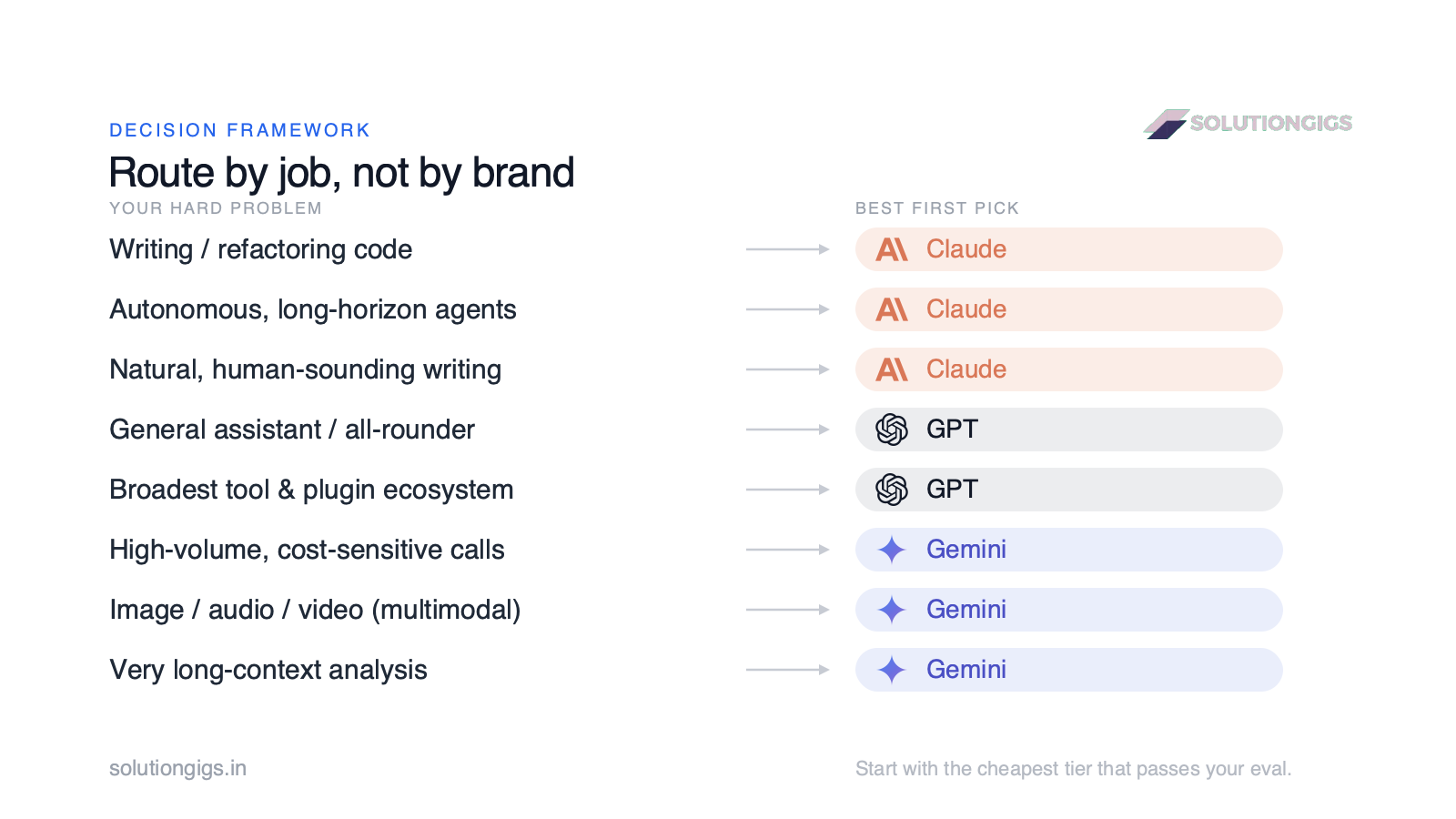
The Decision Framework: Route by Job, Not by Brand
The highest-leverage decision in 2026 isn't which model to standardize on — it's designing your system so you don't have to.
Here's the framework we use with clients:
- Identify the bottleneck per task. Is it code quality, cost, multimodal input, long context, or ecosystem fit? Each points to a different model (see the recommendation table above).
- Default to the cheapest tier that passes your eval. Start with a Flash / mini / Haiku tier and only step up to a flagship when your evaluation set demands it. Most tasks don't need the top model.
- Abstract the provider behind one interface. Wrap Claude, GPT, and Gemini behind a single internal API (frameworks like LangChain make this trivial) so you can swap models per task and as prices shift — without rewriting your app.
- Re-evaluate quarterly. Versions and prices move fast. A model that lost last quarter may lead this one.
See how SolutionGigs can help → Not sure which model — or mix of models — fits your product and budget? Post your project on solutiongigs.in and get matched with an AI engineer who has shipped Claude, GPT, and Gemini in production.
This is why multi-model routing — sending hard coding to Claude, high-volume or multimodal jobs to Gemini, and general reasoning to GPT — usually beats committing to one provider. The flagships are close enough that the win comes from placement, not loyalty.
Common Mistakes to Avoid
Teams choosing between Claude, GPT, and Gemini repeatedly make the same errors:
- Picking a brand instead of a task. "We're a ChatGPT shop" is a marketing statement, not an engineering decision. Match models to jobs.
- Chasing the newest flagship by default. The newest, priciest model is rarely necessary. Start cheap and step up only when your eval set proves you need to.
- Comparing on input price alone. Output tokens and your input:output ratio often dominate the real bill.
- Skipping your own evaluation. Public benchmarks don't reflect your prompts and data. Build a small eval set and test all three on it.
- Hard-coding one provider. Locking your app to a single API makes it painful to switch when prices or quality change. Abstract early.
- Ignoring context and multimodal needs. If your inputs are long documents or video, that requirement should drive the choice more than a leaderboard.
Frequently Asked Questions
Which is better, Claude, GPT, or Gemini?
There is no single best model — it depends on the job. In 2026, Claude leads on coding, long-horizon agents, and natural writing; OpenAI's GPT-5 family is the strongest all-rounder with the largest tool and integration ecosystem; and Google's Gemini 3 offers the best price-to-performance, native multimodal understanding, and long-context handling. Match the model to the task rather than picking one brand for everything.
Which LLM is best for coding in 2026?
Claude is widely regarded as the strongest coding model in 2026 — it handles full-file refactors, follows architectural patterns, and runs long autonomous agentic tasks with fewer errors. OpenAI's GPT-5 Codex variants are a very close second and integrate deeply with popular IDEs. For cost-sensitive or high-volume coding, Gemini 3 Flash is a strong budget option.
Which AI model is the cheapest for API use?
For high-volume API workloads, Google's Gemini tier is usually the cheapest: Gemini 3 Flash is about $0.50 per million input tokens and Gemini 3.1 Flash-Lite is around $0.25. OpenAI's GPT-5 nano and Anthropic's Claude Haiku fill the same budget role. Always compare on total cost — input, output, and cached-input rates — for your specific traffic mix, not just the headline input price.
Which LLM has the best context window and multimodal support?
All three flagships offer roughly a 1 million token context window in 2026. Google's Gemini 3 is the strongest for native multimodal work — it was built from the ground up to reason over text, images, audio, and video together — making it the top pick for document, screenshot, and video-heavy tasks and for very long-context retrieval.
Should I use one LLM or route between several?
For most production systems, routing each task to its best-and-cheapest model beats committing to a single provider. A common 2026 pattern sends hard coding and agent work to Claude, high-volume or long-context and multimodal jobs to Gemini, and general reasoning plus ecosystem-heavy tasks to GPT. Abstract the provider behind one interface so you can swap models per task and as prices change.
Are Claude, GPT, and Gemini prices and versions still changing in 2026?
Yes — model versions and API prices change every few weeks. OpenAI, Anthropic, and Google all ship new point releases and adjust pricing regularly. Treat any specific version number or per-token price as a snapshot, and confirm current numbers on each provider's official pricing page before you budget or build.
Conclusion
Claude vs GPT vs Gemini has no universal winner in 2026 — and that's good news. The three flagships are close enough in raw quality that you get to optimize for what actually matters to your product: Claude for hard coding, reliable agents, and natural writing; GPT for a dependable generalist with the deepest ecosystem; Gemini for value, long context, and native multimodal understanding.
The teams that win don't pick a brand — they route each task to the model that fits it, default to the cheapest tier that passes their evaluation, and keep the provider abstracted so they can adapt as versions and prices move. Build your system to swap models, not to worship one, and you'll ship something faster, cheaper, and more resilient than a single-vendor bet.
Choosing between Claude, GPT, and Gemini for a real product and want it done right the first time? SolutionGigs connects you with vetted AI engineers who have shipped all three in production and can design the right multi-model setup for your use case. Post your project on solutiongigs.in today — it's free to post →
Mohammed Yaseen
Founder, SolutionGigs
Mohammed builds LLM-powered products with Claude, GPT, and Gemini, and founded SolutionGigs to connect teams with AI engineers who pick the right model for the job. LinkedIn →
More in AI & Machine Learning
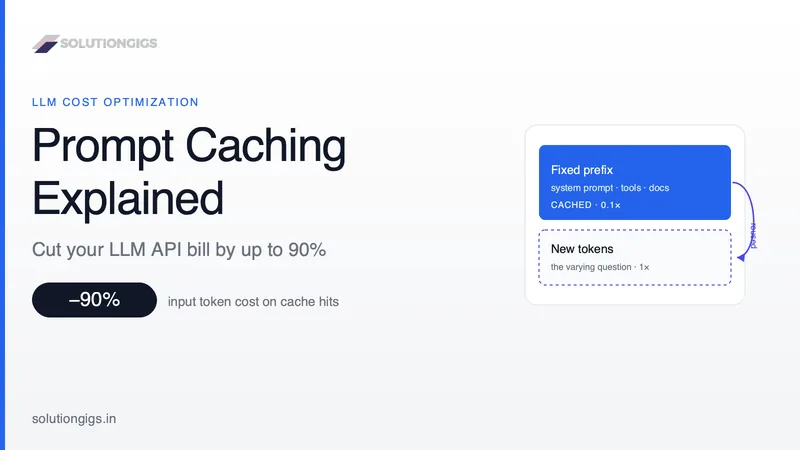
Prompt Caching Explained: Cut LLM API Costs Up to 90%
Prompt caching cuts LLM API costs up to 90% and speeds up responses. Learn how it works, Claude vs OpenAI vs Gemini pricing, real cost math, and how to fix cache misses.
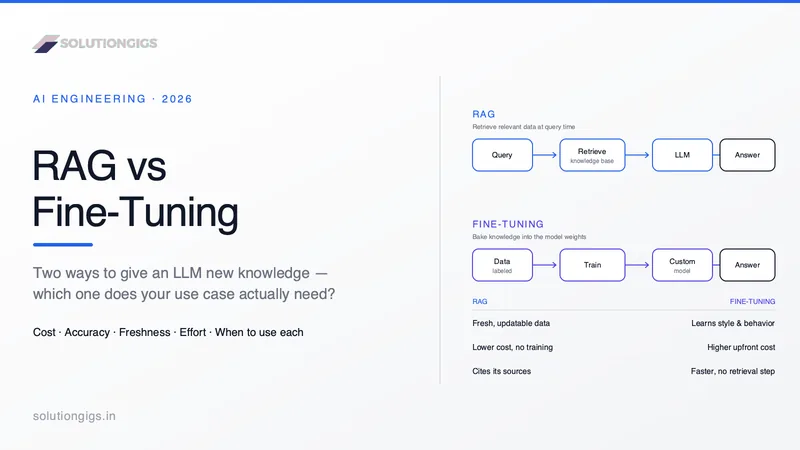
RAG vs Fine-Tuning: Which to Use for Your LLM App
RAG vs fine-tuning explained — the real difference, cost and accuracy trade-offs, and a clear decision framework for choosing how to give your LLM new knowledge in 2026.
Role Prompting: Give Your AI a Job Title and Watch It Perform
Role prompting assigns a specific expert persona to an AI model — 'Act as a senior data engineer' or 'You are a skeptical CFO' — so it responds from that professional frame. Why it works, 12 copy-paste role prompts for technical and non-technical tasks, common mistakes, and how to combine it with few-shot and chain-of-thought for expert-level output.