
Batch vs Streaming: Architecture, Latency Tradeoffs & Decision Rules
Batch vs streaming data processing explained — the real differences, latency and cost trade-offs, micro-batching, and a decision framework for when to choose each in 2026.

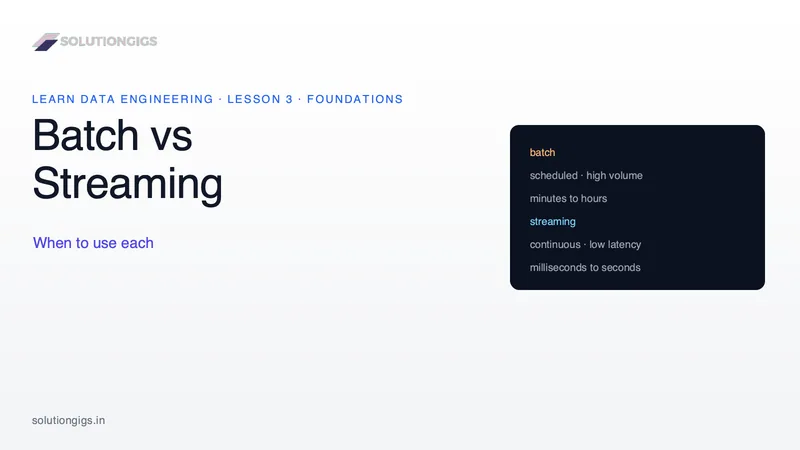
📚 Lesson 3 (final) of the Foundations track in our free Learn Data Engineering course. Builds on what data engineering is and the modern data stack.
Quick Answer: Batch processing handles data in scheduled chunks (say, hourly or nightly), with latency of minutes to hours. Streaming processing handles each event continuously as it arrives, with latency of milliseconds to seconds. Batch is simpler, cheaper, and right for most analytics; streaming is more complex and costly but essential when the business must act on data in real time. The rule of thumb: default to batch, and reach for streaming only when a genuine real-time requirement justifies it.
Batch vs streaming is one of the first big architecture decisions a data engineer makes, and it's easy to get wrong in both directions — running everything nightly when the business needs live data, or building a complex streaming system when a scheduled job would do. This lesson gives you the real trade-offs and a decision framework so you choose deliberately, not by hype.
Batch vs streaming: the core difference
The difference is when data is processed: batch processes data on a schedule; streaming processes each event the moment it arrives. Everything else — cost, complexity, latency — follows from that one distinction.
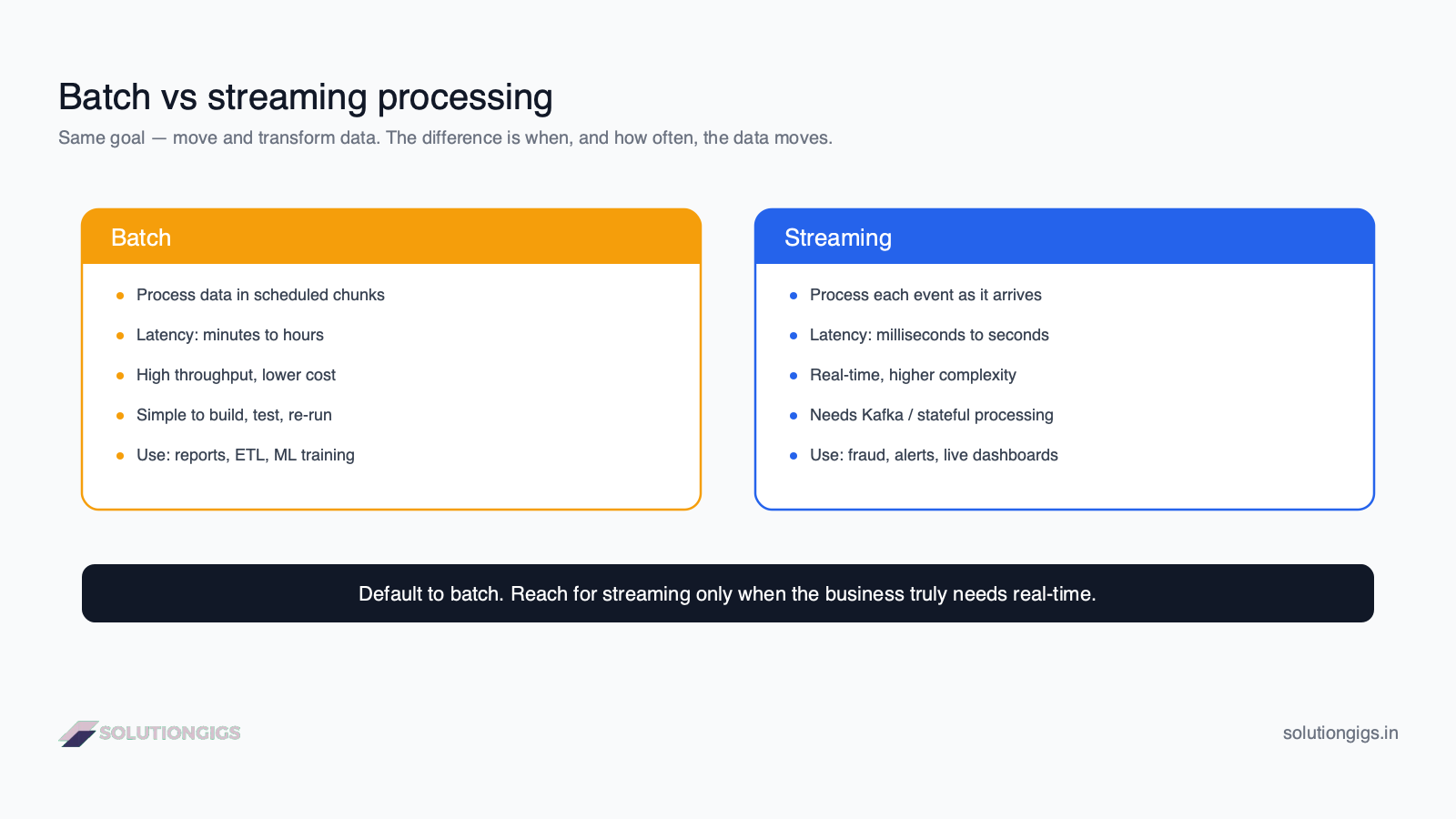
- Batch collects data over a window, then processes the whole chunk at once. Think "run the pipeline every night at 2 a.m."
- Streaming processes an unbounded, continuous flow of events one at a time (or in tiny windows), reacting within seconds.
A useful mental model: batch is doing the laundry once the hamper is full; streaming is washing each sock the instant you take it off. One is efficient and simple; the other is immediate but far more work.
The trade-offs, side by side
Batch wins on cost and simplicity; streaming wins on latency — and pays for it in complexity. Here's the honest comparison:
| Dimension | Batch | Streaming |
|---|---|---|
| Latency | Minutes to hours | Milliseconds to seconds |
| Data handling | Scheduled chunks | Continuous, event-by-event |
| Cost | Lower (run, then stop) | Higher (always running) |
| Complexity | Low — easy to build & test | High — stateful, always-on |
| Re-running / debugging | Easy — just run it again | Hard — state and ordering matter |
| Typical tools | SQL, Spark, Airflow, dbt | Kafka, Spark Streaming, Flink |
| Best for | Reports, ETL, ML training | Fraud, alerts, live dashboards |
The critical insight: streaming's complexity is real and permanent. An always-on system that maintains state, handles late and out-of-order events, and can't simply be "re-run" is fundamentally harder to operate than a scheduled job. That cost is worth paying — but only when latency genuinely matters.
When to use batch processing
Use batch whenever the business can tolerate data that's minutes or hours old — which is most of the time. Batch should be your default. It's the right tool for:
- Scheduled reports — daily revenue, weekly KPIs, monthly finance.
- ETL into a warehouse — the classic nightly load.
- ML model training — models train on historical data, not live streams.
- Billing and reconciliation — periodic, high-volume, correctness-critical.
- Any large backfill — reprocessing history is inherently a batch job.
If someone can't articulate why the data must be fresh right now, the answer is batch.
When to use streaming processing
Use streaming only when the business must act on data within seconds. The use cases are specific and high-value:
- Fraud detection — a fraudulent transaction must be caught before it completes, not in tomorrow's report.
- Real-time alerting & monitoring — infrastructure and security events need immediate response.
- Live dashboards — trading, logistics, and operations screens that must reflect now.
- Personalization — recommendations that react to what a user just did.
- IoT / telemetry — high-frequency sensor data acted on in real time.
For these, the freshness is the product. A fraud alert that arrives an hour late is worthless — the complexity of streaming is justified.
The middle ground: micro-batching
Micro-batching processes tiny, frequent batches (every few seconds) to get near-real-time latency without full streaming complexity. It's often the pragmatic answer when someone says "we need real-time" but really means "within a few seconds is fine."
Spark Structured Streaming works this way by default — it feels like streaming to the developer but processes small batches under the hood. You keep a simpler mental model and still hit seconds-level latency. Before committing to true event-by-event streaming, ask whether micro-batching is good enough; frequently it is.
Update: the ceiling on this middle ground moved. Apache Spark 4.1 shipped Real-Time Mode for Structured Streaming, which keeps stages long-lived and shuffles in memory instead of waiting for a batch to close — Databricks reports p99 latencies from a few milliseconds up to around 300 ms. It comes with real restrictions (stateless-only in open-source Spark, and no Delta sink or foreachBatch even on Databricks), so check it fits before planning around it — but "micro-batch means seconds" is now a property of your Spark version and trigger rather than a hard limit. Details in Spark vs Flink.
A simple decision framework
Ask one question: how fresh must the data be for the business to act?
- Hours or a day old is fine → Batch. (Most analytics.)
- A few seconds is fine → Micro-batch (e.g. Spark Structured Streaming).
- Must react in milliseconds/seconds, always on → True streaming (Kafka + Flink/Spark). Our Spark vs Flink comparison covers which engine fits which latency tier.
Then sanity-check with cost and team capacity. Streaming systems demand more engineering and more operational maturity. If the real-time need is marginal, batch almost always wins on total cost of ownership.
Try it yourself — check your understanding
- Classify each as batch or streaming: (a) nightly warehouse load, (b) credit-card fraud check, (c) monthly finance report, (d) live logistics tracking dashboard.
- A team says "we need real-time analytics" but a 5-second delay is acceptable. What's the pragmatic choice?
- Why is re-running a failed pipeline easy for batch but hard for streaming?
Show answers
- (a) Batch, (b) Streaming, (c) Batch, (d) Streaming.
- Micro-batching (e.g. Spark Structured Streaming) — seconds-level latency without full streaming complexity.
- Batch jobs are self-contained: the same input reproduces the same output, so you just run it again. Streaming systems carry ongoing state and depend on event ordering and timing, so re-running isn't a simple replay.
Common mistakes with batch vs streaming
- Building streaming because it sounds modern. If the business tolerates hourly data, streaming is wasted complexity and cost.
- Forcing everything into nightly batch. If fraud or alerts need real-time, a nightly job is a business failure, not a saving.
- Ignoring micro-batching. Many "real-time" needs are satisfied by seconds-level micro-batches — far simpler than true streaming.
- Underestimating streaming ops. Always-on, stateful systems need monitoring for things like consumer lag; budget for it.
- Not asking "how fresh, really?" The single question that settles most batch-vs-streaming debates goes unasked.
Frequently Asked Questions
What is the difference between batch and streaming processing?
Batch processing handles data in scheduled chunks — collect over a period, then process it all at once. Streaming processing handles each event continuously as it arrives, with millisecond-to-second latency. Batch optimizes for throughput and simplicity; streaming for freshness. The core difference is when data is processed: on a schedule versus immediately.
When should I use batch processing?
Use batch when the business tolerates data that's minutes or hours old — most analytics. It suits daily and hourly reports, ETL into a warehouse, ML training, billing, and any large-volume job where cost and simplicity beat freshness. Batch is easier to build, test, and re-run, so make it your default.
When should I use streaming processing?
Use streaming when the business must act on data within seconds — fraud detection, real-time alerting, live dashboards, personalization, IoT telemetry. Streaming adds real complexity (Kafka plus stateful processing), so adopt it only when a genuine real-time requirement justifies the extra cost and operational effort.
Is streaming better than batch?
No — they solve different problems. Streaming delivers lower latency but costs more and is harder to operate. Batch is cheaper, simpler, and adequate for most analytics. The right choice depends on required freshness. Most companies run mostly batch with streaming reserved for the few cases that truly need real-time.
What is micro-batching?
Micro-batching processes data in very small, frequent batches (e.g. every few seconds) to approximate streaming while keeping a simpler model. Spark Structured Streaming works this way. It's a practical middle ground: near-real-time latency without full event-by-event streaming complexity — enough for many "real-time" needs.
Conclusion
Batch and streaming aren't rivals — they're tools for different freshness requirements. Batch processes data on a schedule: simple, cheap, and right for the vast majority of analytics. Streaming processes each event as it arrives: powerful and necessary for genuine real-time needs, but complex and costly. Default to batch, consider micro-batching when you need seconds, and commit to true streaming only when the business truly must act in real time.
If you've decided you genuinely need streaming, the next choice is which platform carries it — Kafka vs Kinesis vs Pub/Sub costs all three at real traffic levels.
That completes the Foundations track of the free Learn Data Engineering course — you now understand the role, the stack, and this core architecture choice. Next you'll move into SQL, Python, and data modeling. Need this built rather than learned? Tell us what you're moving and how fresh it has to be — we'll tell you whether you actually need streaming.
Mohammed Yaseen
Founder, SolutionGigs
Mohammed builds both batch and streaming pipelines in production and teaches the free Learn Data Engineering course, where these trade-offs come up constantly. LinkedIn →
Try Free Spark Config Optimizer
Free, no signup — right in your browser.
Try Free Spark Config Optimizer →More in Data Engineering
Slowly Changing Dimensions (SCD Type 2) Explained
Slowly Changing Dimensions (SCD Type 2) explained — track dimension history with valid_from, valid_to and is_current, the SCD types compared, and SQL to implement it.
What Is Data Engineering? The Role Explained
What is data engineering? A clear explanation of the role — what a data engineer does day to day, the tools they use, how it differs from data science and analytics, and how to start.
Apache Airflow Fundamentals: DAGs Explained
Apache Airflow fundamentals — what a DAG is, tasks and operators, dependencies, scheduling, retries, and how the scheduler and executor run your data pipelines, with code.