
MCP Servers vs AI Agents: Who Owns the Agent Loop
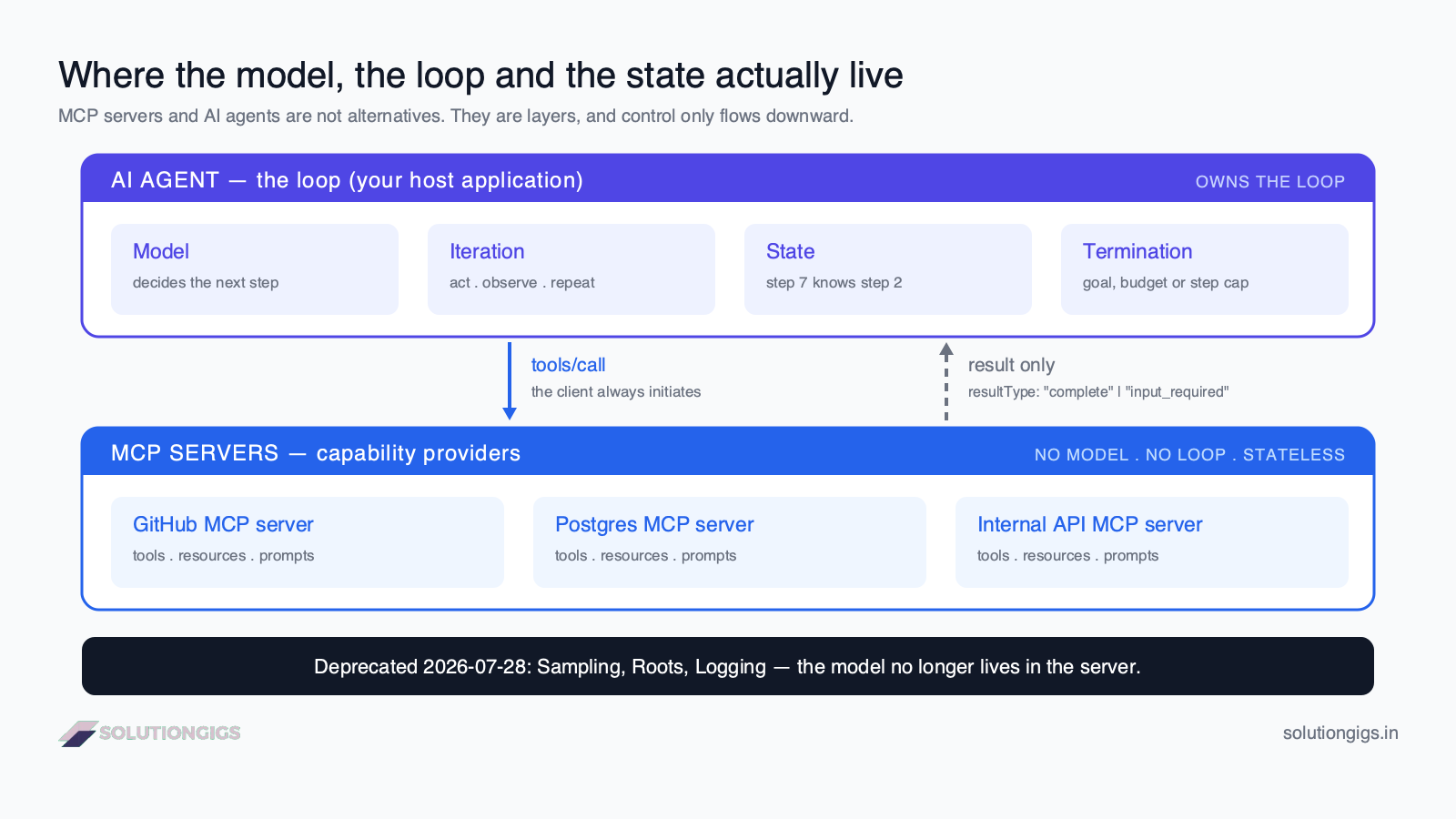
An MCP server has no model and no loop. An AI agent has both. They are layers, not alternatives — and on 28 July 2026 the specification made that boundary official by deprecating Sampling, Roots and Logging and removing protocol sessions. This guide gives the four questions that tell you which layer you are building, the control-inversion proof hiding in Multi Round-Trip Requests, and exactly what breaks when you hide an agent loop inside an MCP tool handler.

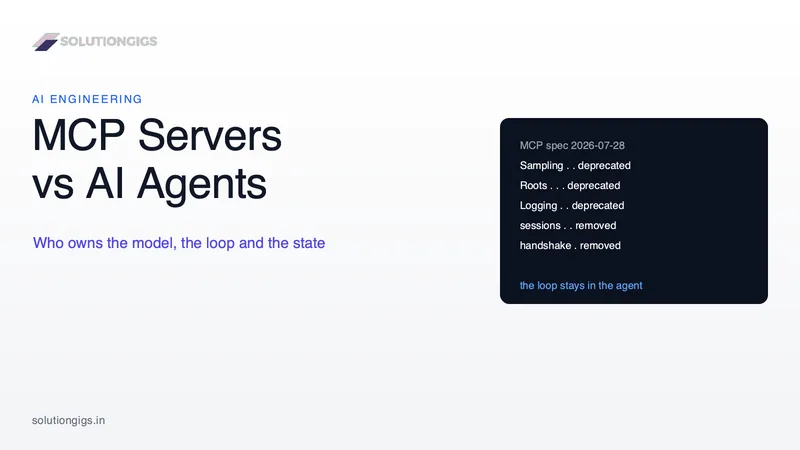
Quick Answer: MCP servers and AI agents are not alternatives — they sit at different layers. The agent is the loop: it holds the model, decides what to call next, keeps the state, and decides when to stop. An MCP server is a capability provider: it publishes tools, resources and prompts over JSON-RPC, holds no model, and never initiates anything. On 28 July 2026 the specification made that boundary official by deprecating Sampling, Roots and Logging and removing protocol sessions — the exact features that let a server pretend to be an agent.
Search "MCP servers vs AI agents" and you get a wall of pages comparing them like competing products, complete with a pros-and-cons table and a verdict about which one to "choose".
There is no choice to make. Asking whether to build an MCP server or an AI agent is like asking whether to build a database or a web application. One of them calls the other.
The confusion is understandable, because both are sold with the same sentence — connect AI to your systems — and because until very recently MCP contained features that genuinely blurred the line. Those features are now on their way out. This piece gives you the boundary that actually holds, the four questions that tell you which layer you are building, and what breaks when you put the loop in the wrong place.
The question is a category error
An AI agent is a control loop. An MCP server is a capability the loop can call. They are not comparable in the way "Postgres vs MySQL" is comparable.
Here is the loop, stripped to its essentials. An agent takes a goal, asks a model what to do next, executes that action, feeds the result back to the model, and repeats until a termination condition is met. That pattern — reason, act, observe, repeat — is what every agent framework implements, whether explicitly as a graph or implicitly inside a model-driven loop.
Four things are required for that loop to exist:
- A model to decide the next step.
- A loop that iterates rather than returning after one pass.
- State carried across iterations, so step 7 knows what happened at step 2.
- A termination condition — a goal test, a step budget, or a cost ceiling.
An MCP server has none of these. It receives a request, does one thing, returns a result. It is much closer to a well-described HTTP endpoint than to anything autonomous.
What an MCP server actually provides
An MCP server publishes three kinds of capability over a JSON-RPC 2.0 protocol: tools the model can call, resources it can read, and prompts a user can invoke. That is the whole surface area.
When an agent calls a create_issue tool on a Linear MCP server, the server turns around and calls Linear's REST API using a credential the model never sees, and returns the result. It made no decisions. It ran no loop. If we covered this ground for you already, what an MCP server is and how to build one in Python walks the implementation, and MCP vs API handles the other common confusion — the one between MCP and the REST API sitting underneath it.
The structural point for this article is narrower: the server is downstream of the decision. By the time your tool handler runs, the thinking has already happened somewhere else.
The four questions that tell you which layer you are building
Run these against whatever you are about to build. They separate the layers cleanly, and they are the questions the comparison articles skip.
| AI agent | MCP server | |
|---|---|---|
| Who holds the model credential? | You do — the agent pays for inference | Nobody, by default |
| Does it iterate? | Yes — that is the definition | No — one request, one result |
| Where does state live? | In the loop, across steps | Nowhere in the protocol (stateless since 2026-07-28) |
| Who initiates? | The agent calls out | It only ever answers |
| What does failure look like? | A loop that won't terminate, or a runaway bill | A non-zero JSON-RPC error on one call |
| How is it reused? | Rewritten per application | Any MCP-capable client, no onboarding |
| What is the unit of trust? | The whole autonomous system | One tool, one scope, one credential |
If your answer to "does it iterate?" is yes, you are building an agent, and the fact that you plan to ship it as an MCP server does not change what it is — it only changes who can see it iterating. More on that below.
The specification just made the boundary official
This is the part that has not made it into the comparison articles yet, and it is the reason the old answers are stale.
The 2026-07-28 revision of the Model Context Protocol removed or deprecated every feature that let an MCP server behave like an agent. Not as a stated goal — the motivation was scalability — but the effect is a hard architectural line.
| What changed on 2026-07-28 | Why it pins the loop outside the server |
|---|---|
| Sampling deprecated (SEP-2577) | Sampling let a server ask the client's model to generate something — a server borrowing a brain. Suggested migration: "integrate directly with LLM provider APIs instead." The model is now the agent's, not the server's |
| Roots deprecated (SEP-2577) | A server can no longer ask what filesystem scope it is operating in. Pass directories via tool parameters or server config instead |
| Logging deprecated (SEP-2577) | logging/setLevel is gone; log to stderr or OpenTelemetry. One less back-channel |
| Protocol sessions removed (SEP-2567) | No Mcp-Session-Id, no session affinity. A server cannot accumulate context across calls at the protocol level |
| Handshake removed (SEP-2575) | No initialize. Every request is self-describing, so any instance can answer any request — which only works if no instance is holding a conversation |
| MRTR replaces server-initiated requests (SEP-2322) | The server can no longer call the client. It returns resultType: "input_required" and waits for the client to retry |
| SSE resumability removed (SEP-2575) | A broken stream loses the in-flight request; the client MUST re-issue it with a new request ID |
| Tasks moved to an extension (SEP-2663) | Long-running work is now an explicit, pollable task — not an open connection you hold |
Read the first row again, because it is the load-bearing one. Through the first half of 2026, the standard answer to "can an MCP server be intelligent?" was yes — use Sampling, the server can ask the client's model to think for it. Whole articles were built on that premise. As of 28 July 2026, Sampling is deprecated with the official migration being "go get your own model credentials".
That is the protocol stating, in a changelog, that inference is not the server's job.
What "deprecated" buys you here: the spec adopted a formal feature lifecycle with a minimum twelve-month deprecation window, so Sampling cannot be removed before 28 July 2027. Existing code keeps working. Do not start anything new on it.
MRTR is the control-inversion proof
Before this revision, a server that needed user input mid-call sent a request back to the client. That is a server driving the interaction, however briefly.
Multi Round-Trip Requests inverts it. The server returns an interim result — resultType: "input_required" with an inputRequests field naming what it needs — and stops. The client decides whether to answer, gathers the input, and re-issues the original request with inputResponses attached.
{
  "resultType": "input_required",
  "inputRequests": [
    { "type": "elicitation", "message": "Which environment should I deploy to?" }
  ],
  "requestState": "srv-opaque-handle-9f2c"
}
Note requestState: the server encodes its own correlation identifier and hands it to the client, because the protocol no longer remembers anything between the two calls. Even the server's memory of its own half-finished work has to travel through the client.
A layer that cannot initiate a request cannot run a control loop. That is the boundary, expressed in wire format.
"But can't I just put an agent inside a tool handler?"
You can. It compiles, it ships, and it is occasionally the right call. But be clear about what you are trading, because four specific things break — and none of them show up in local testing.
1. The cost becomes invisible to the caller. The outer agent sees one tool call. Inside, you burned 40,000 tokens across nine model round trips. The caller cannot budget it, cannot trace it, cannot interrupt it, and cannot attribute it. If you care about what inference actually costs, hiding a loop behind a function signature is the fastest way to lose control of the number.
2. Retries duplicate work. SSE resumability is gone. When a stream breaks, the client re-issues the request with a new request ID — the protocol has no way to know it is a resumption. Your inner loop starts over from zero. If any step in it wrote to a database, sent a message, or moved money, it just happened twice. A single-action tool handler is naturally easy to make idempotent; a nine-step agent loop is not.
3. There is nowhere to keep progress. Statelessness means no protocol-level place to park "I'm on step 4 of 9". The sanctioned pattern is a server-minted handle passed back as an ordinary tool argument — state as visible application data. That works, but at that point you have rebuilt a job queue inside a protocol that just spent a whole revision removing one.
4. Timeouts are the client's, not yours. The client owns the deadline. An agent loop with unpredictable depth against a fixed client timeout fails non-deterministically and only under load.
The pattern that actually works: if the work is long-running rather than agentic, use the tasks extension (io.modelcontextprotocol/tasks) — return a task handle, let the client poll tasks/get. If the work is genuinely agentic, run it as its own agent and expose its results, not its reasoning, as a tool. The loop stays where the loop belongs.
So which one should you build?
The honest answer for most teams: an agent, calling MCP servers that somebody else already wrote.
Build an agent when the work needs judgement across multiple steps — when you cannot write down the sequence of calls in advance because the right next call depends on what the last one returned. Our own multi-agent system walkthrough in Python is a worked example of the loop and the orchestration around it.
Build an MCP server when you have a capability that more than one client needs to discover at runtime — an internal service several assistants should reach, a product surface you want any MCP-capable tool to drive. If you are wrapping an existing HTTP service, turning an API into an MCP tool covers the mechanics, and our free MCP server generator will scaffold the boilerplate.
Build neither when your agent and its tools live in one codebase and one deployment. Define the tools directly in your model API calls. No protocol, no transport, no server process. Runtime discovery is the feature you pay MCP's overhead for — if nothing in your system discovers anything, you are paying for a capability you never exercise.
Common mistakes
- Comparing them at all. If a design doc has a row labelled "MCP server vs agent", the design has not decided what it is building yet.
- Assuming MCP gives you autonomy. It gives you a described capability. Autonomy is the loop you write above it.
- Building on Sampling in new code. Deprecated since 2026-07-28. Working, but a dead end.
- Holding state in server memory. With no sessions and no sticky routing, the next request can land on any instance.
- Hiding a reasoning loop in a tool handler without making it idempotent — then meeting retry semantics in production.
- Exposing one MCP tool per REST endpoint. The model has to choose from your list; forty thin CRUD tools is a worse interface than six task-shaped ones.
- Trusting the tool boundary for authorization. Identity belongs in server-side code, never in a model-supplied parameter — see our guide to prompt injection and agent security.
Frequently asked questions
Is an MCP server an AI agent?
No. An MCP server exposes capabilities — tools, resources and prompts — over JSON-RPC. It contains no model, runs no reasoning loop, and never initiates a request. An AI agent is the loop that holds a model, decides which capability to call next, keeps the state and decides when to stop. An agent can call many MCP servers; an MCP server cannot call an agent.
Do I need MCP to build an AI agent?
No. An agent needs tools, not MCP specifically. If your agent and its tools live in one codebase, defining tools directly in your model API calls is less machinery and usually the right choice. MCP earns its overhead when tools must be discovered at runtime or reused across several clients you do not control.
Can an MCP server call an LLM?
It can, but only with its own model credentials and its own budget. The protocol feature that let a server borrow the client's model — Sampling — was deprecated in the 2026-07-28 specification. The official suggested migration is to integrate directly with an LLM provider API instead, which makes the server's inference cost its own problem rather than the client's.
What replaced Sampling in MCP?
Nothing replaced it as a capability. Sampling, Roots and Logging were deprecated together under SEP-2577. They stay functional through a minimum twelve-month deprecation window, so removal cannot happen before 28 July 2027, but new implementations should not adopt them. Servers needing inference call a provider API directly.
How does an MCP server ask the user a question now?
Through Multi Round-Trip Requests. The server returns an interim result with resultType: "input_required" and an inputRequests field naming what it needs. The client then retries the original request with inputResponses attached. The server never initiates — the client drives every round trip, which is why the reasoning loop cannot live in the server.
Can I put an agent loop inside an MCP tool handler?
You can, and it is sometimes correct, but the cost is hidden from the caller. The outer agent sees one tool call and cannot budget, trace or interrupt the tokens you spend inside it. Because the protocol removed stream resumability, a dropped connection makes the client re-issue the request as a new request ID, so a non-idempotent inner loop runs twice.
What is the difference between an MCP server and a tool?
A tool is a single callable function with a JSON Schema. An MCP server is a process that publishes a set of tools, plus resources and prompts, over a standard protocol so any MCP-capable client can discover them at runtime. One server typically exposes many tools. The agent consumes tools; MCP is one of several ways to deliver them.
Conclusion
The reason "MCP servers vs AI agents" returns so much confused writing is that the question presumes a rivalry that the architecture does not contain. The agent owns the model, the loop, the state and the decision to stop. The MCP server owns one capability and answers when asked. Everything useful you can say about the two of them follows from that.
What changed in July 2026 is that this stopped being a matter of taste. Deprecating Sampling took the model out of the server. Removing sessions took the memory out. Replacing server-initiated requests with Multi Round-Trip Requests took the initiative out. The layers are now enforced by the wire protocol, and designs that straddled them have a twelve-month window to move.
If you are building the loop, start with the agent patterns in our multi-agent Python guide and read Model Context Protocol explained for the protocol fundamentals. If you are building the capability, scaffold it with our free MCP server generator — no signup, and the output is a working stateless server you can run today.
Building something where the two layers meet and want a second pair of eyes on the architecture? Tell us what you're working on — we do this for a living.
Mohammed Yaseen
Founder, SolutionGigs
Mohammed builds agent systems and MCP servers in production, and has been tracking the Model Context Protocol through every specification revision since its release. LinkedIn →
Try Free MCP Server Generator
Free, no signup — right in your browser.
Try Free MCP Server Generator →More in AI & Machine Learning
MCP vs API: What's Actually Different
The usual answer - APIs are stateless, MCP holds a stateful session - stopped being true on 28 July 2026, when the specification removed protocol-level sessions outright. This guide gives the difference that actually holds: who reads the contract, and when. It covers what the 2026-07-28 revision removed, answers the live "is stateless MCP just an API again" argument honestly, and includes a decider for the fork you really face - build an MCP server, or just write tool definitions.
Model Context Protocol (MCP) Explained: The Complete Beginner's Guide
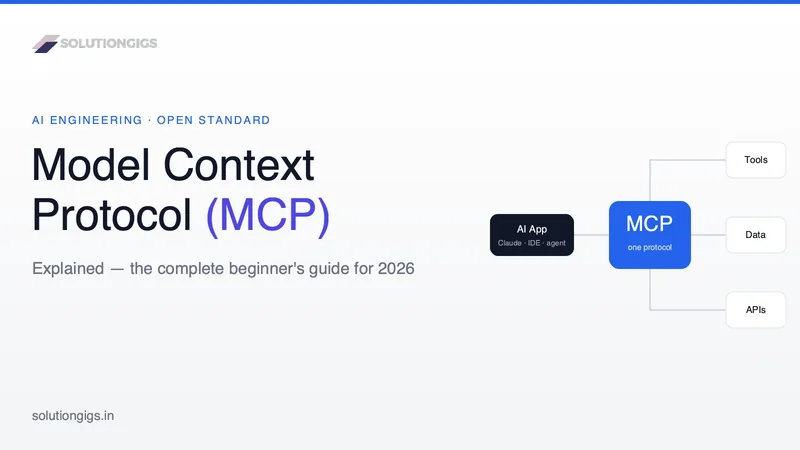
New to the Model Context Protocol? This beginner's guide explains what MCP is, how it works, why it matters for AI in 2026, and how to get started fast.
What Is an MCP Server? Build Your First One in Python
Learn what an MCP server is in plain English and build your first one in Python in 20 minutes. Step-by-step FastMCP tutorial — no prior MCP experience needed.