
50+ Practical Examples of AI in Everyday Life & Work
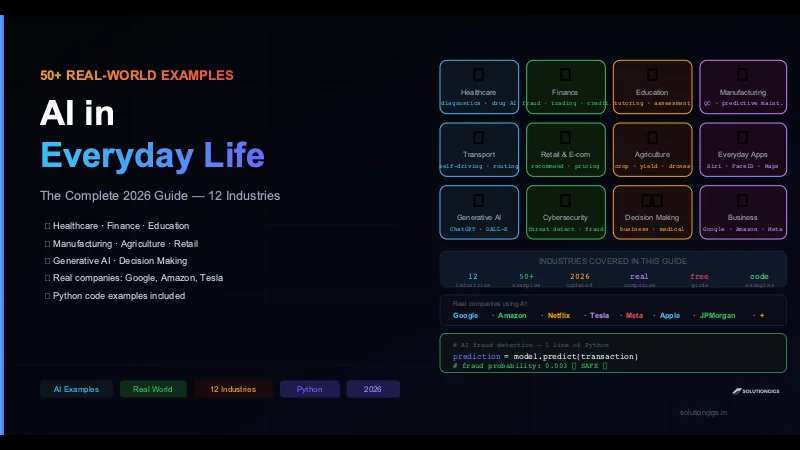
50+ real examples of AI in everyday life across 12 industries — healthcare, finance, education, manufacturing, agriculture, retail, and generative AI. Real companies, how they work, and Python code included.

Quick Answer
Artificial intelligence is already embedded in your daily life — in your phone's Face ID, your email's spam filter, the Netflix show it recommends, your bank's fraud detection, and the GPS route Google Maps picks. In 2026, AI touches healthcare, finance, education, manufacturing, agriculture, retail, and entertainment. This guide covers 50+ real examples of AI in everyday life across 12 industries, with the actual companies using them and Python code showing how they work.
You used AI at least a dozen times today — and probably didn't notice.
The recommendation that made you watch one more episode. The filter that kept 98% of spam out of your inbox. The autocorrect that fixed your typo mid-message. The route Google Maps picked that avoided a jam you didn't even know about.
Artificial intelligence isn't a future technology. It's infrastructure — as invisible and essential as electricity.
In 2026, AI spending globally has crossed $500 billion. Every major industry is restructuring around it. This guide is the most comprehensive map of where AI actually is, what it's actually doing, and which companies are leading in each domain.
What Is Artificial Intelligence? (One Clear Definition)
Artificial intelligence (AI) is the field of computer science that builds systems capable of performing tasks that normally require human intelligence — things like understanding language, recognising images, making decisions, and predicting outcomes.
Modern AI works through machine learning: instead of programming explicit rules, you feed the system millions of examples and let it learn the patterns.
Traditional programming:
  Rules + Data → Output
  ("if spam words detected, move to spam")

Machine learning (AI):
  Data + Output → Rules (learned automatically)
  (model sees 10M emails labelled spam/not-spam, learns the pattern itself)
The three types of AI you'll see in real-world examples:
| Type | What it does | Example |
|---|---|---|
| Machine Learning (ML) | Learns patterns from data to make predictions | Fraud detection, recommendations |
| Deep Learning / Neural Networks | Multi-layer ML — learns complex features automatically | Face recognition, medical imaging |
| Generative AI (GenAI) | Creates new content — text, images, code, audio | ChatGPT, DALL-E, GitHub Copilot |
1. AI in Everyday Smartphone Life
You carry an AI supercomputer in your pocket. Here's what it's doing:
Face ID (Apple, Samsung)
Your phone's Face ID uses a convolutional neural network (CNN) that maps 30,000+ infrared dots projected on your face into a mathematical model. It recognises you in under 300 milliseconds, even as your face ages, with glasses, or in the dark. The false-accept rate is 1 in 1,000,000 — compared to 1 in 50,000 for fingerprint sensors.
Siri, Google Assistant, Alexa
Every voice assistant runs three separate AI models in sequence:
- Speech recognition (converts audio to text — Whisper-class models)
- Natural language understanding (figures out what you meant)
- Response generation (generates or retrieves the answer)
All three run in milliseconds.
Autocorrect and Predictive Text
Predictive text uses a language model (a smaller cousin of GPT) to predict your next word based on context. Modern autocorrect models are trained on billions of messages and account for your personal typing patterns.
Google Photos — "Search your photos"
When you search "beach 2023" in Google Photos, a vision-language model has already processed every photo you've ever taken, matched faces, identified locations, and indexed the content — so your search returns relevant results instantly.
2. AI in Healthcare — Saving Lives at Scale
Healthcare is where AI's impact is most profound — and most measurable in human terms.
Medical Image Analysis
Example: Google DeepMind's retinal scan AI
DeepMind's model analyses retinal scans and detects over 50 eye diseases — including diabetic retinopathy and macular degeneration — with accuracy matching senior ophthalmologists. It takes 30 seconds per scan. A human specialist takes 30 minutes.
The same technology, applied to chest X-rays, detects lung cancer nodules missed by radiologists 11% of the time.
Drug Discovery — AlphaFold
Proteins fold into 3D shapes that determine their function. Predicting how a protein folds from its amino acid sequence was a 50-year unsolved problem in biology.
In 2020, DeepMind's AlphaFold solved it. By 2026, AlphaFold has predicted the structure of every known protein — over 200 million. Drug discovery timelines that took 10 years have been compressed to 18 months.
AI-Powered Diagnostics
- Sepsis prediction: AI models monitor patient vitals in real time and flag sepsis risk 6–12 hours before clinical symptoms appear. Johns Hopkins' system reduced sepsis mortality by 18%.
- Cancer detection: AI analyses biopsy images and detects cancers a pathologist would miss, with sensitivity rates exceeding 99% on specific cancer types.
- Mental health: AI analysis of speech patterns, typing speed, and social media activity can predict depression relapses before patients self-report symptoms.
3. AI in Finance and Banking
Finance was one of the first industries to adopt ML at scale — the data is clean, the outcomes are measurable, and the stakes are high.
Fraud Detection
Real company: Visa's Advanced Authorization
Visa analyses every single transaction — over 65,000 per second globally — using a neural network trained on years of transaction history. Each transaction is scored for fraud probability in under 100 milliseconds before approval is sent back to the merchant's terminal.
Here's what a simplified fraud detection model looks like in Python:
import numpy as np
from sklearn.ensemble import RandomForestClassifier

# Features per transaction
# [amount, hour_of_day, distance_from_home, merchant_category,
#  velocity_last_hour, is_foreign, is_online]

def predict_fraud(transaction_features: list) -> dict:
    # In production: model loaded from trained weights
    # model = joblib.load("fraud_model.pkl")

    # Simulated prediction
    features = np.array(transaction_features).reshape(1, -1)
    fraud_probability = model.predict_proba(features)[0][1]

    return {
        "fraud_probability": round(fraud_probability, 4),
        "decision": "BLOCK" if fraud_probability > 0.85 else "APPROVE",
        "reason": "High velocity + foreign merchant" if fraud_probability > 0.85 else "Normal pattern"
    }

# Example
result = predict_fraud([4200, 2, 1850, "electronics", 4, True, True])
# {"fraud_probability": 0.923, "decision": "BLOCK", "reason": "High velocity + foreign merchant"}
Algorithmic Trading
Hedge funds like Renaissance Technologies and Two Sigma use ML models that scan thousands of market signals — price patterns, news sentiment, social media, satellite imagery of car parks — to execute trades in microseconds.
Credit Scoring
Traditional credit scores ignore 50+ million Americans with thin credit files. AI models from companies like Upstart use 1,600+ variables — education, employment history, repayment patterns on small bills — to approve borrowers that FICO scores would reject. Default rates are comparable to or lower than traditional lending.
AI in Banking Examples (Summary)
| Use Case | Company | Impact |
|---|---|---|
| Fraud detection | Visa, Mastercard, PayPal | Sub-100ms decisions on 65K+ TPS |
| Customer service chatbot | Bank of America (Erica) | 1.5B+ interactions, handles 90% without human |
| Loan underwriting | JPMorgan, Upstart | Minutes vs weeks for decisions |
| AML (money laundering) | HSBC, Citibank | 20× better detection than rule-based systems |
| Robo-advisory | Betterment, Wealthfront | Personalised portfolios at $0 advisor fee |
4. AI in Education
Adaptive Learning
Duolingo adjusts the difficulty of every exercise based on your performance in the last 10 interactions. Its AI models know that if you got 3 consecutive right answers, the next question should be harder. If you're struggling with gendered nouns, it serves more of those — not the lesson plan's default order.
Khan Academy's Khanmigo uses Claude (Anthropic) as a Socratic tutor — it never just gives the answer. It guides students to discover it, asking leading questions exactly as a skilled human tutor would.
AI Writing Tools in Classrooms
Teachers use ChatGPT and Claude to:
- Generate 20 differentiated versions of a worksheet (for different reading levels) in 3 minutes instead of 3 hours
- Create rubrics, lesson plans, and IEP accommodation suggestions
- Provide instant first-round feedback on student essays before teacher review
Plagiarism and AI Detection
Turnitin's AI Detection now flags AI-generated content alongside copied content. It's trained on millions of human-written and AI-generated samples. Universities that adopted it in 2025 found 15–20% of submitted essays contained significant AI-generated sections.
AI in Education Examples (Summary)
| Use Case | Company/Tool | What AI Does |
|---|---|---|
| Adaptive learning | Duolingo, Khan Academy | Personalises difficulty, pacing, content |
| AI tutoring | Khanmigo, Cognii | Socratic guidance on demand, 24/7 |
| Essay grading | Turnitin, Gradescope | Scores grammar, structure, argument |
| Early risk intervention | Civitas Learning | Predicts at-risk students weeks early |
| Accessibility | Microsoft Immersive Reader | Real-time read-aloud and text simplification |
5. AI in Manufacturing
Visual Quality Control
BMW uses AI-powered cameras at every stage of production. Each camera runs a CNN model that inspects for paint defects, assembly errors, and dimensional tolerances in real time — at speeds no human inspector can match.
A single BMW production line inspects 1,400 components per car. Human inspectors catch ~85% of defects. AI inspection systems catch 99.7%.
# Simplified CNN-based defect detector (PyTorch)
import torch
import torchvision.transforms as transforms
from PIL import Image

# Load pre-trained defect detection model
# model = torch.load("defect_detector.pth")
model.eval()

def inspect_component(image_path: str) -> dict:
    transform = transforms.Compose([
        transforms.Resize((224, 224)),
        transforms.ToTensor(),
        transforms.Normalize([0.485, 0.456, 0.406], [0.229, 0.224, 0.225])
    ])

    img = Image.open(image_path).convert("RGB")
    tensor = transform(img).unsqueeze(0)

    with torch.no_grad():
        output = model(tensor)
        defect_prob = torch.sigmoid(output).item()

    return {
        "defect_probability": round(defect_prob, 4),
        "result": "REJECT" if defect_prob > 0.5 else "PASS",
        "confidence": f"{max(defect_prob, 1-defect_prob)*100:.1f}%"
    }
Predictive Maintenance
Siemens and GE embed sensors in turbines, motors, and compressors. ML models monitor vibration, temperature, and pressure patterns continuously. When a pattern starts deviating from baseline in a way that historically preceded a failure, the system alerts maintenance 2–4 weeks in advance.
Result: 30–50% reduction in unplanned downtime. For a large factory, that's millions of dollars saved per prevented outage.
AI in Manufacturing Examples (Summary)
| Use Case | Companies | Impact |
|---|---|---|
| Visual quality control | BMW, Toyota, Samsung | 99.7% defect detection vs 85% human |
| Predictive maintenance | Siemens, GE, ABB | 30–50% reduction in downtime |
| Robotic assembly | FANUC, Kuka, ABB | 24/7 operation, micron precision |
| Energy optimisation | Google DeepMind | 40% reduction in cooling energy |
| Demand forecasting | Bosch, Honeywell | 20% reduction in inventory costs |
6. AI in Agriculture
Agriculture was slow to adopt technology — now it's one of the fastest-changing sectors.
Crop Disease Detection
Plantix (by PEAT) is an app used by 10 million+ farmers across India, Germany, and Brazil. Farmers photograph a diseased leaf and the AI — a CNN trained on millions of labelled plant images — identifies the disease and recommends treatment in seconds.
Accuracy on the top 10 crop diseases: 93%, comparable to expert agronomists.
Yield Prediction
The Climate Corporation (owned by Bayer) uses satellite imagery, weather data, soil sensors, and historical yield records to predict harvest yields at field level, 2–3 months before harvest. Farmers use the predictions to pre-sell commodities or secure financing.
Autonomous Tractors
John Deere's fully autonomous tractor (the 8R series) uses 12 cameras, GPS, and computer vision to plant, spray, and harvest without a driver — adjusting for obstacles and row alignment in real time.
AI in Agriculture Examples (Summary)
| Use Case | Company/Tool | What AI Does |
|---|---|---|
| Crop disease detection | Plantix, Trace Genomics | Diagnoses disease from leaf photos |
| Precision spraying | John Deere See & Spray | Sprays only weeds, saves 90% herbicide |
| Yield prediction | The Climate Corporation | Predicts harvest 3 months ahead |
| Livestock monitoring | Connecterra, Cainthus | Detects illness/stress in cattle via video |
| Soil analysis | Farmers Business Network | Recommends fertiliser by soil zone |
7. AI in Retail and E-Commerce
Amazon's Recommendation Engine
Amazon's recommendation system drives 35% of its total revenue. It's a collaborative filtering model that asks: "What do people who bought this also buy?" — across billions of transactions, personalised to your browsing and purchase history.
The same model runs on product page placement, email campaigns, search result ranking, and Alexa shopping suggestions.
Dynamic Pricing
Amazon changes product prices 2.5 million times per day. An ML model monitors competitor prices, demand forecasts, inventory levels, and time-of-day patterns to maximise revenue per item in real time.
Airlines have done this for decades — AI now does it for everything from hotel rooms to grocery items.
Visual Search
Pinterest Lens lets you photograph any object and find visually similar products to buy. A vision model extracts features from the image — colour, shape, texture, pattern — and searches the product catalogue for matches. Pinterest reports 600 million visual searches per month.
8. AI in Transportation
Self-Driving Vehicles
Tesla's Autopilot and Full Self-Driving use 8 cameras providing 360° vision, processed by a neural network Tesla trained on billions of miles of real-world driving data. The system detects pedestrians, cyclists, lane markings, traffic lights, and other vehicles in real time.
Waymo (Google) uses LiDAR + cameras + radar fused by deep learning models. Waymo's robotaxis have driven 40+ million miles in fully autonomous mode.
Route Optimisation
Google Maps uses reinforcement learning to find optimal routes in real time — accounting for current traffic, predicted traffic 30 minutes ahead, road closures, accidents, and your car's speed profile. On a 30-minute commute, this typically saves 5–10 minutes versus a static route.
UPS's ORION (On-Road Integrated Optimisation and Navigation) uses ML to optimise delivery routes for 100,000+ drivers daily. Result: 100 million fewer miles driven per year, saving 10 million gallons of fuel.
9. Generative AI Examples — The Newest Wave
Generative AI is the most visible AI development of the 2020s. It creates — text, images, code, audio, video — rather than just classifying or predicting.
Text Generation
| Tool | Creator | What it generates |
|---|---|---|
| ChatGPT | OpenAI | Conversations, essays, code, analysis |
| Claude | Anthropic | Long documents, reasoning, coding |
| Gemini | Multimodal — text + images + video | |
| Llama | Meta | Open source, runs locally for free |
Image Generation
| Tool | Creator | Style |
|---|---|---|
| DALL-E 3 | OpenAI | Photorealistic, follows complex prompts |
| Midjourney | Midjourney Inc | Artistic, cinematic, illustrative |
| Stable Diffusion | Stability AI | Open source, highly customisable |
| Adobe Firefly | Adobe | Commercial-safe, style-consistent |
Code Generation
GitHub Copilot (which now lets you pick the underlying model — OpenAI's GPT line, Anthropic's Claude, or Google's Gemini) completes entire functions as you type. In a 2025 study, developers using Copilot completed tasks 55% faster and reported spending more time on interesting work and less on boilerplate.
# Type a function signature — Copilot writes the rest
def calculate_compound_interest(principal, rate, years, n=12):
    # Copilot generates this instantly:
    """
    Calculate compound interest.
    Args:
        principal: Initial investment amount
        rate: Annual interest rate (as decimal, e.g. 0.05 for 5%)
        years: Number of years
        n: Compounding frequency per year (default: 12 for monthly)
    Returns:
        Final amount after compounding
    """
    return principal * (1 + rate/n) ** (n * years)
Video and Audio Generation
- Sora (OpenAI): Generates photorealistic 1080p videos up to 60 seconds from text prompts
- Runway Gen-3: Professional-grade video generation used in film and advertising
- Eleven Labs: Clones any voice from 3 minutes of audio; generates speech in 30+ languages
- Suno: Generates complete original songs with lyrics and instrumentation from a text prompt
10. AI for Decision Making
Business Decision Making
AI for decision making in business replaces gut instinct and spreadsheets with data-driven probability:
- Inventory decisions: Target's demand forecasting AI prevented $1B in markdown losses in 2024 by ordering the right quantities 12 weeks in advance
- Hiring decisions: HireVue's AI analyses video interview responses and scores candidates on 25,000 data points. Unilever replaced first-round interviews with it, reducing time-to-hire from 4 months to 2 weeks
- Marketing spend: Google's Smart Bidding adjusts ad auction bids in real time using signals no human can process — device, location, time, past behaviour, browser
Medical Decision Making
AI decision support tools now assist with:
- ICU triage: Models predict which patients will need ventilators in the next 24 hours
- Treatment selection: NLP models extract patient history and suggest evidence-based treatment options
- Radiology: AI flags the 10% of scans most likely to contain abnormalities, letting radiologists focus there first
AI and Human Decision Making — The Key Principle
The best AI decision systems are human-in-the-loop: AI narrows the options and quantifies confidence, a human makes the final call and takes responsibility.
Pure AI decision making (no human override) remains controversial and risky for high-stakes domains — medicine, criminal justice, credit — because models can inherit and amplify biases present in training data.
11. AI in Cybersecurity
Threat Detection
Traditional cybersecurity tools match known attack signatures. AI-based tools like Darktrace model normal network behaviour for every device and user, then flag anything that deviates — catching novel attacks that have no known signature.
Darktrace detected and contained the Sunburst/SolarWinds attack variant at client sites within hours of it entering the network — before human analysts were even aware it existed.
Email Phishing Detection
Google's AI-powered spam filter blocks 99.9% of spam and phishing emails in Gmail — over 100 million phishing attempts per day. The model analyses content, sender reputation, link destinations, image patterns, and thousands of other signals simultaneously.
AI Fraud Detection in Real Time
# Real-time anomaly detection for login attempts
from sklearn.ensemble import IsolationForest
import numpy as np

# Features: [login_hour, location_country_code, device_fingerprint_changed,
#            failed_attempts_last_hour, ip_reputation_score]

class LoginAnomalyDetector:
    def __init__(self):
        self.model = IsolationForest(contamination=0.01, random_state=42)

    def fit(self, historical_logins: np.ndarray):
        self.model.fit(historical_logins)

    def is_suspicious(self, login_features: list) -> dict:
        features = np.array(login_features).reshape(1, -1)
        score = self.model.score_samples(features)[0]
        is_anomaly = self.model.predict(features)[0] == -1

        return {
            "suspicious": bool(is_anomaly),
            "anomaly_score": round(float(score), 4),
            "action": "REQUIRE_MFA" if is_anomaly else "ALLOW"
        }
12. Companies Using AI — Who's Leading?
| Company | Key AI Applications | Scale |
|---|---|---|
| Search ranking, Maps, Gmail, Photos, Translate, Ads, Waymo | 8.5B searches/day processed by AI | |
| Amazon | Recommendations, Alexa, warehouse robots, AWS AI services | 35% of revenue from AI recommendations |
| Meta | Feed ranking, content moderation, ad targeting, Ray-Ban AI glasses | 3.3B users, billions of AI decisions/day |
| Netflix | Recommendations, thumbnail personalisation, content investment | $1B/year saved by reducing churn via AI |
| Tesla | Autopilot, FSD, manufacturing quality control | 6M+ cars generating driving training data |
| JPMorgan | Fraud detection, trading, document analysis (COiN), risk | COiN reviews 12,000 contracts/second |
| Spotify | Discover Weekly, Podcast recommendations, audio analysis | 600M users, 100M+ tracks analysed |
| Apple | Face ID, Siri, autocorrect, on-device ML privacy | On-device AI — no data sent to servers |
Responsible AI — The Other Side
No honest guide to AI in everyday life skips this section.
Bias in AI systems is well-documented:
- Facial recognition systems from major vendors were found to have 35% higher error rates on darker-skinned women than lighter-skinned men (MIT Media Lab, 2018)
- Criminal recidivism algorithms like COMPAS assigned higher risk scores to Black defendants than white defendants with similar histories
- Amazon's internal resume-screening AI downgraded resumes that included the word "women's" — trained on 10 years of hiring data that skewed male
AI hallucinations — models stating falsehoods with confidence — remain a serious problem for high-stakes applications.
The responsible AI principles now standard across the industry:
- Transparency: disclose when AI made or influenced a decision
- Explainability: provide a human-understandable reason
- Human oversight: keep humans in the loop for consequential decisions
- Bias auditing: test models across demographic groups before deployment
- Data minimisation: use only the data needed, no more
Frequently Asked Questions
What are 10 examples of artificial intelligence in everyday life?
Face ID, spam filters, Netflix recommendations, Google Maps routing, credit card fraud detection, Siri/Alexa/Google Assistant, Instagram/TikTok feeds, autocorrect, Spotify Discover Weekly, and ChatGPT. Each of these runs AI models billions of times per day on data from hundreds of millions of users.
What are examples of AI in business?
Customer service chatbots, dynamic pricing engines, AI-powered CRMs, sales forecasting models, HR resume screening, supply chain demand forecasting, and fraud detection. Companies like Google, Amazon, JPMorgan, and Netflix have AI embedded in nearly every core operation.
How is AI used in healthcare?
Medical image analysis (detecting tumours in MRI/CT/retinal scans), drug discovery (AlphaFold), clinical decision support, robotic surgery assistance, patient risk stratification, and medical documentation automation.
What are examples of generative AI?
ChatGPT (text), Claude (reasoning and writing), DALL-E 3 and Midjourney (images), Stable Diffusion (open-source images), GitHub Copilot (code), Suno (music), Runway and Sora (video), and Eleven Labs (voice cloning).
How is AI used in manufacturing?
Visual quality control using CNN cameras, predictive maintenance using sensor data and ML, robotic assembly automation, energy optimisation (DeepMind cut Google's data centre cooling costs by 40%), and demand forecasting for supply chains.
What are examples of AI in agriculture?
Crop disease detection from leaf photos (Plantix), precision herbicide spraying (John Deere See & Spray saves 90% herbicide), autonomous tractors, satellite-based yield prediction (Climate Corporation), and AI-based soil analysis for fertiliser recommendations.
How is AI used in finance and banking?
Fraud detection on every transaction in under 100ms (Visa/Mastercard), algorithmic trading (Renaissance Technologies), alternative credit scoring (Upstart), AI customer service chatbots (Bank of America's Erica), AML (anti-money laundering) detection, and automated loan underwriting.
Conclusion
AI in 2026 is not a feature — it's the operating layer underneath almost every digital service you use.
The pattern is the same across every industry: AI absorbs repetitive, data-heavy, pattern-matching work at a speed and scale humans can't match. Human judgement focuses on strategy, ethics, exceptions, and high-stakes decisions.
The industries where AI is most mature:
- Finance (fraud detection, trading, credit)
- Technology (recommendations, search, ads)
- Healthcare (imaging, drug discovery)
The industries where AI adoption is accelerating fastest:
- Agriculture
- Manufacturing
- Education
Where it's still early and contested:
- Criminal justice
- Hiring and HR
- Autonomous decision-making in high-stakes public domains
To go deeper on specific topics, see our guides on open source LLMs, building AI agents in Python, and what AI agents actually are.
Need to bring AI into your own product or business? SolutionGigs connects you with vetted AI engineers who have shipped AI in production — free to post.
Mohammed Yaseen
Founder, SolutionGigs
Mohammed builds AI-powered developer tools and data systems. He tracks AI adoption across industries and writes about the gap between AI headlines and what's actually deployed in production today. LinkedIn →
More in AI Development
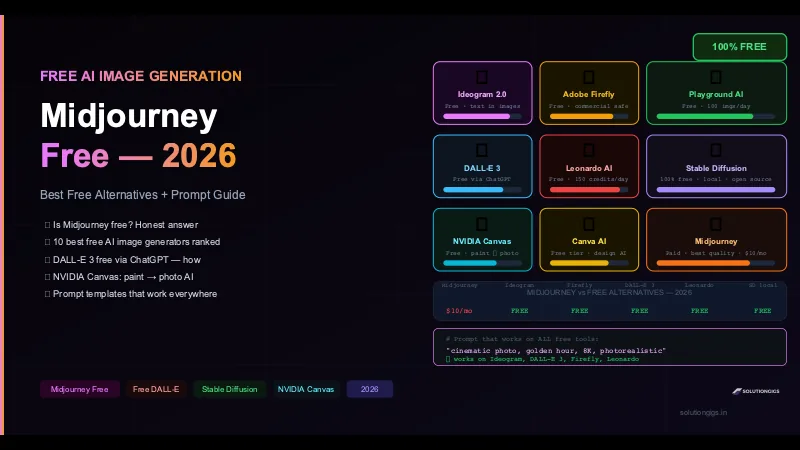
Midjourney: Is It Free? + 10 Best Free AI Image Generators
Is Midjourney free in 2026? Honest answer: no. But here are 10 free AI image generators that actually work — DALL-E 3, Ideogram, Adobe Firefly, Leonardo AI, Stable Diffusion, NVIDIA Canvas. Full prompt guide included.
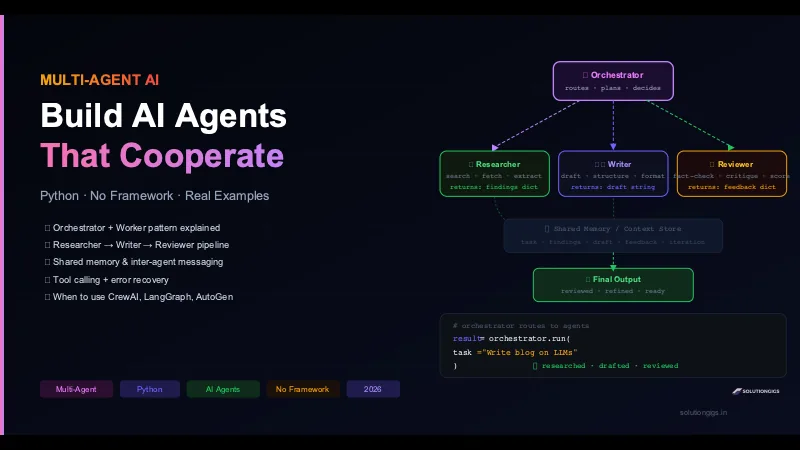
How to Build a Multi-Agent AI System in Python
Build a multi-agent AI system in Python from scratch — orchestrator, researcher, writer, and reviewer agents that cooperate. Includes parallel execution, tool calling, shared memory, and error recovery. No framework required.
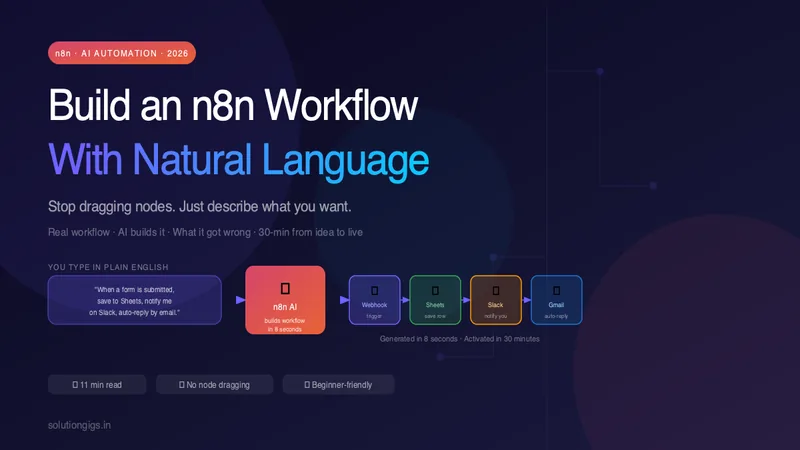
Build an n8n Workflow With Just Natural Language (n8n + AI)
Stop dragging nodes around. I describe a real automation in plain English, let n8n AI build it, show what it got wrong, and fix it live — from idea to a running workflow in under 30 minutes.