
Data Mesh Architecture: What It Is and When It Actually Works
Data mesh is an operating model, not an architecture you can install — it moves data ownership to the business domains and holds them to a product standard. This guide skips the hype and answers the question every other one dodges: should you actually do this? Inside: the four principles stated plainly, an honest verdict on what survived after five years of real adoption (the data product model went mainstream; full decentralization mostly didn't), the 8-item spec a dataset must meet to be a data product, a readiness gate scored on six signals, the data mesh vs data fabric vs lakehouse table, the hybrid shape teams actually run, and a 90-day path that starts with one product instead of a domain-boundary workshop.
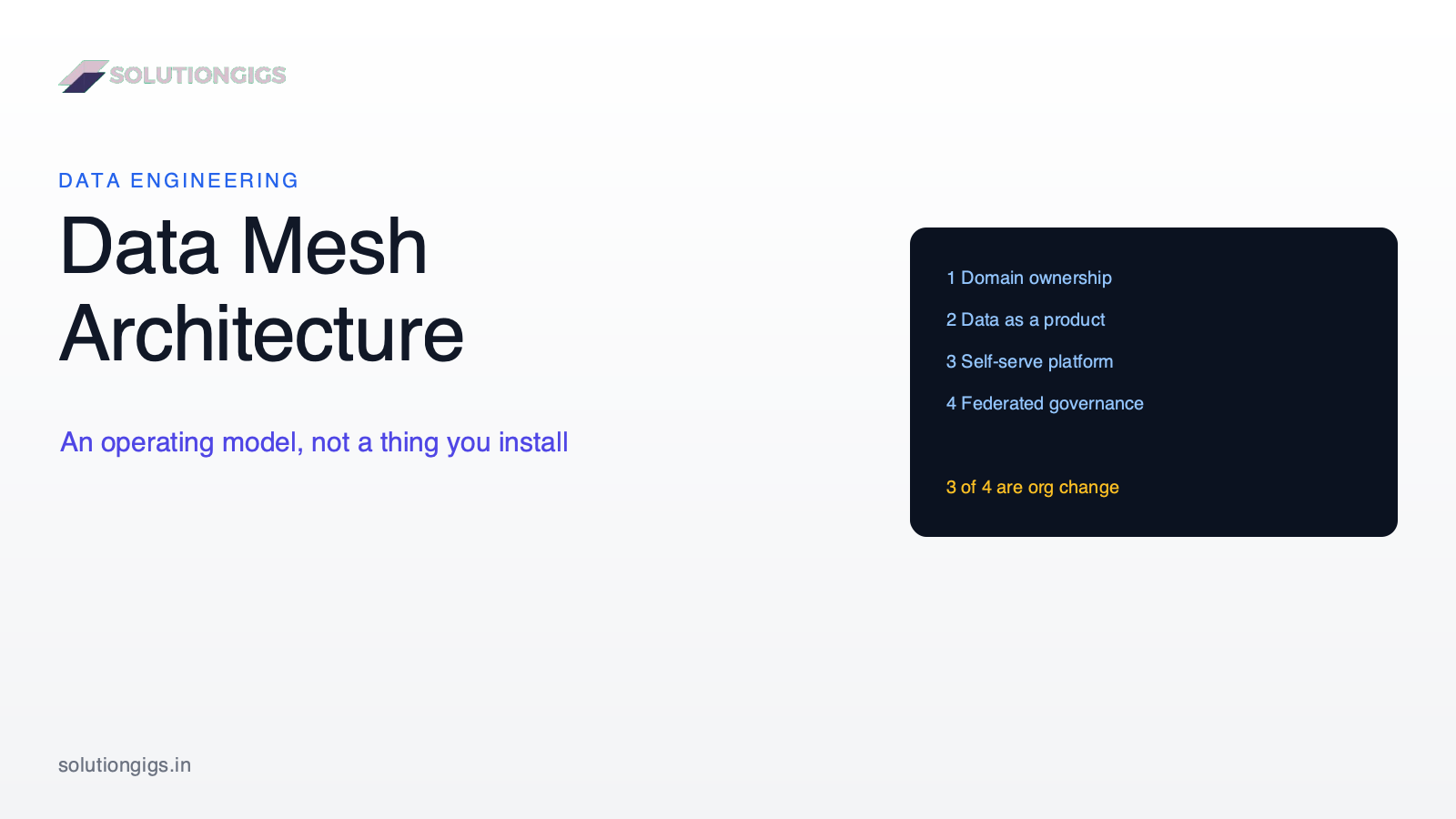
Quick Answer: Data mesh is an operating model, not a piece of architecture you can buy or build. It moves ownership of analytical data from one central data team to the business domains that generate it, and requires each domain to publish its data as a supported product — with an owner, a schema contract, a freshness SLO and a support channel. A central platform team still provides the shared infrastructure. The decentralization is organizational; the tooling usually stays centralized. That distinction is why most "data mesh projects" fail and most successful ones never call themselves a mesh.
Almost every article about data mesh explains the same four principles and stops right where the hard part starts. You finish it knowing the vocabulary and still unable to answer the only question that matters: should we do this, and what do we actually build on Monday?
This guide answers that. You'll get the four principles stated plainly, an honest verdict on where data mesh stands after five years of real adoption, the eight-item spec a dataset must meet before it can be called a data product, a readiness gate that tells you whether your organization qualifies at all, and the hybrid shape that teams who succeeded actually run.
The one idea: data mesh moves ownership, not infrastructure
Data mesh is the claim that the bottleneck in analytics is organizational, not technical — so the fix is to move data ownership to the domains, not to buy a better warehouse.
Here's the problem it was invented for. A central data team sits between every business domain and every data consumer. Payments wants a new metric; the data team has to learn payments. Logistics changes a field name; the data team finds out when a dashboard breaks. As the company adds domains, the central team becomes a queue, and the people who understand the data best — the domain engineers who wrote the producing service — have no responsibility for how it's consumed.
Data mesh's answer: give the data back to the domain, and hold that domain to a product standard. Payments owns and publishes payments.transactions the way a service team owns and publishes an API. The central team stops building pipelines for everyone and starts building the platform everyone builds pipelines on.
That's the whole idea. Notice what it isn't: it is not a storage layout, not a replacement for your lakehouse, and not something you install. Data mesh is a re-org with a platform attached. Every failure mode below traces back to teams treating it as an architecture instead.
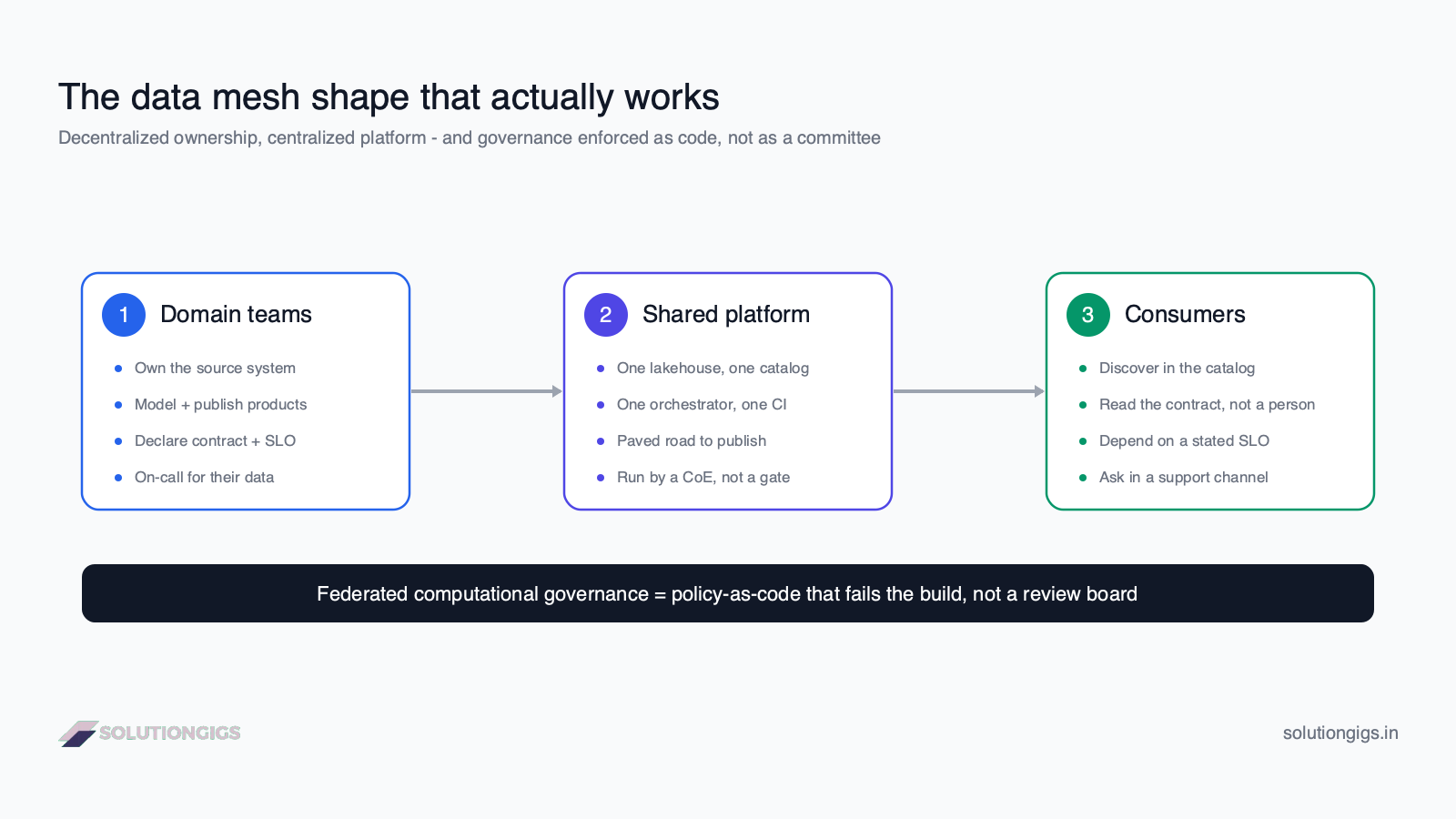
The four principles of data mesh
Data mesh was introduced by Zhamak Dehghani while at Thoughtworks, in the essay Data Mesh Principles and Logical Architecture, and defined by four principles. Three of them are organizational; only one is about technology — which tells you where the real work is.
| # | Principle | What it actually means | Who does the work |
|---|---|---|---|
| 1 | Domain ownership | The team that produces the data owns its analytical form too — modeling, quality, and support | Domain teams |
| 2 | Data as a product | Datasets are built for consumers, with contracts, SLOs, docs and versioning | Domain teams |
| 3 | Self-serve data platform | A central platform makes publishing a compliant data product cheap and boring | Platform team |
| 4 | Federated computational governance | Global rules are agreed cross-domain and enforced automatically in code | Governance guild + platform |
1. Domain ownership
Domain ownership means the analytical dataset is maintained by the same team that owns the operational system behind it. The payments team owns the payments tables, not a central engineer who reverse-engineered them from a database dump.
The critical detail almost everyone skips: ownership means accountability with authority. A domain that is told it now owns its data but has no headcount, no budget line, and no ability to say "not this quarter" hasn't been given ownership — it's been given blame. This is the single most common way principle 1 becomes theater.
2. Data as a product
A data product is a dataset with the guarantees of a product: an owner, a contract, an SLO, versioning, documentation and support. Consumers are treated as customers whose experience matters.
The failure here has a name. Thoughtworks calls it out directly in its 2026 review: teams "confuse one use case with one data product," creating a one-to-one mapping that "severely limits reusability." You end up with marketing_dashboard_v3_final shaped exactly for one dashboard — which is a pipeline with a fancier label, not a product anyone else can use.
3. Self-serve data platform
The platform's job is to make the compliant path the easy path. If publishing a governed data product takes a domain engineer three weeks of Terraform and a ticket to security, the mesh dies quietly and everyone goes back to CSV exports.
Treat the platform as a product too, with its own SLOs and its own users (the domain teams). The measure of success is time from "we want to publish a dataset" to "it's live, tested, catalogued and governed." If that number isn't hours, the mesh isn't ready.
4. Federated computational governance
Federated = the rules are set by a group with representation from every domain, not imposed by a central authority. Computational = those rules are enforced by code, automatically, at the moment someone tries to break them.
That second word is the one people drop, and dropping it turns data mesh into a committee. A rule like "no PII in a public data product" is only computational if there is a check in CI that fails the merge. In practice, federated computational governance looks like this:
# policy enforced in CI on every data product PR
rules:
  - id: pii-must-be-tagged
    applies_to: "*.columns"
    assert: "column.classification in ['public','internal','pii']"
  - id: no-breaking-schema-change
    applies_to: "*.contract"
    assert: "removed_columns == [] and narrowed_types == []"
  - id: freshness-slo-declared
    applies_to: "*.product"
    assert: "slo.freshness_minutes is not null"
If your governance can't be written like that, it's a document, and documents don't govern anything. This is why data contracts became the practical unit of data mesh governance — a contract is a policy you can execute.
The test: ask your governance group to name one rule that automatically blocked a merge last month. If they can't, you have federated governance without the computational half — which is just meetings.
The honest verdict: what survived and what didn't
Data mesh split in two. The data product operating model went mainstream; the fully decentralized architecture largely did not.
That's the fair reading of the evidence, and it's more useful than either "data mesh is dead" or "data mesh is the future."
What survived, and is now normal practice:
- Named owners for datasets, with the owner inside the producing domain
- Data contracts and schema-change gates in CI
- Freshness and quality SLOs published alongside data
- Catalogs where consumers can discover data without asking a person
- The word "data product" as a real unit of work with a backlog
What didn't survive:
- Every domain running its own independent stack. The pattern Thoughtworks now reports as most effective is "a centralized, cost-effective platform" with decentralized "last-mile" tools — which is not the mesh people drew in 2021.
- Big-bang mesh programs. The reported anti-pattern is spending "a year in 'analysis paralysis,' trying to define the perfect, immutable domain boundaries" and building "the one 'perfect platform' from scratch before proving any value."
- The central team disappearing. It didn't disappear; it changed shape. The pattern Thoughtworks calls "the most successful" is the central data office evolving "from a gatekeeper to a center of excellence (CoE) that acts as a facilitator and enabler."
Gartner has been skeptical from the start, forecasting that data mesh would become "obsolete before plateau" — superseded by adjacent approaches before reaching mainstream maturity — and rating both market penetration and benefits realization as low. Their 2021 Data and Analytics Governance Survey found only 18% of organizations had the maturity to adopt data mesh successfully. That figure is now several years old and worth treating as directional rather than current, but nothing since has suggested the readiness bar got dramatically lower.
Read those two things together and the conclusion is not "it failed." It's that data mesh was absorbed. The ideas that were cheap and high-value (products, contracts, ownership) diffused everywhere; the idea that was expensive and only pays off at scale (full decentralization) stayed rare — correctly.
What the research says about real implementations
The most useful empirical evidence isn't a vendor survey — it's an academic study that interviewed practitioners who actually did it. "Towards Avoiding the Data Mess: Industry Insights from Data Mesh Implementations" is based on 15 semi-structured expert interviews across organizations ranging from 150 to 415,000 employees. Four challenges dominated:
- Federated governance was the hardest part. Moving from centralized to decentralized governance while staying compliant was the top-ranked difficulty — one interviewee described the risk of ending up "with one foot in jail" over data protection rules.
- The responsibility shift felt like unpaid work. Domain teams saw data product provision as extra effort with no direct benefit to their own business goals. If you take one thing from this study, take this: ownership without incentive doesn't stick.
- Metadata quality gapped between producer and consumer. What providers documented wasn't what consumers needed, with no standard to close the gap.
- Comprehension. Organizations called centralized systems "data meshes" and every dataset a "data product" — the vocabulary spread faster than the practice.
The reported upside is real too, and specific: clearer ownership improving quality, "develop once, use many times" cutting redundancy, and one interviewee reporting a case "that would have taken five months can now be done in three sprints."
Two of the study's six recommended strategies match what this guide argues independently: quick wins (small, cheap pilots spanning multiple use cases) and conscious adoption (assess properly, don't decide from hype). A third is worth adding to your plan: dedicated ownership — small teams fully committed to data products beat larger groups doing it part-time.
What a data product must actually ship (the 8-item spec)
A dataset is a data product when a consumer can depend on it without talking to you. That's the practical test, and it decomposes into eight concrete artifacts. This is the checklist to hand a domain team on day one.
| # | Artifact | The question it answers | Minimum acceptable version |
|---|---|---|---|
| 1 | Named owner | Who do I page when it's wrong? | A team, not a person; in the catalog |
| 2 | Schema contract | What can I safely build on? | Versioned file in the repo, checked in CI |
| 3 | Freshness SLO | How stale might this be right now? | "Updated within 60 min, 99% of days" |
| 4 | Quality tests | Who checks it before I do? | Not-null, unique key, referential, row-count bounds |
| 5 | Versioning + deprecation policy | Will it break under me? | Semver on the contract; 90-day deprecation window |
| 6 | Discoverability | How do I find it without asking? | Catalog entry with description and example query |
| 7 | Lineage | Where did it come from? | Upstream sources visible, automatically captured |
| 8 | Support channel | Where do I ask questions? | A named Slack channel with a response expectation |
Miss items 1–4 and you have a table. Miss 5–8 and you have a table with good intentions. Ship all eight and you've genuinely changed how the company uses data — whether or not anyone calls it a mesh.
Notice how much of this overlaps with work you may already be doing: item 2 is data contracts, item 4 is data quality testing, and item 3 is pipeline monitoring. That's the cheap path in — you're not starting a mesh program, you're upgrading datasets to products one at a time.
The readiness gate: should you do this at all?
Data mesh is a scaling solution. If you don't have the scaling problem, adopting it makes things worse. This is the section every other guide leaves out, and it's the one that saves money.
Score your organization. You need most of these to be true, not some:
| Signal | Why it matters | You qualify if… |
|---|---|---|
| Number of genuinely independent domains | Mesh amortizes coordination cost across domains | 4+ domains with distinct data, distinct consumers, distinct roadmaps |
| Central team is a queue | This is the actual pain mesh removes | Requests routinely wait weeks; the team can't hire out of it |
| Domain teams have engineers | Someone must maintain the product | Each domain has engineering capacity it can commit |
| Executive sponsorship for a re-org | Ownership changes require authority | A sponsor who can move budget and headcount, not just endorse |
| **A platform team exists (or can) ** | Without it, every domain rebuilds the wheel | 2+ people who can own shared tooling as a product |
| Long-horizon budget | Product ownership is ongoing, not a project | Funding that isn't a 6-month project cycle |
Fewer than four of six? Don't decentralize. Take the data product habits — items 1–8 above — and apply them inside your existing central team. You'll capture most of the value at a fraction of the cost, and you'll be ready if the org grows into the rest.
Thoughtworks names this constraint too, describing a "profound disconnect" where data teams are siloed in IT cost centres and "limited by project-based, short-term budget cycles that are fundamentally antithetical to the long-term, product-centric model Data Mesh requires." Funding model beats architecture diagram, every time.
Data mesh vs data fabric vs lakehouse vs data warehouse
These are not four options for the same decision. Two are organizational, two are technical, and conflating them is why vendor comparisons on this topic are so confusing.
| Data mesh | Data fabric | Lakehouse | Data warehouse | |
|---|---|---|---|---|
| What it is | Operating model | Technology/metadata layer | Storage + compute architecture | Storage + compute architecture |
| Core idea | Domains own and publish data products | Automated metadata connects distributed data | Open table formats over object storage | Managed columnar store, schema-on-write |
| Ownership | Decentralized | Unchanged (usually central) | Unchanged | Usually central |
| Decentralizes storage? | Not necessarily | No | No | No |
| Primary artifact | The data product | The active metadata catalog | Iceberg/Delta tables | Modeled fact and dimension tables |
| Fails when | Domains lack capacity or authority | Metadata is stale or incomplete | Small files, no maintenance | Cost of scale, rigidity |
| Can combine with | Any of the other three | Any | Mesh, fabric | Mesh, fabric |
The one-line disambiguation to remember: data mesh answers "who owns it," data fabric answers "how is it connected," and lakehouse and warehouse answer "where does it live." You can run a data mesh on a single central lakehouse — most successful implementations do exactly that.
The shape that actually works in practice
The version teams succeed with is a hybrid: centralized platform and storage, decentralized ownership and modeling. Concretely:
- One platform, one storage layer. Shared object storage with open table formats, one orchestrator, one catalog, one CI system. Domains do not each pick a stack.
- Domains own the transformation and the contract. Each domain has a repo, owns its models, and publishes products through the shared platform's paved road.
- Medallion layering inside each domain. Raw → cleaned → published, with only the published layer being the data product. The medallion architecture is how a domain organizes its internals; the data product is its public API.
- Governance as code in the shared CI. Policy checks run on every domain's PRs. Nobody gets a bespoke exemption.
- A center of excellence, not a gatekeeper. The former central team consults, builds the paved road, and takes on the hardest data products itself.
This is decentralized in the way that matters (who decides, who supports) and centralized in the way that saves money (what you run it on). It also degrades gracefully: if a domain isn't ready, the CoE runs its products until it is.
Start with one important, time-sensitive business problem, not with a domain-boundary workshop. Thoughtworks's own advice is blunt: "Don't spend months finding the 'perfect' use case. Any sufficiently important, time-sensitive business problem will naturally draw out the most critical data products. Start there."
What we did at Telemetrix (and what we deliberately skipped)
At Telemetrix, our infrastructure-monitoring platform, we run device telemetry through Kafka and Spark into Apache Iceberg tables on S3. When our consumer count grew — alerting, customer dashboards, billing, ML anomaly detection — we hit the exact bottleneck data mesh describes: four consumers, one team, and a queue.
We adopted half of data mesh, on purpose.
We took the data product half. Every published table now has an owner, a versioned contract, a freshness SLO in the catalog, dbt-style tests running in CI, and a support channel. Breaking schema changes fail the build rather than the dashboard. That work took about six weeks and paid for itself the first time a rename was caught in a pull request instead of at 2am.
We skipped the decentralization half, and the reason is the readiness gate above: we don't have four independent domains with their own engineers. Decentralizing would have meant a handful of engineers each maintaining their own Spark configuration, their own retention rules, and their own on-call — four copies of a problem we'd already solved once. Our "mesh" is a single platform with product-grade tables on it.
The honest lesson: the expensive half of data mesh is the org change, and the valuable half is the product discipline. They're separable. Most companies our size should take the second and leave the first.
If you're weighing that same decision, SolutionGigs can match you with a data engineer who's implemented contracts, SLOs and governance-as-code before — usually a faster route than learning it in production.
Common data mesh mistakes
Most mesh failures are predictable, and six of them cause almost all the damage.
- Renaming datasets "data products" with no new guarantees. No SLA, no versioning, no consumer support — the label changes and reliability doesn't. This is the number-one failure.
- One data product per use case. Building a product shaped for a single dashboard destroys reusability, which was the entire point. Model the domain's stable concepts, not the requester's screen.
- Analysis paralysis on domain boundaries. Boundaries are discovered by shipping, not decided in a workshop. Start with an obvious domain and let the ambiguous ones stay central for now.
- Building the perfect platform before proving value. Deliver one real data product on a partially built platform. The platform's roadmap should be written by the friction real domains hit.
- Governance without the "computational." A policy that isn't an automated check is a wish. If it can't fail a build, it won't change behavior.
- Decentralizing without capacity. Handing ownership to a domain with no engineers converts a central bottleneck into distributed neglect — which is strictly worse, because now nobody's watching.
A seventh, subtler one: rebranding people instead of training them. Thoughtworks reports organizations that "rebrand" project managers into data product roles "without giving the right training." Data product ownership is a real skill — consumer discovery, roadmap, deprecation management — and a new title doesn't confer it.
How to start: a 90-day path
Don't launch a mesh program. Ship one data product and let the demand pull the rest.
- Days 1–15 — Pick the problem. Choose one important, time-sensitive business question with a real consumer waiting. Identify the domain that owns the source data.
- Days 16–30 — Define the contract. Write the schema contract and the freshness SLO before writing the pipeline. Get the consumer to review it. This is the highest-leverage artifact in the whole exercise.
- Days 31–60 — Ship it on the paved road. Build the product using shared tooling. Wire quality tests and the contract check into CI. Publish it in the catalog with an example query and a support channel.
- Days 61–75 — Add the second consumer. A product with one consumer is still a pipeline. Find a second use for it; that's the test of whether you modeled the domain or the dashboard.
- Days 76–90 — Write down what hurt. Everything that was slow becomes the platform team's backlog. That backlog is your self-serve platform roadmap, and it's better than any one you could have designed upfront.
Then repeat with the second domain. If the second product takes noticeably less effort than the first, the platform is working. If it takes the same effort, fix the platform before adding a third.
Frequently Asked Questions
What is data mesh in simple terms?
Data mesh is an operating model where the business teams that generate data also own it and publish it as a supported product for others to use. Instead of one central team building every pipeline, each domain publishes curated datasets with an owner, a contract, a quality guarantee and a support channel — while a central platform team provides the shared tooling everyone builds on.
Is data mesh dead in 2026?
No, but the pure form largely is. The data product operating model — domain ownership, contracts, SLOs, federated governance — went mainstream. The literal version where every domain runs its own independent platform did not. Thoughtworks describes 2026 as data products and self-serve platforms becoming foundational commodities, while Gartner has long forecast data mesh would be "obsolete before plateau."
What are the four principles of data mesh?
Domain ownership (the team closest to the data owns it), data as a product (datasets are built and supported for consumers), self-serve data platform (a central platform team provides shared infrastructure), and federated computational governance (global rules agreed cross-domain and enforced automatically in code). Three are organizational; only the platform principle is primarily technical.
What is the difference between data mesh and data fabric?
Data mesh is an organizational model; data fabric is a technology layer — they're not alternatives. Mesh changes who owns data: domains do, and they publish products. Fabric changes how data is connected: metadata, active catalogs and automated integration unify access across distributed systems without moving ownership. Most enterprises run both.
Do you need a data mesh for a small company?
Almost certainly not. Data mesh solves a queue problem that appears when many independent domains wait on one central team. With one data team and fewer than roughly four independent domains, decentralizing adds coordination cost and removes economies of scale. Adopt the data product habits — owners, contracts, tests, docs — without decentralizing the platform.
What makes a dataset a data product?
Eight things: a named owner, a versioned schema contract, a stated freshness and quality SLO, quality tests running automatically, a versioning and deprecation policy, catalog discoverability, visible lineage, and a support channel. If a consumer can depend on it without talking to you, it's a product. If not, it's a table with a new label.
What is federated computational governance?
A cross-domain group agrees the global rules — PII handling, naming, schema evolution, retention — and those rules are enforced automatically by code in the platform and CI, not by a review board. "Federated" is who sets policy; "computational" is how it's applied. If a rule can't be expressed as an automated check that blocks a bad change, it isn't computational governance.
Which tools do you need for a data mesh?
No tool makes you a data mesh, and any modern stack can support one. In practice you need four capabilities: a shared storage and compute layer (a lakehouse on Iceberg or Delta), a transformation framework per domain (dbt or Spark), a catalog for discovery and lineage, and CI that runs contract and quality checks on every change. The differentiator is the operating model, not the vendor list.
Conclusion
Data mesh is best understood as two separable ideas that got shipped as one. The product discipline — owners, contracts, SLOs, tests, catalogs, support — is cheap, portable, and valuable at almost any company size. The decentralization — moving ownership and platform work out to autonomous domains — is expensive, requires organizational authority and long-horizon funding, and only pays off when a central team has genuinely become a queue for four or more independent domains.
The decision framework in one line: adopt the data product spec now; adopt decentralization only when you pass the readiness gate.
That framing explains the seemingly contradictory evidence. Data mesh "failed" as a big-bang architecture program and simultaneously "won" as an operating model, because the two halves had wildly different cost-benefit profiles. Teams that started with one important data product and let the platform roadmap emerge from real friction got the value. Teams that started with a domain-boundary workshop and a platform build spent a year and shipped nothing.
Start with one product, one contract, one consumer, and one automated check that can fail a build. That's a mesh you can actually finish.
Need help getting there? Get matched with a vetted data engineer on SolutionGigs — it's free to post your project.

Mohammed Yaseen
Founder, SolutionGigs
Mohammed builds the data platform at Telemetrix, where published Iceberg tables carry owners, versioned contracts, freshness SLOs and CI-enforced governance — the data product half of data mesh, deliberately adopted without the decentralization half. LinkedIn →
More in Data Engineering
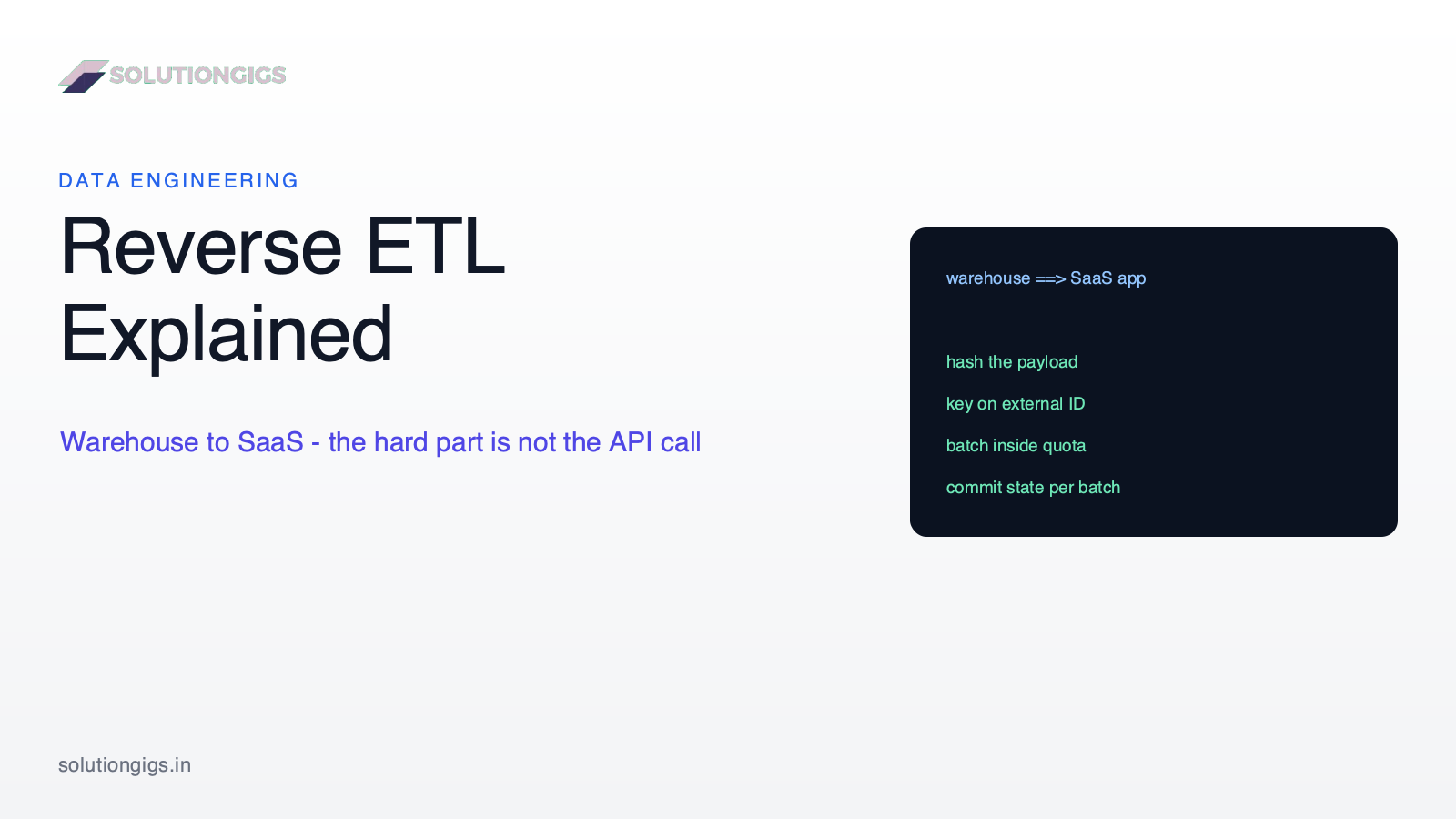
Reverse ETL Explained: Warehouse to SaaS Data Activation
Reverse ETL pushes modeled data out of your warehouse and into the SaaS tools people actually work in — Salesforce, HubSpot, Braze. It's your ELT pipeline run backwards, and the arrow in the diagram hides everything that's hard about it. This guide covers the part after the arrow: the five engineering problems every sync must solve (change detection by payload hash, stable external IDs, rate-limit math, per-batch idempotency, per-record failure handling), each with the exact way it fails; a build-vs-buy table; where the tooling market went after Fivetran absorbed Census and merged with dbt Labs; and the latency floor that tells you when reverse ETL is the wrong tool entirely.
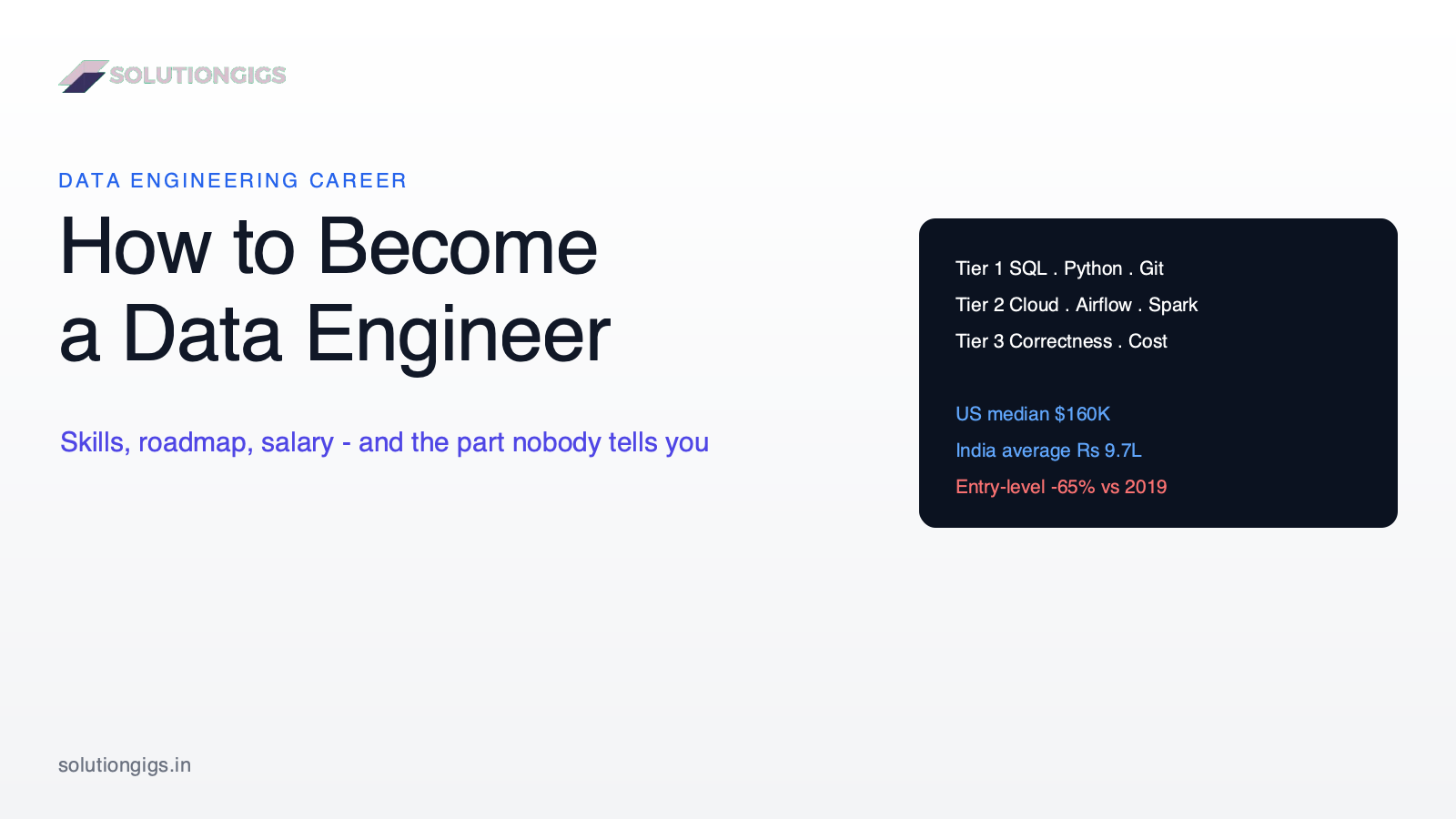
How to Become a Data Engineer: Skills, Roadmap & Salary
How to become a data engineer: the four real entry paths, a six-month roadmap with stop conditions, current US and India salary data, and the honest catch. Demand is real - Robert Half puts the US starting midpoint at $156,250 and 78% of tech leaders are adding headcount - but entry-level hiring is down about 65% against 2019, which is why finishing a course and getting no callbacks are both normal. Inside: what the primary sources actually say (including the BLS stat every guide miscites), the four doors into the field and which is shortest, a three-tier skill order, a month-by-month roadmap with stop conditions, US and India salary tables with collection dates, and the portfolio bar that gets callbacks.
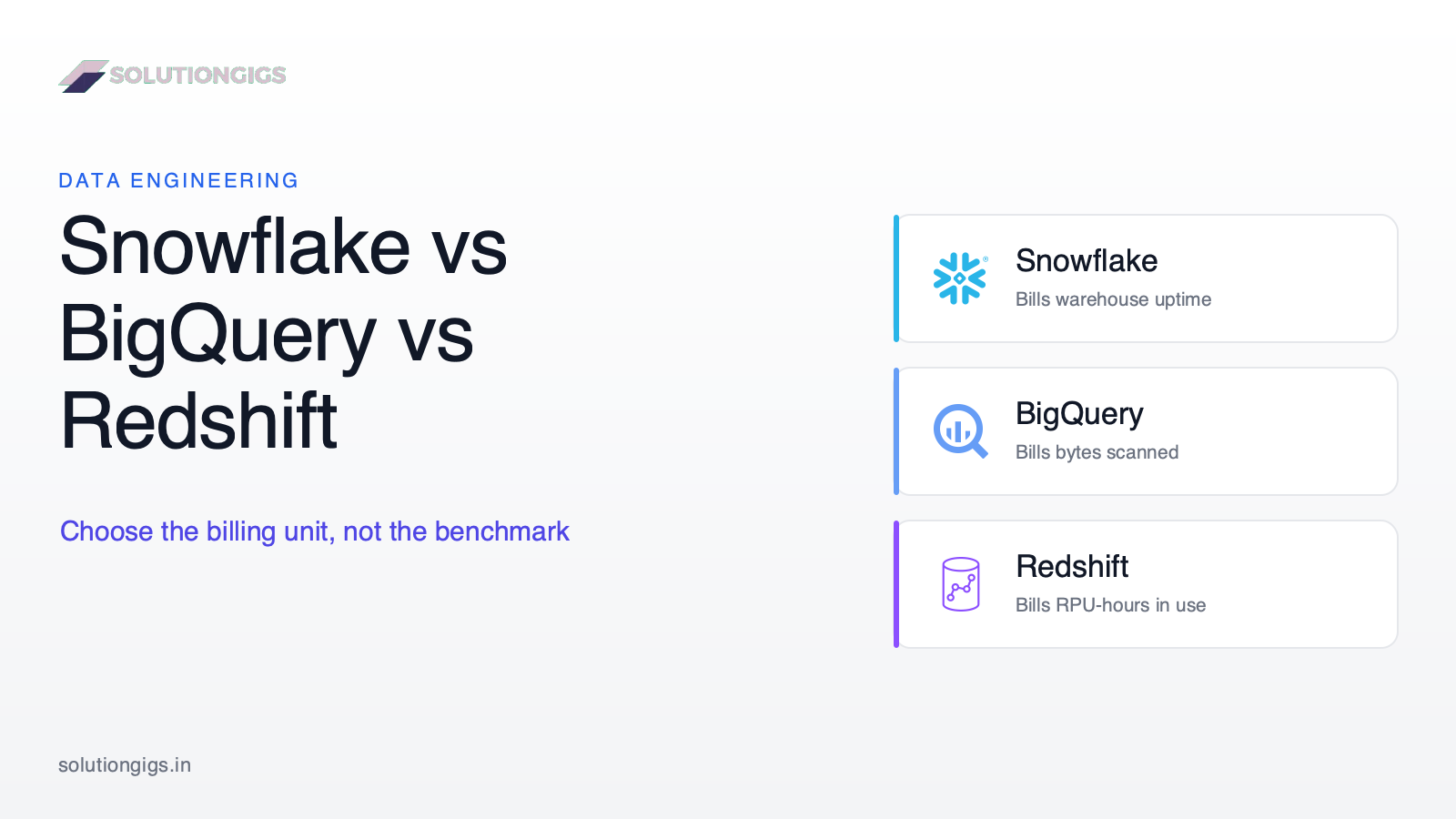
Snowflake vs BigQuery vs Redshift: How to Choose
Snowflake vs BigQuery vs Redshift, decided by the only thing that matters: what each one puts on the meter. Snowflake bills warehouse uptime, BigQuery bills bytes scanned, Redshift bills RPU-hours in use. This guide uses rates read straight from each vendor's own pricing documents, plus three break-even calculations nobody else publishes - the 1.35x Gen2 credit multiplier and the speedup it demands, BigQuery's logical-vs-physical storage crossover, and the on-demand-vs-reservation line - a worked monthly cost example, and what actually changed in 2026 with Redshift's Graviton RG nodes.