
Reverse ETL Explained: Warehouse to SaaS Data Activation
Reverse ETL pushes modeled data out of your warehouse and into the SaaS tools people actually work in — Salesforce, HubSpot, Braze. It's your ELT pipeline run backwards, and the arrow in the diagram hides everything that's hard about it. This guide covers the part after the arrow: the five engineering problems every sync must solve (change detection by payload hash, stable external IDs, rate-limit math, per-batch idempotency, per-record failure handling), each with the exact way it fails; a build-vs-buy table; where the tooling market went after Fivetran absorbed Census and merged with dbt Labs; and the latency floor that tells you when reverse ETL is the wrong tool entirely.
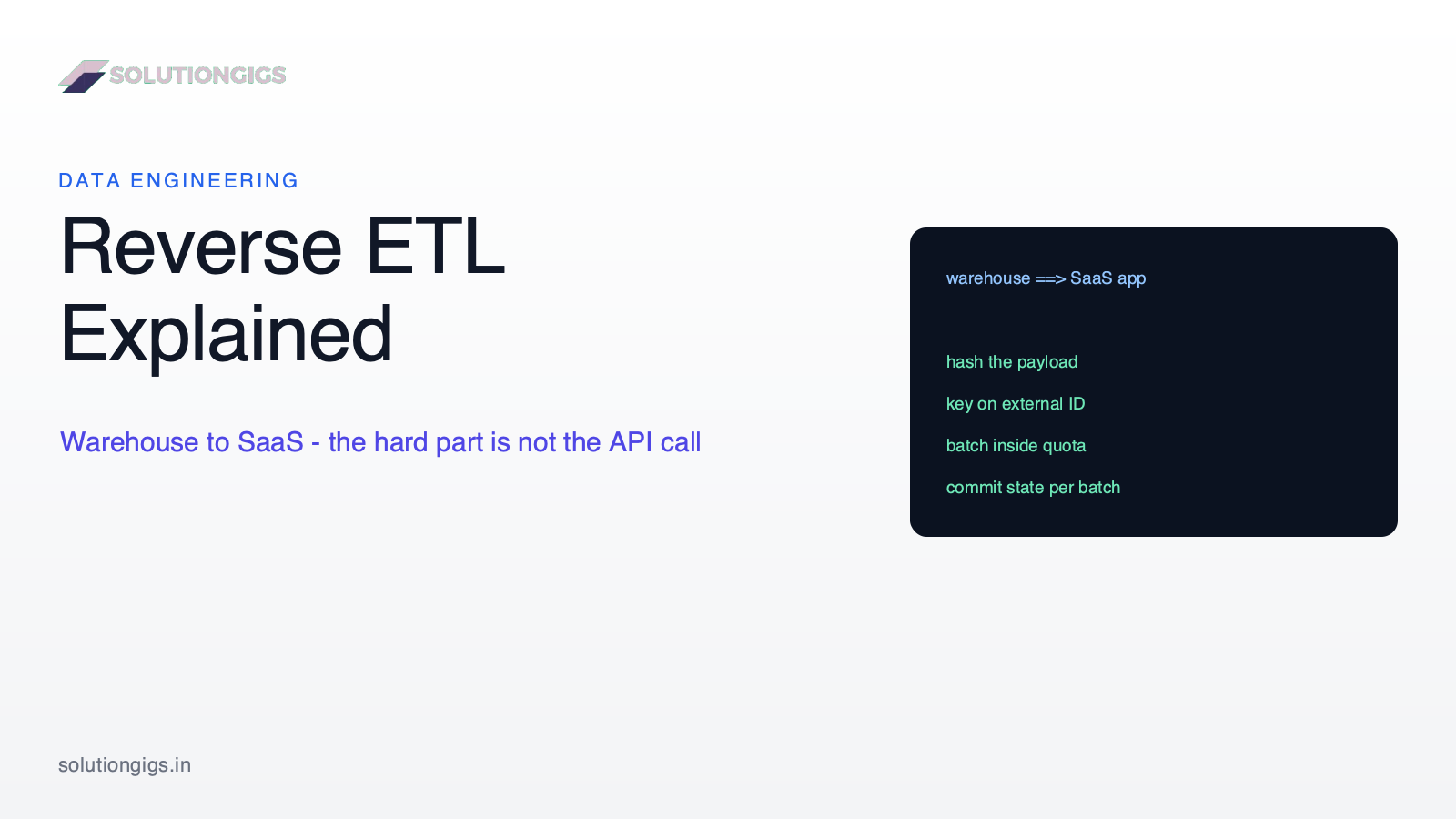
Quick Answer: Reverse ETL copies modeled data out of your data warehouse or lakehouse and into the operational SaaS tools people work in — Salesforce, HubSpot, Braze, Zendesk, Intercom. It's the standard ELT pipeline run backwards: the warehouse becomes the source, the SaaS app becomes the destination. The point is activation — a churn score sitting in a warehouse table changes nothing; the same score on the account record a rep opens every morning changes behavior. The hard part isn't the API call, it's change detection, stable keys, rate limits, idempotency and partial failure.
Most explanations of reverse ETL stop at the diagram: warehouse, arrow, Salesforce. Then you build it, and two weeks later the CRM has 40,000 duplicate contacts and marketing has stopped trusting anything you send.
This guide is about the part after the arrow. You'll get a precise definition, the five engineering problems every sync must solve (and how each one fails), an honest build-vs-buy decision, where the tooling market actually went after the 2025–2026 consolidation, and when reverse ETL is the wrong answer entirely.
What is reverse ETL?
Reverse ETL is a scheduled sync that reads a modeled table from your warehouse and writes those rows into a third-party SaaS application through its API.
The name is a little misleading. Nothing is being "extracted and loaded in reverse" in a technical sense — it's a normal extract-transform-load, just pointed at an unusual destination. What makes it a distinct discipline is what that destination implies:
- You don't own the storage. You're writing into someone else's application, with their schema, their validation rules and their limits.
- Writes are immediately visible to humans. A bad load into a staging table is a rerun. A bad load into Salesforce is 40,000 emails to real customers.
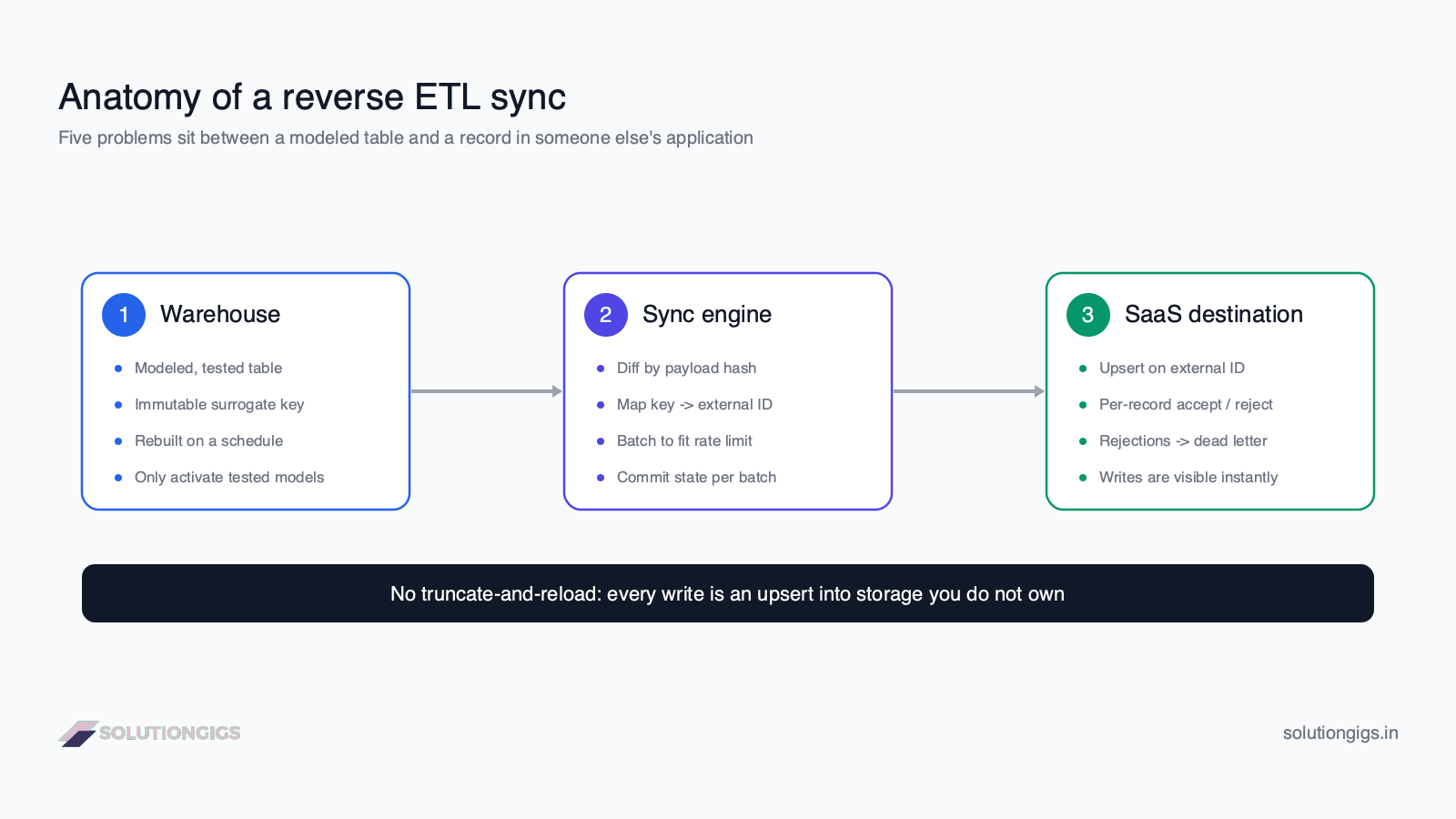
- There is no truncate-and-reload. You can't drop the destination table. Every write must be an upsert against an existing record.
- The API is rate limited. Your throughput ceiling is set by a vendor, not by your cluster size.
Those four facts generate every difficulty below. Hold onto them.
Why it exists
The modern data stack spent a decade centralizing data into the warehouse. It succeeded — the warehouse now holds the best version of nearly every business fact: full customer history, product usage, revenue, support tickets, model scores. And it's all locked in a system that no salesperson, marketer or support agent logs into.
Reverse ETL closes that loop. Instead of asking a rep to check a dashboard, you put health_score, predicted_churn_risk and last_meaningful_action directly on the account record in the CRM. Same number, radically different odds that anyone acts on it.
Reverse ETL vs ETL vs ELT vs CDP
These four terms describe different things — a direction, a direction, an order, and an application — which is why they're constantly confused.
| ETL | ELT | Reverse ETL | CDP | |
|---|---|---|---|---|
| Direction | Sources → warehouse | Sources → warehouse | Warehouse → SaaS apps | Sources → profiles → SaaS apps |
| Transform runs | Before load, in a separate engine | After load, in the warehouse | Before send, in the warehouse | Inside the CDP (or the warehouse, if composable) |
| Destination owner | You | You | A third-party vendor | The CDP vendor |
| Failure recovery | Truncate and reload | Rebuild the model | Per-record retry only | Vendor-managed |
| Primary artifact | Cleaned tables | Models (dbt) | Syncs and field mappings | Customer profiles and audiences |
| Consumers | Analysts, BI | Analysts, BI | Sales, marketing, support | Marketing |
| Typical tools | Informatica, Glue, Spark | Fivetran + dbt + Snowflake | Hightouch, Fivetran Activations | Segment, Braze, Amperity |
The clean one-liner: ETL and ELT fill the warehouse; reverse ETL empties it into the tools where work happens; a CDP is an opinionated application built on top of that movement.
The five problems every reverse ETL sync must solve
This is the section that matters, and it's the one almost no article covers. Writing a row to an API is ten lines of Python. Writing the right rows, once, within quota, with recoverable failures is a system. Here are the five problems in the order they'll bite you.
1. Change detection — sync only what changed
You cannot send the whole table every run. A 2-million-row customer table against a 100,000-calls-per-day API quota means a full sync is mathematically impossible, and even where it fits it's wasteful and slow.
So each run must answer: which rows are different from what the destination already has? Three approaches, in increasing order of correctness:
| Approach | How it works | Breaks when |
|---|---|---|
| Updated-at watermark | Send rows where updated_at > last_run |
The model recomputes every row nightly, so every row looks changed |
| Row hash diff | Store hash(payload) per record; send rows whose hash changed |
Nothing much — this is the right default |
| Full compare | Read destination state, diff in memory | Destination reads also cost quota; doesn't scale |
The row-hash approach in practice: keep a small state table alongside the sync.
-- sync state: one row per record we have ever sent
create table sync_state_salesforce_accounts (
  warehouse_id   string,      -- our stable key
  external_id    string,      -- destination record id
  payload_hash   string,      -- sha256 of the field values we sent
  last_synced_at timestamp
);

-- rows to send this run
select s.*
from   analytics.account_health s
left join sync_state_salesforce_accounts t
       on t.warehouse_id = s.account_id
where  t.warehouse_id is null                       -- never sent
   or  t.payload_hash <> sha2(to_json(struct(
          s.health_score, s.churn_risk, s.plan_tier)), 256);
Two things fall out of this immediately. First, the hash must cover exactly the fields you send — hash more and you'll re-send on irrelevant changes; hash less and real changes will be skipped. Second, this makes the sync idempotent: re-running it sends nothing, because nothing changed.
2. Stable keys — the duplicate factory
The destination needs a key that survives everything about the record changing. This is where homegrown syncs fail most spectacularly.
The instinct is to upsert on email. Emails change. When one does, the sync doesn't find a match, so it creates a new contact — and now the CRM has two records for one human, one of which is silently stale. Repeat across a customer base and you've manufactured a data quality crisis inside the tool the business trusts most.
The fix is a dedicated external ID:
- Pick a key that never changes in the warehouse — a surrogate
account_id, not an email, phone or name. - Write it into a dedicated external ID field on the destination object (Salesforce has native external ID fields designed for exactly this; most CRMs have an equivalent custom field).
- Upsert on that field only, never on a natural attribute.
- Keep the
warehouse_id → external_idmapping in your own state table, so you can recover if the destination is restored from backup or re-created in a sandbox.
That mapping table is, in the end, the thing you actually maintain. The API calls are disposable; the identity mapping is precious.
3. Rate limits — throughput is someone else's decision
Every destination API meters you, and your sync design has to fit inside that budget. Do this arithmetic before you build:
records to sync per run     = 40,000
records per bulk API call   = 200
API calls needed            = 200
daily quota                 = 15,000 calls
syncs per day affordable    = 75  →  ~every 20 minutes, fine
Now redo it with a single-record REST endpoint at 1 record per call: 40,000 calls per run, and you've blown a 15,000-call daily quota on one run. Batch size is the single biggest lever on whether a sync is viable, which is why bulk endpoints (Salesforce Bulk API, HubSpot batch endpoints) matter far more than raw code speed.
Three rules that follow:
- Always prefer the bulk/batch endpoint, even though it has worse error reporting. The quota math doesn't work otherwise.
- Back off on
429, don't retry immediately. Exponential backoff with jitter; respectRetry-Afterwhen the vendor sends it. - Budget for other consumers. Your sync is not the only thing calling that API — the marketing team's tools and the vendor's own integrations share the same quota. Take half at most.
4. Idempotency — retries must not duplicate
A retry has to be a no-op, not a second write. Two mechanisms, and you want both:
- Upsert semantics on the external ID (problem 2), so a repeated write updates the same record rather than creating another.
- Commit state only after the destination confirms. Update
payload_hashandlast_synced_atafter a successful API response, per batch — never optimistically before the call.
The subtle bug: if you update sync state for the whole run at the end, a crash mid-run leaves state saying "nothing sent" while 30 batches actually landed. The next run resends them. With correct upserts that's merely wasteful; without them it's duplicates. Commit state per batch, not per run.
5. Partial failure — the destination rejects row 847
Reverse ETL fails per record, not per job, and your error handling has to match. A batch of 200 comes back with 197 successes and 3 rejections: a required picklist value that doesn't exist, a text field over its length limit, a record locked by a workflow rule.
If your job treats any error as a job failure and retries the whole thing, you'll re-send 197 good records to fix 3 bad ones — and burn quota doing it. The correct shape:
- Capture per-record results from the batch response, keyed back to
warehouse_id. - Advance state for the successes. They're done; don't resend them.
- Route rejections to a dead-letter table with the destination's error message attached.
- Alert on rejection rate, not on any rejection. Three bad records out of 40,000 is Tuesday; 4,000 is a schema change on the destination side.
- Never let a rejection silently vanish. A row that failed to sync but shows a fresh
last_synced_atis a lie your business will act on.
That dead-letter table is also your best debugging asset — destination error messages are usually specific enough to fix the model upstream rather than guess.
The summary that fits on a sticky note: hash to decide what to send, external IDs to decide where it goes, batching to fit quota, per-batch commits for idempotency, and per-record error capture for recovery. Miss any one and the sync is a duplicate generator.
Build vs buy
Buy if you have more than a couple of destinations or a non-engineer needs to change mappings; build if you have one destination, low volume and strong idempotency discipline.
| Build it yourself | Buy a tool | |
|---|---|---|
| Good fit | 1–2 destinations, engineer-owned mappings, unusual internal API | Many destinations, business-owned mappings, marketing use cases |
| Real cost | The five problems above, plus ongoing API version churn per destination | Per-destination or per-record pricing that scales with your customer base |
| Time to first sync | Days to weeks | Hours |
| Who changes a field mapping | An engineer, via a PR | A marketer, via a UI — this is the actual selling point |
| Failure visibility | Whatever you build | Per-record error UI out of the box |
| Lock-in | None | Moderate; mappings and audience logic live in the vendor |
The decisive question is usually the fourth row, not cost. If field mappings change weekly and the requests come from marketing, a tool pays for itself in avoided ticket queues — that's exactly the central-team-as-a-queue problem the data product model exists to remove. If mappings are stable and engineering-owned, a well-built internal sync is genuinely low maintenance.
One hybrid that works well: buy for the marketing destinations, build for the one weird internal system that no vendor supports.
Where the reverse ETL market actually went
Reverse ETL won as a pattern and disappeared as a product category. If you're evaluating vendors from a 2023 blog post, the landscape underneath you has changed:
- Census was acquired by Fivetran in May 2025 and is now offered as Fivetran Activations, bundled into the wider Fivetran platform rather than sold as a standalone reverse ETL product.
- Fivetran and dbt Labs completed their merger on June 1, 2026 (announced October 13, 2025), putting ingestion, transformation and activation under one roof. dbt Core v2.0 and the Fusion engine remain open source under Apache 2.0.
- Hightouch repositioned from "reverse ETL tool" to composable customer data platform, and appeared in the 2026 Gartner Magic Quadrant for Customer Data Platforms as a Leader on its first appearance.
- Data platforms added native activation. Databricks launched CustomerLake in June 2026, an agentic CDP embedded in the lakehouse — occupying the exact layer third-party activation vendors were built to own.
- Zero-copy is the direction of travel. Delta Sharing, Snowflake external tables and BigQuery federated queries let destination tools query data in place rather than receiving copies, which removes whole classes of the problems above — where the destination supports it, which is still the limiting factor.
What this means for your decision: don't buy a standalone reverse ETL tool without first checking what your existing platform contract already includes. The activation capability increasingly ships with the warehouse or the ingestion vendor you already pay.
What it doesn't mean: the engineering problems went away. Consolidation changed the logo on the invoice; hashes, external IDs, quotas and dead letters are all still yours to get right — and entirely yours if you build.
When reverse ETL is the wrong tool
Reverse ETL has a latency floor of minutes, and any requirement below that floor belongs somewhere else.
The floor is structural: your models rebuild on a schedule, change detection scans a table, and the destination API meters your writes. Five to fifteen minutes is a healthy sync; hourly is common. So:
- "Block the transaction if the fraud score is high" → not reverse ETL. That's an event stream with a synchronous decision service.
- "Show a personalized banner on this page load" → not reverse ETL. Serve it from a low-latency store the app can read directly.
- "Trigger the welcome email the second someone signs up" → not reverse ETL. That's an application event, and it belongs in your product's event pipeline.
- "Update the rep's view of account health each morning" → this is reverse ETL. Batch cadence, human consumer, warehouse-computed metric.
- "Suppress ads for customers who churned this week" → this is reverse ETL. Audience membership, tolerant of minutes of lag.
The pattern: reverse ETL is for state a human or a campaign will act on, not for events a machine must react to. If someone asks for "real-time," find out whether they mean "within a few minutes" (fine) or "before the request returns" (build something else). That conversation prevents most reverse ETL disappointment.
What we learned running this at Telemetrix
At Telemetrix, our infrastructure-monitoring platform, we compute an account health score in the warehouse from ingest volume, alert-acknowledgement latency and support-ticket density — a straightforward model over our Iceberg tables. It sat in a table for months. Nobody used it, because nobody on the customer-facing side opens a data warehouse.
So we pushed it into the CRM. Version one was exactly the naive script this article warns about: select the whole table, loop, upsert on email, retry the run on error.
Two failure modes showed up within a fortnight. First, duplicates — a handful of customers had updated their contact email, the upsert found no match, and we created second records. Second, quota exhaustion — we were sending every row every run because the model recomputed updated_at nightly, so the entire table looked changed. One heavy run and the sync was locked out for the day, which also blocked the marketing team's unrelated integration. That last part is what made it a real incident rather than a data bug.
The rewrite was small and boring: a sync_state table with a payload hash and a stored external ID, a dedicated immutable account_id written into a Salesforce external ID field, the bulk endpoint at 200 records per call, state committed per batch, and a dead-letter table for per-record rejections. Volume dropped from ~everything to typically a few hundred rows per run, and the duplicates stopped.
The lesson we'd pass on: the API integration is the easy 10%. The other 90% is the same discipline as any idempotent pipeline — know what changed, key it stably, commit state honestly, and never lose a failure. If you'd rather not learn that in production, SolutionGigs can match you with a data engineer who's built these before.
Common reverse ETL mistakes
- Upserting on email or any natural key. The single most common cause of duplicate records. Use an immutable surrogate ID in a dedicated external ID field.
- Syncing everything every run. Burns quota, blocks other consumers of the same API, and makes every run slow. Hash-diff first.
- Job-level retries on per-record failures. Re-sends thousands of good records to fix a handful of bad ones.
- Committing sync state before the destination confirms. Turns a crash into either wasted quota or, without upserts, duplicates.
- Syncing raw or untested tables. Reverse ETL is the fastest known way to push a data quality bug into a customer-facing tool. Only activate models covered by data quality tests.
- No dead-letter table. Rejections that vanish become quiet, permanent inconsistency between warehouse and CRM.
- Ignoring the destination's own automation. Your write can trigger workflow rules, notifications and emails. Test a 10-record sync in a sandbox before a 40,000-record one in production — this is the mistake with the largest blast radius on this list.
- Treating it as real-time. Setting a five-minute schedule doesn't make the underlying model fresher than its nightly rebuild.
Frequently Asked Questions
What is reverse ETL?
Reverse ETL copies modeled data out of a data warehouse or lakehouse and into operational SaaS tools like Salesforce, HubSpot, Braze or Zendesk. It runs the standard ELT pipeline backwards — the warehouse is the source and the SaaS app is the destination. The purpose is activation: making a metric that already exists in the warehouse usable inside the tool where someone will act on it.
What is the difference between ETL and reverse ETL?
ETL moves data from operational systems into the warehouse for analysis; reverse ETL moves modeled data from the warehouse back into operational systems for action. Beyond direction, the failure modes differ: ETL writes to storage you control and can truncate and reload, while reverse ETL writes into a rate-limited third-party API where writes are instantly visible to users and can't be rolled back.
Is reverse ETL still relevant in 2026?
The pattern is, the standalone category mostly isn't. Fivetran acquired Census in May 2025 (now Fivetran Activations) and completed its dbt Labs merger on June 1, 2026. Hightouch repositioned as a composable CDP. Databricks shipped CustomerLake in June 2026, putting activation natively in the lakehouse. Warehouse-to-SaaS activation is now a platform feature rather than its own product category.
Can I build reverse ETL myself with Python?
Yes, and for one or two low-volume destinations it's reasonable. But the work isn't the API call — it's change detection so you don't burn quota, stable external IDs so you don't create duplicates, batching within rate limits, idempotent per-batch state commits, and per-record error capture. Most homegrown syncs work until the first partial failure, then start duplicating.
What are the best reverse ETL tools?
Hightouch has the widest destination coverage and now positions as a composable CDP. Fivetran Activations is the former Census product, folded into Fivetran after the May 2025 acquisition. DIY options include Airbyte destinations or dbt plus a custom sync layer. Check what your existing platform includes first — Snowflake, Databricks and BigQuery increasingly ship native activation.
How fast can reverse ETL sync data?
Minutes, not seconds. The floor is set by how often upstream models rebuild, how long change detection takes, and the destination's rate limit. Five to fifteen minutes is a healthy sync; hourly is common. Sub-second requirements — blocking a fraudulent transaction, personalizing a page load — belong on an event stream, not a reverse ETL sync.
What is the difference between reverse ETL and a CDP?
Reverse ETL is a movement mechanism; a CDP is an application. Reverse ETL syncs any table to any destination and takes no view on meaning. A CDP owns identity resolution, customer profiles, audiences and journey logic. The composable CDP pattern combines them — warehouse holds profiles and identity, reverse ETL activates the audiences — which is why several reverse ETL vendors became CDP vendors.
Does reverse ETL work with a lakehouse, not just a warehouse?
Yes. Any queryable source works, so Iceberg or Delta tables on object storage are a perfectly good origin for a sync, and platforms like Databricks now offer activation natively. The requirements are the same as with a warehouse: a stable primary key per record, a place to keep sync state, and models that are tested before they're activated.
Conclusion
Reverse ETL is a simple idea with a deceptively hard middle. The concept — push warehouse data into the tools people actually use — is right, and it's the step that finally makes a data platform visible to the rest of the company. But the destination is someone else's application, and that single fact generates every difficulty worth planning for.
The five problems, one line each:
- Change detection — hash the exact payload you send; watermarks lie when models rebuild.
- Stable keys — upsert on an immutable external ID, never on email.
- Rate limits — do the quota arithmetic before you write code; always use bulk endpoints.
- Idempotency — commit sync state per batch, only after the destination confirms.
- Partial failure — capture per-record results, dead-letter the rejections, alert on the rate.
And two decisions around them: buy when non-engineers own the mappings, build when they don't — and check what your existing platform already includes before adding a vendor, because the category consolidated hard in 2025–2026.
Get those right and reverse ETL becomes the least dramatic part of your stack: a boring sync that quietly makes every number in your warehouse actionable. Get them wrong and it becomes the fastest way to lose the business's trust in your data.
Building or fixing an activation pipeline? Get matched with a vetted data engineer on SolutionGigs — it's free to post your project.

Mohammed Yaseen
Founder, SolutionGigs
Mohammed builds the data platform at Telemetrix, including the account-health sync that pushes warehouse-computed scores into the CRM — a pipeline he rewrote after the naive version produced duplicate contacts and exhausted the API quota. LinkedIn →
More in Data Engineering
Data Mesh Architecture: What It Is and When It Actually Works
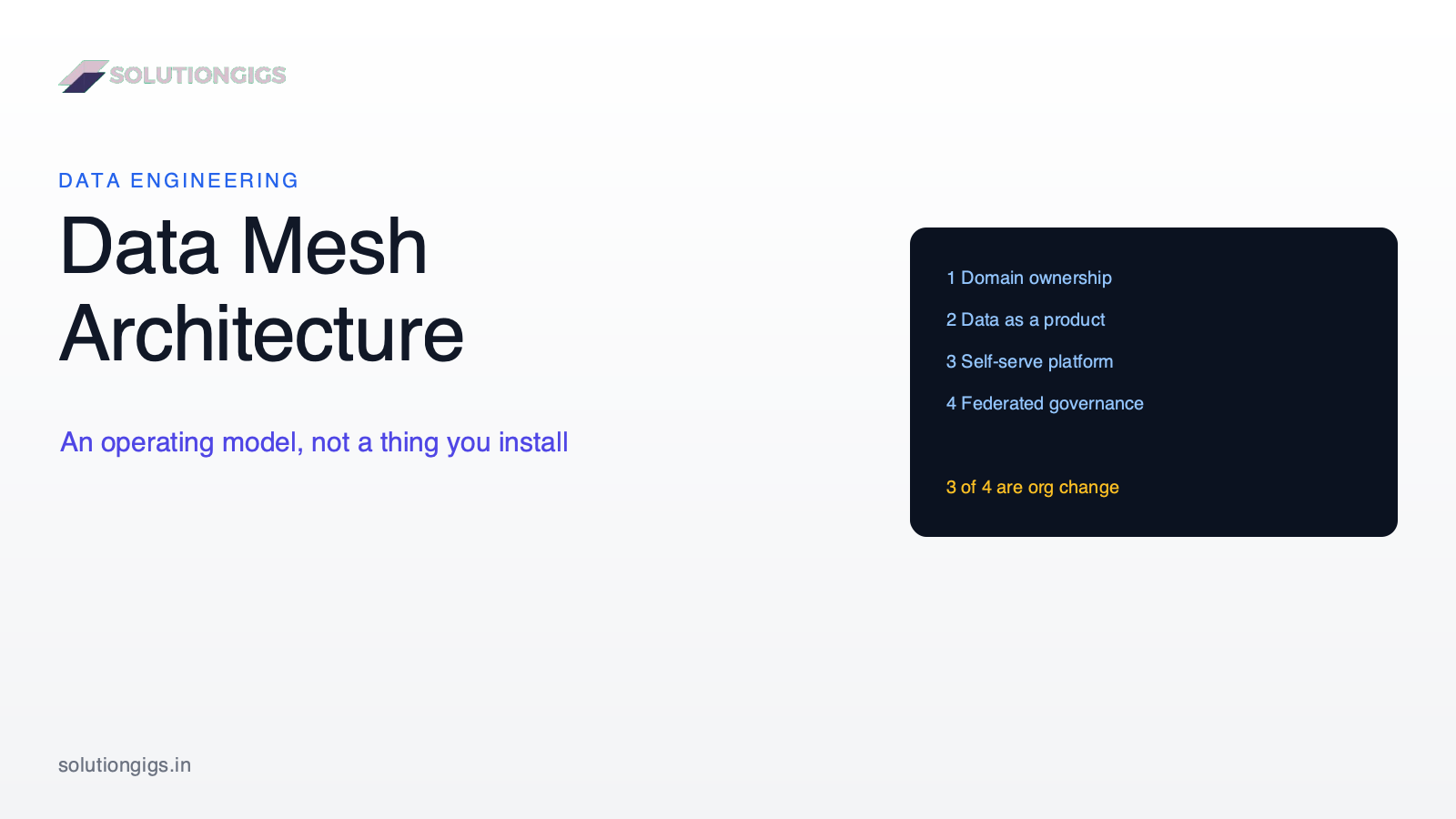
Data mesh is an operating model, not an architecture you can install — it moves data ownership to the business domains and holds them to a product standard. This guide skips the hype and answers the question every other one dodges: should you actually do this? Inside: the four principles stated plainly, an honest verdict on what survived after five years of real adoption (the data product model went mainstream; full decentralization mostly didn't), the 8-item spec a dataset must meet to be a data product, a readiness gate scored on six signals, the data mesh vs data fabric vs lakehouse table, the hybrid shape teams actually run, and a 90-day path that starts with one product instead of a domain-boundary workshop.

How to Become a Data Engineer: Skills, Roadmap & Salary
How to become a data engineer: the four real entry paths, a six-month roadmap with stop conditions, current US and India salary data, and the honest catch. Demand is real - Robert Half puts the US starting midpoint at $156,250 and 78% of tech leaders are adding headcount - but entry-level hiring is down about 65% against 2019, which is why finishing a course and getting no callbacks are both normal. Inside: what the primary sources actually say (including the BLS stat every guide miscites), the four doors into the field and which is shortest, a three-tier skill order, a month-by-month roadmap with stop conditions, US and India salary tables with collection dates, and the portfolio bar that gets callbacks.
Snowflake vs BigQuery vs Redshift: How to Choose
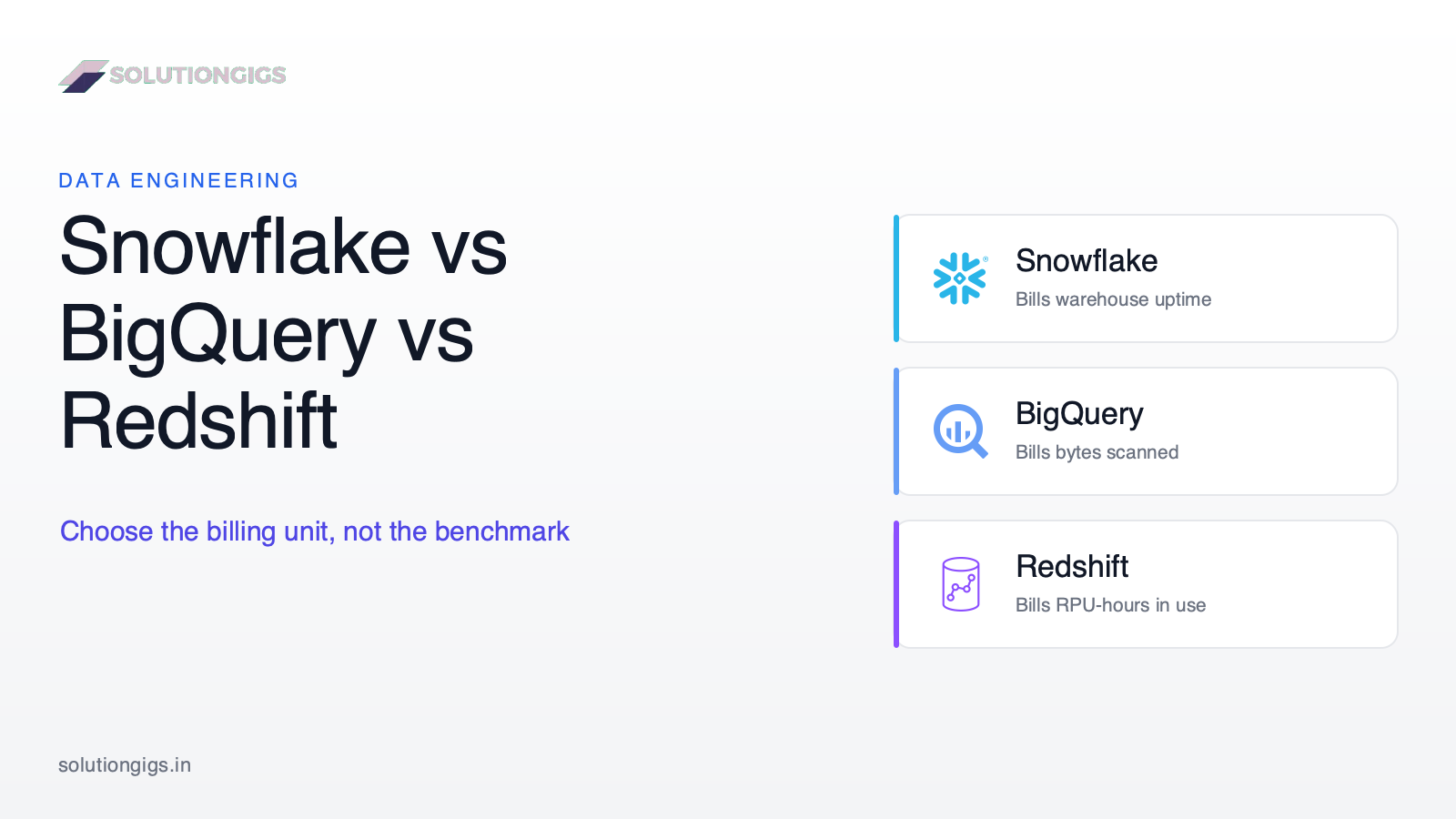
Snowflake vs BigQuery vs Redshift, decided by the only thing that matters: what each one puts on the meter. Snowflake bills warehouse uptime, BigQuery bills bytes scanned, Redshift bills RPU-hours in use. This guide uses rates read straight from each vendor's own pricing documents, plus three break-even calculations nobody else publishes - the 1.35x Gen2 credit multiplier and the speedup it demands, BigQuery's logical-vs-physical storage crossover, and the on-demand-vs-reservation line - a worked monthly cost example, and what actually changed in 2026 with Redshift's Graviton RG nodes.