
DuckDB vs Spark: When You Don't Need a Cluster
Last Updated: July 2026 | 13 min read
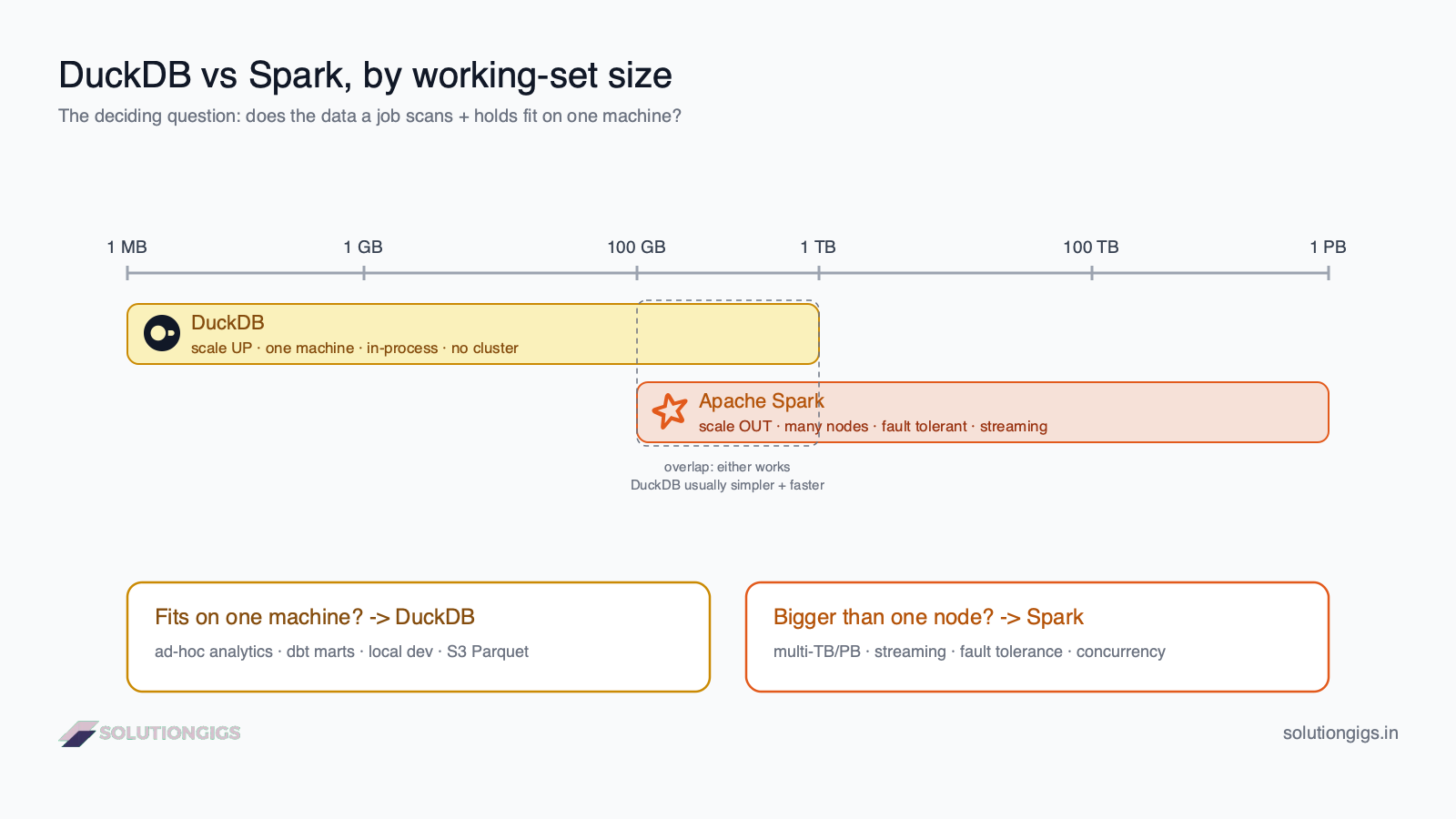
Quick Answer: Use DuckDB when your data fits on a single machine — roughly up to 1 TB on a large cloud box — for ad-hoc analytics, local development, dbt models, and small-to-mid ETL, because it runs in-process with no cluster to manage and is usually faster than Spark at that scale. Use Apache Spark when data genuinely exceeds one node (many terabytes to petabytes), or you need distributed fault tolerance, structured streaming, or high write concurrency. The deciding question isn't "which is better" — it's "does my data fit on one machine?"
For a decade, "we have big data" meant "we need a Spark cluster." In 2026 that reflex is quietly breaking. Cloud machines now come with terabytes of RAM, DuckDB queries Parquet faster than most people expect, and a growing number of engineers are discovering that the 40 GB job they've been running on a 10-node cluster finishes faster — and far cheaper — on a single box. This is the DuckDB vs Spark decision, and getting it right can cut both your runtime and your cloud bill dramatically.
Having built and tuned Spark pipelines processing hundreds of millions of events a day, I'll say the quiet part out loud: most data isn't big data. This guide gives you an honest, engineer's comparison — what each tool actually is, where each wins, the real limits of DuckDB, and a decision rule you can apply today.
What DuckDB and Spark actually are
DuckDB is an in-process analytical database — "SQLite for analytics" — that runs as a library inside your own process; Apache Spark is a distributed compute engine that coordinates work across a cluster of machines. That architectural difference drives every trade-off below.
- DuckDB is an embedded OLAP engine written in C++. You
pip install duckdband it runs inside your Python, R, or CLI process — no server, no cluster, no daemon. It uses columnar storage and vectorized execution tuned for analytical queries (aggregations, joins, window functions), reads Parquet/CSV/JSON directly, and can query files sitting on S3. - Apache Spark is a distributed data-processing framework on the JVM. A driver splits your job into tasks and schedules them across many executor processes on a cluster, coordinating a shuffle to move data between nodes. That machinery is what lets it scale to petabytes — and what makes it heavy for small jobs. (New to it? Start with our PySpark DataFrame fundamentals.)
The one-line mental model: DuckDB scales up (one bigger machine); Spark scales out (more machines).
DuckDB vs Spark: the comparison
| DuckDB | Apache Spark | |
|---|---|---|
| Architecture | Single-node, in-process (a library) | Distributed, cluster (driver + executors) |
| Best data size | KB → ~1 TB (fits one machine) | ~100 GB → petabytes |
| Setup | pip install duckdb — nothing to run |
Cluster, or managed EMR/Databricks/Dataproc |
| Language | SQL first (+ Python/R/Arrow) | Scala/Python/SQL DataFrame API |
| Scaling model | Scale up (bigger box) | Scale out (more nodes) |
| Fault tolerance | None (single process) | Task/stage retries, node loss tolerated |
| Streaming | No (batch/interactive) | Yes (Structured Streaming) |
| Concurrency | Single writer, limited readers | High, multi-tenant |
| Ops overhead | Near zero | Cluster sizing, tuning, monitoring |
| Cost profile | One VM (or serverless) | Cluster of VMs |
The table makes the pattern obvious: DuckDB trades scale and fault tolerance for radical simplicity and speed at small-to-mid size. Spark trades simplicity for the ability to scale out and survive node failures.
When DuckDB wins
Reach for DuckDB whenever the data fits on one machine and you value simplicity and speed over distributed scale. For a large fraction of real analytics work, that's the common case.
- Mid-size analytics (1 GB – ~1 TB). For aggregations and joins on data that fits a single box, DuckDB routinely beats Spark because it skips cluster coordination, JVM startup, and the network shuffle. In published benchmarks up to ~100 GB, DuckDB over Parquet often finishes ahead of a Spark cluster on the same hardware.
- Local development and testing. Run the exact SQL transformation on your laptop against a Parquet sample — no cluster to spin up, instant feedback.
- dbt models and data marts. DuckDB has become a popular dbt backend for building small-to-mid marts on a single scheduled VM.
- Embedded and interactive analytics. Because it's in-process, DuckDB powers notebooks, dashboards, and analytics inside an application with sub-second queries.
- Cost and ops. One machine — or a serverless function — with nothing to babysit. No cluster sizing, no idle executors burning money.
The headline: if your working set fits in memory-plus-disk on a big VM, DuckDB is usually the faster, cheaper, simpler choice.
When Spark wins
Reach for Spark when the data or the workload genuinely exceeds a single machine — that's exactly what its cluster architecture exists for. These are not edge cases; they're the backbone of large platforms.
- Truly large data (multi-TB to PB). When a dataset can't fit on one machine's memory and disk, you need to scale out. Spark distributes both storage of intermediate state and compute across nodes.
- Distributed fault tolerance and SLAs. In a long-running pipeline over hundreds of nodes, machines fail. Spark retries failed tasks and tolerates lost executors; a single-node engine simply dies. Sizing that cluster correctly is its own skill — see our Spark executor tuning guide.
- Streaming. For continuous, event-time pipelines, Spark Structured Streaming has no DuckDB equivalent (see batch vs streaming).
- Heavy joins and shuffles at scale. Big joins across large tables are where Spark's join strategies and shuffle machinery earn their keep.
- Ecosystem and concurrency. Deep integration with the lakehouse (Iceberg/Delta), catalogs, ML, and many concurrent jobs across a team.
If your pipeline is petabyte-scale, streaming, or must not fail halfway through a 6-hour run, that's Spark's territory — and no single node changes that.
The decision rule: does it fit on one machine?
The single most useful question is whether your working data — plus the intermediate state a query produces — fits on one machine. If yes, start with DuckDB; if no, use Spark. Everything else is secondary.
A practical way to decide:
- Estimate the working-set size. Not your whole data lake — the bytes a given job actually scans and holds. A daily job over one partition is often a few GB, not the 50 TB total.
- Does it fit a big VM? Cloud boxes now reach 1–2 TB of RAM and far more local SSD. If the working set fits (with headroom for joins/sorts), DuckDB can handle it.
- Do you need streaming, multi-node fault tolerance, or high write concurrency? If yes → Spark, regardless of size.
- Still unsure? Start with DuckDB. It's a five-minute experiment, and if you hit its ceiling you'll know exactly why you're moving to Spark.
At SolutionGigs, we audited a "big data" Spark job that ran nightly on a 12-node cluster — and found it processed 30 GB. Rewritten as a DuckDB query on a single large VM, it went from 18 minutes and a cluster to under 4 minutes on one box, at roughly a fifth of the cost. Not every job is that story, but far more are than teams assume.
The real limits of DuckDB (don't skip this)
DuckDB's simplicity comes from being single-node — and that's also its hard boundary. Know these before you bet a pipeline on it:
- No horizontal scale. It scales up, not out. When the working set exceeds the biggest machine you can rent, you're done — that's a distributed-engine problem.
- No built-in fault tolerance. One process. If it crashes mid-job, there's no task retry — you rerun. Fine for a 4-minute job, risky for a 4-hour one.
- Concurrency is limited. DuckDB favors a single writer; it's not a multi-tenant warehouse serving hundreds of concurrent writers.
- Not a streaming engine. It's batch/interactive. Continuous event-time processing is Spark/Flink territory.
None of these make DuckDB "not production-ready" — they make it single-node. Match the tool to the shape of the work.
You don't have to choose: use both
The strongest 2026 data stacks use DuckDB and Spark together — each where it fits — on the same Parquet-based lake. Because both read and write Parquet (and increasingly Iceberg), they compose cleanly.
A common pattern:
- Spark runs the heavy, distributed ingestion and the petabyte-scale transformations that produce curated, partitioned Parquet/Iceberg tables. Get the file layout and format right here and everything downstream is faster.
- DuckDB then serves the last mile — analysts querying those curated tables, dbt building marts, dashboards, and local development — without touching a cluster.
Big data goes in the pool with Spark; most people drink from it with DuckDB.
Common mistakes
- Defaulting to Spark for everything. The most expensive habit in data engineering: standing up a cluster for a 20 GB job. Check the working-set size first.
- Trying to force DuckDB past one machine. When the data genuinely doesn't fit, don't fight it with bigger and bigger VMs forever — that's the signal to scale out.
- Comparing on the wrong scale. A benchmark "proving" Spark is slow at 5 GB, or DuckDB at 50 TB, proves nothing — each is being run outside its zone.
- Ignoring the ops cost. DuckDB's biggest win is often not raw speed but the cluster you no longer run. Count that.
Frequently Asked Questions
Is DuckDB faster than Spark?
On a single machine for data that fits in memory or local disk (up to a few hundred GB), DuckDB is usually faster, because it avoids cluster coordination, JVM startup, and network shuffle. Spark pulls ahead once data outgrows one machine and work spreads across nodes. Neither is universally faster — DuckDB wins small-to-mid, Spark wins large.
When should I use DuckDB instead of Spark?
Use DuckDB when your working data fits on one machine (up to ~1 TB on a large VM): ad-hoc analytics, local development, dbt models, embedded dashboards, and small-to-mid ETL where you want no cluster to manage. It runs in-process, reads Parquet/CSV directly, and queries S3 files. Switch to Spark when data truly exceeds a single node.
Can DuckDB replace Spark?
For much of everyday analytics and mid-size ETL, yes — many "Spark" jobs really process tens of gigabytes and are simpler in DuckDB. But it can't replace Spark for multi-terabyte-to-petabyte data, distributed fault-tolerant pipelines, structured streaming, or high write concurrency. Most teams run both, each where it fits.
Can DuckDB handle data larger than memory?
Yes, within limits. DuckDB's out-of-core engine spills intermediate results to disk, so it can process datasets larger than RAM as long as they fit on the machine's local disk. But it's still single-node — once the data or intermediate state exceeds one machine, you need a distributed engine like Spark.
Is DuckDB good for production data engineering?
Yes, for suitable workloads — transforming small-to-mid data, powering dbt models, building marts, and embedded analytics, often on one scheduled VM or a serverless function. Its constraints are concurrency (single writer) and single-node scale. For petabyte pipelines, streaming, and heavy concurrency, Spark or a distributed warehouse fits better.
DuckDB or Spark for querying Parquet on S3?
For interactive queries over a bounded set of Parquet files that fit one machine, DuckDB is often faster and simpler — it reads Parquet natively with filter/projection pushdown and needs no cluster. For scanning very large partitioned datasets across terabytes or writing them with distributed parallelism, Spark wins. Both use Parquet, so you can mix them.
What is DuckDB used for?
DuckDB is an in-process analytical (OLAP) database — "SQLite for analytics." It powers fast local analytics, ad-hoc SQL over Parquet/CSV/JSON, dbt transformations, embedded analytics in apps and notebooks, and small-to-mid ETL. It runs as a library inside your Python, R, or CLI process, with columnar storage and vectorized execution built for aggregations and joins.
Conclusion
The DuckDB vs Spark question is really a mindset shift: stop asking "how big is our data lake?" and start asking "how big is this job?" Most jobs are smaller than the cluster we habitually throw at them. When the working set fits on one machine, DuckDB is faster to run, cheaper to operate, and far simpler than a cluster you have to size and babysit. When the data genuinely outgrows a single node — or you need streaming, fault tolerance, or heavy concurrency — Spark remains the right, proven tool.
The best data engineers in 2026 aren't Team DuckDB or Team Spark. They know the crossover point, reach for the single-node engine by default, and scale out to Spark deliberately when the work demands it. Master both, and you'll ship faster pipelines at a fraction of the cost.
Want to go deeper on the Spark side of that decision? Explore the free, hands-on Spark with Scala course and the SolutionGigs blog for tuning, joins, and lakehouse guides. Building a data platform and want expert help choosing the right stack? SolutionGigs connects you with vetted data engineers — it's free to post your project.

Mohammed Yaseen
Founder, SolutionGigs
Mohammed builds large-scale Spark and Kafka pipelines on the lakehouse — and has quietly moved more than one "big data" job onto a single DuckDB box. LinkedIn →