
AWS vs GCP vs Azure for Startups: Which to Pick
AWS vs GCP vs Azure for startups in 2026 — startup credits compared, real pricing, provider strengths, and a clear decision framework to pick the right cloud without vendor lock-in.

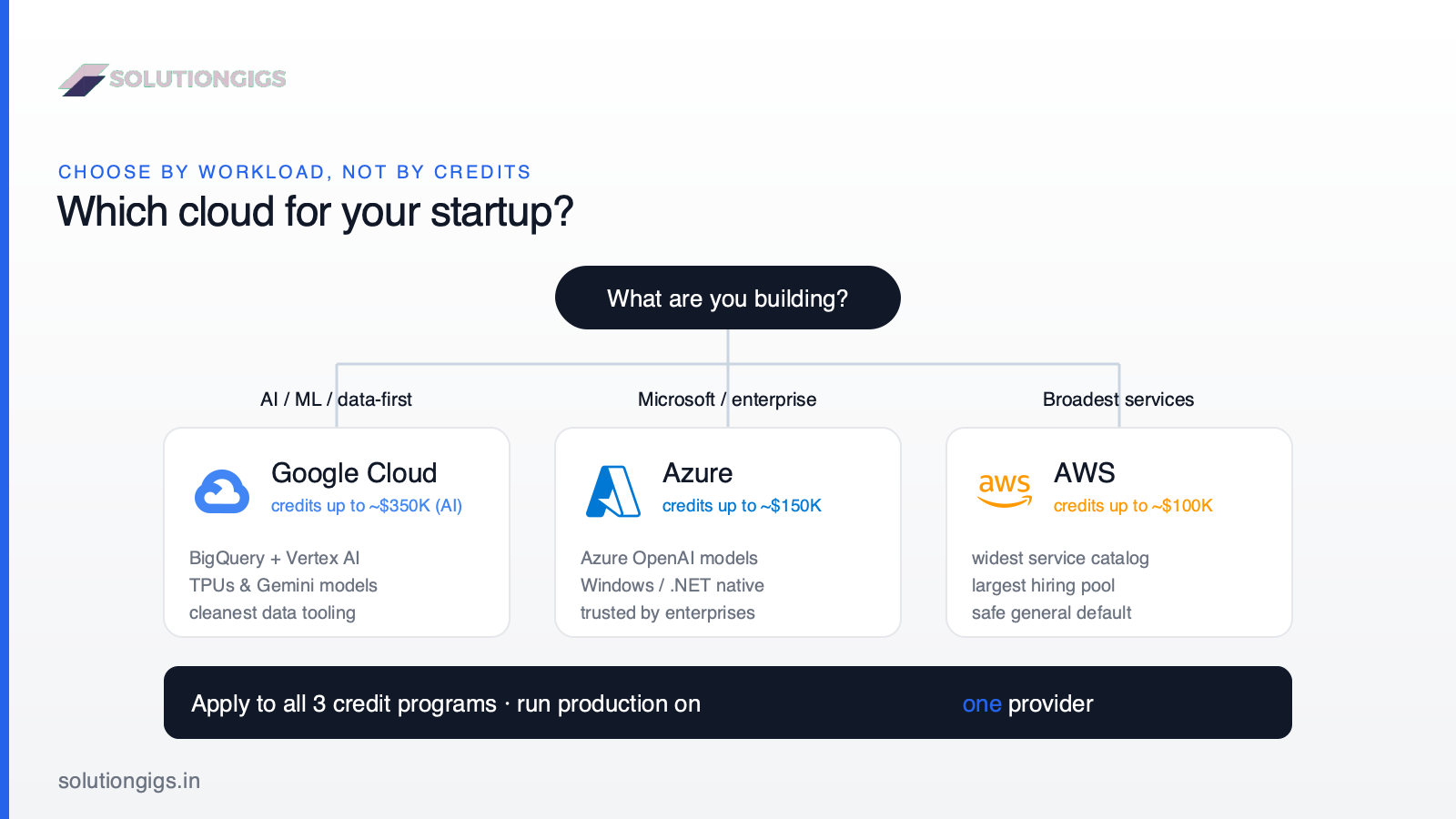
Quick Answer: For startups in 2026, the best cloud depends on your stack, not the biggest credit offer. Pick Google Cloud (GCP) if you're AI/ML- or data-first — it has the most generous startup credits and strong data tooling. Pick Azure if you live in the Microsoft ecosystem or sell to enterprises. Pick AWS if you want the broadest service catalog and the deepest hiring pool. Credits (up to ~$100K on AWS, ~$200K+ on GCP, ~$150K on Azure) should break a tie, not make the decision — technical fit and your team's skills matter far more over a two-year horizon.
Choosing your cloud provider is one of the first big architecture decisions a startup makes — and one of the stickiest. AWS vs GCP vs Azure isn't just about who's cheapest this month; it shapes what you can build fast, who you can hire, and how painful it'll be to move later.
The confusion is real. All three run the same kinds of workloads, all three dangle five- and six-figure startup credits, and every comparison article seems to crown a different winner. Meanwhile, the decision that actually matters — which one fits your product and team — gets buried under credit-amount hype.
This guide cuts through it: what each provider is genuinely good at, a real comparison of startup credits and pricing, a use-case decision framework, and the mistakes that trap founders. At SolutionGigs, we've helped teams deploy on all three — the right answer is rarely the one with the biggest free-credit banner.
The Three Clouds at a Glance
AWS, GCP, and Azure are the three hyperscale cloud providers; they overlap heavily on core services but differ sharply in ecosystem, pricing model, and startup programs.
Amazon Web Services (AWS)
AWS is the market leader with the broadest and deepest service catalog. If a capability exists in the cloud, AWS almost certainly has a managed service for it. That breadth is its superpower and its curse — enormous flexibility, but a steeper learning curve and more ways to misconfigure cost. AWS also has the largest talent pool, so hiring engineers who already know it is easiest.
Best for: general-purpose startups, teams that value the widest service selection, and companies that want the largest hiring market.
Google Cloud Platform (GCP)
GCP is the data- and AI-native cloud, with the strongest defaults for analytics and machine learning. BigQuery, Vertex AI, TPUs, and Gemini models make it the natural home for AI-first products. Its pricing is often competitive thanks to automatic sustained-use discounts — though note those don't apply to the default E2 machine family, so check your VM type before counting on them — and its startup program is the most generous, especially for AI companies. It's also the fastest-growing of the three: Google Cloud revenue grew 82% year over year in Q2 2026, taking roughly 15% of the market to AWS's ~28% and Azure's ~20% (Synergy Research).
Best for: AI/ML startups, data-heavy products, and teams that want a cleaner developer experience and aggressive credits. New to it? Our Google Cloud Platform (GCP) guide explains projects, core services and the pricing traps. See our Claude vs GPT vs Gemini comparison if model choice is driving your platform decision.
Microsoft Azure
Azure is the enterprise and Microsoft-ecosystem cloud. If your team runs on Windows, .NET, Active Directory, or Microsoft 365 — or you're selling into enterprises that do — Azure integrates seamlessly. It's also the primary home for OpenAI models via Azure OpenAI Service, a real draw for some AI startups.
Best for: Microsoft-stack teams, B2B startups selling to enterprises, and products built on OpenAI models.
Startup Credits Compared (2026)
Google Cloud offers the largest startup credits, especially for AI companies; AWS and Azure are competitive but structure their programs differently.
Here's the current picture. These are maximums — most startups qualify for less, and the top tiers require backing from a partner VC or accelerator.
| Program | Entry tier | Top tier | Notes |
|---|---|---|---|
| AWS Activate | ~$1,000 self-serve | up to $100,000 | Top tier needs an Activate Provider (VC/accelerator); select AI startups can reach higher |
| Google Cloud for Startups | ~$2,000 | up to $200,000 | Up to ~$350,000 for AI-first startups — the most generous |
| Microsoft for Startups (Azure) | ~$5,000 | up to $150,000 | Drip-fed over the program; strong if you use Azure OpenAI |
Two things founders miss:
- Unfunded, bootstrapped startups get much less — often around $5,000 — from every program. The big numbers assume VC or accelerator backing.
- You can apply to all three. Programs don't require exclusivity, so it's common to hold credits across providers and use each where it fits.
Reality check: credit amounts and tiers change frequently. Always confirm current terms on the official pages — AWS Activate, Google Cloud for Startups, and Microsoft for Startups.
Pricing & Cost Model: How the Bills Differ
The same app produces three different bills, because each provider discounts and meters differently — so "cheapest" is workload-specific, not universal.
| Factor | AWS | GCP | Azure |
|---|---|---|---|
| Automatic discounts | Savings Plans / Reserved (commit-based) | Sustained-use (automatic) + committed-use | Reserved Instances + savings plans |
| Billing granularity | Per-second (most services) | Per-second | Per-second/minute varies |
| Data egress | Charged, can be significant | Charged, competitive | Charged |
| Free tier | 12-month + always-free | Always-free + trial | 12-month + always-free |
| Cost reputation | Broadest but easy to overspend | Often cheapest on compute | Best value in Microsoft-heavy stacks |
The takeaway: don't pick a provider on a headline per-hour rate. Egress fees, managed-service premiums, and commitment discounts swing the real bill far more than the sticker price of a VM. Model your actual architecture — and once you're live, treat cost monitoring as a first-class concern (see what Datadog does and cheaper monitoring alternatives).
Head-to-Head by Use Case
Match the provider to what you're building — the "best" cloud changes with your workload.
| Your startup is… | Best fit | Why |
|---|---|---|
| AI/ML-first | GCP | Largest AI credits, TPUs, Vertex AI, Gemini |
| Building on OpenAI models | Azure | Azure OpenAI Service is the primary host |
| Data/analytics-heavy | GCP | BigQuery + strong data pipeline tooling |
| Selling to enterprises | Azure | Trusted in Microsoft-centric enterprises |
| Windows / .NET stack | Azure | Native integration, lower friction |
| Broad/general SaaS | AWS | Widest services, easiest hiring |
| Kubernetes-native | Any (GKE leads) | GKE is the most mature; all three are solid |
One 2026 update to that "data/analytics-heavy → GCP" row: it's less decisive than it used to be. AWS launched Graviton-based Redshift RG nodes in May 2026 — up to 2.2× faster than RA3 at 30% lower price per vCPU, with the per-TB Redshift Spectrum scanning charge removed — and Snowflake runs on all three clouds, so the warehouse no longer has to follow the cloud. BigQuery's serverless model is still the easiest analytics start, but if the warehouse is the deciding factor for you, compare them directly in Snowflake vs BigQuery vs Redshift rather than letting it settle your whole cloud choice.
If you're standardizing on containers, your cloud choice matters less — a Docker + Kubernetes foundation keeps most of your stack portable across all three. Similarly, choosing a monolith or microservices architecture affects your cloud bill more than the logo on the invoice.
Which Should You Choose? A Decision Framework
Pick your cloud in this order: team skills first, workload fit second, credits third.
- What does your team already know? A team fluent in AWS shipping on AWS beats a "theoretically cheaper" platform nobody knows. Velocity in the first year matters more than a marginal discount.
- What is your workload? AI/data → lean GCP. Microsoft/enterprise → lean Azure. Everything else, or maximum service breadth → AWS is a safe default.
- Who's backing you? If a VC or accelerator has a preferred partner, the top-tier credits may swing a genuine tie.
- Then, and only then, compare credits. Use the bigger offer to break a tie between two providers that both fit — never to override a clear technical mismatch.
A pragmatic play: run your production product on one primary provider, but claim credits on a second to run isolated experiments — most often AI workloads on GCP or Azure OpenAI — without splitting your core infrastructure. That captures extra runway without the operational tax of true multi-cloud.
Common Mistakes to Avoid
- Choosing by credit amount alone. Credits are a one- or two-year subsidy; your architecture is a multi-year commitment. Optimizing for free money over technical fit is the classic founder trap.
- Going multi-cloud too early. Running production across two providers multiplies networking, security, and ops complexity a small team can't absorb. One production home, please.
- Ignoring data egress. Moving data out of a cloud is where surprise bills live — factor it in before you architect around a second provider.
- Over-indexing on lock-in fear. Some lock-in is fine early; shipping fast matters more. Favor open standards (containers, Postgres, open table formats) where it's cheap to, and don't rewrite everything to stay portable.
- Forgetting the credits expire. Build cost discipline before the credits run out, or you'll get a nasty bill on month 25.
The SolutionGigs Advantage
Picking a cloud is easy to second-guess and expensive to get wrong. We've shipped production systems on all three, and the right answer is usually driven by your team's existing skills and your actual workload shape — not by a credit banner. Tell us what you're building →
Frequently Asked Questions
Which cloud is best for a startup: AWS, GCP, or Azure?
There's no single winner — it depends on your stack. Choose GCP if you're AI/ML- or data-first, since it offers the most generous startup credits and strong data tooling. Choose Azure if you're on the Microsoft ecosystem or selling to enterprises. Choose AWS for the broadest service catalog and the largest hiring pool. Most experienced founders start with the provider that fits their tech and team, not the biggest credit offer.
How much in free credits can a startup get from each cloud?
As of 2026, approximate maximums are: AWS Activate up to $100,000 (portfolio tier via a VC or accelerator; ~$1,000 self-serve), Google Cloud for Startups up to $200,000 (and up to ~$350,000 for AI-first startups), and Microsoft for Startups up to $150,000 over the program. Unfunded founders typically get far less — often around $5,000. Amounts change often; confirm on the official pages.
Is GCP cheaper than AWS and Azure?
For many workloads, yes — Google Cloud tends to win on raw pricing thanks to automatic sustained-use discounts (on eligible families such as N1 and N2, not the default E2) and competitive billing. But "cheapest" depends entirely on your architecture: data egress, managed services, and reserved-capacity discounts vary widely. Model your actual workload rather than trusting a headline rate; the same app can produce three very different bills.
Should a startup use more than one cloud provider?
You can apply to all three credit programs, and many founders do — but running production across multiple clouds early is usually a mistake. Multi-cloud adds networking, security, and operational complexity a small team can't absorb. A common pattern is to run your main product on one provider and use a second provider's credits for isolated experiments while keeping a single production home.
Which cloud is best for AI and machine learning startups?
Google Cloud is the strongest default for AI-first startups in 2026 — largest AI startup credits (up to ~$350,000), TPUs, Vertex AI, and Gemini models. Azure is a close second if you're building on OpenAI models, which are served through Azure. AWS offers Bedrock and a broad model catalog. Match the platform to the models and accelerators your product needs.
Does choosing a cloud provider lock me in?
To a degree, yes. Managed databases, serverless platforms, and proprietary AI services are the stickiest — migrating off them later is real work. You reduce lock-in by favoring open standards (containers, Postgres, open table formats) and keeping business logic portable. Don't over-engineer for portability early, but know that deeper use of proprietary services makes switching harder.
Conclusion
AWS vs GCP vs Azure isn't a contest to crown a universal winner — it's a fit problem. The right cloud is the one that matches your workload and your team's skills, funded by whichever startup program you qualify for.
Use the simple order: skills first, workload second, credits third. If you're AI- or data-first, GCP is the strong default. If you're Microsoft-centric or enterprise-facing, Azure fits. If you want maximum breadth and the easiest hiring, AWS is the safe pick. Apply to every credit program you can, run production on one, and resist multi-cloud until scale genuinely demands it.
Get the foundation right and you'll ship faster and spend less — long after the free credits are gone.
Deciding where to build, or need a second opinion on your cloud architecture? Describe the workload and the budget and you'll get a scope and a price within one business day — or a straight "this is not a fit".
Mohammed Yaseen
Founder, SolutionGigs
Mohammed builds and ships cloud and data infrastructure across AWS, GCP, and Azure — from Spark pipelines to production SaaS backends. He founded SolutionGigs to connect startups with engineers who choose the right platform for the problem. LinkedIn →
More in Cloud & DevOps
GCS vs AWS S3 vs Azure Blob Storage
Google Cloud Storage vs Amazon S3 vs Azure Blob Storage compared for data engineers: real per-GB and per-request pricing, IAM access models, archive-tier retrieval speed, and Azure's new 128 KiB minimum billable object size that can 32x a small-file bill.
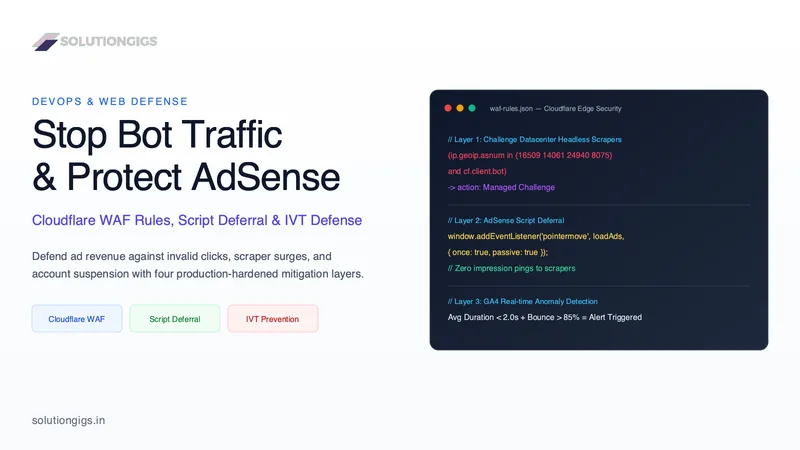
Stop Bot Traffic & Protect Your AdSense Account from Suspension
Stop bot traffic from triggering AdSense invalid traffic limits and suspension. Step-by-step Cloudflare WAF rules, script deferral, and server fixes → Learn how to identify bot signatures in GA4, challenge datacenter scrapers, defer ad scripts, and eliminate crawl traps.
What Is Google Cloud Platform (GCP)?
Google Cloud Platform (GCP) explained: how projects and billing work, core services mapped to AWS and Azure, the free tier, pricing traps and a first deploy. Includes a worked BigQuery example where one dashboard costs $9,000 or $1.84 a month depending on two query choices, a compute decision list, and six default settings to change on day one.