
Feeling Stuck in Your Developer Career? Here's What Actually Moves You Forward
Feeling stuck in your developer job and not sure what to do next? The skills that unstick a career aren't always technical. Get 1:1 help at SolutionGigs → Learn the 5 workplace survival skills that determine whether good engineering work ever gets you promoted.


Quick Answer: Most developers who feel stuck aren't missing a technical skill — they're missing the workplace skills nobody teaches in a bootcamp or a CS degree: communicating impact to non-technical people, making good work visible, reading office politics, and choosing what to learn strategically. Learning your fourth framework won't fix a visibility problem. Fixing the actual gap — often with someone who can see your blind spots from outside the situation — will.
You're good at your job. Your code reviews are clean, your tickets close on time, nobody's complaining. And yet a year has gone by, maybe two, and nothing has moved — not your title, not your pay, not the size of the problems you're trusted with. You've started three different courses on the side. None of them fixed it. If that's you, the problem probably isn't your tech stack.
This is the part of a developer's career that nobody puts in the job description: surviving and growing inside a corporate environment is a different skill set from writing good code, and most engineers are never taught it. Below is the honest breakdown of what's actually keeping you stuck, an original diagnostic to figure out which kind of stuck you are, and what to do about each one.
Why "Just Learn Another Stack" Doesn't Fix This
The default advice for a stalled developer career is almost always the same: learn Kubernetes, pick up Rust, get a cloud cert, do a system design course. Sometimes that's genuinely the gap. Often it isn't.
If you can already build the thing your team needs and you're still not moving, adding a fourth or fifth technology to your resume doesn't touch the actual bottleneck. A skill you have but nobody upstream knows about doesn't count toward your next promotion — it counts toward your next job search, at best. Skills only convert to career growth when someone with the authority to promote or pay you can see them, understand their value in business terms, and connect them to you specifically.
That's the trap: talented developers treat stagnation as a technical problem and respond with more technical study, while the actual blocker sits one layer up — in how their work gets seen, described, and connected to outcomes the business cares about.
The Real Reason Developers Get Stuck (It's Rarely the Code)
At SolutionGigs, we've worked with dozens of engineers who came in assuming they needed to "upskill" and left realizing the real gap was somewhere else entirely. The pattern repeats often enough to name it: quiet stagnation.
Quiet stagnation looks like this — your output is fine, your reviews are fine, nobody is actively unhappy with you, and yet you haven't been handed more scope, more decision-making power, or more pay in over a year. It's dangerous precisely because nothing is visibly wrong. There's no incident to point to, no bad review to fix. Just a slow flattening of your trajectory that's easy to rationalize as "the market" or "bad luck with promotions this cycle."
A quick gut check: if you left your job tomorrow, could your manager name one specific thing you changed for the business in the last 12 months — in one sentence, without checking a doc? If the honest answer is no, the problem usually isn't your ability. It's that your impact never got translated into a story anyone above you can repeat.
The Stuck Developer Matrix: Diagnose Which Kind of Stuck You Are
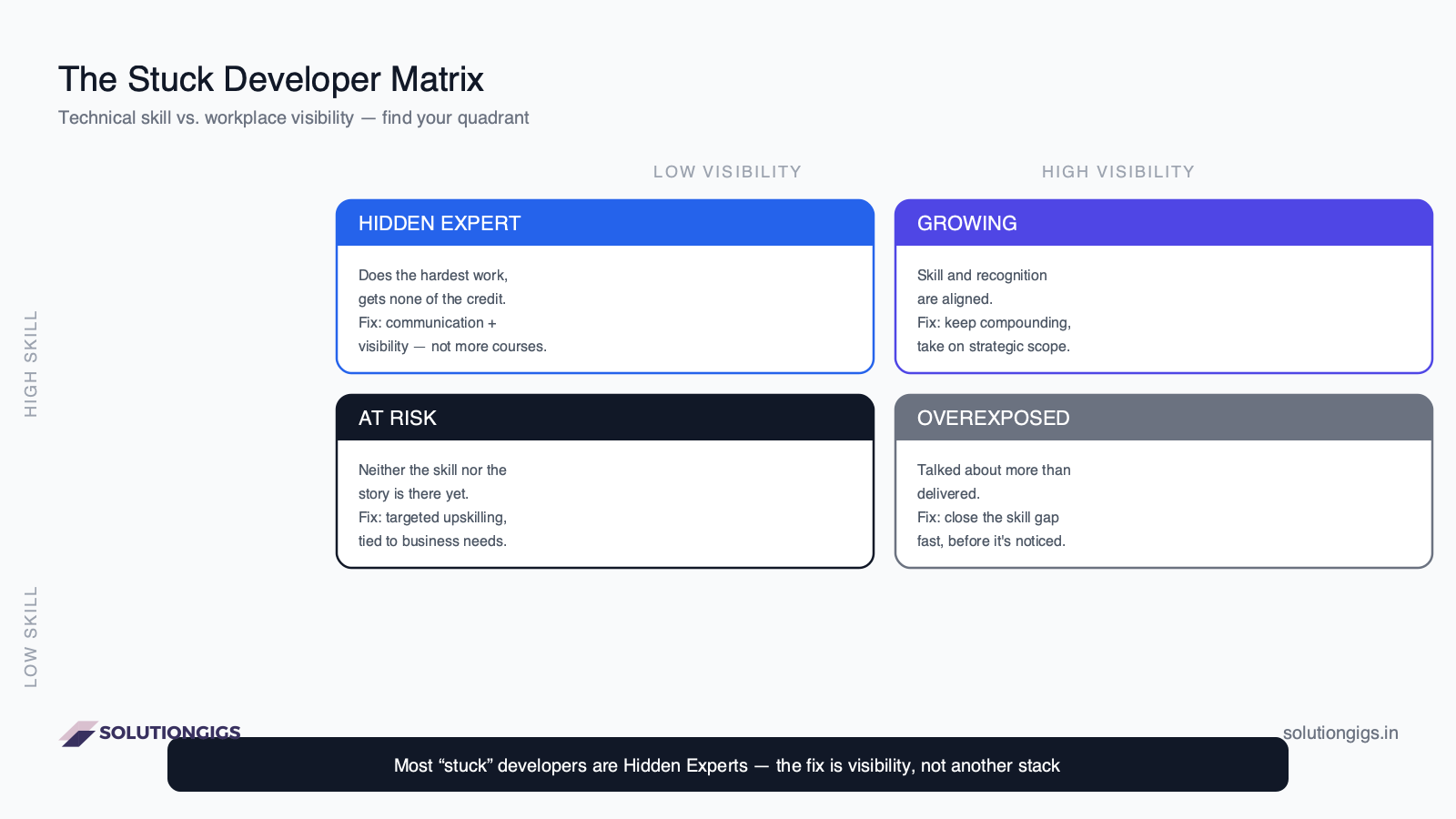
Before fixing anything, you need to know which quadrant you're actually in. Technical skill and workplace visibility are two separate axes — and most career advice only addresses one of them.
| Low Visibility | High Visibility | |
|---|---|---|
| High Skill | Hidden Expert — does the hardest work, gets none of the credit. Fix: communication + visibility, not more courses. | Growing — skill and recognition are aligned. Fix: keep compounding, take on strategic scope. |
| Low Skill | At Risk — neither the skill nor the story is there yet. Fix: targeted upskilling first, tied to what the business actually needs. | Overexposed — talked about more than delivered. Fix: close the skill gap fast before it's noticed by the wrong person. |
Most developers who describe themselves as "stuck" are sitting in Hidden Expert. They keep reaching for the "At Risk" fix — more learning — when what actually moves them is the top-right box: communication, visibility, and strategic positioning of the skill they already have.
The 5 Survival Stacks Every Developer Needs (Beyond Code)
Think of these as a second tech stack — one that determines whether your first tech stack ever gets noticed. None of them are optional if you want to grow past mid-level in a corporate environment.
1. The Communication Stack
Translate technical work into business language before anyone asks you to. "Refactored the auth middleware" means nothing to a director. "Cut login failures that were costing us support tickets every week" does. Practice restating your last three tickets as one-sentence business outcomes — that sentence is what gets repeated in the room you're not in.
2. The Visibility Stack
Good work that nobody sees might as well not exist for promotion purposes. Send a short weekly update to your manager with outcomes, not hours. Speak up in planning and design discussions before decisions are finalized, not after. Document decisions in writing so your name is attached to the reasoning, not just the commit.
3. The Political / Stakeholder Stack
Every org has unwritten incentives — who gets credit, who owns budget, who blocks what. Learn who actually benefits when your project succeeds, and make sure they know it succeeded because of you. This isn't manipulation; it's making sure accurate information about your contribution reaches the people who decide your growth.
4. The Strategic Upskilling Stack
Don't learn what's trending — learn what your organization is about to need. If your company is migrating to microservices next quarter, that's the skill to pick up now, not a random new language. Strategic learning gets noticed because it solves a problem leadership already has in mind; generic learning competes for attention with everyone else's generic learning.
5. The Career-Ownership Stack
Nobody at your company is responsible for your growth — you are. That means setting your own 6-month scope goal, asking directly for the kind of work that builds it, and treating a stalled year as a signal to act rather than a thing that happens to you. Developers who grow fastest treat their career like a project with a backlog, not a byproduct of showing up.
Common Mistakes Developers Make When They Feel Stuck
- Waiting for the annual review to bring it up. By then the story of your year is already written by whoever remembers it, and that's rarely you unless you've been saying it out loud along the way.
- Assuming a certification will speak for itself. It won't, unless you also tell people what you did with it.
- Going quiet instead of asking for scope. Silence reads as satisfaction, not ambition.
- Confusing busy with visible. Working late and shipping fast doesn't automatically translate into anyone upstream understanding your value.
- Quitting before diagnosing. Switching jobs fixes a bad company; it does not fix a communication or visibility gap you'll carry with you.
Should You Fix Your Current Job or Leave?
Fix it first if the ceiling is something in your control — your visibility, your communication, your strategic scope. Those gaps follow you to the next job if you don't close them. Leave if you've genuinely applied the fixes above for 3–6 months and the company still has no next level to offer, no budget for growth, or actively discourages people who ask for more responsibility. According to LeadDev's guidance for engineers looking to level up, creating visible value and building trust with the team is what actually earns more scope — a signal worth testing internally before assuming the door out is the only option. The Muse's breakdown of career ruts makes a similar point: most of what keeps people stuck is within their control, not their company's.
If you've genuinely worked both the skill side and the visibility side and the ceiling is still there, that's real information — not every company has room to grow you, and no amount of communication fixes a role with no next level.
Why a Mentor Fixes This Faster Than Googling It Alone
Here's the honest part: you can figure most of this out by yourself, eventually, through trial and error over a year or two. Or you can talk to someone who's already been on the other side of the table — inside a corporate engineering org, deciding who gets promoted and why — and get the diagnosis in one conversation instead of twelve months of guessing.
That's the exact gap solutiongigs.in/fix and solutiongigs.in/services exist to close. Tell us what's actually going on — the stack you're stuck on, the stall in your title, the conversation you don't know how to start with your manager — and you get a straight, experienced answer: whether it's a skill gap, a visibility gap, or a company that's genuinely capped. If it's a skill gap, we help you close it with the right stack, not a random one. If it's a visibility or communication gap, that's a conversation, not a course — and it's usually the faster fix of the two.
Frequently Asked Questions
Why do I feel stuck in my developer job even though I keep learning new tech?
Because learning a new framework fixes a skill gap, not a visibility gap. Most developers who feel stuck already have enough technical skill for their next promotion — what's missing is that nobody above them knows what they've built, so the work stays invisible while the title stays the same.
Is career stagnation my fault, or is it the company's?
Usually both, in different proportions. Some companies genuinely have no growth ladder. But most "the company won't promote me" situations are really "nobody with promotion authority has ever heard me describe my own impact." Fix what's in your control first, then decide if the company is the real ceiling.
What non-technical skills do developers need to grow their career?
Five matter most: communicating technical work to non-technical people, making your contributions visible without bragging, reading office politics and stakeholder incentives, choosing what to learn based on what the business needs next, and treating your own career like a project you actively manage instead of a side effect of doing good work.
How do I get more visibility for my work without bragging?
Report outcomes, not effort. Instead of describing hours spent, state the business result in one line — "cut checkout errors 40%" reads as visibility; "I worked really hard on the checkout bug" reads as bragging. Send a short weekly update to your manager, speak in meetings before decisions are finalized, and let your commit history and documentation say the rest.
Should I switch jobs or fix my current one first?
Fix it first if the ceiling is your own visibility, communication, or scope — those problems follow you to the next job. Switch if you've genuinely tried for 3-6 months and the company structurally has no next level, no budget for growth, or actively punishes people who ask for more responsibility.
How can a mentor help with career stagnation faster than figuring it out alone?
A mentor who has already navigated a corporate engineering org can see your blind spots in one conversation — the ones you can't see because you're inside the situation. They can tell you within minutes whether your problem is a skill gap, a visibility gap, or a genuinely dead-end company, which usually takes a stuck developer many more months of guessing to work out alone.
What is "quiet stagnation" and how do I know I'm in it?
Quiet stagnation is when your output is fine, your reviews are fine, nobody is complaining — but you haven't been given more scope, more say, or more pay in over a year. It's easy to miss because nothing is visibly wrong. The test: if you left tomorrow, would your manager struggle to name what you specifically changed in the last 12 months? If not, you're in it.
Conclusion
Feeling stuck rarely means you've stopped being a good engineer — it usually means the skills that convert good engineering into career growth were never taught to you in the first place. Before you enroll in another course, run the honest check: is this a skill gap, or is it that nobody above you knows what you've already built? Most of the time, the second question is the real one.
If you want a straight, experienced answer to which one it is — and a plan to fix it — talk to us at solutiongigs.in/fix for hands-on help closing a specific skill or technical gap, or solutiongigs.in/services if you need a broader engagement. You can also build the missing technical stack yourself, on your own time, with our free hands-on courses at solutiongigs.in/learn and practice it against real problems at solutiongigs.in/practice. It's free to ask.
Mohammed Yaseen
Founder, SolutionGigs
I've spent years inside corporate engineering teams and now help developers close both the technical and the invisible gaps that keep careers stuck. LinkedIn →
Talk to a mentor about your career
Free, no signup — right in your browser.
Talk to a mentor about your career →More in Career
Forward Deployed Engineer: What the Job Really Is, What It Pays, and How to Get One
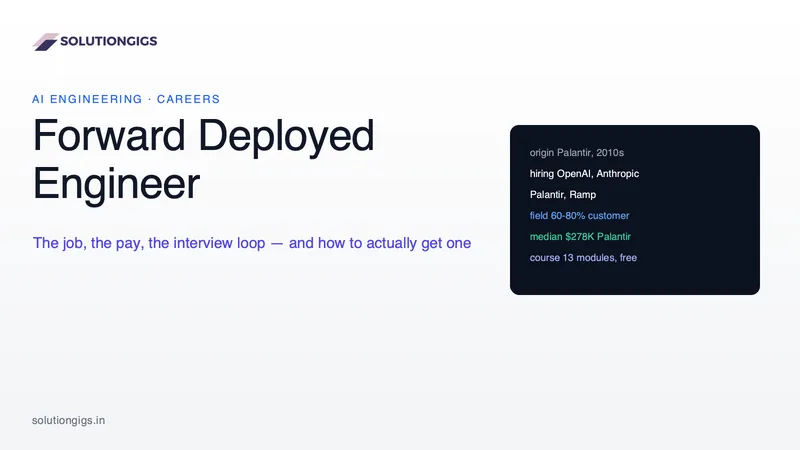
A forward deployed engineer is a software engineer embedded with a customer, shipping production code inside that customer's environment. This guide covers what the week actually looks like, the four deployment topologies, the security questionnaire that stalls deals, what the role pays with sources named, the five-stage interview loop, and a 90-day plan to move into it from an ordinary software job.
AI Agent Security: Stopping Prompt Injection
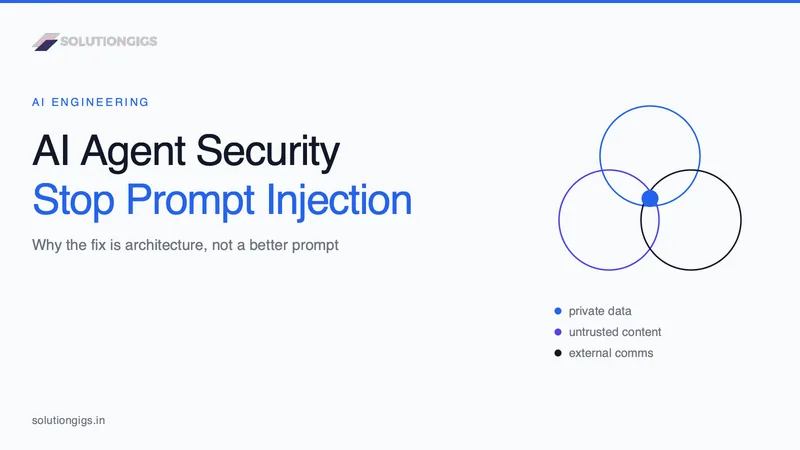
Prompt injection is the number one AI agent risk, and no prompt or filter fixes it. This guide covers the lethal trifecta, the arithmetic showing why a 99%-accurate guardrail is not a control, a decision table for which leg to cut in six common agent shapes, the exfiltration channels teams forget to audit, the MCP tool-poisoning and rug-pull attacks, the six research-backed design patterns that provably constrain agents, and how our own auto-publishing gate is built so a successful injection can flip at most one enum.
AI Agent Skills Explained: Build Reusable Claude Skills
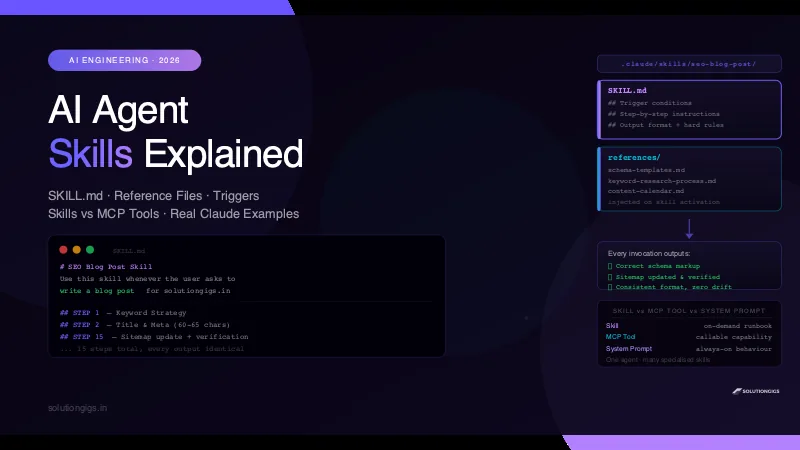
AI agent skills turn good one-off AI interactions into repeatable systems. Learn what skills are, how Claude Code loads SKILL.md files, how to write your own skill with reference files, and when to use skills vs MCP tools vs system prompts — with real examples.