Airflow vs Dagster vs Prefect: Which Data Orchestrator to Choose
Last Updated: July 2026 | 14 min read
Quick Answer: Choose Airflow for the largest ecosystem, mature scheduled batch DAGs, and the deepest hiring pool — it's the safe default for established platforms. Choose Dagster for new, dbt-heavy, or lineage-focused projects, where its asset-centric model makes pipelines behave like well-tested software. Choose Prefect for a Python-first developer experience, dynamic or event-driven workflows, and the fastest path to a managed cloud with almost no ops. The real fork is philosophical: task-centric (Airflow, Prefect) vs asset-centric (Dagster).
Every data team eventually needs an orchestrator — the tool that runs your pipelines on schedule, in the right order, retries failures, and tells you when something breaks. For years that meant Apache Airflow by default. In 2026 the choice is genuinely competitive: Dagster brought software-engineering discipline and data lineage to orchestration, Prefect rebuilt the developer experience around plain Python, and Airflow 3 answered back with a major modernization.
Having built and operated Airflow pipelines in production across event-processing platforms, I'll give you the honest comparison — not a feature-list dump, but how each one thinks, where each genuinely wins, and a decision framework you can apply to your team this week.
What each orchestrator actually is
An orchestrator schedules and runs the steps of a data pipeline, handles dependencies and retries, and gives you observability into runs — Airflow, Dagster, and Prefect all do this, but they model your pipeline in fundamentally different ways.
- Apache Airflow is the pioneer (created at Airbnb, now an Apache project). You write a DAG — a directed graph of tasks — in Python, and Airflow schedules them. Its superpower is a massive ecosystem of 2,000+ provider packages and a decade of production hardening.
- Dagster is the asset-centric challenger. Instead of tasks, you declare Software-Defined Assets — the data objects you want to exist (a table, a dbt model, an ML feature) — and Dagster derives the graph, lineage, and freshness from their dependencies.
- Prefect is the developer-experience-first option. You decorate ordinary Python functions with
@flowand@task, and Prefect runs them — with first-class support for dynamic, event-driven, and operational workflows, and a managed cloud that gets you live fast.
The one-line framing: Airflow orchestrates tasks, Dagster orchestrates assets, Prefect orchestrates Python.
The real dividing line: tasks vs assets
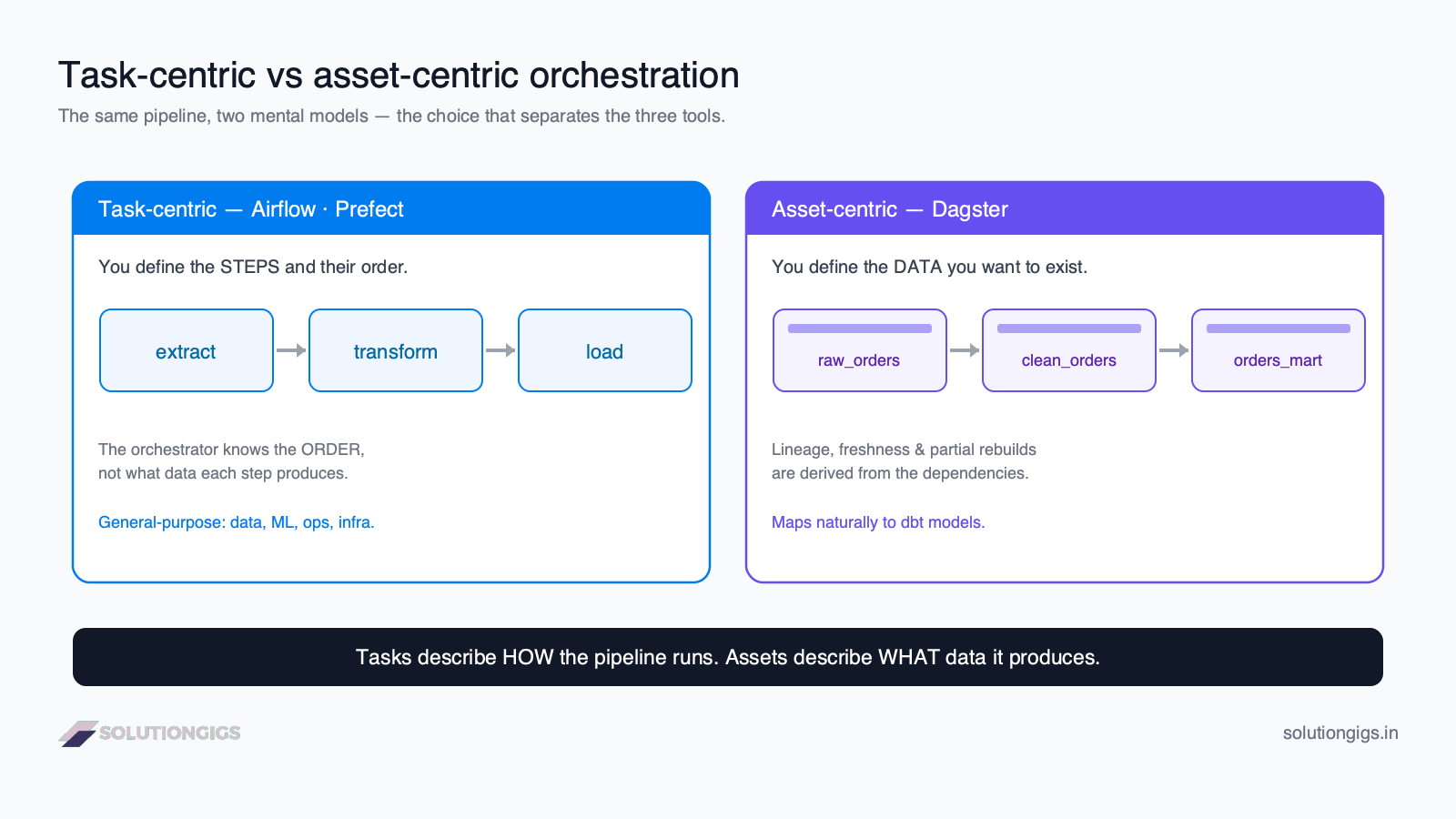
The most important difference isn't syntax — it's whether you describe the steps (tasks) or the data (assets). That single choice shapes lineage, testing, and how naturally the tool fits dbt. Understand this and the rest of the comparison falls into place.
- Task-centric (Airflow, Prefect): you say "run
extract, thentransform, thenload." The orchestrator knows the order of operations, not what data each step produces. It's general-purpose and works for anything — data, ML, ops jobs, infra. - Asset-centric (Dagster): you say "the
clean_orderstable is built from theraw_orderstable." Dagster infers the execution order from the data dependencies, and gets lineage, freshness policies, and partial rebuilds for free — which is exactly how dbt already models transformations.
This is why dbt-heavy teams gravitate to Dagster: each dbt model becomes an asset with automatic lineage. It's also why Airflow 3 invested heavily in data-aware (asset) scheduling — the industry is converging on assets as a first-class concept, even in the task-centric tools.
Airflow vs Dagster vs Prefect: the comparison
| Apache Airflow | Dagster | Prefect | |
|---|---|---|---|
| Model | Task-centric DAGs | Asset-centric (Software-Defined Assets) | Task-centric, Python-native flows |
| Authoring | Python DAG objects + operators | Python assets + ops | Decorated Python functions (@flow/@task) |
| Best at | Ecosystem, scheduled batch, scale | Lineage, testing, dbt, data quality | Dev experience, dynamic/event-driven flows |
| Local dev & testing | Historically weak (much better in v3) | Excellent — pipelines test like code | Very good — it's just Python |
| Lineage / observability | Basic (improving) | Best-in-class, asset-native | Good run observability |
| Ecosystem | Largest — 2,000+ providers | Growing, dbt-first | Growing, Python-first |
| Managed cloud | Astronomer, MWAA, Cloud Composer | Dagster+ | Prefect Cloud |
| Ops burden (self-host) | Highest (scheduler + metadata DB + workers) | Moderate | Low |
| Maturity / hiring pool | Highest | Medium | Medium |
No tool wins every row — which is exactly why the choice depends on your team and workload, not a scoreboard.
Apache Airflow — the mature default
Airflow wins on ecosystem, maturity, and hiring: if you need to connect to almost anything, run scheduled batch at scale, or staff a team quickly, it's the safe choice. Airflow 3 (2025) modernized the weak spots — DAG versioning, a rebuilt React UI, remote/edge execution, and stronger data-aware scheduling.
The trade-off is operational weight: self-hosted Airflow means running a scheduler, a webserver, workers, and a metadata database. Managed options (Astronomer, AWS MWAA, Google Cloud Composer) remove most of that. If you're new to it, our Apache Airflow fundamentals guide covers the core concepts.
Dagster — the asset-native, software-engineering choice
Dagster wins when you want pipelines that behave like well-tested software, with data lineage and freshness built in — especially alongside dbt. Its Software-Defined Assets model, first-class local development, asset checks, and native dbt integration are why it's winning a large share of greenfield projects.
The trade-off is a smaller ecosystem than Airflow and a genuinely different mental model — thinking in assets rather than tasks takes a short adjustment, but it pays off in lineage and maintainability. Pair it with solid data quality tests and you get a very robust platform.
Prefect — the Python-first, low-ops choice
Prefect wins on developer experience and speed to production: decorate your Python functions, point them at Prefect Cloud, and you're orchestrating in a day with almost no infrastructure. Prefect 3's engine handles dynamic and event-driven workflows that map awkwardly onto a static DAG.
The trade-off is a smaller integration ecosystem than Airflow and less asset-lineage tooling than Dagster. For teams of 20–100 who need orchestration but don't want to operate it, Prefect hits a sweet spot.
Which should you choose? A decision guide
Pick by your dominant constraint — ecosystem, data lineage, or developer speed — not by star counts. Here's the framework I use:
- Already run Airflow, or need broad integrations / a big hiring pool? → Airflow. Don't migrate a working platform for fashion; adopt Airflow 3's asset features instead.
- Greenfield, dbt-centric, or lineage and data quality are top priority? → Dagster. The asset model will pay for itself in maintainability and trust in your data.
- Small-to-mid team, Python-first, want to be live fast with minimal ops (or lots of dynamic/event-driven work)? → Prefect.
- Not sure and starting fresh? Prototype the same pipeline in Dagster and Prefect in an afternoon each — both are quick to stand up — and let the mental model that clicks with your team decide.
One more real-world note: orchestrators coexist. Plenty of platforms run Airflow for legacy scheduled DAGs while new dbt-centric domains adopt Dagster. Choosing one for a new project doesn't mean ripping out the other.
Common mistakes when choosing an orchestrator
- Picking on GitHub stars. Airflow has the most stars and the most legacy baggage; Dagster has fewer stars and a cleaner model. Stars measure history, not fit.
- Ignoring the ops cost. A self-hosted Airflow cluster is real infrastructure. If you don't have the team to run it, a managed cloud (any of the three) is cheaper than the hidden ops time.
- Forcing dynamic workflows onto a static DAG. If your work is event-driven or highly dynamic, that's a Prefect strength, not something to bend Airflow around.
- Skipping data quality. An orchestrator schedules pipelines; it doesn't guarantee the data is correct. Pair any of them with data quality tests and sane backfilling practices.
- Migrating a working platform for fashion. The best orchestrator is often the one your team already runs well.
Frequently Asked Questions
What is the difference between Airflow, Dagster, and Prefect?
All three orchestrate data pipelines but model them differently. Airflow is task-centric — a DAG of tasks and their order. Prefect is also task-centric but Python-native, turning functions into flows and excelling at dynamic workflows. Dagster is asset-centric — you define the data assets you want and it derives the graph and lineage. Airflow has the biggest ecosystem, Dagster the best lineage, Prefect the fastest managed cloud.
Is Dagster better than Airflow?
For new, dbt-heavy, or lineage-focused projects, many teams find Dagster better — its asset model, built-in lineage, and strong testing make pipelines behave like engineered software. Airflow is better when you need its 2,000+ integrations, already run it at scale, or want the most battle-tested, widely-hired-for tool. Dagster wins greenfield and data-asset work; Airflow wins ecosystem and maturity.
Should I use Prefect or Airflow?
Use Prefect for a Python-first experience, dynamic or event-driven workflows, and the fastest route to production without operating infrastructure. Use Airflow for its mature ecosystem, scheduled batch DAGs at scale, and the deepest hiring pool. Prefect suits small-to-mid teams that don't want ops; Airflow suits established platforms with broad integration needs.
What is the difference between task-based and asset-based orchestration?
Task-based orchestration (Airflow, Prefect) defines the steps and their order. Asset-based orchestration (Dagster) defines the data you want to produce and derives the execution graph and lineage from those dependencies. Asset thinking maps naturally to dbt models and makes lineage, freshness, and partial rebuilds first-class; task thinking is more general-purpose.
Which orchestrator is best for dbt?
Dagster is widely considered the best fit for dbt: each dbt model becomes a Dagster asset with automatic lineage, and Dagster runs and observes dbt natively. Airflow and Prefect run dbt well too, but you manage the model graph yourself. If dbt is central to your stack, Dagster gives the tightest integration.
Is Airflow still relevant in 2026?
Yes — Airflow is still the most widely used orchestrator, with the largest ecosystem and hiring pool. Airflow 3 modernized it with DAG versioning, a new UI, remote execution, and stronger asset scheduling that narrows the gap with Dagster. For established platforms and broad integrations, it remains a default choice.
Which data orchestrator is easiest to get to production?
Prefect is usually fastest for a small team: sign up for Prefect Cloud, decorate functions with @flow/@task, run a worker, and go live in a day with no scheduler or metadata database. Dagster+ and managed Airflow (Astronomer, MWAA) also cut ops. Self-hosted Airflow takes the most setup.
Conclusion
The Airflow vs Dagster vs Prefect decision comes down to one question before any feature list: do you want to orchestrate tasks or assets, and how much ops can you carry? Airflow remains the mature, ecosystem-rich default — and Airflow 3 has closed real gaps. Dagster is the asset-native choice that makes data pipelines feel like tested software, especially with dbt. Prefect is the Python-first, low-ops path to production for teams that want orchestration without running it.
There's no universal winner, and that's good news: all three are strong in 2026. Match the tool to your team's mental model and operational appetite, pair it with real data quality checks, and you'll have an orchestration layer you can trust. The worst choice is analysis paralysis — pick the one whose model clicks, and ship.
Want to go deeper on the pipelines these orchestrators run? Explore the SolutionGigs blog for guides on dbt, data quality, backfilling, and the modern data stack — and the free, hands-on Spark with Scala course. Building a data platform and unsure which tools to standardize on? SolutionGigs connects you with vetted data engineers — it's free to post your project.

Mohammed Yaseen
Founder, SolutionGigs
Mohammed builds and operates production data pipelines on Airflow, Kafka, and Spark — and has migrated more than one team from cron-and-hope to real orchestration. LinkedIn →