
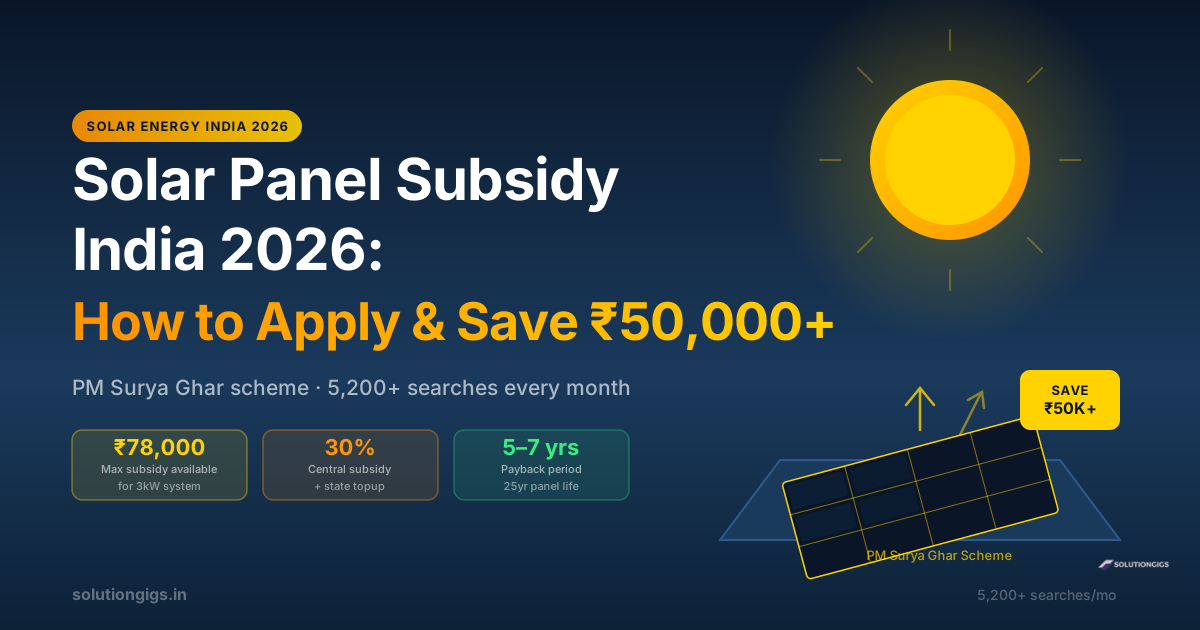
Solar Panel Subsidy India 2026: How to Apply, How Much to Get & Save ₹50,000+
Last Updated: May 2026 · 12 min read
Quick Answer
The solar panel subsidy in India 2026 provides up to ₹78,000 central government subsidy for a 3 kW rooftop system under PM Surya Ghar Muft Bijli Yojana. Apply at pmsuryaghar.gov.in. Many states offer additional subsidies on top, bringing total support to ₹90,000–₹1,20,000.
After the subsidy, a 3 kW system costs ₹70,000–₹90,000 and saves ₹1,500–₹3,000/month on electricity — paying for itself in 4–7 years, then saving for 18+ more years.
The keyword "solar panel subsidy India 2026 how to apply" is searched over 5,200 times every month — and with good reason. India's PM Surya Ghar scheme is one of the most generous residential solar programs in the world, and most eligible homeowners haven't applied yet.
This guide covers everything: the exact application process, how much subsidy you'll receive, which states offer the best deals, which solar companies are empanelled, and how to calculate whether solar makes financial sense for your home.
What Is PM Surya Ghar Muft Bijli Yojana?
PM Surya Ghar Muft Bijli Yojana (PM Solar Home Free Electricity Scheme) was launched by Prime Minister Narendra Modi in February 2024. It is India's flagship residential rooftop solar programme.
Key targets: - Install rooftop solar on 1 crore (10 million) homes by 2026–27 - Provide 300 units of free electricity per month to every beneficiary household (based on average 3 kW system generation) - Create massive domestic solar manufacturing capacity under 'Make in India'
Who can apply: - Residential households (not commercial or industrial) - Must own or have legal occupancy of the property - Must have an active electricity connection from a DISCOM - Income limit: No income ceiling — any household is eligible
As of May 2026, over 73 lakh applications have been approved under the scheme, with 41 lakh installations completed. The remaining slots are still available.
How Much Solar Subsidy Can You Get in India 2026?
Central Government Subsidy (PM Surya Ghar)
| System Size | Central Subsidy | Cost Before Subsidy (approx.) | Cost After Subsidy (approx.) |
|---|---|---|---|
| 1 kW | ₹30,000 | ₹65,000–₹80,000 | ₹35,000–₹50,000 |
| 2 kW | ₹60,000 | ₹1,10,000–₹1,30,000 | ₹50,000–₹70,000 |
| 3 kW | ₹78,000 | ₹1,40,000–₹1,70,000 | ₹62,000–₹92,000 |
| Above 3 kW | ₹78,000 (capped at 3 kW) | Higher | Higher net cost |
How the subsidy works: The central government transfers the subsidy directly to your bank account after installation and DISCOM inspection. You pay the full installation cost upfront and receive the subsidy as a bank credit.
State Government Additional Subsidies (2026)
Many states offer their own subsidies on top of the central scheme:
| State | Additional Subsidy | Notes |
|---|---|---|
| Gujarat | 20% of system cost | Combined with central = 55–60% total |
| Rajasthan | 10% additional | Strong for high-irradiance areas |
| Maharashtra | MSEDCL scheme: ₹5,000–₹20,000 | Varies by utility zone |
| Delhi | BSES/BYPL separate scheme | Check discom.in for current rates |
| Tamil Nadu | TANGEDCO 30% subsidy for below-poverty line | BPL specific |
| Karnataka | BESCOM empanelled installer discount | Negotiated, not fixed |
| Uttar Pradesh | UPNEDA 10% | UP-specific scheme |
Action step: Visit your state's DISCOM or state energy department website to check current state-level solar subsidy schemes. These change periodically.
Step-by-Step Application Process for Solar Subsidy in India 2026
Documents Required for PM Surya Ghar Application
- Aadhaar card (identity proof)
- Electricity bill (latest, with consumer number)
- Bank account details (for subsidy credit)
- Recent photo of your rooftop (for feasibility check)
- Property ownership proof (for rented property, NOC from landlord)
How to Choose the Right Solar Panel System for Your Home
Step 1: Calculate Your Monthly Consumption
Find your electricity bill. Note the units consumed per month (not the amount in rupees). This is the starting point.
| Monthly Units | Recommended System | Monthly Savings |
|---|---|---|
| Under 100 units | 1 kW | ₹600–₹1,000 |
| 100–200 units | 1.5–2 kW | ₹1,000–₹2,000 |
| 200–400 units | 2–3 kW | ₹1,500–₹3,000 |
| 400–600 units | 3–5 kW | ₹2,500–₹4,500 |
| Above 600 units | 5–10 kW | ₹4,000–₹8,000 |
Step 2: Assess Your Rooftop
A 1 kW solar system requires approximately 10–12 sq. metres of unshaded roof space. For a 3 kW system, you need 30–36 sq. metres.
Shadow checklist: Check for shading from water tanks, adjacent buildings, trees, or telecom equipment. Even 10% shading can reduce generation by 30–40% depending on the inverter type. Discuss shade management options (microinverters, optimisers) with your installer if shading is a concern.
Step 3: Verify Your Sanctioned Load
Your sanctioned load is the maximum power draw your DISCOM allows. A 3 kW solar system generally requires a sanctioned load of at least 2–3 kW. If your sanctioned load is lower, request an upgrade from your DISCOM (additional cost of ₹2,000–₹5,000 typically).
Best Solar Panel Companies Empanelled Under PM Surya Ghar
Only purchase from MNRE-empanelled installers. Unempanelled vendors cannot process the PM Surya Ghar subsidy. The full list is at pmsuryaghar.gov.in under "Empanelled Vendors."
Top empanelled brands in India 2026:
| Company | Strength | Panel Warranty |
|---|---|---|
| Waaree Energies | Largest Indian manufacturer, competitive pricing | 25 years |
| Adani Solar | Premium quality, premium pricing | 25 years |
| Loom Solar | Best for smaller homes, strong warranty | 25 years |
| Tata Power Solar | Trusted brand, nationwide installation network | 25 years |
| Vikram Solar | Strong export-grade quality | 25 years |
| Luminous Solar | Good for hybrid (on-grid + battery) systems | 10–25 years |
Price comparison tip: Always get 3 quotes from different empanelled vendors. Prices for the same system can vary by ₹15,000–₹30,000 between vendors. The cheapest isn't always the best — check panel efficiency rating (look for 20%+ efficiency mono PERC panels) and inverter brand.
Financial Analysis: Is Solar Worth It for Your Home?
The 3 kW Case Study (Typical Indian Middle-Class Home)
| Item | Amount |
|---|---|
| Total system cost (before subsidy) | ₹1,50,000 |
| PM Surya Ghar central subsidy | -₹78,000 |
| Net cost after subsidy | ₹72,000 |
| Monthly electricity savings | ₹2,000–₹2,500 |
| Annual savings | ₹24,000–₹30,000 |
| Payback period | 2.4–3 years |
| Panel life | 25 years |
| Total savings over 25 years | ₹5,70,000–₹7,20,000 |
Note: Calculations exclude additional state subsidies, net metering income, and electricity tariff increases (which improve solar ROI over time)
The Net Metering Bonus
With net metering, electricity you generate but don't consume is sold back to the DISCOM at a feed-in tariff (typically ₹2.50–₹4.50 per unit depending on state). A 3 kW system in a sunny state generates approximately 400–450 units/month. If you consume 250 units, the remaining 150–200 units generate ₹375–₹900/month in net metering credits.
This further reduces the payback period and improves lifetime returns.
Common Mistakes When Applying for Solar Subsidy
| Mistake | Consequence | How to Avoid |
|---|---|---|
| Using a non-empanelled installer | Cannot claim subsidy | Always verify on pmsuryaghar.gov.in before signing |
| Installing before DISCOM approval | Subsidy may be rejected | Wait for formal approval email/SMS before any work |
| Wrong system sizing | Overpaying or undersaving | Calculate based on actual consumption, not guesswork |
| Ignoring net metering application | Missing monthly sell-back income | Request net meter along with solar installation |
| Buying cheap, low-efficiency panels | Less generation, poor ROI | Look for Tier 1 panels with 20%+ efficiency and BIS certification |
| Not checking sanctioned load | Installation rejected or incomplete | Call your DISCOM before applying |
Frequently Asked Questions
How do I apply for solar panel subsidy in India 2026?
Apply at pmsuryaghar.gov.in: register with your mobile number, electricity consumer number, and state. Submit a rooftop solar application with roof photos. Wait for DISCOM approval (15–30 days). Install through an empanelled vendor. DISCOM installs net meter. Upload commissioning certificate. Subsidy (up to ₹78,000) credited directly to your bank account.
How much solar panel subsidy can I get in India?
Central subsidy: ₹30,000/kW for first 2 kW, ₹18,000 for the 3rd kW — maximum ₹78,000 for 3 kW. Many states add 10–30% additional subsidies. Gujarat and Rajasthan have the most generous combined programs.
What is PM Surya Ghar Muft Bijli Yojana?
It is India's central government scheme to install rooftop solar on 1 crore homes. It provides direct central subsidies of up to ₹78,000 per household and is designed to give beneficiaries approximately 300 units/month of free electricity from a properly sized system.
Is solar panel profitable for Indian homes?
Yes. For homes paying ₹1,500+ monthly electricity bills, a subsidised rooftop system typically pays back in 3–7 years with 18+ years of free electricity following. Total lifetime savings from a 3 kW system: ₹5–₹7 lakh in most Indian states.
Which state has the best solar subsidy in India?
Gujarat offers the best combined central + state subsidies, covering up to 55–60% of a 3 kW system cost. Rajasthan and Maharashtra also have strong programs. All states benefit from the central PM Surya Ghar subsidy of ₹78,000 maximum.
Conclusion
With India's PM Surya Ghar Muft Bijli Yojana in full swing in 2026, the economics of rooftop solar have never been better. A ₹78,000 central subsidy plus potential state top-ups means many households can install a 3 kW system for ₹60,000–₹80,000 and start saving immediately.
The action steps are straightforward: 1. Check your eligibility at pmsuryaghar.gov.in 2. Calculate your system size based on monthly electricity consumption 3. Assess your roof for space and shading 4. Get 3 quotes from MNRE-empanelled vendors 5. Apply online and wait for DISCOM approval 6. Install, connect, and start saving
More than 73 lakh Indian households have already applied. Don't miss the remaining subsidy slots.

Mohammed Yaseen
Founder, SolutionGigs
Tech entrepreneur and clean energy advocate who researches India's growing solar sector. Mohammed writes about green technology, government schemes, and sustainable living to help Indian households make informed financial decisions. LinkedIn →