
How to Invest ₹1000 Per Month in India — Complete Beginner's Guide 2026
Last Updated: May 2026 · 13 min read
Quick Answer
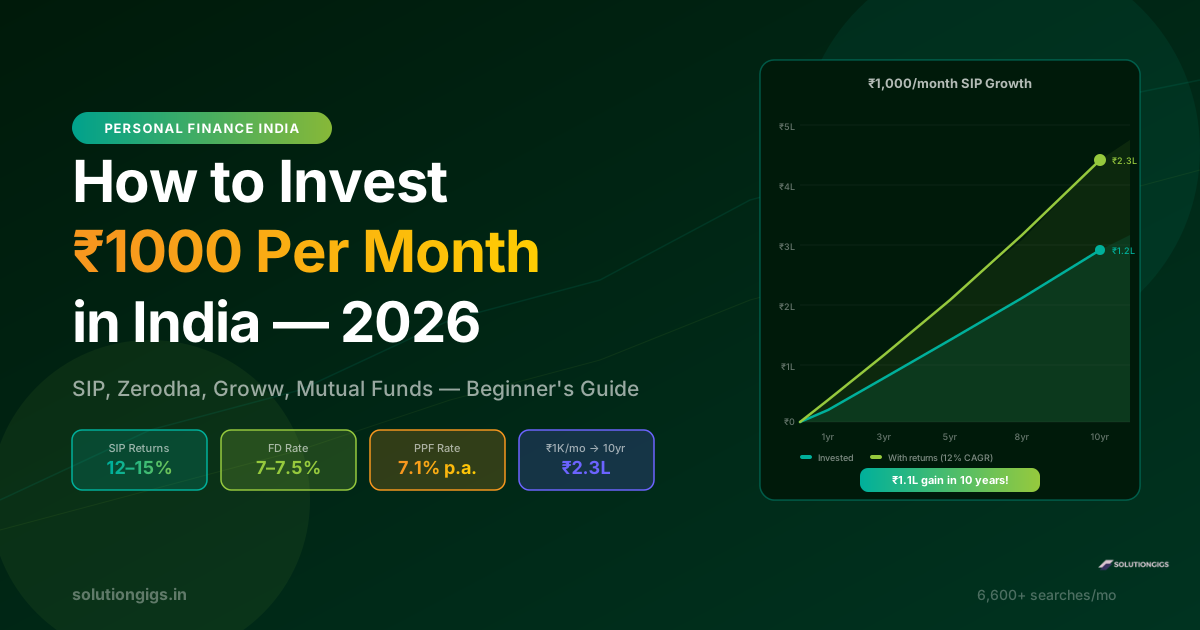
To invest ₹1000 per month in India: start a SIP in a Nifty 50 index mutual fund (Groww or Zerodha Coin, zero commission). Set up auto-debit. Never stop during market dips — that's when you buy cheapest. ₹1000/month at 12% CAGR becomes ₹2.3 lakh in 10 years (₹1.2 lakh invested, ₹1.1 lakh in returns).
The most important rule: start now, even if ₹1000 feels small. Time in market beats timing the market — every month you delay costs you years of compound interest.
"How to invest ₹1000 per month in India" is searched 6,600 times every month — making it one of the most popular personal finance queries in the country. And no wonder: India's young population is earning, but financial literacy is still catching up. The traditional advice ("invest in FD", "buy gold") underperforms for wealth building over decades.
This guide gives you a complete, honest beginner's roadmap: which investment options actually make sense for ₹1000/month, how to open accounts, what returns to realistically expect, and how to gradually scale your investment as your income grows.
Disclaimer: This article is educational, not personalised financial advice. Consult a SEBI-registered financial advisor for investment decisions based on your specific situation. All return figures are based on historical data; past performance doesn't guarantee future returns.
The ₹1000/Month Compounding Reality
Many people dismiss ₹1000/month as "too small to matter." The maths says otherwise.
| Investment | Monthly | CAGR | Value in 10 Years | Total Invested |
|---|---|---|---|---|
| Savings account | ₹1,000 | 3.5% | ₹1.45 lakh | ₹1.2 lakh |
| FD (recurring) | ₹1,000 | 7.2% | ₹1.75 lakh | ₹1.2 lakh |
| Nifty 50 Index Fund SIP | ₹1,000 | 12% | ₹2.30 lakh | ₹1.2 lakh |
| Active equity mutual fund | ₹1,000 | 15% | ₹2.79 lakh | ₹1.2 lakh |
The difference between FD and equity SIP over 10 years: ₹55,000–₹1.04 lakh on the same ₹1,000/month. Over 20 years, the gap widens dramatically due to compounding.
But here's the even more important number: If you start at age 22 and increase your SIP by just ₹500/month each year, by age 40 you'd be investing ₹10,000+/month and the portfolio could reach ₹50–₹70 lakh. The ₹1000 isn't the destination — it's the ignition.
Option 1: SIP in Mutual Funds (Recommended for Most Beginners)
What is a SIP? SIP (Systematic Investment Plan) is a method of investing a fixed amount in a mutual fund every month. It's not a type of investment itself — it's a way to invest in mutual funds automatically.
Why SIP beats lump sum for beginners:
- Rupee Cost Averaging: When the market is down, your ₹1000 buys more units. When the market is up, each unit is worth more. This averages out your purchase price over time.
- Discipline: Auto-debit means you invest before you spend. You can't accidentally skip a month.
- No timing required: You don't need to predict market movements — you invest every month regardless.
Best Mutual Funds for ₹1000/Month SIP in India 2026
Category 1: Index Funds (Lowest Risk, Lowest Cost)
| Fund | Category | Expense Ratio | 5-Year Return |
|---|---|---|---|
| Motilal Oswal Nifty 50 Index Fund | Large Cap Index | 0.10% | ~13.5% |
| UTI Nifty 50 Index Fund | Large Cap Index | 0.18% | ~13.4% |
| HDFC Nifty 50 Index Fund | Large Cap Index | 0.20% | ~13.3% |
| Motilal Oswal Nifty Midcap 150 | Midcap Index | 0.30% | ~18.5% |
Why index funds for beginners: They track the index (like the Nifty 50 — India's top 50 companies). No fund manager risk. Lowest expense ratios (most money stays in your investment). 90% of actively managed funds underperform index funds over 10+ years.
Category 2: Actively Managed Flexi-Cap (Moderate Risk, Higher Potential)
| Fund | Category | 5-Year Return | Why Notable |
|---|---|---|---|
| Parag Parikh Flexi Cap | Flexi-Cap | ~20.5% | Global diversification, value approach |
| Mirae Asset Large & Midcap | Large & Midcap | ~18% | Consistent performer |
| Canara Robeco Flexi Cap | Flexi-Cap | ~17.5% | Balanced risk-return |
Category 3: For High Risk Tolerance (7+ Year Horizon)
| Fund | Category | Potential | Risk |
|---|---|---|---|
| SBI Small Cap | Small Cap | 18–25% | High |
| Nippon India Small Cap | Small Cap | 18–25% | High |
| HDFC Midcap Opportunities | Midcap | 15–20% | Medium-High |
For absolute beginners: Start with the Motilal Oswal Nifty 50 Index Fund. It's the simplest, cheapest, and most reliable choice. You can diversify into other funds later.
Option 2: PPF (Public Provident Fund) — Safe, Tax-Free Returns
PPF is a government-backed long-term savings scheme — completely safe and offering tax-free returns.
| Feature | Detail |
|---|---|
| Current interest rate | 7.1% per annum (reviewed quarterly by government) |
| Lock-in period | 15 years (partial withdrawal after 7 years) |
| Investment limit | ₹500 minimum, ₹1.5 lakh maximum per year |
| Tax benefits | EEE — investment deductible under 80C, interest tax-free, maturity tax-free |
| Where to open | Post office, SBI, HDFC, ICICI, Axis (online and offline) |
The PPF advantage: If you're in the 20–30% income tax bracket, PPF's effective post-tax return is closer to 8.9–10.1% when you account for the 80C deduction on the investment.
Limitation: ₹1000/month × 12 = ₹12,000/year — well within the limit. But returns at 7.1% are lower than equity SIP expectations for long periods.
Best strategy: Combine PPF + SIP. Use PPF for the guaranteed, tax-free portion and SIP for the higher-potential equity portion.
Option 3: Recurring Deposit (FD for Monthly Investment)
A recurring deposit (RD) is a bank product where you invest a fixed amount monthly for a fixed period and earn a fixed interest rate.
| Bank | 1-Year RD Rate | 2-Year RD Rate |
|---|---|---|
| SBI | 6.80% | 7.00% |
| HDFC Bank | 6.60% | 7.10% |
| ICICI Bank | 6.70% | 7.10% |
| AU Small Finance Bank | 7.50% | 7.75% |
| Unity Small Finance Bank | 8.00% | 8.25% |
When RD makes sense: - Short-term goal (1–3 years) — house down payment, vacation fund, emergency fund - Very low risk tolerance - Income is uncertain (RD interest is predictable even if your freelance income isn't)
Limitation: RD interest is taxable as income. At 30% tax bracket, 7.1% RD becomes 4.97% post-tax — barely above inflation.
Option 4: Digital Gold / Gold ETF
Gold has historically been India's traditional store of value, but physical gold has storage risk and making charges. Digital alternatives are better:
| Option | What It Is | Minimum | Liquidity |
|---|---|---|---|
| Gold ETF (Nippon, HDFC, SBI) | Tracks gold price, stored in demat | 1 unit (~₹5,800) | High (sell on NSE) |
| Sovereign Gold Bond (SGB) | Government bond backed by gold | 1 gram (~₹6,000) | Low (8-year term) |
| Digital Gold (Groww, Paytm) | Vaulted physical gold | ₹1 | Medium |
For ₹1000/month: Digital gold via Groww or Paytm Money allows investment from ₹1. You can accumulate ≈0.15–0.17 grams per month at current prices. Over 5 years at ₹1000/month, you'd accumulate ≈10 grams of gold worth ₹60,000–₹80,000 at current rates.
Gold allocation recommendation: Keep gold at 5–10% of total portfolio as a hedge. Don't make it your primary investment at this amount.
Step-by-Step Guide: How to Start Your First SIP in India
Step 1: Get Your Documents Ready
- PAN card (mandatory for any investment)
- Aadhaar card (for KYC verification)
- Bank account details (savings account for auto-debit)
- Mobile number linked to Aadhaar (for OTP-based eKYC)
Step 2: Choose a Platform
Best platforms for beginners:
| Platform | Why Choose | Account Fee |
|---|---|---|
| Groww | Simplest UI, zero commission direct plans | Free |
| Zerodha Coin | Best integration with demat, direct funds | Free |
| Paytm Money | Simple, recognisable brand | Free |
| ET Money | Built-in financial planning tools | Free |
Our recommendation: Groww for first-time investors. The app is extremely intuitive and takes 10 minutes to set up with Aadhaar-based eKYC.
Step 3: Complete KYC
On Groww: Enter PAN → Aadhaar → Face recognition via mobile camera → Bank account → Done. Takes 10–15 minutes. Your account is usually active within 24 hours.
Step 4: Search for Your Chosen Fund
Search "Nifty 50 Index" in the Groww app. Select "Motilal Oswal Nifty 50 Index Fund — Direct Growth."
Key: Always select "Direct Plan — Growth": - Direct Plan: No distributor commission. You get 0.5–1% more returns annually. - Growth Option: Returns reinvested (not paid as dividends). Better for long-term wealth building.
Step 5: Set Up Your SIP
- SIP Amount: ₹1,000
- SIP Date: Choose 5th or 10th of the month (just after salary credit for salaried workers)
- SIP Duration: Perpetual (no end date — keep going until you decide to stop)
- Auto-debit from bank: Enable
Step 6: Don't Stop During Market Crashes
This is the most common and most expensive mistake. When the Sensex drops 15–20%, your SIP is buying units at 15–20% discount. If you stop or redeem, you lock in the loss and miss the recovery.
Historical data: Every significant Indian market correction (2008, 2015, 2020) was followed by a stronger recovery. Investors who continued SIPs through the crash outperformed those who stopped.
Tax Implications of Mutual Fund Investments in India
Understanding taxes ensures you plan your investments efficiently:
| Fund Type | Holding Period | Tax Rate |
|---|---|---|
| Equity mutual funds (index, flexi-cap, small cap) | Less than 1 year | 15% (Short-Term Capital Gains) |
| Equity mutual funds | More than 1 year | 10% on gains above ₹1 lakh (LTCG) |
| Debt mutual funds (liquid, bond funds) | Any | Added to income, taxed at slab rate |
| PPF returns | Any | 0% (tax-free) |
| FD/RD interest | Any | Added to income, taxed at slab rate |
The LTCG advantage: If you hold equity mutual funds for more than 1 year, ₹1 lakh of annual gains is tax-free. This makes SIP the most tax-efficient investment for most Indian middle-class investors.
Common Investment Mistakes to Avoid
| Mistake | Why It Hurts | Fix |
|---|---|---|
| Waiting to invest until you earn "more" | Loses years of compounding | Start with ₹500/month today |
| Choosing regular plan instead of direct | Loses 0.5–1% per year to distributor | Always select "Direct Plan" |
| Stopping SIP during market dip | Locks in paper losses, misses recovery | Continue no matter what |
| Picking funds based on last year's returns | Last year's winner rarely repeats | Choose based on 5–7 year performance and expense ratio |
| Over-diversifying into 10+ funds | Dilutes returns, creates confusion | 2–3 funds is optimal at ₹1000/month |
| Investing emergency fund in equity | Market dip + emergency = forced sale at loss | Keep 3–6 months expenses in liquid fund or FD |
Your ₹1000/Month Investment Plan: A Simple Framework
| Your Situation | Recommended Allocation |
|---|---|
| Complete beginner, risk-averse | ₹700 PPF + ₹300 Nifty 50 SIP |
| Beginner, moderate risk | ₹1,000 Nifty 50 Index SIP |
| Under 30, long horizon (15+ years) | ₹700 Nifty 50 + ₹300 Midcap Index |
| Under 30, high risk tolerance | ₹600 Nifty 50 + ₹400 Small/Midcap |
| Has existing emergency fund | Any of the above |
| No emergency fund yet | Build 3-month emergency fund first, then invest |
Frequently Asked Questions
How do I invest ₹1000 per month in India?
Open a Groww or Zerodha Coin account (free, 15 minutes with Aadhaar eKYC). Search for "Motilal Oswal Nifty 50 Index Fund — Direct Growth." Set up a SIP of ₹1000 with auto-debit from your bank account on a fixed date each month. That's it. The investment runs automatically and you can track it in the app.
Is ₹1000/month enough to invest?
Yes. ₹1000/month at 12% CAGR grows to ₹2.3 lakh in 10 years (on ₹1.2 lakh invested). The bigger benefit is the habit it builds — you'll naturally increase by ₹500–₹1000 with every income increase. Starting small and consistent beats waiting to invest large.
Which is the best SIP for ₹1000/month?
For beginners: Motilal Oswal Nifty 50 Index Fund (Direct Growth) — lowest expense ratio, tracks India's top 50 companies, no fund manager risk. For moderate risk: Parag Parikh Flexi Cap Fund. For higher growth potential: HDFC Midcap Opportunities or SBI Small Cap (7+ year horizon only).
Is SIP safe in India?
SIP in equity mutual funds has market risk — the value fluctuates. But historically, Nifty 50 index funds have never given negative returns over any rolling 7-year period. SEBI strictly regulates mutual funds. Your money is not in the fund company's account — it's held separately in trust. SIP in large-cap/index funds is appropriate for most investors with a 5+ year horizon.
What is the minimum SIP amount in India?
Most major funds accept SIPs from ₹100/month (Parag Parikh Flexi Cap) to ₹500/month (SBI, HDFC). On Groww and Zerodha Coin, ₹100/month SIPs are available for most funds.
Should I choose PPF or SIP?
For tax saving: PPF (80C deduction, guaranteed returns, EEE status). For long-term wealth building: SIP in equity mutual funds (higher expected returns, liquidity, no lock-in for most funds). Best approach: maximise PPF first (for guaranteed tax-free returns), then invest additional savings in SIP for wealth creation beyond your tax-saving goal.
Conclusion
Investing ₹1000 per month is not a small decision — it's the beginning of wealth building. The compounding effect of consistent investing over decades is what separates those who accumulate wealth from those who remain financially stressed despite earning decently.
Your action plan: 1. Open Groww (10 minutes, free, Aadhaar eKYC) 2. Search "Motilal Oswal Nifty 50 Index Direct Growth" 3. Set ₹1000/month SIP with auto-debit on your salary date + 3 days 4. Don't touch it during market dips — that's when you're buying cheap 5. Increase by ₹500 with every income increment
The best time to start was 5 years ago. The second best time is today.

Mohammed Yaseen
Founder, SolutionGigs
Entrepreneur who started investing ₹500/month in mutual funds as a college student and has been a consistent long-term investor since. Mohammed writes about personal finance for Indian professionals and freelancers — focusing on practical, actionable strategies that don't require a finance degree. LinkedIn →