
Flesch Reading Ease Test Online — Free Score Calculator & Converter
Last Updated: July 2026 · 8 min read
If you've ever wondered why some content keeps readers glued to the screen while other writing sends them away in seconds, readability is often the answer — and the Flesch Reading Ease score is the industry's go-to metric to measure it.
Quick Answer: The Flesch Reading Ease score is a number from 0 to 100 that measures how easy your text is to read. Higher scores mean simpler writing. A score of 60–70 is standard for most web content; 70–80 is ideal for marketing copy. Use our free Flesch Reading Ease test to check your text instantly — no signup needed.
In this guide you'll learn exactly what the score means, how the formula works, what targets to hit for different content types, and how to lift your score in minutes.
What Is the Flesch Reading Ease Score?
The Flesch Reading Ease score is a numerical readability metric that rates how easy a piece of English text is to understand, on a scale from 0 (nearly unreadable) to 100 (very easy).
Rudolf Flesch developed the formula in 1948 as part of his work on plain-language writing. Today it is built into Microsoft Word, Grammarly, Yoast SEO, Hemingway Editor, and dozens of other content tools — making it the most widely adopted readability standard in existence.
Two factors drive the score:
- Average words per sentence — longer sentences push the score down
- Average syllables per word — more-complex words push the score down
Everything else — punctuation, vocabulary range, sentence variety — does not directly factor in. This makes the formula transparent, reproducible, and easy to optimize.
The Flesch Reading Ease Formula
The exact formula is:
Score = 206.835 − (1.015 × average words per sentence) − (84.6 × average syllables per word)
Let's break down each component:
Average words per sentence
Count the total number of words, divide by the number of sentences (ending in ., !, or ?). A sentence with 20 words has a much smaller impact than one with 40 words. The coefficient 1.015 means each extra word per sentence costs about 1 readability point.
Average syllables per word
Count the total syllables in all words, divide by the number of words. The coefficient 84.6 makes this the dominant factor — one extra syllable per word swings the score by nearly 85 points. This is why swapping "approximately" for "about" makes such a dramatic difference.
The constant 206.835
This anchor sets the baseline. If your text had the absolute simplest possible words (one syllable each) in the shortest possible sentences (one word each), you'd approach a score near 120 — clamped to 100. Real-world text clusters between 0 and 100.
Flesch Reading Ease Score Chart
Use this converter table to see exactly what your score means:
| Score | Difficulty | US Grade Level | Examples |
|---|---|---|---|
| 90–100 | Very Easy | 5th grade | Children's books, simple instructions |
| 80–89 | Easy | 6th grade | Casual conversation, tabloid news |
| 70–79 | Fairly Easy | 7th grade | Popular fiction, sports reporting |
| 60–69 | Standard | 8th–9th grade | Time magazine, most blog posts |
| 50–59 | Fairly Difficult | 10th–12th grade | Business reports, professional emails |
| 30–49 | Difficult | College | Academic journals, technical docs |
| 0–29 | Very Difficult | College graduate | Legal contracts, scientific papers |
The 60–69 range is the sweet spot for general web content — readable by most adults without feeling dumbed down.
Flesch Reading Ease vs Flesch-Kincaid Grade Level
Readers often confuse these two related but different metrics:
| Metric | Output | Direction | Best For |
|---|---|---|---|
| Flesch Reading Ease | 0–100 score | Higher = easier | Comparing text clarity at a glance |
| Flesch-Kincaid Grade Level | US school grade | Lower = easier | Matching content to a target audience level |
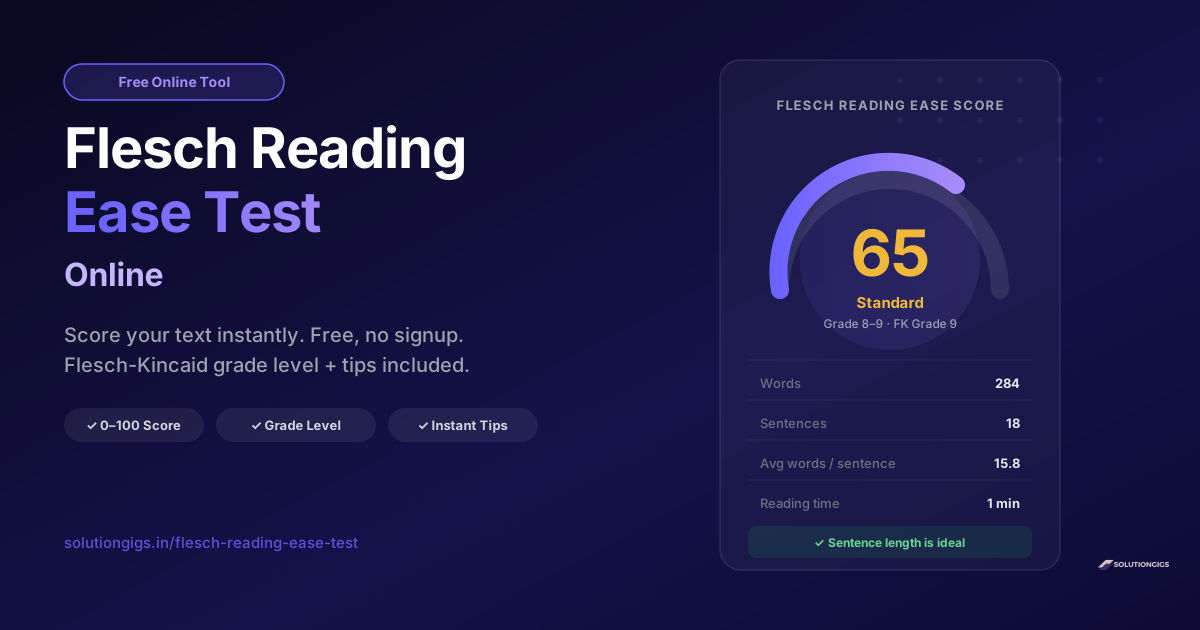
Both use the same two inputs (sentence length and syllables per word) but map them onto different scales. A Flesch Reading Ease score of 65 corresponds to approximately Grade 8–9 on the Flesch-Kincaid scale — meaning a typical 8th grader can comfortably read it.
Our free Flesch Reading Ease test shows both metrics simultaneously so you can use whichever one your workflow requires.
Flesch Reading Ease Benchmarks by Content Type
Different audiences require different reading levels. Here are the targets we recommend at SolutionGigs based on real-world content performance data:
| Content Type | Target Flesch Score | Target Grade Level | Reason |
|---|---|---|---|
| Children's books | 90–100 | 1–5 | Maximum accessibility |
| Social media posts | 80–90 | 5–6 | Short attention spans |
| Marketing emails | 70–80 | 6–7 | Drive action, reduce friction |
| Blog posts / landing pages | 60–70 | 8–9 | Broad adult audience |
| News articles | 60–70 | 8–10 | General readership |
| B2B whitepapers | 50–60 | 10–13 | Educated professional audience |
| Technical documentation | 40–55 | 10–14 | Specialist readers |
| Academic papers | 0–30 | Graduate | Expert audience expected |
| Legal documents | 0–20 | Graduate | Precision over accessibility |
The key principle: match your score to your audience, not to an arbitrary target. An overly simplified technical document loses credibility just as surely as an overly complex consumer email loses conversions.
Why Readability Matters for SEO in 2026
Google's Helpful Content guidelines explicitly reward content written for people. Readable content produces measurable SEO benefits:
- Lower bounce rate — readers who understand your content stay longer
- Higher dwell time — a key correlation with improved rankings
- Better featured snippet eligibility — clear, direct sentences get extracted more often
- More social shares — easier content gets forwarded; complex content gets abandoned
- Higher conversion rates — product pages written at Grade 7 consistently outperform Grade 12 equivalents
A study by the Nielsen Norman Group found that users read web pages in an F-shaped pattern and skip dense, complex text. Every sentence you simplify is one fewer exit point.
How to Improve Your Flesch Reading Ease Score
These six techniques directly move the needle on your score:
1. Shorten your sentences
The fastest way to raise your score is to split long sentences. Every sentence over 25 words is a readability liability. Find the conjunction ("and", "but", "which", "because") in the middle and split there. Aim for an average of 15–20 words per sentence.
2. Replace multi-syllable words with shorter synonyms
Every syllable you cut improves the score. Here are common swaps:
| Complex Word (syllables) | Simpler Alternative |
|---|---|
| utilise (4) | use (1) |
| approximately (6) | about (2) |
| demonstrate (4) | show (1) |
| facilitate (5) | help (1) |
| terminate (4) | end (1) |
| commence (2) | start (1) |
| endeavour (4) | try (1) |
| modification (5) | change (1) |
3. Use active voice
Passive voice adds words and complexity without adding meaning. - Passive: "The report was written by the team" (7 words) - Active: "The team wrote the report" (5 words)
Active constructions are shorter, clearer, and more engaging.
4. Break up long paragraphs
Paragraphs of 3–4 sentences work best for web reading. One idea per paragraph. White space is free — use it.
5. Use lists and tables
Bullet points and numbered lists are structurally easier to process than prose for equivalent content. They also break up visual density and signal to Google that your content is structured.
6. Cut nominalizations
Nominalizations are verbs dressed up as nouns — they add syllables and bureaucratic weight: - "Make a decision" → "Decide" - "Give a recommendation" → "Recommend" - "Conduct an investigation" → "Investigate"
How to Use the Free Flesch Reading Ease Test
Our Flesch Reading Ease Test at SolutionGigs runs entirely in your browser — no data is ever sent to a server.
Step 1 — Paste your text Copy any content you want to check and paste it into the text area. Results update automatically as you type.
Step 2 — Read the score The score gauge, difficulty label, and grade level appear instantly. The score table highlights your exact range so you know immediately whether you need to improve.
Step 3 — Follow the improvement tips The tool generates tailored tips for your specific text — whether your sentences are too long, your words too complex, or your grade level too high for your target audience.
Step 4 — Copy results Hit "Copy Results" to get a formatted summary you can paste into a doc, Slack message, or client report.
No signup. No limits. Works on any device.
Frequently Asked Questions
What is the Flesch Reading Ease score?
The Flesch Reading Ease score measures how easy a text is to read on a scale of 0 to 100. Higher scores mean simpler writing. Scores between 60 and 70 are considered standard for most web content. The formula was developed by Rudolf Flesch in 1948 and is the most widely used readability metric in English.
What is the Flesch Reading Ease formula?
The formula is: Score = 206.835 − (1.015 × average words per sentence) − (84.6 × average syllables per word). Two factors drive the result: sentence length and word complexity. Shorter sentences and simpler words both raise the score.
What Flesch Reading Ease score should I target?
Target 60–70 for general web content and blog posts, 70–80 for marketing emails and landing pages, and 50–60 for professional reports. Academic and legal writing typically falls below 30. Match your score to your audience — not to an arbitrary number.
How do I improve my Flesch Reading Ease score?
Shorten sentences to 15–20 words on average, replace multi-syllable words with simpler synonyms, use active voice, and break long paragraphs into shorter ones. Each of these changes directly raises the Flesch score.
Is the Flesch Reading Ease test free?
Yes — our Flesch Reading Ease test at SolutionGigs is completely free. Paste any text to instantly see your score, grade level, word and sentence statistics, and targeted improvement tips. No account required, no limits.
Does readability score affect SEO?
Google does not use Flesch scores as a direct ranking signal, but readable content reduces bounce rate and increases dwell time — both of which correlate strongly with higher rankings. Easier-to-read content also earns more social shares and backlinks naturally.
What is the difference between Flesch Reading Ease and Flesch-Kincaid Grade Level?
Both formulas use the same two inputs — sentence length and syllables per word — but produce different outputs. Flesch Reading Ease gives a score from 0 to 100 (higher is easier). Flesch-Kincaid Grade Level gives a US school grade (lower is easier). A Flesch Reading Ease score of 65 corresponds approximately to Grade 8–9.
Does readability matter for AI Overviews and ChatGPT citations?
Yes, indirectly. AI engines like Google AI Overviews, ChatGPT, and Perplexity preferentially quote text they can extract cleanly — short, declarative sentences with one idea each. That is exactly the writing a high Flesch Reading Ease score rewards. Content in the 60–70 range tends to be lifted verbatim into AI answers more often than dense, multi-clause prose, because a simpler sentence survives being pulled out of context. Optimizing readability is now an answer-engine optimization (AEO) tactic, not just a human-reader one.
Conclusion
The Flesch Reading Ease score is one of the simplest and most powerful levers in content quality. It turns the vague sense that writing "feels hard" into a concrete, actionable number. Whether you're optimizing a landing page, editing a client report, or testing a product description, the formula gives you a clear target and an immediate feedback loop.
The two rules that matter most: keep sentences short and keep words simple. Apply those two principles and your score — and your readers — will reward you for it.
Test your text now with the free SolutionGigs Flesch Reading Ease Test →

Mohammed Yaseen
Founder, SolutionGigs
Mohammed builds free developer and content tools at SolutionGigs, and writes about readability, SEO, and writing clarity to help content teams produce work that actually gets read. LinkedIn →