
Flesch-Kincaid Readability Test Online — Free Calculator & Grade Level Guide
Last Updated: May 2026 · 9 min read
The Flesch-Kincaid readability test is the gold standard for measuring how easy English text is to understand. It's built into Microsoft Word, Grammarly, Yoast SEO, Hemingway Editor, and dozens of other writing tools — yet most writers don't know how it actually works, or how to use it strategically.
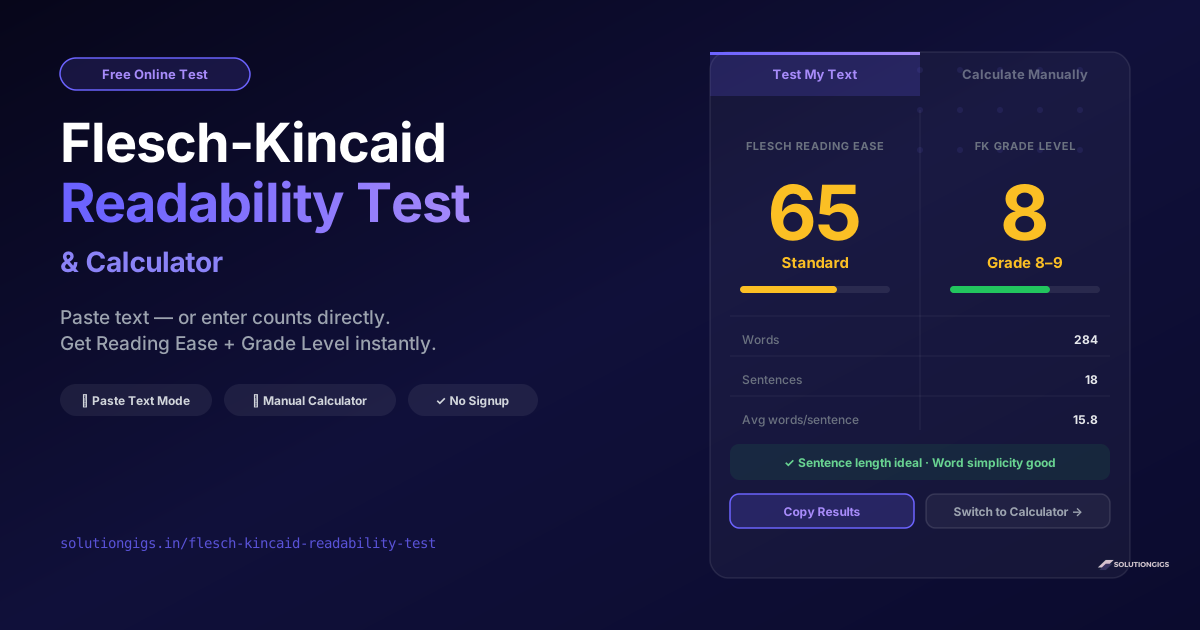
Quick Answer: The Flesch-Kincaid test produces two scores — the Flesch Reading Ease (0–100, higher = easier) and the FK Grade Level (US school grade, lower = easier). Both use the same two inputs: average sentence length and average syllables per word. To test your text instantly, use our free Flesch-Kincaid calculator — or enter your word, sentence, and syllable counts directly without pasting text.
This guide covers both formulas, score interpretation, grade level targets by content type, and the fastest ways to improve your score.
What Is the Flesch-Kincaid Readability Test?
The Flesch-Kincaid readability test is a pair of readability formulas that measure how easy English prose is to read. Linguist Rudolf Flesch developed the original Reading Ease formula in 1948; the US Navy later modified it into the Grade Level formula in the 1970s for military technical documentation.
Today, both formulas are the most widely used readability metrics in the world. When someone talks about a "readability test" or "reading level checker" for English text, they almost always mean one of these two formulas.
The two scores serve different purposes:
| Metric | Scale | Direction | Best Used For |
|---|---|---|---|
| Flesch Reading Ease | 0–100 | Higher = easier | Comparing content clarity at a glance |
| Flesch-Kincaid Grade Level | US school grade | Lower = easier | Targeting a specific audience age / education level |
The Flesch-Kincaid Formulas
Flesch Reading Ease Formula
Score = 206.835 − (1.015 × average words per sentence) − (84.6 × average syllables per word)
The result is a number from 0 to 100. The key insight: the syllable coefficient (84.6) is 83× larger than the sentence coefficient (1.015). This means word complexity has far more impact on the score than sentence length. Swapping "approximately" (5 syllables) for "about" (2 syllables) moves the score more than cutting two words from a sentence.
Flesch-Kincaid Grade Level Formula
Grade Level = (0.39 × average words per sentence) + (11.8 × average syllables per word) − 15.59
The result is a US school grade. A Grade Level of 8 means a typical 8th grader (14-year-old) can read and understand the text comfortably. Both coefficients are smaller here, but the relationship between the two formulas is inverse — a higher Reading Ease score corresponds to a lower Grade Level.
How the two scores relate
| Reading Ease | Approximate Grade Level |
|---|---|
| 90–100 | Grade 1–5 |
| 80–89 | Grade 6 |
| 70–79 | Grade 7 |
| 60–69 | Grade 8–9 |
| 50–59 | Grade 10–12 |
| 30–49 | College (Grade 13–16) |
| 0–29 | Post-graduate (Grade 17+) |
Flesch-Kincaid Score Chart
Use this reference table to interpret your scores and understand what reading level your content targets:
| Flesch Reading Ease | Difficulty | US Grade | Real-World Examples |
|---|---|---|---|
| 90–100 | Very Easy | 5th | Children's books, simple instructions |
| 80–89 | Easy | 6th | Tabloid news, casual social media |
| 70–79 | Fairly Easy | 7th | Popular fiction, sports reporting |
| 60–69 | Standard | 8th–9th | Time magazine, most blog posts |
| 50–59 | Fairly Difficult | 10th–12th | Business reports, professional emails |
| 30–49 | Difficult | College | Academic journals, technical docs |
| 0–29 | Very Difficult | Post-grad | Legal contracts, scientific papers |
Flesch-Kincaid Targets by Content Type
Different audiences need different reading levels. These are the benchmarks we recommend at SolutionGigs:
| Content Type | Target Reading Ease | Target Grade Level |
|---|---|---|
| Social media captions | 80–90 | 5–6 |
| Marketing emails | 70–80 | 6–7 |
| Product descriptions | 70–80 | 6–8 |
| Blog posts / articles | 60–70 | 7–9 |
| News reporting | 60–70 | 8–10 |
| Business reports | 50–60 | 10–12 |
| Technical documentation | 40–55 | 11–14 |
| Academic papers | 0–30 | 14+ |
| Legal documents | 0–20 | 16+ |
The guiding principle: match your score to your audience. Over-simplifying a specialist white paper is as problematic as writing a product email at a PhD level.
How to Calculate Flesch-Kincaid Manually
You can calculate both scores from any piece of text using three numbers:
Step 1 — Count total words Count every word in the text. Most word processors show this in Tools → Word Count.
Step 2 — Count total sentences Count every sentence-ending period, exclamation mark, or question mark. Abbreviations (e.g. "Dr.", "U.S.") don't count.
Step 3 — Count total syllables Count the vowel sound groups in each word. Practical shortcuts: - Words of 1–3 letters = 1 syllable - Count vowel groups: "garden" has "ar" + "en" = 2 syllables - Silent final "e" doesn't count: "made" = 1 syllable - Compound words: count as separate words
Step 4 — Calculate averages - Avg words/sentence = Total words ÷ Total sentences - Avg syllables/word = Total syllables ÷ Total words
Step 5 — Apply the formulas - Reading Ease = 206.835 − (1.015 × avgWPS) − (84.6 × avgSPW) - Grade Level = (0.39 × avgWPS) + (11.8 × avgSPW) − 15.59
Or skip all of this and use our free Flesch-Kincaid calculator. The Calculate Manually tab lets you enter totals or averages directly — no text pasting needed.
How to Use the Free FK Readability Test
Our Flesch-Kincaid readability tool has two modes in one page:
Mode 1 — Test My Text
Paste any content into the text area. Both the Flesch Reading Ease score and FK Grade Level appear instantly and update as you edit. The score table highlights your exact range, and the tool generates tailored improvement tips specific to your text.
Mode 2 — Calculate Manually
Don't have the raw text? Enter your word count, sentence count, and syllable count from any source. Or if you already have the averages (from Microsoft Word, for example), enter those directly in Method B. Both scores calculate instantly on click.
Copy Results exports a formatted summary you can paste into a client document, Slack message, or content brief.
6 Ways to Improve Your Flesch-Kincaid Score
1. Split long sentences
Every sentence over 25 words is a readability liability. Find the main conjunction (and, but, because, which) and split there. Aim for 15–20 words on average.
2. Replace multi-syllable words
The syllable coefficient (84.6) dominates both formulas. Every syllable you cut has an outsized effect:
| Replace | With | Syllables saved |
|---|---|---|
| utilise (4) | use (1) | −3 |
| approximately (6) | about (2) | −4 |
| demonstrate (4) | show (1) | −3 |
| facilitate (5) | help (1) | −4 |
| subsequently (5) | later (2) | −3 |
| initiate (5) | start (1) | −4 |
3. Use active voice
Active sentences are shorter and clearer: - Passive: "A decision was made by the committee to postpone the review." - Active: "The committee postponed the review."
Active saves words; fewer words per sentence raises the Reading Ease score.
4. Cut nominalizations
Nominalizations disguise verbs as nouns and add syllables: - "Make a recommendation" → "Recommend" - "Conduct an investigation" → "Investigate" - "Provide an explanation" → "Explain"
5. Break long paragraphs
One idea per paragraph. Three to four sentences maximum. White space helps readers process complex information.
6. Use lists and tables
Bullet points and numbered lists are cognitively easier to scan than equivalent prose. They also reduce visual paragraph density.
Why Flesch-Kincaid Matters for SEO
Google's Helpful Content update explicitly rewards content written for people. Readable content produces measurable SEO benefits:
- Lower bounce rate — readers who understand your content stay longer on the page
- Higher dwell time — a strong correlation with improved rankings in competitive queries
- Featured snippet eligibility — simple, direct answers are more likely to be extracted
- Increased sharing — easy-to-read content gets forwarded and linked to more naturally
- Better conversion — product pages at Grade 7 consistently convert better than Grade 12 equivalents
Yoast SEO and Rank Math both include FK readability checks in their green-light systems — because readable content earns better engagement signals, which Google interprets as quality.
Frequently Asked Questions
What is the Flesch-Kincaid readability test?
The Flesch-Kincaid readability test is a pair of formulas — the Flesch Reading Ease score (0–100, higher is easier) and the Flesch-Kincaid Grade Level (a US school grade, lower is easier). Both measure text difficulty using sentence length and syllables per word. They are built into Microsoft Word, Grammarly, Yoast SEO, and Hemingway Editor.
What is the Flesch-Kincaid formula?
Two formulas: Reading Ease = 206.835 − (1.015 × avg words/sentence) − (84.6 × avg syllables/word). Grade Level = (0.39 × avg words/sentence) + (11.8 × avg syllables/word) − 15.59. Both use the same two inputs but produce inverse outputs — a higher Reading Ease score corresponds to a lower Grade Level.
What is a good Flesch-Kincaid score?
For general web content and blog posts, aim for Reading Ease 60–70 (Grade 8–9). Marketing emails: 70–80 (Grade 6–7). Technical documentation: 40–60 (Grade 10–12). Academic and legal writing typically falls below Grade 13. Match your target to your audience.
How do I calculate Flesch-Kincaid without pasting full text?
Use the Calculate Manually tab on our free tool. Enter total word count, sentence count, and syllable count — or enter average words per sentence and average syllables per word directly. Both FK scores compute instantly.
How do I improve my Flesch-Kincaid grade level?
Two changes have the largest impact: (1) shorten sentences to 15–20 words on average, and (2) replace multi-syllable words with simpler alternatives. The syllable coefficient is 84.6× in the formula — word complexity moves the score far more than sentence length.
Does Flesch-Kincaid affect Google SEO rankings?
Not directly — Google does not use FK scores as a ranking signal. However, readable content lowers bounce rate and increases dwell time, both of which correlate strongly with better rankings. Yoast SEO flags readability issues because of this indirect effect on engagement metrics.
Conclusion
The Flesch-Kincaid readability test gives you a concrete, reproducible metric for something that's usually subjective — how easy your writing is to understand. Whether you're optimizing a landing page, checking a client deliverable, or testing a product description, knowing your Reading Ease score and Grade Level tells you exactly where you stand and what to fix.
The two rules that matter: keep sentences short, and keep words simple. Do both and your scores — and your readers — will follow.
Run the free Flesch-Kincaid readability test →

Mohammed Yaseen
Founder, SolutionGigs
Mohammed builds free content and developer tools at SolutionGigs, and writes about readability, SEO clarity, and writing techniques that help content teams produce work people actually read and share. LinkedIn →